
Hybrid cooling is likely to be a useful option for some data centers, not a single design that will replace air cooling everywhere. The term can mean liquid cooling for much of a server’s heat while air handles the rest, or a cooling plant that switches between wet and dry heat rejection. Those choices solve different problems, and the right mix depends on IT heat density, local climate, water availability, energy priorities and the facility’s existing equipment.
What does “hybrid cooling” mean in a data center?
“Hybrid” is an umbrella term, so it helps to ask which part of the cooling path is being combined. A data center may combine air and liquid at the IT equipment, or combine wet and dry methods at the facility’s heat-rejection plant. It can do both, but one does not imply the other. ASHRAE’s 2019 handbook notes that datacom rooms often need to support a hybrid of air and liquid cooling. ASHRAE Handbook, Chapter 20 (2019)
Air and liquid at the IT equipment
Direct liquid cooling carries heat away close to where it is generated, such as at processors or racks. In many designs, liquid captures most, but not all, of the IT heat; room air still removes heat from components that are not liquid-cooled and from the remaining room load. The U.S. Department of Energy describes several liquid-cooling approaches as hybrid for this reason. DOE, Best Practices Guide for Energy-Efficient Data Center Design (2024)
Wet and dry heat rejection
A separate use of “hybrid” describes a facility plant that can use evaporative or wet cooling when conditions suit it and dry cooling when conserving water or avoiding freezing is more important. ASHRAE says such systems can transition with ambient conditions and be designed to balance water and power use. ASHRAE Handbook, Chapter 20 (2023)
Recommended Free Tools
#1 Best Overall

- Ventilation Fan: Designed to quietly ASUS GT/RT- AC5300 , cool Xboxs, CPU/ GPU, Playtations, Rokus, TVs, receivers, mondems, routers, DVRs, window fans ,network appliances, DIY aquarium cooling and other audio video electronics
- Variable Speed Control: 110V - 220V Fan power supply with speed control function, turn the knob to adjust the speed, 4V - 12V adjustable fan speed,and can turn off the fan . | Input: 100V - 240V 50/60Hz | Output: DC 3-12V 200-2000ma
- DIY Vertical Window Fan: Can both vertical and horizontal, provide efficient cooling and ventilation. Mining rigs rely on the cooling power of fans for optimal operation.Double Metal Protective, the fan is equipped with double metal protective net
- Easy to Install: Draw out air in refrigerators, provide ventilation in greenhouses, prevent amplifier overheating, and vent hot air from living room consoles like PS4. Y cable connects 2 fans, two fans can be 42cm/16.5 in far away from each other
- Dual Ball Bearing: 240mm x 240mm x 25mm / 9.45in(L) x 4.72in(W) x 1in(H) in in total. | Rated Voltage :12V | Rated Current: 0.93A at full speed | Airflow: (82CFM)x4 at 12V | Speed: 2500 RPMx4
How do air, hybrid and predominantly liquid designs compare?
The labels describe broad approaches, not guaranteed performance. A project’s equipment, operating conditions and detailed design determine how much heat each system captures and what it costs to run.
| Approach | Heat capture and IT density | Energy and water considerations | Design and operating considerations |
|---|---|---|---|
| All-air | Room air removes IT heat. Suitability depends on the equipment and the room’s ability to move heat at the installed density. | Requires air movement; the sources do not establish a universal energy or water figure for comparison. | May suit existing air-cooled equipment, but higher heat densities can challenge traditional room-air approaches. Site climate and facility design matter. |
| Hybrid liquid/air | Liquid captures a substantial share of heat near the source; air handles components and heat the liquid loop does not capture. The uncaptured share varies by design. | May retain substantial fan power. ASHRAE’s 2021 white paper gives a CPU-liquid/memory-air example in which high fan power can erode some total-cost benefit. | Requires coordination of IT-side liquid and room-air systems. A cooling distribution unit (CDU) commonly interfaces the IT loop with facility cooling and supplies coolant at the required temperature, pressure and chemistry. |
| Predominantly liquid | Liquid carries heat from a larger share of IT components, supporting higher heat densities than traditional room-air approaches; the extent depends on the equipment and loop design. | Can reduce reliance on room-air heat removal, but the sources do not establish one universal energy, water or lifecycle-cost advantage. | Needs project-specific choices for components, pumps, heat exchangers, rack configuration and coolant requirements. Air may still be needed for residual heat. |
The comparison is about heat capture at IT equipment. A wet/dry plant decision sits downstream and can be paired with more than one IT-cooling approach. None of these labels alone establishes a universal saving or payback period.
Rank #2
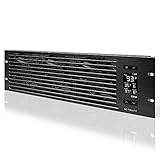
- An intelligent fan system designed for cooling audio video, DJ, server, network, and IT equipment racks.
- Protects rack-mount equipment from overheating, performance issues, and shortened lifespans.
- Programmable thermostat controller with automated speed control, alarm warnings, and backup memory.
- Premium anodized aluminum construction with CNC-machined detailing for a professional appearance.
- Size: 3U Rack Space | Design: Intake | Airflow: 60 to 300 CFM | Noise: 12 to 38 dBA | Bearings: Dual Ball
Why is hybrid cooling drawing attention now?
High-density AI and high-performance computing loads can put more heat in a smaller space than conventional room-air systems were designed to handle. Liquid can transport heat near its source, while an air system can remain in place for equipment or heat the liquid loop does not capture. That combination can offer a transition path or a way to serve mixed equipment, but it is not automatically more efficient than a well-designed alternative.
ASHRAE’s 2026 AI Data Center Energy Performance Framework says U.S. data-center electricity consumption tripled from 2014 to 2023 and accounted for about 4.4% of U.S. electricity consumption in 2023. The framework also reports that the sector’s annual contribution to U.S. GDP rose from $355 billion in 2017 to $727 billion in 2023. These figures establish the scale of the sector’s growth, not the performance of any particular cooling design. ASHRAE, AI Data Center Energy Performance Framework: Introduction and Purpose
Do these 3 things before closing this tab:
1Clear out junk files and repair common Windows errors2Scan for outdated or missing drivers - takes under a minute3Repair Windows errors before they cause bigger problemsRank #3

- [Adjustable] Adjustable temperature control helps ensure optimal performance for your rackmount such as network, server, music, and AV cabinets
- [Quiet and powerful] Equipped with three powerful 4” (120mm) noise control ball bearing fans capable of pumping 225 CFM of air, preventing overheating of expensive equipment
- [Optimal Airflow] This three fan cooling system will provide excellent cooling with its high-performance fans, which keep the hot air stream away from your setup with its top exhaust cool air system.
- [Compact Design] Device is standardized to mount to any 19" server rack or cabinet while taking only a single unit (1U) of space and has a wide variety of applications.
- [Programmable] Equipped with a programmable thermostat sensor controller for better temperature monitoring that will trigger fans based on your parameter configuration.
When does a liquid/air hybrid make sense?
A hybrid approach can be worth evaluating when some of the IT load needs liquid cooling but the facility still has air-cooled equipment, or when a full liquid conversion is impractical. The useful question is not simply whether liquid is present, but how much heat it captures and what remains for air to remove.
- Match the design to the actual IT mix. Servers differ in which components are liquid-cooled, and the residual air load affects fans, room airflow and heat removal.
- Check density and future equipment plans. Direct liquid cooling can support higher heat densities than traditional room-air approaches, but suitability depends on the equipment and its operating requirements.
- Include the entire cooling chain. A CDU, pumps, heat exchangers, rack arrangement and facility loop all affect the result. ASHRAE’s liquid-cooling guidance emphasizes detailed component and system design rather than treating liquid cooling as a plug-in upgrade. ASHRAE, Emergence and Expansion of Liquid Cooling in Mainstream Data Centers (2021)
- Account for fan power and total cost. A hybrid system can leave fans doing substantial work. In ASHRAE’s CPU-liquid/memory-air example, high fan power can erode some of the total-cost benefit; that example should not be generalized to every hybrid design.
- Plan for maintenance and coolant requirements. The IT and facility loops must meet the required coolant temperature, pressure and chemistry, with components selected for the rack and operating conditions.
How should operators choose between wet, dry and hybrid heat rejection?
Wet or evaporative operation can be more energy-efficient when ambient conditions favor it, while dry operation avoids evaporative water use and can improve freeze protection. A hybrid plant can change modes as conditions and priorities change. The balance is site-specific: climate, water constraints and the relative importance of electricity and water all influence the choice. ASHRAE Handbook, Chapter 20 (2023)
Rank #4

- Adjustable temperature control helps ensure optimal performance for rackmount such as network, server, music, and AV cabinets
- Noise controlled fans makes the cooling system useful for a quiet office or business space
- Compact design mounts to any 19" inch cabinet and takes up only 1 unit of space
- Simple and easy to use LCD display allows user to control temperature
- Air pumped through to the top exhaust system of the fan
- Favor water conservation? Determine how much operation can be shifted to dry cooling and whether the resulting conditions still meet IT cooling requirements.
- Favor lower cooling energy? Assess when wet operation is practical and how its water use fits local constraints.
- Face cold or very hot weather? Evaluate freeze protection and high-ambient limits for the actual heat-rejection equipment, rather than assuming a hybrid plant can maintain the same performance in every mode.
ASHRAE describes a specific warm-water dry-cooler arrangement that may reach a temperature limit; under extreme ambient conditions, a hybrid dry cooler may use a small amount of misting during the hottest hours. Its AI framework also says temperatures above the dry-cooler limit may trigger CPU or GPU throttling. Those are configuration-dependent cautions, not a universal limit for all hybrid plants. ASHRAE, Integrated Design Principles
Independent reader supportYour contribution helps us test, update, and keep practical guides available for everyone.What should a cooling design review establish?
Before choosing a configuration, the design team should establish how heat moves from IT equipment to the environment and what happens when conditions change. A useful review covers:
Quick wins for a faster PC:
Repair Windows errors before they cause bigger problemsFix Now →Scan for outdated or missing drivers - takes under a minuteDriver Scan →Best Value
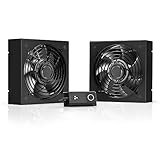
- A quiet fan kit designed for standard 19” racks, to be mounted on the roof or to replace existing fans.
- Features a speed controller utilizing PWM which can control the fan's speed without generating noise.
- Compatible with CLOUDPLATE series rack fans and can be linked to share the same programming.
- Heavy-Duty steel construction with spiral fan guards, mounting hardware, and power adapter.
- Size: Standard 120mm Rack Fans | Fans: 2 | Airflow 200 CFM | Noise: 26 dBA | Bearings: Dual Ball
- Heat capture: which components are liquid-cooled, what remains on air, and how that split changes across racks and workloads.
- Operating envelope: required coolant conditions, ambient limits and any workload throttling risk at the edge of the design range.
- Energy and water priorities: expected operation by mode and season, assessed against the site’s electricity and water constraints.
- Resilience: what happens if a pump, heat exchanger, liquid loop or air system is unavailable, and how long the IT load can ride through the event.
- Retrofit scope: compatibility with existing racks, piping, floor or room airflow, maintenance practices and facility cooling equipment.
- Heat reuse: whether there is a real nearby sink, such as district heating, adjacent buildings or an on-site process that can use recovered heat.
ASHRAE notes that air/liquid hybrid arrangements can provide ride-through if the primary cooling system fails, but this is a possible design attribute, not a guarantee that every hybrid system is more resilient. Resilience depends on the failure mode, controls, backup capacity and how the load behaves during a transition. ASHRAE Handbook, Chapter 20 (2019)
Can a data center reuse the heat it produces?
Potentially, if there is a practical heat user nearby. District heating, neighboring buildings or an on-site process can provide a destination for recovered heat; without a usable sink, heat recovery has little value simply because the facility has warm coolant. Warm-water liquid loops can supply higher-grade heat that is more suitable for reuse than lower-temperature heat, but the opportunity depends on the loop conditions and the receiving system. ASHRAE, Energy and Thermal Efficiency
What do ASHRAE’s liquid-water classes tell operators?
ASHRAE’s AI Data Center Energy Performance Framework describes liquid-water classes W17, W27, W32, W40, W45 and W+. W+ denotes capability beyond 45°C. These class names are design references, not a promise that any particular server, workload or facility can operate at those water conditions; equipment requirements and the full system design still govern. ASHRAE, AI Data Center Energy Performance Framework: Introduction and Purpose
Does “hybrid HVAC” mean the same thing?
No. DOE also uses “hybrid HVAC” for building-scale systems combining heat pumps, thermal energy storage and indirect evaporative cooling. That is a different use of the term and does not, by itself, establish data-center cooling performance. U.S. DOE, Hybrid HVAC with Thermal Energy Storage Research and Demonstration
Quick Recap
Product prices and availability are accurate as of the date/time indicated and are subject to change. Any price and availability information displayed on Amazon at the time of purchase will apply.

