
Do these 3 things before closing this tab:
1Repair Windows errors before they cause bigger problems2Fix the driver behind crashes, sound loss and screen glitches3Clear out junk files and repair common Windows errorsFacebook’s “new” server and storage designs are best understood as a series of modular platforms, not one current server model. The company’s 2017 designs separated dense hard-drive storage from GPU compute; Meta’s later AI infrastructure applies the same broad idea at larger scale, pairing specialized GPU systems with storage and data paths built for AI workloads. The 2017 hardware is historical, while Meta’s 2024 and 2026 accounts describe later systems and design priorities.
What Facebook’s server designs were meant to do
Facebook launched the Open Compute Project (OCP) in 2011 to share infrastructure designs and invite collaboration. Its initial publications covered servers as well as power, racks, battery backup and building designs. These were reference designs for data-center infrastructure, not consumer servers sold under a Facebook brand. Facebook’s 2011 OCP announcement also framed open hardware as an industry collaboration effort.
In that announcement, Facebook reported that its Prineville data center had an initial power usage effectiveness (PUE) of 1.07, compared with 1.5 at its existing facilities. The company also said the design used 38% less energy to do the same work, reduced infrastructure build-out costs by 24%, and saved more than six pounds of material per server through a simplified design. Those are Facebook’s 2011 figures against its stated baseline, not current or industry-wide results.
How the 2017 platforms divided storage and compute
Facebook’s 2017 fleet refresh included different building blocks for different jobs. Bryce Canyon concentrated on hard-drive capacity; Big Basin separated GPU resources from CPU compute. Tioga Pass and Yosemite v2 added head-node and modular compute options in the same hardware family. This is a description of that 2017 generation, not Meta’s present-day fleet. Meta’s 2017 fleet refresh account describes these designs.
#1 Best Overall

- Value NAS with RAID for centralized storage and backup for all your devices. Check out the LS 700 for enhanced features, cloud capabilities, macOS 26, and up to 7x faster performance than the LS 200.
- Connect the LinkStation to your router and enjoy shared network storage for your devices. The NAS is compatible with Windows and macOS*, and Buffalo's US-based support is on-hand 24/7 for installation walkthroughs. *Only for macOS 15 (Sequoia) and earlier. For macOS 26, check out our LS 700 series.
- Subscription-Free Personal Cloud – Store, back up, and manage all your videos, music, and photos and access them anytime without paying any monthly fees.
- Storage Purpose-Built for Data Security – A NAS designed to keep your data safe, the LS200 features a closed system to reduce vulnerabilities from 3rd party apps and SSL encryption for secure file transfers.
- Back Up Multiple Computers & Devices – NAS Navigator management utility and PC backup software included. NAS Navigator 2 for macOS 15 and earlier. You can set up automated backups of data on your computers.
Bryce Canyon: dense hard-drive storage
Bryce Canyon was a high-density storage chassis supporting 72 hard drives in four Open Rack units. Its modular configurations ranged from a JBOD (a drive enclosure without its own storage-server compute) to a full storage server, and it could accept a single-socket compute card. Meta reported 20% greater HDD density than Open Vault. In a configuration using the Mono Lake compute card, Meta said it offered four times the compute capability of the Honey Badger storage server.
Big Basin: GPU capacity as a separate building block
Big Basin was a JBOG, or “just a bunch of GPUs”: an eight-GPU unit designed to work with an external server head node, keeping CPU compute separate from GPU resources. Its announced configuration used eight NVIDIA Tesla P100 accelerators. Meta said the design raised available GPU memory from 12 GB to 16 GB and enabled training models 30% larger than Big Sur. In Meta’s reported ResNet-50 tests, Big Basin achieved nearly 100% higher throughput than Big Sur. These are the company’s 2017 comparisons, not an independent or current benchmark.
Rank #2

- Entry-level NAS Personal Storage:UGREEN NAS DH2300 is your first and best NAS made easy. It is designed for beginners who want a simple, private way to store videos, photos and personal files, which is intuitive for users moving from cloud storage or external drives and move away from scattered date across devices. This entry-level NAS 2-bay perfect for personal entertainment, photo storage, and easy data backup (doesn't support Docker or virtual machines).
- Set Your Devices Free, Expand Your Digital World: This unified storage hub supports massive capacity up to 64TB.*Storage drives not included. Stop Deleting, Start Storing. You can store 22 million 3MB images, or 2 million 30MB songs, or 43K 1.5GB movies or 67 million 1MB documents! UGREEN NAS is a better way to free up storage across all your devices such as phones, computers, tablets and also does automatic backups across devices regardless of the operating system—Window, iOS, Android or macOS.
- The Smarter Long-term Way to Store: Unlike cloud storage with recurring monthly fees, a UGREEN NAS enclosure requires only a one-time purchase for long-term use. For example, you only need to pay $459.98 for a NAS, while for cloud storage, you need to pay $719.88 per year, $2,159.64 for 3 years, $3,599.40 for 5 years. You will save $6,738.82 over 10 years with UGREEN NAS! *NAS cost based on DH2300 + 12TB HDD; cloud cost based on 12TB plan (e.g. $59.99/month).
- Blazing Speed, Minimal Power: Equipped with a high-performance processor, 1GbE port, and 4GB RAM on Board, this NAS handles multiple tasks with ease. File transfers reach up to 125MB/s—a 1GB file takes only 8 seconds. Don't let slow clouds hold you back; they often need over 100 seconds for the same task. The difference is clear.
- Let AI Better Organize Your Memories: UGREEN NAS uses AI to tag faces, locations, texts, and objects—so you can effortlessly find any photo by searching for who or what's in it in seconds. It also automatically finds and deletes similar or duplicate photo, backs up live photos and allows you to share them with your friends or family with just one tap. Everything stays effortlessly organized, powered by intelligent tagging and recognition.
How the pieces fit
Tioga Pass was a dual-socket server motherboard and head-node option, while Yosemite v2 accepted compute and device cards. Together with Bryce Canyon and Big Basin, they illustrate a modular approach: storage capacity, general-purpose compute and GPU acceleration could be configured as distinct components rather than treated as a single fixed server.
How Meta’s AI infrastructure changed the scale and workload
Meta’s infrastructure approach extends beyond individual servers. In a 2023 overview, infrastructure leader Santosh Janardhan described the company’s scope: “We design, build and operate everything — from the data centers to the server hardware to the mechanical systems that keep everything running.” Meta said it can place GPUs, CPUs, networking and storage together when a workload benefits from that arrangement. Meta’s infrastructure overview appeared in May 2023 and the page also records an April 2025 update.
Rank #3
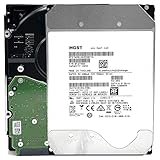
- NOTE: These HDD is used by Datacenter Servers for about 5 Years period. HDD was refurbished and data wiped with DoD standard. It's fully tested & passed HGST factory diagnose software test. Since this is heavy duty enterprise HDD with a 2.5M-hour MTBF rating.
- 10TB, 128MB Cache, 7200RPM, SATA 6.0Gb/s - Designed for 24/7/365 Heavy Duty, 2.5M-hour MTBF
- Works for Any SATA Server, NAS (network storage), RAID, PC/Mac, CCTV DVR, Surveillance System, CCTV DVR
- Bare Drive Only, Single Pack, (No Screws, Cables or Accessories included) -Friendly Reminder- Please FORMAT HDD on system in order to be detected/shows on system.
In March 2024, Meta described two large generative-AI clusters based on Grand Teton, its in-house-designed GPU platform contributed to OCP. The clusters used either RoCE Ethernet or NVIDIA InfiniBand, with 400 Gbps endpoints. Meta said both had been used for large GenAI workloads, including Llama 3 training on the RoCE cluster. Meta’s 2024 infrastructure account describes the cluster designs.
The storage systems supporting those workloads used YV3 Sierra Point servers with high-capacity E1.S SSDs. Meta described two access approaches: a home-grown FUSE API backed by Tectonic and optimized for flash, and a Hammerspace parallel NFS deployment for interactive workflows. Meta presented these choices as a balance among throughput, rack count and power efficiency. The account does not establish that one storage arrangement is universally better; the workload and operating constraints matter.
Rank #4

- 4TB Enterprise Storage Capacity – Provides ample space for business applications, databases, backup systems, and data center storage requirements.
- 12Gb/s SAS Interface – High-speed Serial Attached SCSI connectivity delivers superior data transfer performance and improved reliability compared to SATA drives.
- 7200 RPM Performance – Optimized rotational speed ensures fast data access and dependable throughput for enterprise workloads.
- 24/7 Enterprise Reliability – Designed for continuous operation with enhanced workload ratings and advanced error correction technology.
- Ideal for Servers & Data Centers – Perfect for enterprise servers, storage arrays, virtualization platforms, RAID systems, and cloud infrastructure deployments.
How Meta describes AI storage in 2026
In a July 2026 engineering account, Meta described Tectonic as the horizontally scalable block layer beneath object storage, file systems and block-device interfaces. The company said Tectonic uses erasure coding, supports HDD and flash tiers, and organizes data into hot, warm and cold classes. Meta characterized its environment as hundreds of exabyte-scale storage clusters; those scale terms are Meta’s description, not an independently audited count. Meta’s AI storage account details the newer design.
Shortening the path from stored data to GPUs
Meta said older BLOB storage paths could involve numerous metadata layers, sometimes leading to latencies of hundreds of milliseconds. Its redesigned path uses a unified metadata schema for O(1) path lookup, removes a data-plane proxy so a client SDK streams data directly from storage, and places regional BLOB storage near GPU clusters. The aim is to reduce delays between data retrieval and GPU work.
Outdated Drivers Are Slowing You Down
One free scan finds every outdated or missing driver and matches the right update for your exact hardware.Free scan · exact hardware matchWindows Errors? Fix Them Before They Spread
Repair common Windows errors and clear accumulated junk for a smoother, more stable PC - no reinstall needed.Free scan · no reinstallBest Value

- Secure private cloud - Enjoy 100% data ownership and multi-platform access from anywhere
- Easy sharing and syncing - Safely access and share files and media from anywhere, and keep clients, colleagues and collaborators on the same page
- Automated Backup Protection - Set-and-forget backups for Macs, PCs and mobile devices to multiple destinations including cloud and external drives
- Home Security System - Record and monitor your property 24/7 with support for multiple IP cameras and remote viewing
- 2-Year Warranty - Reliable hardware backed by Synology's expert customer support team and ongoing software updates
Caching and prefetching for training jobs
The design uses spare GPU-host memory to cache commonly read data and a distributed metadata cache for read plans. Meta reported an average 80% hit rate for the distributed data cache and 1–2 ms access to the read-plan cache in its 2026 account; these are company-reported figures, not independent benchmarks.
For research workflows, Meta described a hierarchy spanning host memory and flash, regional flash, and global BLOB storage. Dataloaders can prefetch batches, and an explicit prefetch API can hydrate data ahead of use. Configurable TTL and LRU policies govern regional-cache eviction. This arrangement lets teams trade some consistency in performance for quicker access to datasets that remain remotely stored.
What the design progression means
The useful through-line is specialization and modularity, rather than a claim that one Facebook server design evolved unchanged into Meta’s AI fleet. Bryce Canyon addressed dense HDD capacity; Big Basin made GPU resources independently scalable; Meta’s later clusters combine GPU platforms, network choices and storage systems around AI training and research needs. In the newer storage account, the emphasis shifts from capacity alone toward reducing latency and keeping data close enough to feed GPUs effectively.
- For dense, economical storage, the 2017 Bryce Canyon example prioritized many HDDs per rack unit.
- For accelerator-heavy compute, Big Basin separated GPUs from the external CPU head node; Meta’s 2024 Grand Teton clusters represent a later platform generation.
- For AI data pipelines, Meta’s 2024 and 2026 accounts emphasize flash, regional placement, caching and prefetching alongside durable, globally stored data.
The sources describe different generations and workloads, not a controlled, apples-to-apples comparison of performance, cost, rack footprint or power across all the systems.
Quick wins for a faster PC:
Repair Windows errors before they cause bigger problemsFix Now →Fix the driver behind crashes, sound loss and screen glitchesFind Drivers →Clear out junk files and repair common Windows errorsFree Scan →Quick Recap
Product prices and availability are accurate as of the date/time indicated and are subject to change. Any price and availability information displayed on Amazon at the time of purchase will apply.

