
Recommended Free Tools
A sound data center strategy starts by matching each workload to the operating model that can meet its requirements—not by assuming that cloud, colocation, or an owned facility is best for every application. Decide where workloads should run, how capacity can grow, and who is responsible for each layer by testing cost, power, connectivity, reliability, staffing, sustainability, and risk against your actual needs.
Should we build, outsource, or use cloud?
Start with the workload. For each application or service, document its latency, control, data-location, security, availability, and growth requirements. Then identify how much capacity it needs now and later, who will operate each layer, and what happens if a provider, facility, utility, or region fails.
The U.S. Department of Energy’s Best Practices Guide for Energy-Efficient Data Center Design (July 2024) distinguishes owned facilities, cloud, colocation, and hybrid arrangements. Its cost observations are qualified: cloud and colocation may have lower initial costs and may have lower operating costs than on-premises infrastructure. That is not a universal cost ranking. A useful comparison needs realistic utilization, labor, energy, network, contract, resilience, and migration assumptions.
| Model | Who provides what | Questions to resolve |
|---|---|---|
| Owned/on-premises | Your organization owns and operates the facility and IT systems. | Can you plan capacity, secure reliable power and communications, maintain cybersecurity, and staff the operation? Do mission requirements call for a backup facility? |
| Cloud | A provider supplies the service and manages infrastructure; the DOE guide describes cloud as potentially scalable and vendor-managed, including cybersecurity. | Does the service meet requirements for control, data location, security, availability, and cost at your workload’s actual usage? What responsibilities remain yours under the service terms? |
| Colocation | The provider rents space, power, and cooling and supplies network service; your organization owns and manages its IT systems. | What facility services and responsibilities are included? What must your team supply, operate, secure, and support? |
| Hybrid | Workloads are split across arrangements; one example in the DOE guide keeps especially critical operations on premises and uses cloud for other needs. | Can your applications, data, network, and operating procedures work across environments? How will you manage dependencies and failure across them? |
Do not treat a hybrid pattern as an automatic compromise. It can introduce integration, security, and operational work of its own. For every option, model full lifecycle cost under the contract and utilization you realistically expect; account for migration and resilience as well as infrastructure.
#1 Best Overall

- Funny design for a sys admin, network engineer, devops, and more.
- Lightweight, Classic fit, Double-needle sleeve and bottom hem
Can the site deliver power and connectivity when we need them?
For a facility project, distinguish a plausible future supply from power that is deliverable on the project’s required schedule. Ask the utility and project partners about available capacity, connection timing, cost, nearby substations, and a credible route to expand. A reservation or forecast alone does not establish that a site will be energized when required.
- Power: What capacity can be delivered, by what date, at what cost, and under what conditions? What evidence supports plans for expansion?
- Connectivity: Which providers can serve the site, and do their routes use genuinely independent physical pathways? A carrier map showing multiple providers does not prove route diversity.
- Continuity: What redundancy and failover do the workloads require if a utility feed, network route, provider, or facility is unavailable?
Rick Einhorn of EYP Mission Critical Facilities made power availability and multiple, diverse fiber pathways central questions in his March 30, 2021 Data Center Dynamics site-screening article. Treat that checklist as a starting point, not current confirmation of local conditions: verify utility capacity, connection schedules, provider routes, costs, and service terms for the specific project.
How should we screen a development site before detailed design?
Do an initial due diligence study to surface fatal constraints before paying for detailed planning. Einhorn’s 2021 practitioner checklist recommends vetting the land first and master planning afterward. Evaluate the project’s intended users and operating model alongside the parcel itself.
Rank #2
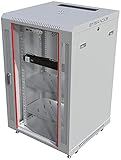
- PROFESSIONAL SERVER RACK CABINET – Wall mount network rack cabinet designed for IT infrastructure installations supporting switches, routers, patch panels, NAS storage, PoE networking equipment and structured cabling systems.
- 24” DEEP NETWORK DEPLOYMENT CABINET – 24” (600 mm) overall depth with 20” usable mounting depth and universal 19-inch rack compatibility for switches, patch panels, security appliances, PoE systems and professional office IT infrastructure installations.
- ACTIVE & PASSIVE COOLING – Ventilated cabinet structure with top-mounted cooling fan promotes stable airflow and temperature control for rack-mounted switches, routers, NAS units and network security equipment.
- SECURE NETWORK CABINET DESIGN – Locking tempered glass door, removable side panels and reinforced steel construction provide controlled access, equipment visibility and efficient airflow for professional IT deployments.
- HEAVY-DUTY MOBILE DEPLOYMENT KIT – Includes 2 vented steel shelves, casters, leveling feet, rack-mount PDU, brush cable entry panels and mounting hardware; supports up to 133 lbs wall mounted or 200 lbs on feet for flexible equipment staging, mobility and professional network infrastructure deployment.
- Land and expansion: Confirm usable area, physical restrictions, room for required facilities, and realistic expansion runway. Einhorn offers an acreage-to-critical-megawatt ratio only as a rough guide; it is not an engineering standard or a universal sizing rule.
- Location and access: Examine skilled-labor availability, transport access, elevation, flood exposure, natural hazards, civil and seismic conditions, and physical security.
- Local constraints and opportunity: Check water and other site resources, zoning, permitting, applicable incentives, intended users, and competing or complementary development. Verify current local facts rather than relying on dated examples.
- Portfolio fit: For a global strategy, compare site risk, hub selection, power availability, cost and type, connectivity, expansion, consistency across locations, and strategic ambition. The January 19, 2022 Data Center Dynamics global-strategy resource lists these as considerations; local feasibility still needs project-specific validation.
Do not let an attractive parcel or a preliminary utility estimate stand in for confirmed feasibility. Site screening should test whether the required power, connectivity, resources, permits, workforce, and risk controls can align with the workload’s timeline.
Quick wins for a faster PC:
Repair Windows errors before they cause bigger problemsFix Now →Fix the driver behind crashes, sound loss and screen glitchesFind Drivers →Clear out junk files and repair common Windows errorsFree Scan →How do we compare the options on the same terms?
Use the same workload assumptions and evaluation horizon for each plausible choice. The comparison below synthesizes the DOE operating-model guidance, site and global-strategy checklists, and Uptime Institute’s sustainability and liquid-cooling guidance. Fill it with project-specific evidence rather than generic provider claims.
| Decision axis | Questions to answer |
|---|---|
| Cost and capital | What are initial and recurring costs for energy, network, staffing, migration, and resilience at realistic utilization and contract terms? |
| Capacity and speed | What capacity is available when needed, and what is the credible path to expand? |
| Responsibility | Who owns and operates IT, facility infrastructure, cybersecurity, maintenance, and incident response? |
| Reliability and risk | What redundancy and failover are required? Which geographic, provider, utility, physical, and supply risks matter? |
| Power and connectivity | Can power be delivered on schedule at acceptable cost? Are network providers and physical routes genuinely diverse? |
| Sustainability | What are the energy, water, carbon, land, equipment-lifecycle, and reporting implications, measured on comparable boundaries? |
| Workload fit | Do latency, control, data sovereignty, density, cooling, and dynamic-load requirements fit the option? |
| Flexibility | Can you scale, relocate, change providers, or use a hybrid pattern without disproportionate cost or lock-in? |
The U.S. Department of Energy guide does not supply a universal numeric total-cost comparison across these models. Build your own scenario using your workload, geography, power, utilization, labor, contracts, resilience requirements, and migration costs.
Rank #3

- Customizable Depth Design: Enjoy flexible configuration with 4-post 27U Network rack pen frame featuring 4 vertical rails and adjustable 22"-35" depth range. Offers ample clearance for AV systems, network gear, and cable management while providing multi-angle access to ports and equipment
- Strong Load Capacity: 27U Network Rack is constructed from durable cold rolled steel for better weldability performancedesigned for ventilation with 27U mounting height and 1200lbs (550kg) weight capacity
- Enterprise-Grade Compatibility: Full 27U height (43.5"H) accommodates standard 19" rack-mount equipment. Features pre-installed square holes with included M6 screws/cage nuts. Universal depth adjustment (21"W x 22"-35"D) works seamlessly with switches, patch panels, and UPS systems.
- Quick-Lock Assembly System: Assembly is required, but it's simple. With all the included hardware & witty instructions, you'll have your server rack ready for servers & networking gear in under 20 minutes.
- Multi-Environment Ready: Enterprise-grade solution for server rooms, data centers, broadcast studios, and commercial spaces. Ideal for consolidating IT infrastructure in offices, schools, retail stores, or home lab setups with space-saving vertical organization
How should sustainability shape location and operations?
Evaluate energy and water together. Cooling choices affect water use, while siting and design constrain which sustainability measures are practical. Andy Lawrence and Jay Dietrich of Uptime Institute Intelligence, in their May 3, 2022 summary on water, circularity, and siting, recommend tracking water use and discharge, setting appropriate reduction goals, extending IT equipment life, and managing end-of-life equipment responsibly.
- Compare cooling options against local water constraints and the facility’s energy needs.
- When reporting an efficiency metric, state its boundary and calculation method; a single PUE or water metric cannot settle the sustainability question.
- Include circularity practices such as reuse, recycling, recycled materials, and heat recovery where relevant.
- Consider siting and partner selection early, because those choices can limit later operating options.
What extra questions matter for AI and liquid-cooled colocation?
Where high-density or liquid-cooled workloads are planned, confirm the specific capability rather than assuming a data center is ready for them. Jacqueline Davis’s September 11, 2025 Uptime Institute guidance on liquid-cooled colocation says providers must accommodate varying tenant equipment specifications, operational procedures, and tailored service-level agreements. It also notes that concrete quantitative details are often confidential.
Do these 3 things before closing this tab:
1Scan for outdated or missing drivers - takes under a minute2Repair Windows errors before they cause bigger problems3Fix the driver behind crashes, sound loss and screen glitches- Who supplies and maintains the cooling loop and its interfaces?
- Which tenant and provider operating procedures apply, and who responds to an incident?
- How does the service-level agreement address this tenant’s cooling requirements and responsibilities?
Do not infer a universal density threshold or assume every colocation site is liquid-ready. Confirm the intended configuration and operating terms with the provider.
Rank #4

- Sturdy Construction: Made of high quality cold rolled steel, supports up to 110lbs (50kg), providing a durable resilent base for your IT equipment
- Ventilation and Security: one-built-in top fan(with power cable) and flow through ventilation to prevent overheating of the network rack. Tempered glass front door and side panels are lockable to prevent unauthorized access
- Easy equipment configuration: Fully adjustable mounting rails and numbered U positions, with square holes for easy equipment mounting with top and bottom punchout panels for easy cable access.The inner mountable depth is 14.2inch
- Convenient Design: Reversible front door,can be installed on either side to satisfy your door swing orientation preference.Removable top and bottom panels for easy cable management. Compact design of 21.65"Lx17.72"Dx24.25"H and 16inch apart mounting holes are to accommodate stud placement
- Safety& Compliance: PCI & HIPPA and EIA/ECA-310-E compliant for the server rack cabinet
AI infrastructure also makes coordination across compute, power, thermal management, controls, deployment, commissioning, and operations especially important. A September 7, 2026 sponsored Data Center Dynamics article presents this as a vendor-industry perspective, not independent comparative research. It describes interacting pressures from density, speed, scale, complexity, and changing workload profiles. Martin Olsen, Vertiv’s vice president of segment strategy and deployment, put the system-level point this way: “A megawatt does not create value simply because it has been contracted or installed,” and “It creates value when the complete system can reliably convert it into productive compute.”
Measures such as tokens per second, tokens per watt, tokens per dollar, and time to productive output can help assess a specific workload, but they are not universal benchmarks. The sponsored article notes that results vary with models, workloads, utilization, and operating conditions. Define the workload and measurement conditions before using such metrics to compare options.
What evidence can published surveys actually provide?
Uptime Institute’s 2025 Service Providers and Capacity Survey, published December 9, 2025, reports 872 respondents and says it benchmarks public cloud, owned data center capacity, and colocation capacity. The page describes downloadable results and crosstab files, but its visible text does not provide the comparative findings. The respondent count and survey scope establish what was surveyed—not which operating model performs best.
Outdated Drivers Are Slowing You Down
One free scan finds every outdated or missing driver and matches the right update for your exact hardware.Free scan · exact hardware matchWindows Errors? Fix Them Before They Spread
Repair common Windows errors and clear accumulated junk for a smoother, more stable PC - no reinstall needed.Free scan · no reinstallHow do we turn the questions into a decision?
- Inventory workloads: Record requirements for latency, control, data location, security, availability, density, cooling, and growth.
- Set the service and risk bar: Define required availability, recovery, failover, and acceptable provider, facility, utility, regional, and supply risks.
- Identify viable operating models: Compare owned, cloud, colocation, and hybrid choices, assigning responsibility for each operating layer.
- Screen sites and capacity: For facility options, validate land, deliverable power, diverse connectivity, resources, local approvals, staffing, and expansion on the needed timeline.
- Compare lifecycle scenarios: Use consistent assumptions for utilization, contracts, energy, network, staffing, migration, resilience, sustainability, and exit or expansion costs.
- Validate commitments: Confirm capacity, routes, cooling capabilities, service levels, responsibilities, and timing in provider and utility documentation before making the final commitment.
The right strategy is the option—or workload-specific mix—that meets service requirements with credible capacity, clear operational ownership, acceptable lifecycle cost, and manageable risk. Revisit it when workloads, power availability, contracts, or business priorities change; no model is best independent of those conditions.
Quick Recap
Product prices and availability are accurate as of the date/time indicated and are subject to change. Any price and availability information displayed on Amazon at the time of purchase will apply.

