
Free tools Windows power users keep installed
One-click scans. No signup required.
TinyML puts machine-learning inference on ordinary microcontrollers. In a July 28, 2023 interview, Remi El-Ouazzane, then president of STMicroelectronics’ microcontrollers and digital ICs group, argued that this could become a dominant endpoint-computing market. He forecast that 500 million STM32 microcontrollers would run TinyML or other AI workloads within the following five years. That is a strategic forecast, not a verified count of devices in operation today.
What TinyML is—and what it is not
TinyML is machine-learning inference performed on a resource-constrained device such as a microcontroller. The device reads sensor or image data, runs a trained model, and produces a result locally: an anomaly flag, a class, a numerical estimate, or a control decision.
The model is generally trained or prepared on a more capable computer. The microcontroller then executes the compact model without sending every raw sample to a cloud service. That can reduce latency, limit bandwidth, and keep sensitive sensor data on the equipment, but it also imposes strict limits on RAM, flash, compute time, and energy.
Inference versus training
- Training adjusts a model using large datasets and is normally done on a workstation or server.
- Inference applies the finished model to new readings and is the part TinyML moves onto the MCU.
Typical TinyML outputs
- Anomaly or outlier detection for machinery that is beginning to behave differently.
- Classification of a sound, vibration pattern, image, or operating state.
- Regression, such as estimating a condition from several sensor values.
Why El-Ouazzane called it a “tsunami”
El-Ouazzane said, “I really believe this is the beginning of a tsunami wave,” and predicted that TinyML would “become the largest endpoint market in the world.” His argument was based on the enormous installed base and shipment volume of general-purpose MCUs: he said ST was shipping roughly 5–10 million STM32 MCUs per day at the time of the interview.
The Tool Desk
Outbyte Driver Updater FREEFix the driver behind crashes, sound loss and screen glitchesFind Drivers →Outbyte PC Repair FREEClear out junk files and repair common Windows errorsFree Scan →#1 Best Overall

- The ESP32-C3 is a 32-bit RISC-V CPU that contains the FPU (floating point unit) for 32-bit single-precision operations with powerful computing power. It has excellent RF performance and supports IEEE 802.11b/g/n WiFi and Bluetooth 5(LE) protocols
- It is equipped with a wealth of interfaces, with 11 digital I / 0s that can be used as PWM pins and 4 analog 1/0s that can be used as ADC pins
- It supports four serial interfaces: UART, 12C and SPI. The board also has a small reset button and a boot loader mode button
- The ESP32C3SuperMini is positioned as a high-performance, low-power, cost-effective iot mini development board for low-power iot applications and wireless wearable applications
- ESP32C3SuperMini is a loT mini development board based on the ESP32-C3 WiFi/Bluetooth dual-mode chip, ESP32-C3 32-bit RISC-V single-core processor,running up to 160 MHz
He then projected that 500 million STM32 MCUs would run TinyML or AI workloads over the next five years. Both figures are statements attributed to El-Ouazzane in that 2023 interview. They should be read as a company executive’s forecast, not as an independently measured market total or a guarantee that every shipped MCU will gain an AI workload.
The forecast also does not mean every STM32 will run a neural network. TinyML can involve several kinds of compact algorithms, and the useful choice depends on the sensor, memory budget, response time, and power target. The significance of the prediction is that AI processing could spread from specialized accelerators into the much larger population of conventional endpoint controllers.
How companies were using STM32 TinyML
The interview cited three customer examples. They show the practical pattern: collect a local signal, recognize a condition at the edge, and use the result to change maintenance or control behavior.
Rank #2

- 【ESP32S】Powerful Performance – Features a 1 core chip running at up to 240 MHz, supports low-power modes, Bluetooth 4.2, and Wi-Fi. Widely used in smart home IoT, DIY, robotics, drones, STEAM, AI edge computing, LEDs, and more. Quickly get started with Wi-Fi and Bluetooth modes via sample codes, and control the chip using a mobile app or the cloud — simple and convenient.
- 【Rich Peripherals】 – Offers extensive peripheral capabilities, including up to 34 GPIOs, I2C, SPI, UART, I2S, PWM, and many other interfaces. Compatible with almost all common peripherals such as cameras, LCDs, sensors, LEDs, batteries, and motors — bringing your creative ideas to life.
- 【Platform Compatibility】 – Strong platform compatibility with ESP-IDF, Arduino, VSCode, MicroPython, LVGL, TinyML, and more. Suitable not only for conventional programming control but also for AI data processing and recognition. Supports FreeRTOS and Zephyr operating systems.
- 【Development Resources】 – As professional developers, we provide abundant learning code accompanying the product, including source code (IDF, Arduino, MicroPython, LVGL), chip/component datasheets, development tools, and more for study and reference github.com/yezeganghelei/ESP32
- 【AI Edge Computing】 – Low‑cost AI learning and exploration chip. Easily connect to large language models via Wi-Fi, and use I2S for voice input/output to implement AI chat and similar functions. Through TinyML and third‑party trained model deployment, it supports voice wake‑up and recognition, gesture recognition, and image/person recognition.
| Company | Application reported in the interview | Operational purpose |
|---|---|---|
| Schneider Electric | People counting and thermal imaging on STM32 | Optimize HVAC operation using occupancy and temperature information |
| Crouzet | TinyML-based monitoring of industrial doors | Predictive maintenance by identifying behavior associated with impending problems |
| Goodwe | Vibration and temperature analysis in high-power inverters | Help prevent arcing by detecting abnormal operating conditions |
The cited examples establish the use cases, not a universal percentage of energy savings, a guaranteed failure-prediction rate, or a common hardware configuration. Those results depend on sensor placement, training data, installation conditions, and the safety rules around the equipment.
Which STM32 board should you use for TinyML?
Choose the development board by the workload and the MCU’s resource budget, rather than by the word “AI” on the box. The most direct starting point is an STM32 development board built around the same part you expect to use in production. The 2023 interview said ST had made a board available in its developer cloud for each STM32 part; current board inventory and software support should be checked before purchase.
| Prototype workload | Selection priorities | Good first target |
|---|---|---|
| Simple vibration, current, temperature, or acoustic anomaly detection | Low power, suitable analog or digital sensor interfaces, enough RAM for the feature window, and a mature library workflow | An STM32 board using the MCU family you plan to deploy, paired with the actual sensor type |
| Multi-sensor classification or regression | More RAM and flash, faster CPU execution, reliable data logging, and enough headroom for several models or longer windows | A development board with the target MCU and expansion connectors for the production sensors |
| Camera or other high-rate vision inference | Memory bandwidth, camera and display interfaces, inference latency, and any available neural-network acceleration | A board based on the target vision-capable MCU; do not extrapolate from a low-rate sensor demo |
| Ultra-low-power, battery-operated sensing | Sleep current, wake-up path, duty cycle, sensor power, and the energy cost of each inference | The lowest-power STM32 part that still meets RAM, flash, and latency requirements |
Check these constraints before committing
- RAM and flash: include the model, intermediate tensors, sensor buffers, firmware, and update reserve.
- Latency: measure the complete sensing-to-decision path, not only the model’s arithmetic time.
- Interfaces: confirm that the board exposes the ADC, I2C, SPI, camera, microphone, or other interfaces your sensor requires.
- Power: budget the MCU, sensor, memory, radio, and wake/sleep transitions together.
- Production support: verify toolchain licensing, generated-code ownership, debug access, and the availability of the exact MCU in your region.
NanoEdge AI Studio versus STM32Cube.AI
ST’s software stack described in the interview has two principal entry points. They address different development styles rather than representing two interchangeable versions of the same tool.
Rank #3
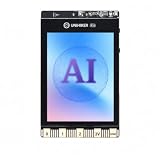
- All-in-One AI Learning Platform: Combines vision AI, offline voice recognition, and TinyML machine learning in one compact device – ideal for STEM education and beginners exploring AI, IoT, and coding.
- Pre-Loaded AI Models & Offline Voice Control: Comes with 4 pre-installed vision AI models (face, pet, QR code, motion) and supports offline speech recognition – no internet needed to start building smart projects.
- Train Your Own AI Models with TinyML: Go beyond built-in features and create custom vision or sensor models for personalized AI projects, enhancing learning and creativity.
- Rich Sensors & Wireless Connectivity: Features a 2MP camera, microphone, speaker, environmental sensors, and dual Wi-Fi/Bluetooth for IoT applications, remote control, and real-time data monitoring.
- User-Friendly with Graphical & MicroPython Coding: Supports drag-and-drop graphical programming (Mind+) and MicroPython, perfect for all skill levels. Includes 2.8" color screen for instant data visualization.
| Tool | Primary approach | Typical problems | Skills and trade-offs |
|---|---|---|---|
| NanoEdge AI Studio | Low-code generation of libraries for anomaly detection, outlier detection, classification, and regression | Sensor-driven condition monitoring and other applications where the useful signal is learned from normal or labeled data | Reduces embedded ML implementation work; success still depends on representative sensor data and careful validation |
| STM32Cube.AI | Import, analyze, and optimize neural networks for constrained STM32 devices | Neural-network deployments where model size, RAM use, and execution speed must be tuned for a specific MCU | Offers a more advanced optimization path; developers need greater familiarity with model formats, memory use, and embedded integration |
A practical tool choice
- Start with the physical signal and the decision you need, such as “raise a maintenance alert” or “classify an operating mode.”
- Use NanoEdge AI Studio when a low-code, sensor-centric anomaly, outlier, classification, or regression workflow fits the problem.
- Use STM32Cube.AI when you already have a neural network or need explicit control over network optimization on a particular STM32 MCU.
- Run the generated result on the target board and measure RAM, flash, latency, and energy under the real sampling schedule.
- Test with data from normal operation, fault conditions, temperature changes, sensor tolerances, and installation differences before treating an alert as production-ready.
What the STM32N6 represented
The STM32N6 was presented as a Cortex-M microcontroller with an on-chip neural-processing unit (NPU), aimed at bringing substantially more capable edge inference to the STM32 line. The interview reported a custom YOLO demonstration at 314 frames per second.
That number is a demonstration result as reported in 2023, not a general performance guarantee for every YOLO model, camera resolution, memory configuration, or application. The interview also discussed sampling and launch plans. Those dates were plans at that time, so they should not be treated as the current availability date; consult current ST documentation and distributors when selecting an STM32N6 device.
When an NPU matters
An NPU can make a major difference when a project repeatedly runs a neural network and the CPU alone cannot meet its latency or energy target. It does not remove the need to size memory, choose sensors, prepare data, or validate the model. For a temperature or vibration anomaly detector, a conventional low-power MCU may remain the better fit.
Rank #4
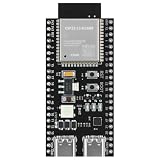
- 【ESP32 S3】Powerful Performance – Features a dual-core chip running at up to 240 MHz, supports low-power modes, Bluetooth 5.0, and Wi-Fi. Widely used in smart home IoT, DIY, robotics, drones, STEAM, AI edge computing, LEDs, and more. Quickly get started with Wi-Fi and Bluetooth modes via sample codes, and control the chip using a mobile app or the cloud — simple and convenient.
- 【Rich Peripherals】 – Offers extensive peripheral capabilities, including up to 45 GPIOs, I2C, SPI, UART, I2S, PWM, and many other interfaces. Compatible with almost all common peripherals such as cameras, LCDs, sensors, LEDs, batteries, and motors — bringing your creative ideas to life. Large storage capacity: 8MB RAM, 16MB Flash (can be virtualized for EEPROM read/write access).
- 【Platform Compatibility】 – Strong platform compatibility with ESP-IDF, Arduino, VSCode, MicroPython, LVGL, TinyML, and more. Suitable not only for conventional programming control but also for AI data processing and recognition. Supports FreeRTOS and Zephyr operating systems.
- 【Development Resources】 – As professional developers, we provide abundant learning code accompanying the product, including source code (IDF, Arduino, MicroPython, LVGL), chip/component datasheets, development tools, and more for study and reference.
- 【AI Edge Computing】 – Low‑cost AI learning and exploration chip. Easily connect to large language models via Wi-Fi, and use I2S for voice input/output to implement AI chat and similar functions. Through TinyML and third‑party trained model deployment, it supports voice wake‑up and recognition, gesture recognition, and image/person recognition.
A deployment workflow for a real TinyML project
- Define the event: specify the condition the device must detect and the acceptable false-alarm and missed-event rates.
- Measure the signal: select sampling rate, sensor range, window length, and installation position; record normal and abnormal behavior.
- Select the MCU and board: reserve memory for firmware and model execution, and confirm interfaces and power modes.
- Build the model or library: choose NanoEdge AI Studio for an appropriate low-code sensor workflow or STM32Cube.AI for neural-network optimization.
- Profile on target hardware: measure inference time, peak RAM, flash use, energy per decision, and behavior during sensor or communications activity.
- Integrate safeguards: define what happens when data is missing, confidence is low, the sensor is disconnected, or the model sees an unfamiliar condition.
- Validate in the field: test across units, sites, temperatures, loads, and maintenance states before enabling automatic control or safety-related action.
What the forecast means for engineers
El-Ouazzane’s thesis is less about replacing every MCU with a high-end AI processor than about adding useful local inference to products that already contain microcontrollers. The commercial opportunity is largest where a small, fast decision can avoid sending continuous raw data to a server or can identify a developing fault before a scheduled inspection.
For product teams, the decisive comparison is not “AI board versus non-AI board.” It is whether the chosen MCU, sensors, model, software workflow, and power budget can deliver a reliable decision at an acceptable cost. The 2023 forecast makes TinyML strategically important, while the customer examples show why predictive maintenance, building control, and power-conversion monitoring are early candidates.
Quick Recap
Limits to keep in view
- The 500-million-device figure is a five-year forecast made in 2023; it is not a current market census.
- The 5–10 million-per-day shipment figure is also attributed to that interview and does not identify how many units were running ML.
- The 314-frames-per-second STM32N6 result is a particular custom YOLO demonstration, not a universal benchmark.
- The cited customer examples do not publish a common set of energy, accuracy, or payback metrics in the interview summary.
- Board availability, MCU supply, tool features, and launch status can change; verify current product documentation before designing in a part.
Product prices and availability are accurate as of the date/time indicated and are subject to change. Any price and availability information displayed on Amazon at the time of purchase will apply.
What’s actually slowing this PC down?
Pick the symptom - the matching free tool is one click away.

