
Recommended Free Tools
This September 2017 dual-socket build pairs two Intel Xeon E5-2696 v4 processors with 64 GB ECC DDR4, SAS SSD scratch storage, a GeForce GTX 970 and a 1,000 W power supply. It is best understood as a parallel-work workstation for 3D point-cloud and encoding workloads—not as a guaranteed high-frame-rate gaming or low-latency trading machine. No controlled gaming, trading or modern application benchmarks were published, so those outcomes depend on the software, GPU, BIOS configuration and NUMA behavior.
The documented build
The AnandTech forum build from September 2017 was assembled to benchmark 3D point-cloud processing for machine-vision inspection, while also serving 4K video editing, gaming and trading workloads.

| Part | Documented choice | What it contributes |
|---|---|---|
| Processors | 2 × Intel Xeon E5-2696 v4 | Dual-socket compute capacity for highly parallel workloads. |
| Motherboard | Supermicro X10DAX | Dual-Xeon platform with the expansion and memory connectivity required by the build. |
| Memory | 64 GB Crucial DDR4 PC-2666, 8 × 8 GB | Eight DIMMs distributed across the two sockets; population must follow the board manual. |
| Application/scratch storage | 2 × 800 GB HGST SAS SSDs in RAID 0 | High-capacity scratch and application volume. RAID 0 provides no drive redundancy, so project data needs a separate backup. |
| Operating-system drive | 512 GB Samsung 850 Pro | Dedicated OS volume. |
| Graphics | Nvidia GeForce GTX 970 | GPU acceleration and display output; actual results vary by application and game. |
| Case | Lian-Li PC-V2120x | Large chassis suitable for a dual-socket workstation and its cooling hardware. |
| Power supply | Seasonic Titanium 1000 W | High-capacity supply for two CPUs, the GPU, storage and expansion cards. |
| CPU cooling | Noctua NH-U12DX i4 coolers | Socket-compatible cooling for the Xeon processors; airflow and clearance still depend on the chassis layout. |
Why the platform suits machine-vision workloads
Parallel point-cloud processing
The stated purpose was benchmarking 3D point-cloud processing used in machine-vision inspection and quality control. Such pipelines can divide filtering, reconstruction, feature extraction and batch analysis across many worker threads, allowing a dual-socket system to expose substantially more parallel compute than a conventional desktop.
Memory and expansion headroom
Intel’s Xeon E5 v4 datasheet describes a 14 nm multi-core family for server, workstation and HPC use. Each socket provides up to 40 PCIe 3.0 lanes, two QPI links rated up to 9.6 GT/s, and an integrated DDR4 memory controller. On a suitable motherboard, that connectivity can support multiple GPUs, high-speed storage and large memory configurations, subject to the board’s lane wiring, firmware and slot-sharing rules.
#1 Best Overall

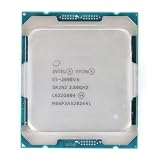
- INTEL XEON E5-2696v4 / E5-2699v4 SR2J0 22-CORE 2.2GHz (3.6GHz Max) LGA2011-3 CPU Both models are identical processors with identical specifications. Intel used different part numbers - one for retail marketing and other for OEM.
NUMA is part of the design
Two sockets create a non-uniform memory access (NUMA) system: memory attached to one processor is local to that processor, while access to the other socket crosses the inter-socket link. Machine-vision software that is NUMA-aware can place threads and data efficiently; software that assumes a single uniform memory pool may lose some of the theoretical advantage.
Workload-by-workload expectations
Machine vision
This is the strongest evidence-backed use case. The build was explicitly intended for 3D point-cloud inspection, and its dual processors, DDR4 memory and PCIe capacity are appropriate for parallel processing. Results still depend on whether the application scales across both sockets and whether GPU acceleration is supported.
Rank #2

- INTEL XEON E5-2696v4 / E5-2699v4 SR2J0 22-CORE 2.2GHz (3.6GHz Max) LGA2011-3 CPU Both models are identical processors with identical specifications. Intel used different part numbers - one for retail marketing and other for OEM.
4K video editing and encoding
The system was also intended for 4K editing. Two Xeons can be useful for CPU-based encoding, rendering and background transcodes, while the GTX 970 may accelerate software effects that support its GPU APIs. The build log does not provide controlled timeline-playback, export-time or codec benchmarks, so smooth playback and export speed cannot be promised for a particular editor, codec or effects stack.
Gaming
Gaming performance is primarily constrained by the GTX 970 and by a game’s ability to use many threads. Dual-socket scheduling and remote-memory access can add latency in some titles, while a faster single-socket CPU and newer GPU may deliver better frame rates and frame-time consistency. The cited build contains no measured game results, so treat it as a workstation that can run games rather than a demonstrated gaming benchmark platform.
Rank #3

- Intel Xeon E5-2699 V4 Docosa-core (22 Core) 2.20 Ghz Processor - Socket Lga 2011-v3 - 5.50 Mb - 55 Mb Cache - 64-bit Processing - 14 Nm - 145 W
Trading and interactive work
Trading software can combine data feeds, analytics and charting, but many user-facing actions remain sensitive to single-thread latency, storage response and network conditions. The platform’s parallel capacity may help with batch analytics or multiple services; it does not establish low-latency performance for a particular trading application. No controlled trading measurements were reported.
Power, clocks and thermals
An AnandTech forum participant reported wall consumption below 400 W for a specific dual-2696 v4 system under an all-core, non-AVX load and estimated approximately 2.8 GHz all-core turbo. These are configuration-specific observations from 2017, not Intel ratings: GPU choice, memory, storage, BIOS settings and workload can materially change power draw and frequency.
Rank #4
- Total Cores 14
- Total Threads 28
- Processor Base Frequency 2.60 GHz
- Max Turbo Frequency 3.50 GHz
- Sockets Supported LGA2011-3
The 1,000 W Seasonic Titanium supply leaves capacity for the documented components and additional cards, but expansion should be checked against the supply’s connector count and the motherboard’s slot layout. Use both Noctua coolers with unobstructed intake and exhaust paths; sustained point-cloud or encoding loads are thermal stress tests, not merely boot tests.
Assembly and validation checklist
- Install both Xeons and both NH-U12DX i4 coolers, verifying mounting pressure and clearance in the PC-V2120x.
- Connect every required CPU power lead, including both 8-pin EPS connectors on the X10DAX.
- Install the eight 8 GB DIMMs in the exact channels specified by the motherboard manual so each socket receives the intended memory.
- Seat the GTX 970 fully in its slot, secure its bracket, and attach any auxiliary GPU power connector.
- Connect the OS SSD and both HGST SAS SSDs through the controller or ports supported by the board; create RAID 0 only for replaceable applications and scratch data.
- Update or configure firmware using a BIOS version that supports the exact E5-2696 v4 stepping, then load stable defaults before tuning.
- At first boot, confirm that both processors, all 64 GB of memory, the GPU and every storage device are detected.
- Run a memory test and a sustained CPU/GPU load while monitoring temperatures, clock behavior and system stability before starting production benchmarks.
What the build’s troubleshooting history teaches
A related setup report documented repeated blue-screen failures and eventually identified basic installation details, including an unplugged 8-pin EPS connector and an incorrectly seated GPU. The author tried four motherboards, 16 RAM sets, two power supplies, two GPUs and several SSDs. That experience favors a disciplined diagnostic method: reduce the system to the minimum hardware needed to post, change one variable at a time, and only then add memory, storage and expansion cards. If instability appears after a BIOS change or memory rearrangement, return to known-good defaults before interpreting benchmark results.
How to judge it against a newer workstation
| Decision axis | Where this dual-Xeon build can help | Where a newer single-socket system may win |
|---|---|---|
| Parallel throughput | Two processors and broad PCIe connectivity suit point clouds, rendering and batch encoding that scale well. | Modern architectures can complete lightly threaded stages faster. |
| Interactive latency | Can run many background workers simultaneously. | Higher per-core performance and simpler memory topology generally favor editing responsiveness, trading interfaces and many games. |
| Memory and expansion | Dual-socket memory channels and up to 40 PCIe lanes per socket provide substantial attachment capacity, subject to the X10DAX layout. | Newer platforms offer current PCIe generations, newer media engines and longer software-support horizons. |
| Acquisition and reliability | Used parts may make high parallel capacity affordable. | New hardware brings warranty coverage, lower energy use and less uncertainty about component history. |
| Software behavior | NUMA-aware applications can exploit both sockets. | A single-socket design avoids cross-socket scheduling and memory-placement issues. |
Bottom line
This documented configuration is a credible used workstation for highly parallel machine-vision point-cloud work and CPU-heavy video tasks. Its gaming and trading value is conditional: the GTX 970, software scaling, single-thread speed and NUMA behavior matter more than the presence of two Xeons alone. Build it only after confirming firmware, EPS power, memory population, GPU seating, cooling and storage-controller compatibility, and keep RAID 0 limited to data that can be recreated.
Quick Recap
Product prices and availability are accurate as of the date/time indicated and are subject to change. Any price and availability information displayed on Amazon at the time of purchase will apply.

