
The Tool Desk
Outbyte Driver Updater FREEFix the driver behind crashes, sound loss and screen glitchesFind Drivers →Outbyte PC Repair FREEClear out junk files and repair common Windows errorsFree Scan →IoT in agriculture connects sensors, communications networks, software and equipment so farmers can monitor conditions and act on timely data. It can support irrigation, nutrient decisions, crop-health monitoring, livestock management and harvesting—but savings or yield gains are not guaranteed. The value depends on whether the data changes a real farm decision and whether the system works reliably in that farm’s conditions.
What IoT in agriculture means
The Internet of Things (IoT) is a way to connect physical equipment and sensors to software that can collect, share and use data. On a farm, that may mean a soil-moisture probe sending readings to an app, a weather station feeding an irrigation schedule, or a connected controller operating a pump or valve.
A 2024 review describes four practical layers of an agricultural IoT system:
| Layer | What it does | Farm example |
|---|---|---|
| Sensing and actuation | Measures conditions or carries out an action. | A soil sensor measures moisture; a connected valve controls water flow. |
| Network | Moves readings and commands between equipment and software. | A field device sends a reading over its available communications connection. |
| Cloud | Stores or processes information for access and analysis. | Farm records and incoming sensor readings are available through a service. |
| Application | Presents information, alerts or controls to the user. | A farmer checks conditions or changes an irrigation setting in software. |
These layers do not require every farm to use the same equipment or a fully automated system. A setup may simply collect and display measurements; a more automated one can use readings to trigger an alert or operate compatible equipment.
Crashes, No Sound, or Screen Glitches?
Random freezes, missing sound and display glitches usually trace back to one bad driver. Find and replace yours safely.Free scan · under a minuteWindows Errors? Fix Them Before They Spread
Repair common Windows errors and clear accumulated junk for a smoother, more stable PC - no reinstall needed.Free scan · no reinstall#1 Best Overall

- 【About Smart Agriculture Kit】The micro:bit Smart Agriculture Kit has a well-selection of IoT:bit, DS18B20 temperature sensor, soil moisture sensor, water level sensor, PIR sensor, servos and etc., We can use it to build simulated ecological greenhouses, simulated fish pond water level monitoring devices and other cases, from which we can learn the modern agriculture and program and explore more possibilities to apply the information technology in agriculture.
- 【Fun Case】You can use sensors to simulate farmland protection devices to build your own smart farm, and you can also monitor the water temperature and water level of fish ponds. More cases are waiting for you to develop…
- 【Components】For this microbit kit, we selected executed components commonly used at farm as soil moisture sensor, water level sensor, OLED screen, temperature and humidity Sensor , Water-proof Temperature Sensor , PIR sensor, rainbow LED and more.
- 【Graphical Programming Languages】It fits for graphical Makecode programming, students can use easier-to-understand programming method to achieve what they want. It better improves their interest in programming!
- 【TIPS 】(1)WITHOUT micro: bit (2)Wiki Tutorial Get: Pls enter "wiki.elecfreaks.com/en/microbit/wisdom-life/microbit-smart-agriculture-kit/" to learn. (3)Strong Technical Support—Pls click “elecfreaks” amazon store and click “Ask a question” to email us! Looking for your consultation!
How farms use IoT
Irrigation and water management
Soil-moisture probes, weather data, water-level and flow measurements, and remote sensing can help farmers decide when and where to irrigate. Monitoring can also help flag possible leaks or crop water stress. The decision remains farm-specific: a reading is useful only when it is interpreted for the crop, soil, field conditions and irrigation system.
FAO’s AQUASTAT provides standardized water and irrigation data, while its WaPOR platform uses satellite information on crop water use and productivity. These illustrate how water-management decisions can draw on both field measurements and broader data sources.
Soil and nutrient decisions
Connected sensors can measure variables such as soil moisture, nitrogen or NPK, nitrate, pH and electrical conductivity. These readings can inform where and when to investigate or apply nutrients, rather than treating an entire field as if conditions were uniform. Sensor results are decision inputs, not a substitute for sound interpretation and farm management.
Rank #2
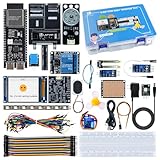
- 【High-Performance ESP32-S3 Microcontroller】 Equipped with revolutionary MCP protocol technology, the kit delivers a native AI voice control experience, perfectly adapting to various AIoT application scenarios, suitable for beginners, educators and makers.
- 【8 Versatile Hardware Modules Included】Comes with RGB LED module (full-color dimming, breathing light effect), WS2812 smart light strip (8 programmable LEDs), DHT11 sensor (real-time temperature and humidity monitoring), SG90 servo, DC fan, dual relay, raindrop and soil sensor, meeting diverse project needs.
- 【Zero-Threshold AIoT Control】Adopts innovative MCP protocol, allowing AI models to directly recognize hardware functions without complex programming. Pre-compiled firmware supports plug-and-play after burning, with an extensible architecture for secondary development.
- 【Multi-Scenario Application Coverage】Widely applicable to STEM education (learning IoT, AI interaction, embedded programming), smart home prototype verification, maker project development, and smart agriculture (soil monitoring, automatic irrigation systems).
- 【Comprehensive Learning & Technical Support】Provides an online document center with detailed quick-start guides and free professional technical support to answer questions and assist in problem-solving, helping users get started quickly.
Crop health, pests and disease
Cameras, environmental sensors and connected scouting can help identify conditions associated with crop stress, pests or disease. A monitoring system may help direct attention to a location sooner, but detection does not by itself establish the cause or determine the right treatment. The 2024 review also lists fire detection among agricultural IoT applications.
Greenhouses and local climate
Temperature, humidity, carbon dioxide, light and weather-station sensors can provide continuous environmental measurements. In a greenhouse or other controlled growing environment, those measurements can help operators monitor conditions and make adjustments through compatible controls.
Yield, quality, logistics and harvest
Connected monitoring can contribute to forecasts, yield and quality records, processing and logistics information, and harvest decisions. The usefulness of these records depends on consistent data collection and on how well the software fits the farm’s actual workflow.
Rank #3

- Build a 37-Module Sensor Lab: Add motion, distance, light, sound, temperature, touch, display and control functions to compatible UNO, MEGA, Nano, ESP-32 or STM32 projects for prototyping, classroom experiments and maker builds
- Explore Input Sensors and Motion: Experiment with GY-521 motion sensing, PIR detection, ultrasonic ranging, temperature and humidity, DS18B20, flame, Hall, touch, light, sound, tilt, tracking and obstacle-avoidance modules
- Add Displays, Timing and Control: Use the LCD1602, DS1307 real-time clock, joystick, rotary encoder, relay, buzzers, RGB LEDs and infrared modules to build clocks, alarms, counters, status displays and automated projects
- Follow Guided Projects Materials: Use digital tutorial materials, datasheets, wiring diagrams and example code for compatible UNO R3, MEGA 2560 and Nano boards, then adjust thresholds, timing and logic to create custom experiments
- Module-Only Expansion Kit: Controller board, USB cable, breadboard and jumper wires are not included; use 6.5–9 V DC only with the included power module, verify pin requirements before wiring and keep the laser emitter away from eyes
Livestock and safety
Agricultural sensor systems can also cover livestock and safety-related monitoring. The review identifies livestock, smoke and flame sensing among agricultural sensor categories. The specific measurements, alerts and actions available depend on the equipment and system chosen.
What benefits are realistic—and what is not established
Digital agriculture may help farms make decisions sooner, reduce wasted inputs, save labor, improve productivity or product quality, and reduce environmental pressure. Those are potential outcomes, not automatic results. Sensor placement, calibration, data quality, connectivity, crop and soil conditions, and management all affect whether a system helps.
USDA’s Economic Research Service says digital agriculture may help address challenges including rising production costs, climate change and labor shortages. Its report describes U.S. adoption trends using Agricultural Resource Management Survey data from 1996 through 2019. In that report’s historical period, automated guidance was used on well over 50% of the acreage planted to corn, cotton, rice, sorghum, soybeans and winter wheat. That figure is specific to those crops and the report’s historical period; it is not a current measure of all IoT use or adoption across every farm.
Rank #4

- GXHTV3 Chip Sensor: The GXHTC3 is a digital humidity and temperature sensor designed for battery-powered, high-volume consumer electronics applications. Temperature and humidity sensors based on the GXHTV3 chip belong to the Heltec Quick Link series. This module uses an LGA (Legacy Interface Gauge) package for direct soldering onto circuitry, or a B2B interface version compatible with the ESP32 LoRa 32 V4 expansion kit
- Buzzer Sensor: A LoRa 32 V4 compatible buzzer can be directly mounted on its expansion board using the B2B interface
- BME280 Atmospheric Pressure Sensor: The BME280 is a low-power digital environmental sensor that integrates the measurement of atmospheric pressure, temperature, and humidity. It communicates with the main controller via an I²C interface. With its compact size and stable performance, the BME280 barometric pressure sensor is widely used in weather stations, indoor navigation, IoT devices, and wearable technology, providing reliable environmental data monitoring solutions. It also features a B2B interface, compatible with the ESP32 LoRa 32 V4 expansion kit
- Applicable Devices and Scenarios: Supports Meshtastic devices, Arduino IDE, and PlatformIO, making it ideal for smart agriculture, asset tracking, industrial monitoring, home automation, and other applications. It can also be used with the ESP32 LoRa 32 V4 expansion kit
- After-sales Service: If you have any questions about the product, please contact us. We will resolve them for you as soon as possible. We have a professional support team to easily solve your problems
FAO has called for more evidence on the economic, environmental and social effects of digital agriculture. A farmer should therefore treat projected savings or yield improvements as claims to verify against a local baseline, not as a guaranteed return.
Barriers that can make a system less useful
- Cost: Equipment may have upfront costs as well as recurring connectivity, software, maintenance or service costs.
- Connectivity and electricity: Rural internet or power may be unreliable or unavailable where a device needs to operate.
- Skills and support: Devices and dashboards require setup, interpretation and troubleshooting; limited training or technical support can reduce their value.
- Compatibility: Sensors, controllers, pumps, valves, machinery and farm software may not work together as expected.
- Data security and control: Buyers should understand who can access farm data, how it is protected, and whether it can be exported or moved to another system.
- Uncertain return: A system can collect information without changing a decision enough to justify its total cost.
FAO’s analysis of 22 case studies worldwide identifies cost, skills, connectivity, electricity, data policy and infrastructure as adoption conditions. Those factors vary by location and farm type, so an approach that works in one setting may not transfer directly to another. A 2024 Government Accountability Office report also highlights the need for better data-driven estimates of benefits and for extension support.
Independent reader supportYour contribution helps us test, update, and keep practical guides available for everyone.How to decide whether agricultural IoT is worth it
Start with a costly or time-sensitive decision, not with a device. For example, if irrigation timing is the problem, identify what information would change the schedule and what action would follow. Then check whether a sensor can provide that information at a useful location and whether the farm can act on it.
Best Value

- Build a Real, Working Smart Farm from Scratch - It’s your gateway to building a fully functional IoT farm. With the ESP32 at its core, you’ll assemble a charming wooden farmhouse, connect 8 sensors and 6 actuators, and bring it to life with code. Monitor real-time data, control devices remotely via WiFi, and see your creation respond to the environment.
- Learn Two Ways to Code - Start with Scratch 3.0 — drag and drop colorful blocks to build logic visually. Then, when you’re ready, dive into Arduino IDE and write real C++ code. Every step comes with clear tutorials and sample code. Whether you’re a complete beginner or ready for a challenge, we’ve got you covered.
- Rich Sensor & Actuator Set for Real Projects - This kit includes 8 sensors (soil moisture, water level, DHT11, PIR motion, light, rain, ultrasonic, button) and 6 actuators (water pump, servo, fan, LED, buzzer, LCD display). You’ll learn how sensors gather data, how actuators take action, and how to connect them all into a smart system.
- Assembly & Coding Made Easy - Worried it might be too hard? Don’t be. We provide step-by-step online tutorials with video guidance and sample code for every single project. The kit comes unassembled (so you get the full building experience), and the code isn’t pre-burned (so you learn to upload it yourself). All you need is 6 AA batteries. No soldering.
- Exquisite Models - You can paint them and customize them to create your very own masterpiece. This is both a craft project and a programming challenge—a truly immersive STEM experience that combines craftsmanship with coding.
- Define the decision. State what you want to decide differently—such as when to irrigate, where to investigate crop stress or when to adjust a controlled environment.
- Choose the variable and location. Match the measurement to the decision and the field, crop, soil or livestock context. A measurement from the wrong depth or location may not represent the conditions that matter.
- Check power and communications. Confirm that the device can operate and send data from its intended location, including any needed network coverage, electricity, battery or solar supply.
- Confirm system compatibility. Check whether the proposed system works with existing pumps, valves, machinery and farm software, and whether it can send alerts or automate only the actions you intend.
- Review data terms and ownership. Establish who controls the data, how it is secured and whether you can export it in a usable form.
- Plan for reliability and support. Ask about calibration, outdoor durability, maintenance, service, training and what happens when a sensor or connection fails.
- Compare total cost with a baseline. Include recurring fees and upkeep, then track a relevant farm measure before and after adoption. A purchase is easier to justify when the intended benefit can be measured in the farm’s own conditions.
Choosing starter hardware
A soil-moisture sensor is a practical starting point when the goal is better-informed irrigation, because moisture measurement is directly relevant to irrigation decisions. Other options include a wireless agricultural weather station or a smart irrigation controller. The right choice depends on the decision and the farm’s existing equipment—not simply on how many measurements a device advertises.
Before buying, check:
- Probe depth and whether it measures the part of the soil profile relevant to the crop and decision.
- Calibration requirements and how readings should be interpreted.
- Outdoor rating and suitability for the intended field conditions.
- Battery or solar life and the effort required to maintain the power supply.
- Radio, cellular or Wi-Fi range at the installation site.
- Whether data can be viewed or exported in a useful format, and whether the app or service has ongoing costs.
- Compatibility with existing irrigation equipment if remote control or automation is required.
A sensor that produces precise-looking numbers is not necessarily useful if it is poorly placed, unreliable, difficult to maintain or disconnected from a decision the farm can act on.
What adoption figures do—and do not—tell you
U.S. adoption data shows that some digital tools have become common in particular crop operations, but adoption varies by technology and farm. USDA’s historical guidance figure is evidence about automated steering for specified crops, not proof that every farm benefits from connected sensors or that all smart-farming systems are widely adopted.
Separately, the U.S. Government Accountability Office reported that USDA and the National Science Foundation provided almost $200 million for precision-agriculture research and development during fiscal years 2017–2021. That is a historical federal research and development funding figure, not a measure of current product availability, farmer spending or realized farm-level savings.
Quick Recap
Product prices and availability are accurate as of the date/time indicated and are subject to change. Any price and availability information displayed on Amazon at the time of purchase will apply.

