
PC Slower Than It Used to Be?
A free scan shows the junk files, broken settings and background clutter dragging Windows down - then fixes them in one click.Free scan · Windows 10 & 11Crashes, No Sound, or Screen Glitches?
Random freezes, missing sound and display glitches usually trace back to one bad driver. Find and replace yours safely.Free scan · under a minuteYes. Owners reported updating Voodoo3 BIOSes and cross-flashing Voodoo3 2000 and 3000 cards in early-2000s forums. The results were mixed: one Voodoo3 3000 owner said a BIOS update worked normally, while another discussion recorded a cross-flash that left a card unusable. Those anecdotes show that it was attempted, not that a particular ROM is safe for your board.
What the historical reports actually show
A Voodoo3 3000 BIOS update reportedly worked
In an AnandTech thread opened January 27, 2002, forum member maxis wrote: “I flash my V3 3000 bios to version 2.15.12-SD long time ago. I didn’t notice any different but everything is ok.” That is an individual user report, not a controlled compatibility test. Read the AnandTech discussion.
Cross-flashing a 2000 and 3000 was also reported
A February 2002 Slo-Tech discussion describes changing a Voodoo3 2000 to a 3000 BIOS and later reverting it. The same discussion includes a failed cross-flash report that left a card unusable. Participants mention saving the original ROM and trying an ordinary PCI graphics card for recovery, but those are period forum suggestions rather than verified, board-specific procedures. Read the Slo-Tech thread.
Why a 2000-to-3000 flash is not automatically compatible
3dfx’s August 1999 Voodoo 3 2000-3000 Reviewers Guide lists different stock controller clocks: 143 MHz for the Voodoo3 2000 and 166 MHz for the Voodoo3 3000. The guide also specifies 16 MB SDR SDRAM for the referenced 166 MHz board. A ROM intended for another model can therefore alter default operating settings, and board revisions, memory configuration, bus type and vendor implementation may differ. These specifications do not establish that every 2000 and 3000 board can share a BIOS. See the 3dfx guide.
#1 Best Overall
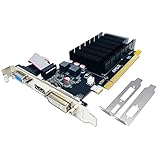
- 【2GB GDDR3 Memory】AMD Radeon HD 5450 graphics card is with 650MHz core frequency, up to 1066MHz memory speed,80 Stream Processors,perfect for working,video and photo editing,allows good fluency,which can effectively meet your needs.
- 【Low Profile Design】The computer graphics cards is small in size,saves more space and plug and play.Small Form Factor design fits in today’s low profile desktops and workstations (with half height bracket).
- 【Multi-monitor Support】Supports up to two monitors for the video card including DVI,VGA,HDMI, and for flexibility of use(the VGA Interface is removable),This low profile, low power consumption card will improve multimedia performance, extend the desktop, and accelerate apps.
- 【Fanless Design for Zero Noise】The HD 5450 is a budget video card with silent passive fanless cooling system.Using high performance heatsinks,it is small enough to provide fanless operation and comfortable to use with zero noise.
- 【Independently Power】No external power supply, about 19W full-load power consumption.Works with Windows 10 as well as 7, 8 and 8.1(NOT compatible with windows 11).
Three different things people mean by “flashing”
Updating the same model’s BIOS
This replaces the firmware with a version intended for the same model and board family. The AnandTech account is an example of a reported 3000-to-3000 update.
Cross-flashing to change model behavior
Installing a 3000 image on a 2000 may attempt to change the card’s default clock or identification. Because the models’ reference clocks differ, this carries stronger compatibility assumptions than a same-model update.
Recovering after a bad flash
A card that no longer initializes may require a recovery display adapter or another hardware-specific method. The historical sources do not prove that a secondary PCI card, a particular motherboard, or any one recovery sequence will work in your system.
Rank #2

- 【4GB VRAM for Smooth Multitasking】: Equipped with 4GB DDR3 memory and a 128-bit bus width, this GT 740 provides a significant performance boost over standard 2GB models. It ensures smooth 1080P video playback and lag-free performance for office multitasking and basic graphic design.
- 【Triple Display Versatility (HDMI+DVI+VGA)】: Features a comprehensive output interface including HDMI, DVI, and VGA ports. Connect to modern monitors or legacy projectors without needing expensive adapters. Ideal for setting up a dual-monitor workstation to increase productivity.
- 【The Perfect Legacy PC Upgrade】: An excellent, cost-effective solution for reviving older desktop PCs. This card supports DirectX 12 (11_0) and is fully compatible with Windows 11/10/7, making it the go-to choice for upgrading from integrated graphics to a dedicated GPU.
- 【Low Power & Plug-and-Play】: Designed for high efficiency, this graphics card draws all its power directly from the PCIe slot with no external power connector required. It is compatible with standard power supplies, making installation quick and hassle-free.
- 【Quiet & Reliable Cooling System】: Built with an optimized heatsink and a low-noise cooling fan that maintains stable temperatures even during extended use. Perfect for building a Quiet Office PC or a dedicated HTPC for the living room.
Flash and Userflsh: what one 2002 explanation claimed
A March 2002 TechSpot forum reply distinguishes the period utilities Flash 2.14, Userflsh 1.02 and DOS4GW. According to that forum post, Userflsh preserved existing DramInit0/DramInit1 memory timing and memory-clock values and required the card’s subsystem vendor ID to match the BIOS image, while Flash was said to write without those restrictions. This is a forum repost, not authenticated current documentation, and the old download links should not be treated as trusted sources. See the TechSpot explanation.
How the reported approaches compare
| Approach | Potential purpose | Evidence and risk |
|---|---|---|
| Same-model BIOS update | Apply firmware intended for the same card family | One 3000 owner reported success, but no universal compatibility or success rate is established. |
| 2000-to-3000 cross-flash | Attempt to change default model settings or clock behavior | Reported by forum users; the models have different reference clocks, and a separate report describes an unusable card after cross-flashing. |
| Userflsh (historical description) | Preserve selected memory settings while writing a ROM | Forum explanation says it checks subsystem vendor ID; provenance and compatibility are unverified. |
| Flash (historical description) | Write a ROM without the stated restrictions | Forum explanation says it imposes fewer checks, which can increase the consequences of a mismatch. |
| Recovery with a spare PCI card | Provide video output after a failed flash | Mentioned in the Slo-Tech thread only; not guaranteed for every motherboard or Voodoo3. |
What you should verify before considering any ROM
- Exact board model and vendor, including PCI versus AGP.
- Memory type and capacity, plus the board revision.
- Current BIOS version and the ROM image’s intended subsystem/vendor ID.
- Whether you have a verified backup of the original ROM and a recovery display path.
- That the ROM comes from a trustworthy, documented source; the cited discussions do not provide a modern authoritative archive.
Do not infer a safe flash command or ROM choice from these old posts. They do not establish compatibility for your specific card, distinguish every memory variant, or provide a recovery method that is guaranteed to work.
Bottom line
Yes, people did flash Voodoo3 2000 and 3000 BIOSes, including 2000-to-3000 cross-flashes. Historical reports include both a normally working update and a card made unusable. Treat cross-flashing as an experimental, board-specific operation rather than a reliable way to turn a Voodoo3 2000 into a 3000; identify the exact hardware and preserve the original firmware before doing anything.
Quick Recap
Product prices and availability are accurate as of the date/time indicated and are subject to change. Any price and availability information displayed on Amazon at the time of purchase will apply.

