
Free tools Windows power users keep installed
One-click scans. No signup required.
RFID in banking is primarily a custody, inventory and workflow tool. Radio tags identify cash boxes, bags, equipment or other assets so handheld or fixed readers can capture movements with less manual data entry. The tag read establishes the object’s identity; it does not prove that a person is authorized to handle it. Effective deployments connect readers to identity checks, backend records, audit logs and broader physical and cybersecurity controls.
What RFID does in a banking environment
Radio-frequency identification (RFID) uses radio fields to exchange data between a tag and a reader. Depending on the design, tags may be passive or active, and readers may be handheld or installed at a doorway, dock or processing point. The appropriate configuration depends on the business process, asset and environment.
For a bank, the useful output is normally an event such as “cash box 1842 was read at the vault handover station at 09:14.” Software can associate that event with a location, transaction, employee identity and time, then reconcile it with inventory or custody records.
Vault inventory and cash-box handovers
One documented example is a Chainway case study for Bank of China. It describes a deployment combining UHF RFID, barcode scanning, network-connected handheld devices and separate clerk identity verification. A handheld reader captures cash-box or bag identifiers and handover details; the results are synchronized with a server so administrators can consult inventory and handover records.
#1 Best Overall

- DUAL-BAND COMPATIBILITY: Supports both 125KHz and 13.56MHz RFID frequencies, compatible with ISO14443-A/B protocol and IC ID card protocol for versatile card reading
- PLUG AND PLAY: Works instantly with Windows, Linux, and Android systems without requiring any driver installation for hassle-free setup
- EASY OPERATION: Simple 3-step process - connect to PC, open text software, and place card over reader to instantly capture card data
- UNIVERSAL USB CONNECTION: Features standard USB interface for broad compatibility with various devices and convenient power supply through USB port
- RELIABLE PERFORMANCE: Built with microelectronics RF module technology ensuring stable reading capabilities and consistent data transfer
This pattern addresses a specific operational problem: proving which physical container was received, transferred or returned. RFID can reduce repeated individual scans when several tagged items are presented together, while barcodes can remain useful as a fallback or for assets that are not RFID-tagged. The case-study details and claimed benefits are vendor-reported, not an independent performance evaluation.
What the workflow can record
- Tagged cash-box or bag identifier
- Handover location and timestamp
- Employee or clerk identity verified by a separate method
- Reader or workstation that captured the event
- Synchronization status and reconciliation result in the bank’s backend system
Cash-in-transit and lifecycle traceability
Seuic describes an unnamed leading bank using tagged cash boxes and an industrial RFID handheld terminal. The described process follows assets from storage into circulation, records handovers and transmits scan data in real time. The page presents this as a closed-loop lifecycle workflow, but it does not identify the bank or show a publication date in the reviewed material. Treat it as an example of a possible design rather than a verified, dated result for a named institution.
Where RFID fits in the chain
- Preparation: A cash box receives a unique tag linked to its asset record.
- Dispatch: Staff read the box before it leaves a vault, cash center or branch.
- Transfer: Each custody change is recorded with the responsible workflow and location.
- Receipt: The receiving point scans the container and reconciles it against expected items.
- Return or retirement: The system records the box’s return, repair, replacement or removal from service.
RFID does not replace physical seals, dual control, reconciliations, transport procedures or investigation processes. It supplies machine-readable custody evidence that those controls can use.
Rank #2

- . IC card USB reader, Send data to cursor location, HID USB no driver is requested
- . usb reader supports iso14443A protocol cards
- .Support 4 byte UID and 7 byte UID 13.56M card
- .Emualte USB keyboard output, so easy interfaced into RFID system without changing the original software or program, selectable 28 formats are suitable for most common system
- .Default setting is 8H 10D format, Send card data in 10 digital datas to focused window as an external input device
Fixed-asset inventory and equipment tracking
NIST lists asset management and tracking among RFID application classes. In a financial institution, tags can be assigned to equipment and other fixed assets so receiving, allocation, transfer and periodic inventory counts generate consistent records. Seuic’s banking material also describes lifecycle management for fixed assets, although those operational details are vendor claims.
Typical candidates include technology equipment, secure containers, processing devices and furnishings that move between branches, operations centers and storage rooms. The business case depends on the value of faster reconciliation and better custody records relative to tags, readers, software integration, training and maintenance.
Access control: useful complement, not proof of authorization
RFID can be part of an access-control design—for example, a tagged object can trigger a workflow when it reaches a controlled station, or an employee badge can be read by an access system. However, an asset tag read identifies the object, not the person operating the reader and not the person authorized to approve a transfer.
Rank #3
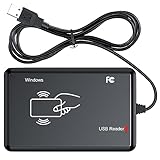
- RFID Reader Scanner read both 125KHz/13.56Mhz 1326 family ISO Prox whole family cards & EM ID EM4100 cards together, MF S50 S70 bank card and other 14443A protocol labels that support ISO14443-A/B protocol, ID card and other 14443B protocol labelsHID USB device no driver request.
- 125KHz/13.56Mhz Dual-frequency RFID reader supports EM4100 ID cards and also 1326 1346 1386 ISO Prox card, H10301 H10304 format etc.
- RFID Reader with 40 output formats for EM4100 ID card UID, max. 40 bits card number in 10H or 13 digital decimal format, configurable with config card by user.
- Proximity card reader sends 125KHz/13.56Mhz Dual-frequency proximity card 1326 family card number in 40 type formats or in raw wiegand bit data format, from 24 bit to 80 bits data, easy for understanding 1326 family card type.
- USB Inteface,Card reader only, Open the software or document that needs to be read,simulate keyboard input, works in Linux Andriod Windows Mac IOS.
The Bank of China example pairs asset scanning with separate clerk identity verification. A bank should likewise bind an asset event to authenticated personnel, approved roles and, where risk warrants it, a second factor or dual authorization.
Security and privacy controls
NIST’s Securing Radio Frequency Identification (RFID) Systems explains that every RFID system has different components and customizations, so risks and available controls vary. The publication advises addressing security and privacy during initiation, design, implementation and operation. It dates from 2007, so it is foundational guidance rather than a product-specific control list.
Questions to answer during design
- Tag data: What is stored on the tag? Use a non-meaningful identifier where possible instead of account, customer or transaction details.
- Read exposure: Could an unauthorized reader discover or track tagged containers? Assess shielding, reader placement, read ranges and policies for sensitive areas.
- Reader authorization: How are handhelds enrolled, authenticated, updated and disabled if lost?
- Backend protection: Encrypt communications, restrict administrative access and segment reader networks from other systems as appropriate.
- Auditability: Retain tamper-evident logs showing what was read, by which device and user, when, where and whether synchronization succeeded.
- Resilience: Define offline operation, duplicate reads, failed reads, clock errors and a controlled reconciliation process after connectivity returns.
- Privacy: Limit who can view movement histories and establish retention and disposal rules for records that could reveal staff routines or asset locations.
Controls should be tested against the actual vault, branch or transport environment. Metal, liquids, dense packing and reader placement can affect performance, so tag selection and field testing are part of the security and reliability design.
Rank #4

- USB Inteface: No external power source needed, Plug in and Play, so it doesn't need driver, just Plug USB into your smartphone or compurter, read the card number.
- Strong compatibility: Supporting multiple systems, Windows, PC.
- Applications: Card MF S50 S70 bank card and other 14443A protocol labels that support ISO14443-A/B protocol, ID card and other 14443B protocol labels.
- Working Status: Red indicates standby mode, and green indicates successful card swiping.
- Working Frequency:13.56MHZ
How RFID relates to U.S. banking security requirements
U.S. guidance is risk-based and layered; it does not make RFID mandatory. Federal Reserve authentication guidance calls for risk assessment, monitoring and stronger authentication such as multifactor authentication or equivalent controls when the risk warrants it, and says it does not establish a new compliance standard.
The Federal Reserve’s bank security procedures rule requires member banks to adopt appropriate security procedures and specified baseline devices, while allowing additional devices to be selected through the security officer’s risk assessment. RFID may support those procedures, but an RFID installation by itself does not satisfy regulatory, physical-security or authentication obligations. Requirements in other countries and supervisory regimes may differ.
RFID versus barcode workflows
The choice is process-specific rather than ideological. A barcode may be cheaper and easier to print, while RFID can support batch or less visually directed reads. The following questions provide a practical comparison framework; they are not a vendor-neutral benchmark.
| Decision axis | What to evaluate |
|---|---|
| Read workflow | Individual scans versus batch reading, line-of-sight requirements and manual handling. |
| Object and environment | Tag fit, attachment method, metal or other difficult surfaces, packing density and conditions in vaults or transport. |
| Custody evidence | Whether the process records the item, handler, time, location and approval—not merely a scan. |
| Integration | Reader connectivity, backend synchronization, inventory reconciliation and audit-log retention. |
| Security and privacy | Tag-data exposure, reader authorization, backend permissions and defenses against unauthorized reading or tracking. |
| Total deployment fit | Compatible tags and readers, software and network changes, training, support and maintenance. |
A practical deployment sequence
- Define the control objective: Specify whether the goal is faster inventory, stronger custody evidence, fewer manual entries or another measurable outcome.
- Map the process: Document every receiving, handover, storage, transport, exception and retirement point.
- Classify the data: Decide what belongs on the tag, what remains only in backend systems and who may access each record.
- Select and test hardware: Match tags and readers to the asset and environment; test dense loads, metal surfaces, missed reads and duplicate reads.
- Integrate identity and approvals: Require authenticated users and appropriate dual control or second-factor checks for high-risk actions.
- Build reconciliation and exception handling: Define responses to an unexpected item, missing item, failed read, offline device or disputed handover.
- Pilot and monitor: Compare the new workflow with the existing process using internally defined measures, then review logs, false reads, operator behavior and security events before expansion.
What the available evidence does—and does not—show
Vendor case studies demonstrate plausible banking workflows and name specialized equipment such as the Chainway C4050 UHF RFID handheld reader and an industrial RFID handheld terminal described by Seuic. They do not establish an independent, dated bank-wide performance result. Seuic’s undated page includes an “80%” headline claim and differing handover baselines in its body; that figure should not be treated as a reliable comparative statistic without further verification.
The defensible conclusion is narrower: RFID can automate identification and improve the timeliness and consistency of custody and inventory records when it is integrated with authenticated people, protected systems and established physical controls. It is not a standalone vault-security or regulatory-compliance solution.
Quick Recap
Product prices and availability are accurate as of the date/time indicated and are subject to change. Any price and availability information displayed on Amazon at the time of purchase will apply.

