
Recommended Free Tools
There is no single maximum coolant temperature that is safe for every PC water-cooling loop. Follow the specifications for the coolant and every temperature-sensitive component; the lowest applicable limit is the one that matters. For radiator fans, use coolant temperature as the control input when your sensor and controller support it, then tune a gradual curve for your system.
What is the maximum recommended water temperature?
It depends on the coolant and the loop’s parts, including tubing, fittings, seals, pump, and water blocks. A fluid’s temperature rating does not certify the assembled loop: check the specifications for each component and stay within all applicable limits.
As one product-specific example, EK Water Blocks lists a recommended use range of 5–60°C for EK-CryoFuel Clear premix on its product page. EK also says decomposition begins above 65°C, where individual coolant components may start to break down. That decomposition threshold is not a recommended operating target, and neither figure establishes a limit for other fluids or loop components.
There is no standards-body maximum or third-party population statistic establishing one universal temperature limit for all PC loops. In particular, do not treat 40°C as a universal safety rule.
#1 Best Overall

- Includes: 1x iCUE LINK XC7 RGB ELITE CPU Block, 1x iCUE LINK XD6 RGB Pump Reservoir Combo, 3x iCUE LINK RX120 RGB fans, 1x XR5 360mm Radiator, 1x iCUE LINK System Hub, XT Hardline Tubing & Fittings
- Gorgeous Hardline Cooling, Made Simple – This complete Hydro X Series custom cooling kit delivers the stunning look that only hardline loops can achieve, with iCUE LINK making the build simpler than ever.
- Dynamic RGB Lighting - Individually addressable RGB LEDs integrated into the CPU water block, pump/reservoir, and cooling fans give your PC a striking look to make it stand out from the crowd.
- Low-Noise Custom Cooling - CORSAIR iCUE software lets you adjust fan and pump settings, monitor temperatures, customize RGB lighting, and synchronize it with all iCUE-compatible products in your setup.
Should radiator fans follow coolant or CPU temperature?
When a coolant sensor and compatible controller are available, use the measured coolant temperature to control radiator fans. Coolant temperature reflects the loop’s thermal state, while CPU temperature can jump quickly during short bursts of work. A coolant-based curve can therefore avoid making fans react to every brief CPU spike.
Set a gradual fan curve that suits your noise preference and the specifications of your loop, then check coolant temperature and fan behavior during sustained load. A curve that is too quiet may let coolant continue to warm under prolonged load.
Rank #2

- CONTACT FRAME FOR INTEL LGA1851 | LGA1700: Optimized contact pressure distribution for longer CPU life and better heat dissipation
- ARCTIC's P12 PRO FAN: More power at any speed - more powerful and quieter than the P12, especially at low speeds. Higher maximum speed for optimal cooling performance under high load
- NATIVE OFFSET MOUNTING FOR INTEL AND AMD: Shifting the cold plate center towards the CPU hotspot ensures more efficient heat transfer
- INTEGRATED VRM FAN: PWM-controlled fan that lowers the temperature of the voltage converters and thus ensures reliable performance
- INTEGRATED CABLE MANAGEMENT: The PWM cables of the radiator fans are integrated in the sheathing of the hoses so that only a single visible cable is connected to the motherboard
Vendor curves are examples, not universal targets
Corsair’s Hydro X iCUE LINK default curve is one quiet-operation preset: Corsair reports that its fans stop below 34°C and run at 46% duty at 40°C. Those points describe that preset, not a generally suitable curve or safe-temperature threshold for other systems.
Corsair’s separate explanation of CPU versus water temperature for fan control uses 45°C as an example maximum coolant setting. That is an illustrative configuration, not a broadly certified maximum for PC loops.
Outdated Drivers Are Slowing You Down
One free scan finds every outdated or missing driver and matches the right update for your exact hardware.Free scan · exact hardware matchPC Slower Than It Used to Be?
A free scan shows the junk files, broken settings and background clutter dragging Windows down - then fixes them in one click.Free scan · Windows 10 & 11Rank #3
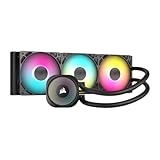
- Simple, High-Performance All-in-One CPU Cooling: Renowned CORSAIR engineering delivers strong, low-noise cooling that helps your CPU reach its full potential
- Efficient, Low-Noise Pump: Keeps your coolant circulating at a high flow rate while generating a whisper-quiet 20 dBA
- Convex Cold Plate with Pre-Applied Thermal Paste: The slightly convex shape ensures maximum contact with your CPU’s integrated heat spreader, with thermal paste applied in an optimised pattern to speed up installation
- RS120 ARGB Fans: RS ARGB fans create strong airflow and high static pressure, with easy ARGB control via a compatible motherboard. CORSAIR AirGuide technology and Magnetic Dome bearings ensure great cooling performance and low noise
- Easy Daisy-Chained Connections: Reduce the wiring in your system by daisy-chaining your RS ARGB fans and connecting them to just one 4-pin PWM fan header and one +5V ARGB header
What to check if coolant temperature rises unexpectedly
First confirm the coolant reading and compare it with the limits specified for your fluid and components. Check that the fans are connected, rotating, and responding to the curve; then verify that the pump has power and liquid is flowing.
- Inspect tubing for kinks that could restrict flow.
- Check water-block channels for debris or blockage.
- Confirm that the coolant is compatible with the loop and follow its maker’s instructions.
- Check the pump and fan connections rather than inferring coolant temperature from a CPU reading alone.
EK’s installation manual lists pump faults and broken fans among possible causes of high CPU temperatures. A high CPU reading can also have other causes, so it does not by itself establish that coolant has exceeded a particular temperature.
Rank #4

- CONTACT FRAME FOR INTEL LGA1851 | LGA1700: Optimized contact pressure distribution for longer CPU life and better heat dissipation
- ARCTIC's P12 PRO FAN: More power at any speed - more powerful and quieter than the P12, especially at low speeds. Higher maximum speed for optimal cooling performance under high load
- NATIVE OFFSET MOUNTING FOR INTEL AND AMD: Shifting the cold plate center towards the CPU hotspot ensures more efficient heat transfer
- INTEGRATED VRM FAN: PWM-controlled fan that lowers the temperature of the voltage converters and thus ensures reliable performance
- INTEGRATED CABLE MANAGEMENT: The PWM cables of the radiator fans are integrated in the sheathing of the hoses so that only a single visible cable is connected to the motherboard
The same manual recommends keeping the operating environment at or above 5°C because coolant can freeze in very low ambient conditions. That is guidance for the cited EK manual, not a general room-temperature rule for every system.
What you need for coolant-based fan control
You need a coolant-temperature sensor and a controller that can use its reading for fan control. Depending on the motherboard and loop, a sensor fitting or separate controller may also be necessary. Check sensor threading and controller support before buying: compatibility varies, and no particular sensor model is established here.
The Tool Desk
Outbyte Driver Updater FREEFix the driver behind crashes, sound loss and screen glitchesFind Drivers →Outbyte PC Repair FREEClear out junk files and repair common Windows errorsFree Scan →Quick Recap
Product prices and availability are accurate as of the date/time indicated and are subject to change. Any price and availability information displayed on Amazon at the time of purchase will apply.

