
Recommended Free Tools
Start with the motherboard manual and BIOS defaults. Test one known module in the manual’s recommended single-DIMM slot, then move that same module through every slot. Repeat the complete test with the second module. This isolates a bad DIMM from a failed slot, memory channel, motherboard trace, CPU socket contact, or processor memory controller.
What “one RAM channel” means
Desktop motherboards usually divide memory slots between channel A and channel B. Labels such as A1, A2, B1 and B2 are common, but the correct single- and dual-DIMM population order is motherboard-specific. Use the exact manual for your board rather than assuming that similarly named slots behave identically.
Intel describes a one-DIMM-per-channel design as 1DPC and a two-DIMM-per-channel design as 2DPC. Those terms describe slot topology, not a failure rate or a guarantee that every combination will run at its rated speed.
Read the symptom before replacing parts
| Observed result | Most useful interpretation | Next check |
|---|---|---|
| One module fails in every slot | The DIMM may be defective, incompatible, or incorrectly seated. | Reseat it, restore BIOS defaults, and test a known-good compatible module. |
| Both modules work in one channel’s slots but fail in the other channel’s slots | Suspect the unused slot or channel, motherboard traces, CPU/socket contact, CPU seating or cooler pressure, or the CPU’s memory controller. | Inspect the board and socket, then use a known-good module and, if available, another compatible CPU or motherboard. |
| The system boots but reports less memory than installed | A slot may be unpopulated, a module may not be fully engaged, BIOS settings may be abnormal, or the combination may be unsupported. | Verify the manual’s slot order, reseat both modules, and load BIOS defaults. |
| The problem began after changing modules or enabling a memory profile | The profile or DIMM combination may be unstable at its selected settings. | Return BIOS to defaults and retest before changing any other variable. |
Safe slot-by-slot diagnostic procedure
- Power down completely. Shut down the operating system, switch off the PSU, unplug AC power and follow normal electrostatic-discharge precautions.
- Record settings. Note current BIOS/UEFI settings so you can restore needed options later. Load BIOS/UEFI defaults before testing. Update firmware only through the motherboard maker’s documented method.
- Check the manual. Identify the board’s recommended slot for one DIMM and its approved two-DIMM arrangement. Do not infer the order from slot color alone.
- Test the first module. Install only one DIMM in the recommended slot. Press evenly until the board’s specified retention latch or latches are fully engaged; do not force the module.
- Record the result. Note whether the system reaches POST, any diagnostic LED or beep code, and the capacity shown in firmware.
- Move the same module. Power down between changes and test that unchanged DIMM in every relevant slot. Keep a written record instead of relying on memory.
- Repeat with the second module. Perform the same complete slot sequence. Change only the DIMM or slot being tested.
- Apply a control part. If one module fails everywhere, try a known-good module that matches the board and CPU’s supported memory type.
- Inspect persistent channel failures. With power removed, look for damaged or contaminated DIMM slots, motherboard damage, bent or broken CPU-socket pins, contamination, or an improperly seated CPU. Never straighten socket pins or force a DIMM unless you have the manufacturer’s repair guidance.
- Cross-test when possible. Intel’s troubleshooting guidance recommends testing another working motherboard; AMD similarly recommends testing each DIMM separately in different slots. A compatible replacement CPU can also distinguish a processor memory-controller problem from a board problem.
How to interpret the complete test
Only one DIMM fails
If a particular stick fails in every slot while another compatible stick works, the failed DIMM is the leading suspect. Compatibility and seating still need to be checked first. A known-good replacement is the cleanest confirmation.
#1 Best Overall

- [Color] PCB color may vary (black or green) depending on production batch. Quality and performance remain consistent across all Timetec products.
- DDR3L / DDR3 1600MHz PC3L-12800 / PC3-12800 240-Pin Unbuffered Non-ECC 1.35V / 1.5V CL11 Dual Rank 2Rx8 based 512x8
- Module Size: 16GB KIT(2x8GB Modules) Package: 2x8GB ; JEDEC standard 1.35V, this is a dual voltage piece and can operate at 1.35V or 1.5V
- For DDR3 Desktop Compatible with Intel and AMD CPU, Not for Laptop
- Guaranteed Lifetime warranty from Purchase Date and Free technical support based on United States
Every DIMM fails in one channel
When both sticks work in channel A but neither works in channel B, the fault is unlikely to be the individual modules. Concentrate on the B slots, board traces, CPU/socket contact, CPU installation and cooler pressure, and the processor’s integrated memory controller. Intel specifically advises inspecting for bent or broken motherboard pins and, when available, testing another compatible processor or motherboard.
The machine starts with one stick but not two
Use the manual’s paired-slot arrangement, reset BIOS settings, and verify that both modules are fully latched. The pair may be unsupported at the selected speed, may use incompatible specifications, or may expose a marginal channel that single-DIMM operation does not exercise.
Rank #2

- material: plastic
- Color: black, transparent
- Length: 128mm, wall thickness 0.3mm
- Features: Effectively protect DDR memory RAM modules, dust-proof and anti-static.
- Used for: Place a standard size DDR2 DDR3 DDR4 desktop DIMM module.
Compatibility and correct placement
Check all of the following against the motherboard and CPU support documentation:
- DDR generation, such as DDR4 or DDR5; generations are not interchangeable.
- Desktop UDIMM versus laptop SO-DIMM form factor.
- Total capacity per module and the board’s maximum supported capacity.
- Rated speed, timings and operating voltage.
- Rank configuration and any ECC or registered-memory requirement.
- Qualified-memory-list entries and the specified slot order.
- Whether the modules are a matched kit rather than unrelated sticks.
For Intel 600-series guidance, two DIMMs with identical part numbers are the recommended configuration. Intel warns that mixed part numbers are not guaranteed to reach the target speed and can prevent booting. The exact limits remain platform-specific.
Rank #3

- Capacity – 32GB RAM KIT (2 x 16GB Modules) Speed up to 2666MHz Non-ECC Unbuffered 288-Pin 1.2V UDIMM.
- Specs – Black PCB Color and Dual Rank (2Rx8).
- Compatibility – Designed for selected DDR4 Desktop PCs and workstations that support 288-Pin UDIMM memory. NOT compatible with Laptop SODIMM slots.
- Installation – Plug-and-Play Upgrade, Quick and Easy to Install, no expertise required (please refer to your system's manual for guidelines).
- Warranty – All Timetec products are high-quality and rigorously tested to meet stringent standards. Backed by Timetec Limited Lifetime Warranty and professional technical support based in the United States.
Choosing a test or replacement DIMM
Because the platform is unspecified, the safest shopping description is “compatible desktop DIMM RAM module,” followed by a check of the exact motherboard and CPU support lists. Compare the characteristics below before ordering.
| Characteristic | Why it matters |
|---|---|
| DDR generation | Must match the motherboard’s memory standard. |
| Form factor | Desktop UDIMMs do not substitute for laptop SO-DIMMs. |
| Capacity | Each module and the total kit must stay within board and CPU limits. |
| Speed, timings and voltage | Unsupported settings can cause failed POST or reduced performance. |
| Rank and ECC/registered status | These must match what the platform accepts. |
| Part-number matching | A matched kit is less ambiguous than mixing separately purchased DIMMs. |
When the evidence points to a board or CPU fault
If two known-good, compatible DIMMs work in one channel but consistently fail in the other after BIOS defaults, correct placement and careful inspection, the remaining suspects are the motherboard and CPU path. Cross-testing with another compatible board or processor is the strongest practical confirmation. A persistent defect after those controls is a reason to pursue the component maker’s warranty or replacement process rather than repeatedly changing BIOS profiles.
Rank #4
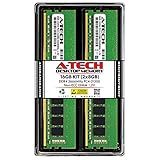
- Compatible with select DDR4 Desktop computers + Easy to install at home, no expertise required
- Maximize your system's performance, boost loading speeds and multitask with ease
- Backed by A-Tech's Lifetime Warranty + Friendly tech support team available to help before and after your purchase
- 16GB RAM Kit ( 2 x 8GB Modules ) | DDR4 DIMM 288-Pin | Speeds up to 2666MHz (2667MHz), PC4-21300 / PC4-2666V
- NON-ECC Unbuffered | 1Rx8 or 2Rx8 - Single or Dual Rank | JEDEC DDR4 standard 1.2V
Official troubleshooting guidance
Intel’s support article “Troubleshooting Steps When RAM (Random Access Memory) Is Not Detected,” reviewed June 6, 2023, directs users to place the memory module in one channel, test the motherboard when another working board is available, inspect socket pins and use BIOS defaults or an update as appropriate. AMD’s “Troubleshooting Common Boot Failures” likewise advises testing each DIMM separately and in different slots to determine whether the system can POST.
Quick Recap
Product prices and availability are accurate as of the date/time indicated and are subject to change. Any price and availability information displayed on Amazon at the time of purchase will apply.

