
What’s actually slowing this PC down?
Pick the symptom - the matching free tool is one click away.
Yes. The LM317 has built-in current limiting, safe-area protection and thermal overload protection. Those features reduce the chance that a short immediately destroys the regulator, but they do not make a circuit safe under every input voltage, heat load, capacitor-discharge event or sustained fault. Check the exact part’s datasheet and design for the heat and fault current your circuit can produce.
What happens when an LM317 output is shorted?
A short from the output to ground pulls the output voltage close to zero. The regulator tries to limit current, while nearly the full input voltage appears across its internal pass transistor. That combination can create substantial heat:
P ≈ (VIN − VOUT) × IOUT
During a direct output short, VOUT ≈ 0, so the approximation becomes P ≈ VIN × Ishort. The actual short-circuit current is not necessarily the regulator’s advertised normal output current; it varies with voltage differential, temperature, device revision and manufacturer.
As the regulator heats or encounters high voltage stress, its protection may reduce current or shut down. Depending on the part and circuit conditions, the output may recover, remain at reduced current, or cycle between shutdown and restart. Do not assume that every LM317 follows the same recovery pattern.
Do these 3 things before closing this tab:
1Fix the driver behind crashes, sound loss and screen glitches2Clear out junk files and repair common Windows errors3Scan for outdated or missing drivers - takes under a minute#1 Best Overall
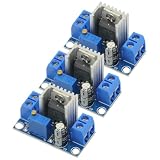
- 3PCS LM317 Adjustable Voltage Regulator Power Supply LM317 DC-DC 4.2-40V To 1.2-37V Step Down Buck Converter Board Module
- Adjustable output voltage range: 1.2 ~ 37V
- Voltage Input: 4.2 ~ 40 V
- Output Current: 1.5A (min), 2.2A (typ)
- Size: 3.5x2.1x1.7cm(approx)
How the internal protection works
TI describes the LM317 as having internal current limiting, thermal overload protection and safe-area protection (TI LM317 product information). These mechanisms address different stresses:
- Current limiting reduces output current when it exceeds the device’s protection characteristic.
- Safe-area protection accounts for the combination of current and voltage across the pass transistor. During a short, that transistor may face both high current and nearly the full input voltage, so the permitted current can fall below the normal output-current rating.
- Thermal shutdown reduces or interrupts operation when the junction becomes too hot. It is an emergency safeguard, not a way to make an overheated design suitable for continuous use.
These protections remain subject to the exact device’s electrical and thermal limits. For the current TI LM317 datasheet, the maximum input-to-output differential is 40 V and the maximum junction temperature used in thermal guidance is 125°C. Other manufacturers and LM317-family variants may specify different limits. Check the datasheet for the exact part fitted to your board (TI LM317 datasheet).
Calculate dissipation before relying on protection
For normal operation, TI gives the dissipation calculation as:
PD = ((VIN − VOUT) × IL) + (VIN × IG)
Here, PD is regulator power dissipation, IL is load current, and IG is the regulator’s ground or adjustment-related current. In many rough estimates, the small IG term is omitted, but use the full datasheet method when checking thermal limits.
Rank #2

- BOJACK LM317T Adjustable Positive Voltage Regulator
- Input Voltage : 4.2 ~ 40 V
- Output Voltage:Adjustable Between 1.2 V to 37 V
- Output Current(Max): 1.5 A
- LM317T employs internal current limiting,Thermal Overload Protection, and Output Transistor Safe Operating Area Compensation
Example: normal load
With an 18 V input, 5 V output and 0.5 A load, the main dissipation term is:
(18 − 5) × 0.5 = 6.5 W
That is already a significant heat load for a linear regulator. The required heatsink depends on the package, ambient temperature, board layout and thermal resistances.
Example: output short
If the same circuit’s short-circuit current is 0.7 A, approximate short-circuit dissipation is:
18 × 0.7 = 12.6 W
This estimate illustrates the thermal stress; it is not a prediction that a particular LM317 will sustain 0.7 A during a short. The device’s current-limit and safe-area characteristics determine its actual behavior.
Free tools Windows power users keep installed
One-click scans. No signup required.
Rank #3

- ALLECIN LM317T is a monolithic integrated circuit in TO-220 - Perfectly suitable for variety electronic experiments.
- Output current: 1.5A. Output Voltage range: 1.2V to 37V. Operating junction temperature: 0℃ - 125℃.
- Features: 0.1% line and load regulation & Floating operation for high voltages & Complete series of protections: current limiting, thermal shutdown.
- Widely Application: make a programmable output regulator & electronic DIY project & regulated power supply & limiting circuit.
- Humanized packaging for easy storage and use. ### Please confirm the data before purchasing.
TI’s thermal approach is to calculate the maximum permitted temperature rise and thermal resistance:
TR(MAX) = TJ(MAX) − TA(MAX)RθJA(MAX) = TR(MAX) / PD
TJ is junction temperature, TA is ambient temperature, and RθJA is the effective junction-to-ambient thermal resistance of the mounted device. If the required thermal resistance is lower than the package and board can provide, reduce dissipation or ambient temperature, or improve the heatsinking. Thermal shutdown does not substitute for this calculation.
Why a protected LM317 can still fail
- Too much input-to-output voltage: A short can put nearly the full input voltage across the regulator. Exceeding the exact part’s maximum differential can damage it even if current limiting is present.
- Excessive heat: Protection cannot remove the power generated by a large voltage drop and fault current. An undersized heatsink or hot enclosure reduces thermal margin.
- Long or repeated faults: Repeated thermal cycling is undesirable, and nearby capacitors, wiring, PCB traces, connectors, transformers and rectifiers can overheat while the regulator limits itself.
- Reverse discharge from capacitors: A charged output capacitor, or an adjustment-pin bypass capacitor, can discharge through internal junctions during certain input or output faults.
- Transients and inductive wiring: A fast input collapse or stored energy in wiring can create stresses not represented by a steady-state short-circuit calculation.
- Wrong part or installation: Pinout and tab connections can vary by package and manufacturer. Check the device marking and exact datasheet, including tab isolation where relevant.
When protection diodes are needed
Protection diodes address capacitor-discharge and reverse-current paths; they are not the LM317’s primary output-short current limiter. TI’s LM317A guidance describes two relevant paths (TI LM317A datasheet).
Output capacitor: VOUT to VIN
If the output capacitor is charged and the input is suddenly shorted to ground, the capacitor can try to discharge through the regulator. A diode from VOUT to VIN provides a lower-impedance path: connect its anode to VOUT and cathode to VIN. Place it close to the regulator pins so the transient path is short.
Rank #4
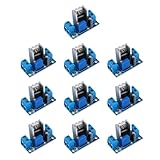
- lM317 adjustable power converter with a wide input voltage range of 40V-4.5V, allowing for versatile applications
- Reliable and efficient DC-DC converter module with an output current of up to 2.2A, providing stable and powerful performance for your devices
- Enjoy the flexibility of adjusting the output voltage within a wide range of 1.2-37V, allowing for customization to suit your specific needs
- Designed to withstand extreme temperatures from -55°C to +150°C, ensuring durability and reliability in various environments
- Compact yet powerful, this lM317 power converter module measures 35.6mm x 16.8mm, making it ideal for space-constrained applications
Adjustment bypass capacitor: ADJ to VOUT
If a capacitor is connected from ADJ to ground to improve ripple rejection, a second diode may be needed from ADJ to VOUT. Its anode goes to ADJ and cathode to VOUT. It provides a discharge path if the output is shorted or the input is interrupted.
Whether either diode is required depends on the capacitor values, fault scenario and exact variant. TI’s LM317-N documentation, for example, gives variant-specific capacitor-discharge guidance; do not apply its limits automatically to a different manufacturer’s part (TI LM317-N military datasheet).
Capacitors and stability
For the standard TI LM317, an output capacitor is generally optional for stability, though it can improve transient response. TI says an input bypass capacitor is particularly important when the regulator is more than about six inches from the input filter capacitor; its current datasheet specifies at least 0.1 µF in that situation (TI LM317 product information).
A larger output capacitor stores more energy, so it can increase reverse-discharge stress if the input collapses. Consider capacitor values, startup behavior and the datasheet’s diode recommendations together rather than adding a large capacitor by default.
Best Value

- Transistor Type: Positive Voltage Regulator Transistor for power regulation.
- Specification: Outputs VO of 1.2~37V and IO of 1.5A, with an input voltage limit (VI) of 40V and a minimum voltage drop (VD) of 3V.
- Application: Widely utilized in power supply designs for output voltage regulation, ensuring consistent power for your electronics.
- Features: Adjustable 3-Terminal voltage regulation, providing flexibility and adaptability in various electronic circuit designs.
- Package: Shipped in an Anti-Static bag for electrostatic protection, ESD safety, and prolonged shelf life.
Choose external protection for the system’s fault
The right added protection depends on whether the concern is damage to the regulator, the upstream supply, or the load. A regulator’s internal limiter does not necessarily protect the rest of the power system.
- Input fuse or resettable protection: Use it to protect the source, transformer, wiring or PCB against sustained faults. Select it for normal current, inrush, available fault energy and required clearing time; there is no universal LM317 fuse rating.
- Series resistor: It can reduce fault current in a low-current design, but causes voltage drop and worsens load regulation. Choose it against both normal-load and fault conditions.
- External transistor current limiter: It can carry more current or provide adjustable limiting, but requires design for sense-resistor loss, transistor safe operating area, startup and interaction with the LM317 limiter.
- Foldback limiting: It reduces current as output voltage collapses and can lower short-circuit dissipation compared with constant-current limiting. The extra circuit complexity may prevent some loads from starting if they need high startup current.
- Electronic shutdown or thermal switch: A comparator, load switch, relay or temperature sensor can disconnect power after a fault. This is useful when predictable behavior during a persistent short matters more than automatic uninterrupted operation.
A fuse protects the broader system; it is not a replacement for the LM317’s current limiter, and the internal limiter is not a replacement for a fuse where the source or wiring needs protection.
Independent reader supportYour contribution helps us test, update, and keep practical guides available for everyone.Troubleshoot an LM317 that does not recover
If the output remains wrong after a short is removed, first distinguish temporary overload behavior from a damaged regulator. TI documents a possible overload-recovery issue for the LM317M family under high input voltage, low output voltage and heavy load: the current-voltage characteristic can intersect the load line at multiple points, leaving the circuit in an unintended operating state (TI LM317M datasheet).
- Remove the short and disconnect the load if practical.
- Measure input voltage at the regulator pins, then measure output voltage with no load and with a known safe load.
- Measure the voltage across the regulator and estimate its dissipation under the observed load.
- Check the regulator temperature, heatsink contact, package pinout, tab connection and the polarity and value of external capacitors.
- After the device cools, restore input power and see whether regulation returns. Power-cycling can help with an overload state, but it is not a guaranteed fix.
- If it still fails to regulate, replace it only after checking for a continuing overload, excess differential voltage or reverse-current path that could damage the replacement.
A minimum load may be relevant to a particular circuit, but do not add one as a universal remedy; confirm the requirement in the exact device datasheet and circuit design.
Recommended Free Tools
Which LM317-family part or alternative fits?
Family members are not interchangeable solely because their names are similar. Check current rating, package, thermal limits, pinout and protection guidance for the exact suffix.
Quick Recap
| Device or approach | When it may fit | Key qualification |
|---|---|---|
| LM317 | Adjustable linear supply where its current capability and heat can be managed. | TI lists 1.5 A and built-in protection features; the actual deliverable current depends on operating and thermal conditions. TI product information |
| LM317A | When tighter output accuracy is useful. | It remains a linear regulator with the same fundamental heat concern. TI lists 1.5 A and overcurrent, thermal-overload and safe-area protection. TI LM317A part details |
| LM317M / LM317MQ | Lower-current designs, up to approximately 0.5 A according to TI product information. | Verify the exact package and device datasheet. TI LM317M product information |
| LM317L | Low-current applications up to approximately 100 mA according to TI product information. | Not a drop-in substitute where the circuit needs a 1.5 A-class regulator. TI LM317L product information |
| Other manufacturers’ LM317 parts | Potential replacements after checking the exact specification. | Do not assume identical pinout, thermal ratings, current limits or capacitor guidance. See onsemi LM317 datasheet and ST LM317 product information. |
| Buck regulator or eFuse/load switch | Large input-output voltage difference, substantial current, efficiency needs or controlled persistent-fault behavior. | A switching regulator still needs suitable fault protection; an eFuse or protected switch may better provide controlled limiting, shutdown, inrush control or reverse-current blocking. |
Design checklist
- Identify the exact manufacturer, suffix, package and pinout.
- Check maximum input-to-output differential and expected input voltage.
- Calculate normal and short-circuit dissipation using realistic current and thermal conditions.
- Check ambient temperature, package thermal resistance and heatsink requirements.
- Review input, output and adjustment-pin capacitor values and polarity.
- Determine whether VOUT-to-VIN or ADJ-to-VOUT diodes are recommended for the circuit’s fault cases.
- Protect the source, wiring and PCB separately if a sustained fault could overheat them.
- Consider foldback, shutdown, a buck regulator or an eFuse if the fault must be controlled for a long duration.
Product prices and availability are accurate as of the date/time indicated and are subject to change. Any price and availability information displayed on Amazon at the time of purchase will apply.

