
What’s actually slowing this PC down?
Pick the symptom - the matching free tool is one click away.
DTS:X Ultra is mainly an OEM-integrated spatial-audio renderer for Windows PCs. It processes game, film, and other application audio for laptop speakers, headphones, USB devices, or—on some systems—an HDMI output. HDMI can carry the resulting audio, but DTS:X Ultra does not universally guarantee a native DTS:X bitstream that an AV receiver or soundbar will identify as “DTS:X.”
What DTS:X Ultra actually is
DTS:X Ultra is a licensed Windows audio implementation aimed especially at gaming and XR systems. DTS describes it as supporting static sound sources, conventional multichannel audio, and object-based audio within the Microsoft Spatial Sound platform. Microsoft Spatial Sound supplies the Windows framework and application interfaces; the DTS renderer calculates how those sounds should be presented through the selected endpoint.
The name is not one identical retail product. A laptop maker may combine DTS components with its own audio driver, speaker calibration, equalizer profiles, amplifier tuning, or control application. Therefore, two computers carrying the DTS:X Ultra label can expose different controls and support different outputs.
On built-in speakers, the effect is virtualized: software changes level, timing, frequency response, and other cues to suggest width, surround, or elevation. It cannot create physical overhead channels from a laptop enclosure. Results depend on speaker placement, enclosure design, OEM tuning, content, and listening position.
The Tool Desk
Outbyte PC Repair FREERepair Windows errors before they cause bigger problemsFix Now →Outbyte Driver Updater FREEFix the driver behind crashes, sound loss and screen glitchesFind Drivers →#1 Best Overall

- 【HDMI Audio Extractor】The HDMI audio extractor can extract audio from HDMI signal and transmit it to AV receiver through optical or 3.5mm Cable.(Note: Devices do not support ARC and eARC.TV is not supported as the input source,otherwise product doesn't p video.)
- 【3 modes】2.0CH, 5.1CH and PASS mode. Select 3.5mm stereo output, please use 2.0CH mode. Select optical output, please use 5.1CH mode. When you use the first and two modes and find that no audio and video signal is output, use the pass mode.
- 【4K Ultra-HD with HDMI 1.4V】HDMI audio converter up to 10.2G bandwidth, support HDCP1.4,4K@30Hz RGB / YUV4:4:4 Ultra high definition image quality. The optical output supports DTS 5.1. The 3.5mm output supports PCM2.0. The audio splitter does not support 7.1 channels.Note: Fire TV, Apple TV, PS4/5 etc. only support 1080p format signals and do not support 4K
- 【Low energy consumption】HDMI audio splitter has a low energy consumption,only requires the USB port to be connected to the 5V-USB port of another device to work. Or use your other 5V-USB power adapter
- 【Wide Compatibility & Plug and Play】Suitable for various HDMI source devices without dedicated audio output as well as Blu-ray/ DVD/ HD player, cable/satellite box, Amazon Fire TV, PS4,PS5, Xbox, PC/laptop etc
DTS:X Ultra, DTS:X, and related names
| Technology or label | Primary role | Typical endpoint |
|---|---|---|
| DTS:X Ultra | OEM-integrated Windows spatial renderer and processing layer | Built-in speakers, headphones, and selected Windows audio endpoints |
| DTS Headphone:X | Headphone spatialization, including tuned profiles for many headphone models | Analog, USB, and other supported headphone endpoints |
| DTS:X for Home Theater | Home-theater DTS:X delivery and decoding path | Compatible HDMI receiver or soundbar |
| DTS Virtual:X | Virtual surround or height processing implemented in compatible playback hardware | Soundbars, televisions, and other consumer devices |
| Manufacturer DTS controls | OEM-specific profiles and enhancements surrounding licensed DTS processing | A particular laptop, motherboard, or audio device |
DTS Sound Unbound provides access to DTS technologies on supported Windows systems, but installing the application alone does not add every DTS:X Ultra feature to hardware that lacks the required OEM integration or license. DTS explains the product and its technologies at DTS Sound Unbound.
How the signal path works
In practical terms, the path is:
- A game, movie player, or music application produces audio.
- Windows sends it through its audio engine and spatial-audio interfaces.
- A licensed DTS:X Ultra renderer processes or positions the sound for the selected endpoint.
- The OEM audio driver and endpoint apply device-specific processing.
- The result reaches built-in speakers, headphones, USB audio, analog audio, or HDMI.
Four terms explain why an HDMI connection does not automatically mean “DTS:X” on the receiver:
- Rendering: calculating spatial cues and mixing sound for a destination.
- Encoding: packaging audio into a compressed DTS or DTS:X bitstream.
- Transport: carrying the resulting signal over HDMI.
- Decoding: having the receiver or soundbar interpret a DTS/DTS:X bitstream.
A Windows spatial-audio option proves that a renderer is available for a particular endpoint; it does not, by itself, prove that Windows is encoding a DTS:X bitstream. Microsoft documents Spatial Sound as a platform for surround and elevation cues and explains how HDMI capabilities are exposed through the connected device in its Spatial Sound documentation.
Does DTS:X Ultra work with speakers and headphones?
Built-in laptop or PC speakers
This is usually the clearest DTS:X Ultra use case. The computer must have the manufacturer’s supported audio driver and DTS component installed. The control may appear as DTS:X Ultra, DTS Audio Processing, DTS:X Ultra Speakers, DTS Sound Unbound, or a vendor-specific panel. ASUS, for example, documents opening its DTS:X Ultra controls from Windows Search and enabling an immersive panoramic effect in its support instructions.
Do not expect physical height channels. The processing is a perceptual effect, and an OEM’s speaker tuning can matter as much as the DTS technology.
Rank #2

- Supported Resolution: Video Pass-through Up to 4K @ 50/60Hz (YUV4:4:4), DOES NOT SUPPORT 1440@120hz, 4K @ 30Hz, 1080P @ 120Hz and 1080P 3D @ 60Hz. Supported Audio: LPCM 2/5.1/7.1CH, Dolby Digital, DTS 5.1, Dolby Digital+, Dolby TrueHD, DTS-HD Master Audio, Dolby Atmos, DTS:X.
- Supports HDMI High Bit Rate(HBR) audio pass through & CEC Bypass| HDMI 2.b (18Gbps), HDCP 2.2 and DVI compliant, NO ARC SUPPORT. The device comes with a dual voltage supply using a US plug, and an adapter/converter is provided for international use
- Dolby Digital & DTS Support – Supports LPCM 2CH, Dolby Digital 5.1, and DTS audio formats via optical output. Enjoy reliable surround sound performance for home theater systems
- 18Gbps Bandwidth with HDR Pass-Through – Maintains full 4K Ultra HD resolution with 10-bit HDR support. Ensures no video degradation while splitting audio from your HDMI source
- Wide Compatibility & Plug-and-Play – Compatible with Blu-ray players, PS5, Xbox, PCs, streaming devices like Apple TV, Fire TV Stick,and Roku.HDMI 2.0b and HDCP 2.2 compliant with a durable metal housing for home or commercial AV setups
Headphones
DTS Headphone:X is the related technology designed to render spatial sound through ordinary headphones. DTS says it can work with any pair of headphones and offers a database of tuned profiles intended to optimize the result. A PC marketed with DTS:X Ultra may include a related Headphone:X license, but that is a manufacturer and product decision—not a guarantee for every installation.
Wired 3.5-mm headphones, USB headsets, and some Bluetooth devices may work. Bluetooth adds its own codec, latency, and Windows endpoint limitations, so the available DTS effect can differ from a wired path. No Bluetooth headset should be assumed to receive a native DTS:X home-theater bitstream.
Does DTS:X Ultra work via HDMI?
Sometimes HDMI is the physical route, but native DTS:X passthrough is not guaranteed. The result depends on the OEM license, Windows endpoint, audio and GPU drivers, application, HDMI handshake, TV or receiver capabilities, and the selected processing mode. DTS’s consumer PC FAQ describes a focus on headphones and multichannel speakers directly connected to the PC and historically characterized HDMI home-theater support as a roadmap item. That wording may predate current Windows implementations, so it is a qualification rather than proof that every newer system is incapable of HDMI audio.
Do these 3 things before closing this tab:
1Fix the driver behind crashes, sound loss and screen glitches2Clear out junk files and repair common Windows errors3Scan for outdated or missing drivers - takes under a minute| Question | Correct interpretation |
|---|---|
| Can HDMI carry audio processed by DTS:X Ultra? | Potentially, when HDMI is the selected Windows endpoint and the driver exposes that path. |
| Does any HDMI cable make DTS:X Ultra work? | No. Source software, drivers, endpoint capabilities, and the receiving device still determine the result. |
| Will an AVR necessarily display “DTS:X”? | No. It may receive multichannel PCM or another Windows-rendered format. |
| Can an AVR use multichannel PCM for surround? | Often, if the PC and AVR negotiate the channel layout correctly, but PCM is not the same as a DTS:X bitstream. |
| Is DTS:X Ultra the same as DTS:X for Home Theater? | No. They are related DTS technologies with different licensing and output paths. |
| Does PC HDMI work like Xbox home theater? | No. DTS documents separate behavior and requirements for Windows PCs and Xbox. |
PC to TV or monitor
The display may advertise only stereo PCM, or it may expose multichannel PCM and other formats. Windows populates available spatial options according to the connected endpoint’s reported capabilities. A monitor often exposes fewer audio formats than an AVR. If the HDMI device offers only stereo, Windows cannot select a multichannel mode that the handshake does not advertise.
PC directly to an AVR or soundbar
Direct connection is generally the most controllable home-theater topology. Select the AVR or soundbar’s HDMI audio endpoint in Windows, confirm that it reports the desired formats, and configure the receiver for compatible PCM or bitstream operation. The receiver must support the format and the HDMI input must support the required video and audio combination.
Rank #3

- 【Wide Compatibility】Works with various HDMI players, such as Roku or Chromecast without dedicated audio output, and Blu-ray/DVD/HD players, cable/satellite boxes, PS3/4, PS4 Pro, PS5 Xbox, Fire TV, HD camera, HD DVR, etc.Note: Devices do not support ARC and eARC. TV is not supported as the input source,otherwise product doesn't work.)
- 【4k 3D HDMI Audio Extractor】High performance and multifunction high definition audio extractor, can extract audio signals from HDMI high definition signals into power amplifier system to achieve audio effects that difficult to achieve with TV speakers. This HDMI audio extractor supports 3D stereo imaging technology, giving you an immersive and breathtaking visual experience(Requires your input and output devices to support 3D).
- 【Light Weight】Easy installation and smaller size. Normally no external power adapter is required. Plug and play. For some devices with a low power HDMI port (like PS4, PS4 Slim and other Sony devices), please use a USB adapter or other device's USB port to charge it (free USB cable included in the package).
- 【High Resolution】HDMI audio converter, convert HDMI input to HDMI output and R/L analog audio output, audio output supports R/L analog audio output, input resolution up to 4Kx2K@30Hz, can realize audio signal synchronous separation. The picture is more vivid and the visual effect is better.
- 【Package】Each product accessories include 1 x HDMI Audio Splitter,1 x USB Power Supply Cable,1xAudio cable,1x 4K HDMI cable,1 x Manual. Reminder: If you have any questions that need to be consulted, you can contact us at any time.
PC to TV, then eARC to an AVR or soundbar
Here the television becomes an audio bottleneck. It must pass the relevant format, and the TV and audio device must support the required eARC behavior. DTS specifically requires eARC for its documented Xbox-to-TV-to-home-theater DTS:X path; that Xbox requirement should not be generalized into a universal Windows DTS:X Ultra rule. When practical, connecting the PC directly to the AVR or soundbar avoids TV passthrough limitations.
What “via HDMI” means in Windows
Windows may show the HDMI sink by the name of a television, monitor, GPU audio endpoint, AVR, or soundbar. Depending on the build and OEM package, the device properties may contain a Spatial sound menu with DTS, Windows Sonic, or no spatial option at all. Microsoft’s current instructions use Settings → System → Sound, then the selected playback device’s properties; the classic taskbar route is to right-click the speaker icon, choose Spatial Sound, and select the available option. See Microsoft’s Windows spatial-sound instructions.
Labels vary between Windows 11 builds, Windows 10 legacy systems, OEM packages, and endpoint types. Windows 10 reached end of support on October 14, 2025, so the steps below focus on Windows 11.
How to enable DTS:X Ultra in Windows 11
- Install the current audio driver and DTS software supplied for the exact PC model. Generic Windows audio drivers may omit the licensed OEM component.
- Install or open DTS Sound Unbound if that system uses the Microsoft Store implementation, and check whether the relevant feature is licensed.
- Connect the intended endpoint: built-in speakers, headphones, USB audio, or HDMI equipment.
- Open Start → Settings → System → Sound.
- Under Output, select the endpoint you actually want to use.
- Open that device’s properties and inspect Spatial sound.
- Select the available DTS option. If none appears, verify the OEM driver, license, and selected endpoint rather than assuming the application installation failed.
- Play known content and check the physical output device. A DTS application toggle alone does not identify the signal received by an AVR.
HDMI-specific verification
- Where possible, connect the PC directly to the AVR or soundbar.
- If using a TV in the chain, verify its pass-through and eARC settings.
- Select the AVR, soundbar, or HDMI display as the active Windows output.
- Record which spatial options Windows actually offers for that endpoint.
- In classic playback properties, inspect Supported Formats when that tab is available.
- Test stereo, 5.1, and 7.1 separately.
- Read the receiver or soundbar input indicator: PCM means PCM is arriving; DTS or DTS:X indicates a DTS-identified bitstream.
- If the system falls back to stereo or loses sound, troubleshoot the handshake, driver, display path, and endpoint capabilities.
How to tell what the system is actually sending
| Observed result | Most likely meaning |
|---|---|
| DTS option appears for laptop speakers | The OEM DTS integration is active for that speaker endpoint. |
| DTS option appears for headphones | A licensed headphone renderer such as DTS Headphone:X is available. |
| HDMI offers only stereo | The sink or driver is advertising stereo capability only. |
| AVR shows PCM | Windows is sending PCM; this does not prove that earlier spatial processing was absent. |
| AVR shows DTS:X | A DTS:X-identified bitstream reached the receiver. |
| No audio after enabling DTS | Unsupported endpoint, driver, licensing, HDMI handshake, firmware, or application-output issue. |
The receiver’s display reports the incoming format, not every operation that happened earlier in Windows. A PCM indication therefore cannot establish whether DTS processing occurred, but it does establish that the receiver is not identifying the incoming signal as a DTS:X bitstream.
Troubleshooting common failures
No DTS option appears
- Install the exact audio package from the PC manufacturer and restart.
- Confirm the intended device is selected under Settings → System → Sound.
- Open DTS Sound Unbound and check licensing.
- Reconnect the HDMI device and inspect its spatial-sound menu.
- Remember that installing the Store app without OEM integration may not add DTS:X Ultra.
DTS documents license status in its application, while Microsoft recommends the device manufacturer’s audio driver when the generic driver is insufficient. Microsoft’s general guidance is in Fix sound or audio problems in Windows.
Rank #4
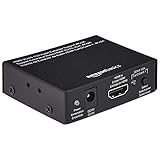
- 4K@30Hz HDMI to HDMI audio extractor converter box in durable metal housing
- Supports HDMI source devices without dedicated audio output
- Supports two channel left-right or SPDIF stereo output and uncompressed and compressed audio
- Supports up to 4k video resolution; 8-bit 4K (30 Hz), 12-bit 1080p (60 Hz), or 12-bit 720p/1080i (60 Hz), plus 3D formats
- Compatible with devices such as Blue-ray, DVD/HD/DVR players, cable/satellite, PS3/4, Xbox, PC/laptop, HD cameras and more
It works on laptop speakers but disappears over HDMI
The OEM may license DTS:X Ultra only for the built-in speaker endpoint. Alternatively, the HDMI sink may report stereo or conventional PCM, or the GPU audio driver may expose a separate endpoint without the DTS integration. This behavior is common enough that a working laptop-speaker mode should not be treated as proof of HDMI support.
Outdated Drivers Are Slowing You Down
One free scan finds every outdated or missing driver and matches the right update for your exact hardware.Free scan · exact hardware matchPC Slower Than It Used to Be?
A free scan shows the junk files, broken settings and background clutter dragging Windows down - then fixes them in one click.Free scan · Windows 10 & 11The AVR says PCM instead of DTS:X
Possible explanations include Windows spatial rendering followed by PCM output, an application that is not passing through a DTS bitstream, or an HDMI negotiation that selected PCM. Multichannel PCM can still provide discrete surround channels when the source and receiver agree on the layout; it simply does not preserve a DTS:X identification for the receiver to decode.
There is no sound after selecting DTS
- Recheck the selected Windows output and AVR input.
- Confirm the TV or receiver firmware is current.
- Disconnect and reconnect HDMI to force a new capability handshake.
- Disable the setting and test ordinary stereo PCM.
- Check whether the application is using a different output device.
ARC is connected but DTS:X does not work
ARC has less bandwidth and more format restrictions than eARC. A television may decode a format internally but refuse to pass it from an HDMI source to an external audio device. For a reliable home-theater path, direct PC-to-AVR or PC-to-soundbar wiring is often preferable.
DTS:X Ultra sounds worse
- Compare processing bypassed and enabled at matched volume.
- Disable other Windows, OEM, Dolby, or receiver enhancements so effects are not stacked.
- Try the OEM’s Music, Movie, Game, and Voice profiles separately.
- Update or reinstall the manufacturer’s audio driver.
Microsoft notes that audio enhancements can cause distortion and recommends disabling them while troubleshooting in its distorted or crackling audio guidance.
Independent reader supportYour contribution helps us test, update, and keep practical guides available for everyone.Choosing DTS:X Ultra, Windows Sonic, Dolby Atmos, or receiver processing
Choose DTS:X Ultra when
- Your laptop or PC already includes a licensed DTS implementation.
- You primarily want wider or more positional sound from built-in speakers or headphones.
- Your games and applications benefit from Windows spatial rendering rather than receiver decoding.
Choose Windows Sonic when
You want a built-in Windows baseline for headphone spatial audio without buying a DTS license. Microsoft lists Windows Sonic alongside DTS Sound Unbound and Dolby Access in its spatial-sound guidance.
Recommended Free Tools
Best Value
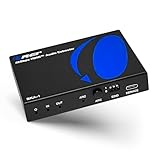
- 8K HDMI Audio Extractor: Designed to extract audio from any HDMI-compliant source and convert it to Optical (S/PDIF) or high-quality stereo 3.5mm audio output. Input: 1× HDMI | Output: 1× HDMI ARC, 1× L/R Audio Out, 1× Optical Out (S/PDIF).
- DOES NOT SUPPORT eARC: Supports video pass-through up to 8K @ 50/60Hz, 4K @ 120Hz (YUV 4:4:4), 4K @ 30Hz, 1080P @ 120Hz, and 1080P 3D @ 60Hz. HDMI 2.1 protocols supported — ALLM, QMS, QFT, SBTM, HLG Pass-through, Dolby Vision, HDR, HDR+. Supported Audio: LPCM 2/5.1/7.1CH, Dolby Digital, DTS 5.1, Dolby Digital+, Dolby TrueHD, DTS-HD Master Audio, Dolby Atmos, DTS:X.
- High Bandwidth & ARC Support: Supports 48 Gbps FRL and 18 Gbps TMDS video bandwidth. Features HDMI High Bit Rate (HBR) audio pass-through and CEC bypass. HDMI 2.1 | HDCP 2.3 | DVI Compliant | Supports ARC. NOTE: Volume cannot be controlled using the TV’s remote. The device comes with a dual voltage supply using a US plug, and an adapter/converter is provided for international use.
- HDMI 2.1 Cable Required: HDMI Input supports Computer, Laptop, PS5, PS4, PS3, Xbox, Blu-ray DVD Player, and STB devices. HDMI Video Output supports Projectors, HDTVs, Monitors, and Screens. Heavy-duty metal enclosure ensures efficient heat dissipation and durability; compact size allows easy plug-and-play installation.
- Package Includes: 100-240V 50/60 Hz auto-switching power supply (worldwide use), HDA-913 Audio Extractor, User Manual, Lifetime OREI Tech Support, and 12-Month Manufacturer’s Warranty.
Consider Dolby Atmos when
You specifically need Dolby Atmos for Headphones or a compatible HDMI home-theater workflow and are prepared to use Dolby Access and its licensing. Microsoft presents Dolby Access as an alternative spatial-audio application; neither brand is universally superior because endpoint, content, and receiver support decide the result.
Use receiver upmixing when
You already own an AVR and want it to create an immersive presentation from stereo or PCM. DTS Neural:X, Dolby Surround, and manufacturer modes are receiver-side processing and are not equivalent to receiving native DTS:X object metadata.
Use application passthrough for authored movie soundtracks
A compatible local media player may pass an existing DTS or DTS:X soundtrack directly to an AVR. That is a separate source-to-receiver bitstream path, not the same as applying DTS:X Ultra rendering to ordinary Windows application audio. Player, driver, operating-system, and HDMI-chain support must be checked individually.
Bottom line
DTS:X Ultra is best understood as a Windows/OEM spatial-processing layer, not as a universal HDMI codec or guaranteed home-theater passthrough feature. It can improve the perceived positioning of laptop speakers and headphones and may send processed audio to an HDMI endpoint. For native DTS:X on an AVR or soundbar, verify the complete chain—application, Windows mode, OEM license, audio and GPU drivers, HDMI endpoint, TV or eARC path, and receiver—then confirm the receiver’s actual input indicator. An HDMI connection alone is not proof that a DTS:X bitstream is being delivered.
Quick Recap
Product prices and availability are accurate as of the date/time indicated and are subject to change. Any price and availability information displayed on Amazon at the time of purchase will apply.

