
What’s actually slowing this PC down?
Pick the symptom - the matching free tool is one click away.
Automation will transform farming gradually, not by replacing farmers overnight. Guidance systems, automated milking, crop sensors and precision application already handle defined tasks; the next wave will connect those tools with computer vision, AI and robots. The most realistic near-term model is supervised autonomy: machines carry out bounded jobs while people monitor them, manage exceptions and make decisions about crops, animals and risk.
What counts as farm automation?
Automation is not synonymous with a driverless tractor. It spans a continuum from machines that provide physical power to systems that sense conditions and act with limited human control.


- Mechanization: Tractors, combines, pumps and mechanical weeders provide power, but people direct the work.
- Automated assistance: Software handles a function while an operator remains in control, as with autosteer, section control, yield mapping or greenhouse climate regulation.
- Robotics: A machine senses its surroundings and performs a specialized physical job, such as milking, weeding or sorting.
- Autonomy: A machine plans and carries out a defined operation with limited direct control, generally under supervision and within set conditions.
“Autonomous” usually means capable within a particular task, field, route, crop and safety protocol—not able to run a whole farm independently. USDA describes the wider technology mix as sensors, information technology, precision agriculture and robotics intended to improve farm profitability, efficiency, safety and environmental performance (USDA National Institute of Food and Agriculture).
Why farms are adopting automation
Farm work is constrained by short planting and harvest windows, labor availability, rising input costs and unpredictable weather. Automation can improve timing and repeatability, reduce physically demanding work, and help one operator oversee more equipment. Sensors can also make it easier to detect crop stress, equipment faults or animal-health changes before they become larger problems.
#1 Best Overall
These advantages do not make every technology worthwhile. A system has to solve a real bottleneck, work reliably in local conditions and earn back its full cost. The FAO’s review of 22 case studies identifies cost, skills, infrastructure, connectivity, electricity and data policy as important conditions for adoption (FAO review of agricultural automation).
Which farm tasks will change first?
Automation is most mature where tasks are repetitive, measurable and performed in structured environments. The table describes relative readiness, not a guarantee that a particular product is available or economical for every farm.
| Readiness | Tasks and examples | Why it fits—or what holds it back |
|---|---|---|
| Higher | Tractor guidance and steering; field mapping; seed placement and section control; variable-rate application; robotic milking; livestock monitoring; greenhouse climate and irrigation control; grain storage monitoring; recordkeeping and equipment telematics | These jobs are relatively structured and produce measurable data. Adoption still varies by crop, farm and equipment. |
| Developing | Autonomous tillage; precision spraying; mechanical vegetable weeding; feed pushing; robotic scouting; sorting and grading; orchard mowing; irrigation scheduling | Performance depends more heavily on crop, field layout, terrain, weather, connectivity and service support. |
| Hardest to generalize | Harvesting delicate fruit; work in irregular fields or mixed crops; repairs; strategic crop choices; complex disease, weather, market and animal-welfare judgments | Conditions vary and exceptions matter. Harvesting robots must identify produce, judge ripeness, avoid damage and work fast enough to compete economically. |
USDA adoption data show how uneven progress can be: automated guidance has been used on more than half the acreage planted to several major U.S. crops, while variable-rate technology, soil maps and yield maps have been less widespread for several crops. These are crop- and survey-period-specific findings, not a measure of every farm or technology (USDA Economic Research Service adoption data).
How sensors and AI turn information into action
Farm technology increasingly links a sense–decide–act loop: sensors or cameras collect information; software classifies a condition; a person or system chooses a response; machinery acts; and the result is recorded. AI may help detect weeds, pests, nutrient stress, disease or unusual animal behavior; forecast yields and harvest timing; schedule irrigation; plan routes; predict equipment failures; and combine satellite, drone, weather, soil and machine data into field-specific recommendations.
PC Slower Than It Used to Be?
A free scan shows the junk files, broken settings and background clutter dragging Windows down - then fixes them in one click.Free scan · Windows 10 & 11Outdated Drivers Are Slowing You Down
One free scan finds every outdated or missing driver and matches the right update for your exact hardware.Free scan · exact hardware matchAdvice is not the same as execution
- Decision support recommends where or when to act.
- Automated execution makes a machine perform an operation.
- Closed-loop automation senses conditions, decides, acts and checks the result.
An AI recommendation is not automatically correct. Poor calibration, unusual weather, unfamiliar varieties, low-quality images, sensor faults or training data that do not represent local conditions can produce errors. Human review remains important, especially where a wrong action could harm a crop, animal or worker.
Rank #2
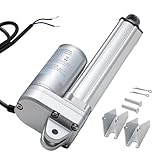
- IP65 Superior Protection: Rated IP65 for excellent dust and water resistance, VEVOR 12V linear actuator delivers dependable performance in outdoor environments. Suitable for door openers, lawn mowers, solar panel tracking systems, irrigation systems, etc
- Strong Torque Output: 675lbs (3000N) powerful torque output excels in various demanding tasks like agricultural machinery, construction equipment, and industrial automation, ensuring reliable performance in medium-load applications
- Durable and Sturdy: Featuring an aluminum alloy housing and precision screw drive, the 12V linear actuator offers enhanced wear resistance and long-lasting stability. Operating under 65 dB (no-load noise) to reduce vibration and jamming during frequent cycles
- Versatile Applications: Our linear motion actuator integrates across a wide range of applications, from furniture and home automation to industrial systems, mechanical equipment, transportation, and beyond. Empower automation at every step
- Key Specifications: Travel Speed: 0.2"/s (5 mm/s); Stroke Length: 4" (101.6 mm); Extended Length: 13" (330.2 mm); Retracted Length: 9" (228.6 mm); Current Draw: 6 Amps; Input Voltage: DC 12V; Duty Cycle: 25%
Where specific technologies are headed
Tractors and field machinery
Guidance and autosteer are established forms of assistance. More capable systems can automate repeatable operations such as tillage, while remote monitoring lets an operator supervise equipment and respond to alerts. John Deere describes its autonomous tillage system as using 360-degree cameras, onboard processing, AI, field data and remote monitoring; those are manufacturer descriptions, and the system is limited to supported configurations rather than unrestricted autonomy (John Deere autonomous tractor). Availability, supported implements and order status can change, so buyers should confirm them for their location and equipment.
Autonomy can extend work into narrow weather windows and reduce fatigue, but obstacles, dust, mud, poor visibility, boundary errors, connectivity interruptions and implement compatibility remain practical concerns. A stopped machine still needs someone able to diagnose and recover it.
Precision spraying and mechanical weeding
Computer vision can identify plants so a system can target individual weeds rather than treat an entire field uniformly. The sense-and-act sequence is to capture images, classify plants, choose chemical or mechanical treatment, apply it and record the result. John Deere says its See & Spray Ultimate uses 36 cameras to distinguish crops from weeds and selectively spray; this is a manufacturer claim, not an independent estimate of typical chemical savings (John Deere See & Spray description).
The Tool Desk
Outbyte PC Repair FREERepair Windows errors before they cause bigger problemsFix Now →Outbyte Driver Updater FREEScan for outdated or missing drivers - takes under a minuteDriver Scan →Drones and crop monitoring
Drones are generally more mature as data-collection tools than as fully autonomous treatment systems. They can support stand counts, crop-stress mapping, irrigation inspection and checks of livestock or infrastructure. Turning images into a useful prescription still takes interpretation, and operations may be constrained by weather, battery life, aviation rules, operator certification, privacy concerns and data handling.
Greenhouses and controlled environments
Greenhouses are comparatively automation-friendly because temperature, humidity, light and irrigation can be controlled in a bounded space. Automation can extend to seeding, transplanting, conveyors, crop monitoring, harvest assistance, packing and grading. The trade-off is a greater dependence on buildings, energy, climate-control systems and capital rather than simply land and outdoor weather.
Livestock and dairy
Automated milking, feeding and feed pushing, barn climate control, weighing, heat detection, calving alerts, health monitoring and manure handling can provide more frequent information about individual animals. That can improve the chance of spotting a problem early, but sensors can raise false alerts and equipment failures can quickly become animal-welfare issues. Farmers remain responsible for intervention, maintenance and emergency response.
A January 2026 USDA Economic Research Service analysis associated robotic milking or multiple precision-dairy technologies with an average 13% increase in net returns among the U.S. dairy operations studied. A related ERS summary reported average increases of $3.15 per hundredweight for robotic milking and $3.18 per hundredweight for farms using more than one type of precision-dairy technology, compared with nonadopters (ERS analysis; ERS summary chart). These are average estimates, not guaranteed paybacks; adoption may also be associated with farm size, management, herd characteristics, financing or other differences.
Robotic harvesting
Harvesting remains difficult to automate broadly, especially for delicate fruit. A robot must locate produce that may be hidden by leaves, distinguish ripeness and size, grasp it without bruising, adapt to different plants and work at commercially useful speed. Targeted commercial applications are possible, but a successful demonstration in one crop or setting does not establish reliable economics across varieties, fields and seasons.
What automation means for farm workers
Automation is more likely to change tasks and skill requirements than eliminate the need for people across agriculture. Repetitive field work may require fewer workers, while equipment supervision, diagnostics, calibration, repairs, mapping, data management and agronomy become more important. Some workers may face displacement, and new technical roles will not necessarily arise in the same place or be accessible to the same people without training.
Machines can reduce exposure to heat, chemicals, heavy equipment and repetitive physical strain. They can also let one operator oversee multiple machines, improving output per worker while keeping a human responsible for exceptions. The OECD–FAO outlook expects mechanization to improve the timeliness and efficiency of planting and harvesting and to facilitate labor reallocation within agriculture and into other work; it also notes that small farm sizes, limited market access and weak infrastructure can constrain adoption in lower-income regions (OECD–FAO Agricultural Outlook 2026–2035).
Rank #4

- Steel Material: Made of advanced bearing steel, and after special heat treatment, the advanced manufacturing equipment and technology greatly increase the service life of the bearings. It can save costs for equipment with high requirements and difficult to disassemble.
- Main Application: This linear ball bearings'main function is to support the mechanical rotating body, reduce the friction coefficient during its movement, and ensure its rotation accuracy.
- High Speed: High bearing accuracy, fast running speed, low friction torsion, good rotation. The bearings runs with low noise.
- Wide Application: The linear ball bearings is widely used in EPE equipment, agricultural machinery, robots, robotic arms, construction machinery, manipulators, accuracy instruments, factory equipment, engraving machines, 3D printers, textile machinery, automation equipment, etc.
- Specification: This linear ball bearing has a 80mm width, 60mm outer diameter, 40mm inner diameter. Provide you with an accurate choice.
Will automation make food cheaper or farms more profitable?
It may reduce selected production costs, but neither lower food prices nor higher farm profits follows automatically. Less labor for repetitive jobs, fewer overlaps during spraying, optimized routes, lower input losses, better use of weather windows and earlier animal-health interventions can improve productivity. Against those gains are equipment purchase and financing, software and connectivity, training, maintenance, specialist service, downtime, insurance, data integration and cybersecurity costs.
Do these 3 things before closing this tab:
1Repair Windows errors before they cause bigger problems2Scan for outdated or missing drivers - takes under a minute3Clear out junk files and repair common Windows errors- Gross productivity is output per worker or machine.
- Net farm profitability is revenue after labor, equipment, financing, maintenance, software and other operating costs.
- Consumer food prices also depend on processing, transport, energy, trade, retail and market power.
Productivity gains may be absorbed by capital costs, land prices, financing or competition rather than passed to consumers. A farm’s decision is better judged by total cost of ownership, break-even acreage and a downside scenario than by a generic promise of savings.
Can automation make farming more sustainable?
Precision tools can help apply fertilizer where it is needed, spray individual weeds, avoid unnecessary passes, detect irrigation leaks, match water to soil and crop conditions, and identify animal illness earlier. Smaller or lighter machines may reduce compaction in some operations. These are opportunities, not automatic environmental outcomes: results depend on calibration, farmer decisions, field conditions and what happens to total production.
Automation can also add energy demand, battery and electronic waste, and manufacturing impacts. If efficiency makes expansion more profitable, total resource use can rise; cheaper or easier spraying could also increase total acres treated. Heavy autonomous equipment can compact soil, and standardized machinery may reinforce uniform cropping systems.
The OECD–FAO outlook projects global agricultural production to grow 13% from 2026 to 2035 and direct agricultural greenhouse-gas emissions to rise about 6% over that period. These global projections do not show that automation causes emissions to rise; they illustrate why greater productivity alone does not guarantee an absolute reduction in environmental impact (OECD–FAO Agricultural Outlook 2026–2035).
Best Value

- Ultra Heavy Duty - The PA-HD3 heavy duty linear actuator provides the highest force ratings in our line up and static waterproof capabilities in a ball screw design
- High Performance - The stainless steel shaft, accompanied by metal gears, allows it to push and pull up to 3822 lbs and hold up to 4496 lbs; as a linear actuator with manual override, users can still change stroke positions in the event of an electrical power outage
- Durable Protection - The IP67 linear actuator's ingress protection rating provides a versatile unit able to withstand exposure to dust and water submersion while static in harsh environments
- Use Cases - This ultra high-force linear actuator has the durability and protection ratings for use cases in industries such as agricultural machines and equipment, manufacturing, and industrial machinery, construction, factory, industrial electric lifting system, mechanical equipment, medical devices, gate opener, petroleum machinery, power generator, rv sewage drain gate, smart automation, snow blower, solar tracker, electric power transportation, and many others
- Top Quality - Progressive Automations is ISO 9001:2015 certified and committed to bringing top quality in all our linear actuators and accessories to ensure the durability and performance that serves you well over the years
Will small farms be left behind?
Capital-intensive systems can favor large operations that spread fixed costs over more acres or animals. Small farms may have lower utilization, irregular or fragmented fields, less access to financing and fewer nearby repair options. Yet farm size is not destiny: access models can matter as much as machine design.
| Access model | How it can help | What to check |
|---|---|---|
| Ownership | Full control and availability when needed | Utilization, financing, upkeep and resale risk |
| Leasing | May reduce the initial capital outlay | Term, service, software fees and end-of-lease obligations |
| Cooperative ownership | Shares capital cost across farms | Scheduling, governance, maintenance and liability |
| Custom hire or contractor | Pay for a service without owning the machine | Availability during peak windows, quality and service terms |
| Robotics-as-a-service | Can make specialized equipment available by use | Coverage area, contract, data access and fallback arrangements |
| Dealer service or public programs | Can add technical support or help lower adoption barriers | Eligibility, local availability and continuing costs |
Shared equipment, rental, custom-hire services, cooperatives, lower-cost sensors and mobile tools may broaden access. But these options do not remove the need for connectivity, electricity, compatible equipment, technical support and clear data policies.
How automation may reshape the farm business
A machine that saves labor can also make it economical to operate more land with fewer people. Large farms may gain an advantage by spreading fixed costs across more acres, while dealers and contractors may become more important as service providers. Software platforms can become influential because they connect machines, maps and operating records. These are possible structural effects, not an inevitable path to consolidation: specialty farms may use targeted robots, and smaller operations may cooperate or buy services instead of owning fleets.
Efficiency can also create dependence on software, electricity, satellite signals, cloud platforms and specialized parts. Precision and monitoring bring questions about worker surveillance, animal records, yield and land data, commercial confidentiality, and access by vendors, lenders, insurers, processors or governments. Buyers should understand who can access operational data and whether it can be exported before committing to a system.
Free tools Windows power users keep installed
One-click scans. No signup required.
What to check before adopting farm automation
- Identify the bottleneck. Decide whether the problem is labor availability, narrow work windows, input expense, crop damage, operator fatigue, animal health or poor visibility. Do not buy a system without a defined job to do.
- Estimate utilization. Calculate acres and hours per season, number of crops and fields, idle time, and whether custom-hire work or multiple tasks could raise use.
- Model total cost. Include purchase or lease, financing, software, connectivity, service, maintenance, sensors, batteries or fuel, insurance, training, downtime, integration, depreciation and resale value.
- Verify compatibility. Confirm tractor and implement models, crop and row spacing, boundaries, terrain, GNSS requirements, connectivity, weather limits and data-export options.
- Plan for failure and intervention. Establish what happens if cameras are dirty, GPS or cellular service drops, a sensor misclassifies a plant, an implement clogs, or a machine stops overnight. Decide who responds and how work continues safely.
- Protect operational independence. Ask who owns and accesses field and machine data, whether it can be exported, whether equipment depends on a subscription, what happens if a vendor exits, and what cybersecurity controls are available.
- Keep a manual fallback. Maintain emergency shutdown procedures, spare parts, local diagnostic capability and a way to complete or safely pause the operation if connectivity, software or equipment fails.
Before a commitment, compare ownership with leasing, shared use and hired services. A demonstrated machine is not proof of commercial reliability, support availability or a viable payback on a particular farm.
The likely future: supervised autonomy
Farms will increasingly combine people, machines and software rather than hand the entire operation to robots. Guidance, sensing and automation will take over more defined, repetitive jobs; people will still handle exceptions, maintenance, safety, biological judgment and strategy. How far that shift goes will depend less on futuristic capability alone than on whether a system fits a crop, earns its cost, has dependable support and leaves the farm resilient when technology fails.
Quick Recap
Product prices and availability are accurate as of the date/time indicated and are subject to change. Any price and availability information displayed on Amazon at the time of purchase will apply.

