
What’s actually slowing this PC down?
Pick the symptom - the matching free tool is one click away.
For the same fan, CFM is approximately proportional to fan RPM when air density and operating conditions are comparable. A 10% speed increase therefore predicts roughly 10% more airflow—but RPM alone cannot tell you how much air a fan will deliver. Static pressure, system resistance, fan design, and equipment limits all matter.
What CFM and RPM measure
CFM means cubic feet per minute: a measure of volumetric airflow. RPM means revolutions per minute: a measure of rotational speed. RPM describes how fast a fan turns; CFM describes the volume of air it moves. They are different quantities, and there is no universal conversion between them.
This article uses CFM to mean airflow, not CFM International aircraft engines. Specifications may use CFM generically; in technical work, check whether airflow is stated as actual CFM (ACFM) at operating conditions or standard CFM (SCFM) corrected to defined reference conditions. They are not interchangeable without knowing those conditions.
The CFM-to-RPM formula
For a given fan, the first fan affinity law estimates airflow at a new speed as:
The Tool Desk
Outbyte PC Repair FREERepair Windows errors before they cause bigger problemsFix Now →Outbyte Driver Updater FREEScan for outdated or missing drivers - takes under a minuteDriver Scan →#1 Best Overall
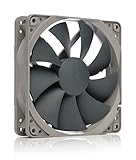
- High performance cooling fan, 120x120x25 mm, 12V, 4-pin PWM, max. 1700 RPM, max. 25.1 dB(A), >150,000 h MTTF
- Renowned NF-P12 high-end 120x25mm 12V fan, more than 100 awards and recommendations from international computer hardware websites and magazines, hundreds of thousands of satisfied users
- Pressure-optimised blade design with outstanding quietness of operation: high static pressure and strong CFM for air-based CPU coolers, water cooling radiators or low-noise chassis ventilation
- 1700rpm 4-pin PWM version with excellent balance of performance and quietness, supports automatic motherboard speed control (powerful airflow when required, virtually silent at idle)
- Streamlined redux edition: proven Noctua quality at an attractive price point, wide range of optional accessories (anti-vibration mounts, S-ATA adaptors, y-splitters, extension cables, etc.)
CFM₂ = CFM₁ × (RPM₂ ÷ RPM₁)
To estimate the fan speed needed for a target airflow, rearrange it:
RPM₂ = RPM₁ × (target CFM ÷ current CFM)
These are estimates for the same fan under comparable conditions, not guarantees of measured field airflow. For example, a fan delivering 1,000 CFM at 800 RPM would ideally need to turn at 1,000 RPM to reach 1,250 CFM: 800 × (1,250 ÷ 1,000) = 1,000 RPM.
Quick estimates for speed changes
The table applies the affinity-law ratios to the same fan. Values are theoretical multipliers, not promises about delivered airflow or equipment capability.
Rank #2

- HIGH STATIC PRESSURE: Efficient even with resistance – the generated airflow easily penetrates dense radiators, narrow perforated panels and mesh structures and ensures reliable cooling
- PWM CONTROL WITH WIDE SPEED RANGE: The speed can be progressively adjusted up to 3000 rpm via the 4-pin PWM connection – the fan stops completely at less than 5% PWM
- PRECISE MANUFACTURING FOR MAXIMUM SMOOTH RUNNING: Minimal gaps, automatic balancing and high-precision measurement noticeably reduce vibrations – for quiet, efficient and long-lasting performance
- SMOOTH-RUNNING FLUID DYNAMIC BEARING (FDB): The self-lubricating bearing minimizes noise during operation – ideal for quiet, efficient cooling and a long, reliable service life
- NEW FAN BLADE DESIGN FOR MORE PERFORMANCE: The redesigned rotor blades offer an optimal balance of performance and low noise – especially efficient at low speeds
| RPM change | CFM multiplier | Static-pressure multiplier | Brake-horsepower multiplier |
|---|---|---|---|
| 5% | 1.05 (5% increase) | 1.1025 (about 10.3% increase) | 1.1576 (about 15.8% increase) |
| 10% | 1.10 (10% increase) | 1.21 (21% increase) | 1.331 (about 33.1% increase) |
| 20% | 1.20 (20% increase) | 1.44 (44% increase) | 1.728 (72.8% increase) |
| 25% | 1.25 (25% increase) | 1.5625 (about 56.3% increase) | 1.9531 (about 95.3% increase) |
Why pressure and power rise faster than airflow
The fan affinity laws relate speed to three performance measures: airflow changes roughly in proportion to RPM, static pressure to the square of RPM, and brake horsepower (BHP) to the cube of RPM. The pressure and power estimates assume the fan-law conditions hold; actual electrical consumption also depends on motor and drive efficiency.
Outdated Drivers Are Slowing You Down
One free scan finds every outdated or missing driver and matches the right update for your exact hardware.Free scan · exact hardware matchWindows Errors? Fix Them Before They Spread
Repair common Windows errors and clear accumulated junk for a smoother, more stable PC - no reinstall needed.Free scan · no reinstallFor a 25% speed increase, the ratios are 1.25 for airflow, 1.25² = 1.5625 for static pressure, and 1.25³ = 1.9531 for BHP. So a fan starting at 0.50 in. w.g. would have a calculated pressure of about 0.78 in. w.g.; one starting at 2 HP would have calculated BHP of about 3.91 HP. Those increases can exceed the capacity of the motor or the safe limits of the fan. Johnson Controls explains the fan relationships and fan-speed interpretation; Greenheck’s performance guide provides a worked example and operating-limit cautions.
Why actual airflow can differ from the estimate
A fan operates at the point where its performance curve meets the system’s resistance curve. Ducts, filters, coils, grilles, dampers, elbows, leakage, and undersized openings affect that resistance. Raising fan speed changes the fan’s available performance, but it does not remove restrictions in the system. At the same RPM, a fan can deliver less CFM against higher resistance.
Rank #3
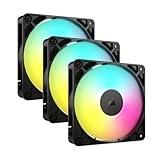
- Streamlined Fan Connections: Daisy-chain multiple fans together and control them all through just one 4-pin PWM connector and one +5V ARGB connector.
- Lighting Made Easy: Eight LEDs per fan shine bright with customisable lighting through your motherboard’s built-in ARGB control (requires compatible motherboard).
- Precise PWM Speeds: Set your fan speeds up to 2,100 RPM while providing up to 72.8 CFM airflow to your system.
- CORSAIR AirGuide Technology: Anti-vortex vanes direct airflow at your hottest components for concentrated cooling, pushing air in the direction you need when mounted to a radiator or heatsink.
- High Static Pressure: RS fans work well as radiator fans with a static pressure of 2.8mm-H2O to push through obstructions.
The simple calculation assumes the same fan diameter and geometry, comparable air density, a comparable operating region, and a system condition for which the fan laws are appropriate. Changes in temperature, elevation, humidity, or gas composition can affect air density and performance. Manufacturer performance curves or tables are the better basis for equipment selection and system changes. See Greenheck’s guide to fan performance and North Carolina State University’s overview of fans and ventilation.
- Two different fans at the same RPM can have very different CFM because their diameters, blade or impeller geometry, housings, and fan types differ.
- A published maximum CFM may be a free-air rating at little or no static pressure. Do not treat it as the airflow available in a duct system at a specified pressure.
- A controller’s speed command or motor frequency is not necessarily a measurement of actual fan-shaft RPM. Motor slip and drive conditions can make actual speed differ.
Use fan RPM, not automatically motor RPM
In a direct-drive arrangement, the motor shaft and fan turn together, so their RPM is equal. In a belt-driven arrangement, the fan speed depends on the sheave ratio; using motor RPM as though it were fan RPM will produce a wrong estimate.
Quick wins for a faster PC:
Fix the driver behind crashes, sound loss and screen glitchesFind Drivers →Clear out junk files and repair common Windows errorsFree Scan →A rough belt-drive relationship is:
Fan RPM ≈ motor RPM × (motor-sheave diameter ÷ fan-sheave diameter)
Rank #4

- 【High Performance Cooling Fan】 Automatic speed control of the motherboard through the 4PIN PWM fan cable interface, which can determine the speed according to the temperature of the motherboard, with a maximum speed of 1550RPM. Configured with up to 55cm of cable for PWM series control of fans, ideal for cases and CPU coolers.
- 【Quality Bearings】The carefully developed quality S-FDB bearings solve the problem of pc cooling fan blade shaking in lifting mode, keeping fan noise to a minimum while providing maximum cooling performance when needed and extending the life of the fan.
- [Excellent LED light] The high-brightness LED atomizing argb fan blade can effectively reflect the light, making the ARGB lighting effect softer, and it matches the cooler and case more perfectly. Up to 17 modes of light effects with ARGB support, color can be managed and synchronized through the port on motherboard.
- 【Silent Fan Size】 Model: TL-C12C-S X5, Size: 120*120*25mm, Speed: 1550RPM±10%, Noise ≤ 25.6dBA Connector: 4pin pwm, Current: 0.20A, Air Pressure: 1.53mm H2O, Air Flow: 66.17CFM, Higher air flow for improved cooling performance.
- 【Perfect Match】The PC fan can be used not only as a case fan, but is also suitable for use with a cpu cooler to create a cooling effect together, which can take away the dry heat from the case and the high temperature generated by the CPU in operation, allowing for maximum cooling; Ideal for cases, radiators and CPU coolers.
Use effective sheave diameters and account for belt slip or gearbox ratios where applicable. Johnson Controls notes that fan-performance RPM refers to fan RPM, which equals motor RPM in direct-drive applications. Read its fan and airflow guidance.
Calculate a target speed, then verify it
Estimate the speed
- Start with a known operating point for the exact fan: measured or rated CFM and fan-shaft RPM at a stated pressure condition.
- Divide the target CFM by the known CFM, then multiply that ratio by the known fan RPM.
- Treat the result as a preliminary estimate. Do not assume it is a safe operating speed or that the system will deliver the target airflow.
For example, a system delivering 2,400 CFM at 900 fan RPM has an estimated target speed of 1,125 RPM for 3,000 CFM: 900 × (3,000 ÷ 2,400) = 1,125 RPM.
Check the fan curve and equipment limits
- Find the exact fan model and configuration in the manufacturer’s performance data.
- Determine the system’s required external static pressure or total pressure and locate the operating point for the target CFM.
- Read the corresponding RPM, horsepower, efficiency, and sound data from the curve or table.
- Confirm the operating point is within the manufacturer’s maximum speed and the limits of the motor, drive, bearings, impeller, and system.
Fan curves account for the actual design and pressure conditions more reliably than a speed-ratio calculation. For a published example, Greenheck calculates that a fan moving 10,000 CFM at 1,000 RPM, 1.50 in. static pressure, and 5 HP would need 1,250 RPM for 12,500 CFM; its calculated pressure is 2.34 in. w.g. and BHP is 9.77 HP, leading the guide to specify a 10 HP motor for that example. Greenheck’s guide describes the assumptions and limits behind the calculation.
Best Value

- 【High Performance Cooling Fan】 Automatic speed control of the motherboard through the 4PIN PWM fan cable interface, which can determine the speed according to the temperature of the motherboard, with a maximum speed of 1550RPM. Configured with up to 55cm of cable for PWM series control of fans, ideal for cases and CPU coolers.
- 【Quality Bearings】The carefully developed quality S-FDB bearings solve the problem of pc cooling fan blade shaking in lifting mode, keeping fan noise to a minimum while providing maximum cooling performance when needed and extending the life of the fan.
- [Excellent LED light] The high-brightness LED atomizing argb fan blade can effectively reflect the light, making the ARGB lighting effect softer, and it matches the cooler and case more perfectly. Up to 17 modes of light effects with ARGB support, color can be managed and synchronized through the port on motherboard.
- 【Silent Fan Size】 Model: TL-C12C-S X3, Size: 120*120*25mm, Speed: 1550RPM±10%, Noise ≤ 25.6dBA Connector: 4pin pwm, Current: 0.20A, Air Pressure: 1.53mm H2O, Air Flow: 66.17CFM, Higher air flow for improved cooling performance.
- 【Silent Fan Size】 Model: TL-C12C-S X3, Size: 120*120*25mm, Speed: 1550RPM±10%, Noise ≤ 25.6dBA Connector: 4pin pwm, Current: 0.20A, Air Pressure: 1.53mm H2O, Air Flow: 66.17CFM, Higher air flow for improved cooling performance.
When a simple calculation is—and is not—enough
- Useful for: a rough estimate, an initial feasibility check, or understanding how a speed adjustment may affect the same fan.
- Not enough for: choosing a replacement fan, sizing a motor or VFD, confirming code compliance, diagnosing delivered building airflow, comparing unrelated fan models, or authorizing operation above rated limits.
- For high-temperature, high-altitude, or process-air applications: use manufacturer data corrected for actual conditions rather than assuming air density is unchanged.
Troubleshoot a CFM result that does not match
- Check the speed basis: verify actual fan-shaft RPM rather than a motor nameplate rating, controller command, or nominal frequency.
- Check system resistance: inspect filters, coils, dampers, grilles, duct restrictions, and openings for blockage or incorrect settings.
- Check the drive: look for belt wear, incorrect sheave sizes, or slip that lowers fan speed.
- Check the airflow measurement: poor traverse location, turbulence, instrument setup, calibration, duct leakage, and missing temperature or pressure compensation can skew field readings.
- Check the comparison point: confirm that the published rating and field measurement refer to comparable pressure and airflow conditions, rather than comparing a free-air rating with ducted-system airflow.
For more on how fan performance relates to pressure and system conditions, see North Carolina State University’s ventilation reference and Greenheck’s fan performance guide.
What to check before increasing fan speed
Higher speed can provide more potential airflow, but it also raises pressure and required horsepower more quickly. Before changing an operating speed, check the manufacturer’s maximum RPM, motor and drive capacity, bearing and impeller limits, and the system’s pressure and structural limits. Noise, vibration, current draw, and mechanical stress may also rise; increasing speed is not a substitute for correcting a restriction or selecting a fan suited to the duty.
Fan-law assumptions and diameter or density qualifications are summarized in this engineering reference. For broader affinity-law context, see AMETEK Rotron’s fan-law reference and the U.S. Department of Energy/NREL fan-system guide.
Quick Recap
Product prices and availability are accurate as of the date/time indicated and are subject to change. Any price and availability information displayed on Amazon at the time of purchase will apply.

