
Free tools Windows power users keep installed
One-click scans. No signup required.
Edge-only anti-aliasing did not disappear as one technology. The name was used loosely for different techniques, and the one many PC gamers mean is MSAA, which is still available in some rendering paths. But smoothing polygon outlines is no longer enough for games whose aliasing also comes from materials, foliage, reflections, shadows, and motion. That broader problem shifted developers toward post-process and temporal methods such as FXAA, TAA, TSR, DLSS, FSR, and XeSS.
What does “edge-only anti-aliasing” mean?
It is an informal label, not the name of one universally adopted standard. It can refer to hardware sampling that concentrates on polygon coverage, a proprietary graphics feature, or an image-space filter that detects edges in the finished frame. Those methods work at different points in the rendering pipeline and do not fix the same artifacts.
| Method | What it samples or analyzes | Typical strength | Main limitation |
|---|---|---|---|
| SSAA (supersampling) | Multiple shaded samples or a higher-resolution render, then a downsample | Broad reduction of image aliasing | High shading, memory, and bandwidth cost |
| MSAA (multisampling) | Multiple raster coverage and depth samples; the pixel shader is commonly evaluated once per pixel | Geometric coverage edges | Does not fully sample shading, textures, or many transparent effects |
| FXAA | High-contrast features in the finished image | Low-cost cleanup after rendering | Can soften fine detail and has no direct knowledge of scene geometry |
| SMAA and related morphological methods | Image-space edge patterns | Sharper spatial filtering than a simple blur in suitable cases | Spatial filtering alone does not resolve temporal shimmer |
| TAA | Jittered samples accumulated across frames, using motion and history data | Temporal stability and several kinds of shading aliasing | Can ghost, smear, or lose fine detail |
| TSR, DLSS Super Resolution, FSR temporal methods, and XeSS | Temporal inputs plus reconstruction from a lower-resolution render | Anti-aliasing combined with upscaling | Quality depends on integration, motion data, hardware path, and implementation |
“Full-screen” is not the opposite of “edge-only.” FXAA may run as a full-screen pass while changing mainly pixels near detected edges. MSAA runs during rasterization but often concentrates its benefit at geometric coverage boundaries. The label describes neither a single algorithm nor a clean division between whole-image and edge-only processing.
Which older technique might you remember?
MSAA: the common edge-focused setting
In ordinary MSAA, the rasterizer tracks multiple coverage and depth samples within a pixel. The shader commonly runs once for a covered pixel, and the final color is resolved using the covered samples. That makes MSAA much less costly than shading every supersample, and effective at smoothing the outline where a polygon covers only part of a pixel.
#1 Best Overall

- 【INTEGRATED SPEAKERS】Whether you're at work or in the midst of an intense gaming session, our built-in speakers provide rich and seamless audio, all while keeping your desk clutter-free.
- 【EASY ON THE EYES】 Protect your eyes and enhance your comfort with Blue-Light Shift technology. This feature reduces harmful blue light emissions from your screen, helping to alleviate eye strain during long hours of use and promoting healthier viewing habits.
- 【WIDEN YOUR PERSPECTIVE】Our sleek minimal bezel design ensures undivided attention. The nearly bezel-free display seamlessly connects in a dual monitor arrangement, delivering an unobstructed view that lets you focus on more at once, completely distraction-free.
It is not full supersampling: a highlight, texture pattern, or other detail inside the polygon may still be shaded from insufficient samples. Unreal Engine’s anti-aliasing documentation makes this distinction explicitly: its MSAA path primarily addresses geometry edges, not aliasing from materials, textures, or transparent surfaces. The exact behavior can vary with custom sample-frequency shading or hybrid techniques.
Matrox Fragment Antialiasing and proprietary approaches
Some readers may recall Matrox Fragment Antialiasing (FAA), associated with its Parhelia graphics processor, or other vendor-specific line- or edge-based approaches. FAA was a hardware-specific branch, not a cross-vendor successor to MSAA. A historical AnandTech forum discussion distinguishes FAA from MSAA and describes FAA as largely tied to Parhelia, but that is secondary commentary rather than authoritative documentation of its internals. It should not be treated as the universal meaning of “edge AA.”
Other remembered options may have been driver controls or post-process injectors. Their shared use of “edge” does not mean they sampled geometry in the same way. A screen-space filter can detect a contrast boundary without knowing whether it came from a triangle, a texture, or a shader.
Rank #2

- QHD Resolution (2560 x 1440) has 1.7 times the pixel density of Full HD for incredibly detailed pinsharp images
- HDR10 provides brighter highlights and nuanced shadow for added depth - making every scene feel more vivid and realistic
- The 180Hz refresh rate minimizes lag for gameplay with ultra-smooth action. Plus, the 1ms response time helps capture your moves in real-time, allowing you to react fast for gaming precision
- AMD FreeSync reduces choppiness, screen lag and image tearing, ensuring that your fast-paced, complex in-game action is stable with minimal stutter
- Ergonomic stand allows for tilt, pivot and height adjustments to maximize gaming comfort
Why did MSAA lose its place as the default?
Deferred rendering makes broad MSAA more costly
A simplified forward path shades geometry as it is drawn. A deferred path first stores surface information—often depth, normals, and material attributes—in intermediate buffers, then performs lighting and later effects. To preserve multisample detail throughout a deferred pipeline, an engine may need multisampled G-buffers and more complex sample-aware lighting, resolves, and downstream passes. That increases storage and bandwidth demands and complicates effects such as transparency and screen-space processing.
Quick wins for a faster PC:
Scan for outdated or missing drivers - takes under a minuteDriver Scan →Repair Windows errors before they cause bigger problemsFix Now →Fix the driver behind crashes, sound loss and screen glitchesFind Drivers →This is a cost and implementation problem, not a mathematical impossibility. Engines can build specialized or hybrid multisample paths, but conventional, broad MSAA is harder to support efficiently in many deferred renderers. Epic’s mobile deferred documentation cites G-buffer space and the cost of shading samples rather than pixels as reasons its mobile deferred mode does not support MSAA.
Unreal Engine shows the renderer-specific trade-off
In Unreal Engine 5.8’s documented options, MSAA is associated with the Forward Renderer, while the Desktop/Console Deferred feature matrix lists TAA, FXAA, and TSR rather than MSAA. This is a renderer-specific example, not a rule that every deferred engine must make the same choice. Epic documents MSAA sample choices of 2x, 4x, and 8x where supported; availability depends on platform and rendering path.
Rank #3

- Smooth motion: 240Hz refresh rate and fast 0.5ms response time provide crisp visuals and fluid movement with less input lag.
- Seamless gaming: FreeSync Premium and HDMI VRR eliminate tearing for smooth, responsive PC and console gameplay.
- Fast IPS: Faster 0.5ms response with excellent color accuracy across wide IPS viewing angles.
- Rich color: 99% sRGB color coverage delivers vivid, detailed imagery with strong accuracy.
- Eye comfort: TÜV Rheinland 3‑star certified display lowers blue light while preserving color quality.
Epic’s Forward Renderer guidance also says TAA can be preferable in many scenes because it addresses geometric and specular aliasing. It identifies VR as a case where MSAA can be preferable: constant head-tracked subpixel motion can make temporal methods appear blurry. Epic reports an example test with an approximately 25% increase in GPU frame time from MSAA, while cautioning that actual cost depends on content; that figure is not a universal performance penalty.
The aliasing problem expanded beyond polygon outlines
MSAA can make a silhouette look clean while leaving other unstable details untouched. Modern scenes produce aliasing throughout the image:
Do these 3 things before closing this tab:
1Clear out junk files and repair common Windows errors2Fix the driver behind crashes, sound loss and screen glitches3Repair Windows errors before they cause bigger problems- Specular highlights and normal maps: small or high-frequency lighting changes can flicker as the camera moves.
- Foliage, fences, and particles: alpha-tested or transparent coverage often comes from textures and blending rather than ordinary opaque polygon boundaries.
- Shadows, reflections, and ambient occlusion: these effects have their own sampling limits and can shimmer or crawl.
- Distant geometry and small triangles: features can shrink below a pixel and appear or disappear between frames.
- Ray-traced effects: limited samples can create noise-like instability across surfaces and edges.
Only a portion of those problems is fundamentally a polygon-coverage edge. Fixing the rest may require better material filtering, temporal accumulation, more samples, or reconstruction rather than simply adding more coverage samples.
Rank #4

- 27” 240Hz 1500R Curved FHD 1080P Gaming Monitor for Game Play.
- Prioritizes Gaming Performance: Up to 240Hz high refresh rate, more immersive 1500R Curvature, FreeSync, MPRT 1ms Response Time, Black Level adjustment(shadow booster), Game Modes Preset, Crosshair.
- Cinematic Color Accuracy: 130% sRGB & DCI-P3 95% color gamut, 4000:1 contrast ratio, 300nits brightness, HDR, Anti-flicker; Anti-Glare.
- Plug & Play Design: HDMI & DP1.4 & Audio Jack(No built-in speakers), durable metal stand, tilt -5°~15, VESA 100*100mm compatible.
- Warranty: Money-back and free replacement within 30 days, 1-year quality warranty and lifetime technical support. Pls contact SANSUI service support first if any product problem.
What techniques took over?
FXAA: inexpensive screen-space filtering
FXAA examines the rendered image for high-contrast boundaries and blends nearby pixels. It is inexpensive, works naturally after deferred rendering, and can affect some texture or alpha-test edges that MSAA misses. But it cannot recover scene information that was never rendered, and its filtering can blur text, fine geometry, or high-frequency textures. Epic describes FXAA as a spatial-only post-process and cautions that image fidelity can be lower than other methods.
TAA: stability by combining frames
Temporal anti-aliasing typically jitters the projection to gather different subpixel samples over time, then reprojects and blends prior-frame information using motion vectors and history checks. It can reduce both geometric and shading aliasing, including some shimmer that a still screenshot hides. Its costs are temporal artifacts: history can trail moving objects, fail around newly uncovered regions, or soften detail. Missing or inaccurate motion vectors make those problems worse.
Temporal upscalers: anti-aliasing plus reconstruction
Unreal’s TSR, NVIDIA DLSS Super Resolution, AMD’s FSR temporal methods, and Intel XeSS occupy related territory: they use temporal information to reconstruct an output from a lower-resolution internal image. They are not interchangeable implementations, and results depend on the game’s integration, available motion data, hardware path, and settings. Epic describes TSR as reconstructing a higher-quality output from a significantly lower internal resolution; its documentation also lists DLSS, FSR, and XeSS as temporal-upscaling alternatives.
Best Value
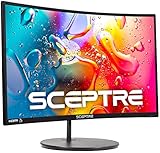
- 1800R curve monitor the curved display delivers a revolutionary visual experience with a leading 1800R screen curvature as the images appear to wrap around you for an in depth, immersive experience
- Hdmi, VGA & PC audio in ports
- High refresh rate 75Hz.Brightness (cd/m²):250 cd/m2
- Vesa wall mount ready; Lamp Life: 30,000+ Hours
- Windows 10 Sceptre Monitors are fully compatible with Windows 10, the most recent operating System available on PCs.Brightness: 220 cd/M2
NVIDIA’s DLSS 3.7 Unreal integration documentation also lists DLAA, an AI-based anti-aliasing mode aimed at image quality rather than rendering at a lower internal resolution. DLAA is therefore not simply another name for DLSS Super Resolution, even though the technologies share an ecosystem.
SSAA: broad coverage when the cost is acceptable
Supersampling renders more shaded information—through multiple subpixel samples or a larger image—and filters it down. Because it samples shading as well as coverage, it can improve more than polygon silhouettes. The trade-off is substantial rendering and storage cost, which makes it most practical when image quality matters more than frame rate, such as a static or cinematic scene with sufficient GPU headroom.
Independent reader supportYour contribution helps us test, update, and keep practical guides available for everyone.When is edge-focused AA still the better choice?
MSAA remains useful when the renderer exposes a forward path and the dominant defect is jagged opaque geometry. It can also suit VR, engineering visualization, or a relatively simple scene where crisp edges matter more than temporal reconstruction artifacts. Its advantage is clearest when materials are authored to limit specular aliasing and the scene has little troublesome transparency or post-processing.
For a game player, the available choice is usually determined by the game’s engine and renderer. A driver override may sometimes force a limited form of antialiasing, but it cannot generically recreate engine-level geometry data, multisampled G-buffers, motion vectors, or transparency handling. If a game offers only temporal AA or an upscaler, that is often a renderer design choice rather than proof that edge coverage sampling no longer exists.
Recommended Free Tools
How to choose among the options
- Try MSAA when a forward renderer offers it, polygon outlines are the main issue, and temporal softness is unacceptable.
- Try FXAA when performance and compatibility matter most and a modest loss of fine sharpness is acceptable.
- Try TAA or a temporal upscaler when foliage, specular effects, shadows, or subpixel shimmer dominate, or when the game renders below output resolution.
- Raise render scale or use SSAA when image quality is the priority and performance headroom is available.
Judge the result in motion as well as in a still frame: inspect a thin wire, moving foliage, a glossy highlight, a shadow edge, and a moving object against a newly revealed background. MSAA can win on a static polygon outline while losing on temporal shimmer; TAA can stabilize motion while softening detail. There is no universal best method because each answers a different sampling problem.
Bottom line
If “edge-only AA” means MSAA, it survived as a specialized geometry-edge technique, especially in forward rendering and some VR workloads. If it means Matrox-style proprietary edge hardware, that was a short-lived vendor-specific branch. What became common was not one replacement, but a family of spatial and temporal methods designed for deferred pipelines and images whose aliasing comes from much more than triangle boundaries.
Quick Recap
Product prices and availability are accurate as of the date/time indicated and are subject to change. Any price and availability information displayed on Amazon at the time of purchase will apply.

