
Use FFmpeg and limit video output to one frame. For a frame around 30 seconds in a local transport-stream file, run:
ffmpeg -ss 00:00:30 -i input.ts -frames:v 1 screenshot.jpgReplace input.ts with a UDP or other stream URL when the source is on the network. Use input-side -ss for speed, output-side -ss when frame placement matters more than startup time, and omit -ss on a live feed when you want the first decodable frame.
What you need
- FFmpeg, including its
ffmpegandffprobecommands, installed and available on your PATH. - Read access to the MPEG-TS file or stream URL.
- Write permission in the directory where the still image will be saved.
An MPEG transport stream can contain several programs, video PIDs, discontinuous timestamps, and long GOPs. FFmpeg normally chooses a video stream automatically, but inspecting the input first avoids capturing the wrong program.
ffprobe -show_programs -show_streams input.tsFor a network source, quote the URL so shell characters are not interpreted:
#1 Best Overall

- 【1080P 60FPS Video Capture Card】 This HDMI game capture card is based on USB3.0 high speed transmission port, input resolution up to 4K@30HZ, output resolution up to 2K@30Hz or 1920×1080@60Hz. Type c and USB interface can meet most of the devices in daily life. Easily meet the online capture, real-time recording, online meetings, live gaming and other functions, so you have a better visual enjoyment. Note: For capture use only; requires capture software to function and is not intended for direct screen casting to a monitor or TV
- 【Ultra Low Latency Screen Sharing】 HDMI capture card is made of good quality aluminum alloy with strong heat dissipation, allowing you to enjoy ultra low latency while live gaming or video recording or live streaming, avoiding blue screens and lag. This HDMI to USBC capture card supports easy recording of good quality audio or HD video and transferring it to your computer or streaming platform, allowing you to record 60 fps HD video directly on your hard drive and real-time preview
- 【Plug and Play, Easy to Carry】 This HDMI 1080P video capture card does not require any additional drivers or external power supply, just plug and play for fast capture. The capture card is small and lightweight, so you can put it in your bag for emergencies, making it very portable for outdoor live streaming. It's also a great way to share content in game recording, video conference, video recorder and online teaching
- 【Wide Compatibility USB Capture Card】 Easily streams to Facebook, Youtube or Twitch. With the connection, this HDMI to USB C/3.0 video capture devices can be working on several Operating Systems and various software: Windows 7/ 8/ 10, Mac OS or above, Linux, Android, Laptop, Xbox One, PS3/PS4/PS5, Camera, DVDs, Set Top Box, Webcame, DSLR, Switch/Switch 2, TV BOX, HDTV, Potplayer/VLC, ZOOM, OBS Studio etc.
- 【Package Content & Note】 1x HD Audio Capture Card , 1x USB 3.0 to USB C Adapter (A-side 3.0, B-side 2.0), 1x user manual. Please note that you need to restart the OBS Studio software after the audio setup is complete, otherwise it will result in no sound output. When using an adapter, if the device is recognized as USB 2.0, try using the other side with the USB-C port. Simply flip the capture card and reconnect it to be recognized as USB 3.0
ffprobe -show_programs -show_streams 'udp://HOST:PORT'Capture one frame at a timestamp
Local .ts file
This command seeks near 30 seconds, decodes as needed, and writes exactly one JPEG:
ffmpeg -ss 00:00:30 -i input.ts -frames:v 1 screenshot.jpg-frames:v 1 stops after one video frame. The output suffix selects the image format: .jpg creates a compressed JPEG, while .png preserves the decoded pixels without JPEG compression.
UDP or another network URL
ffmpeg -ss 00:00:30 -i 'udp://HOST:PORT' -frames:v 1 screenshot.jpgThe timestamp is meaningful only when the source and protocol provide seekable or usable timestamps. A live UDP sender generally cannot be rewound; in that case FFmpeg must receive packets from the point at which it joins the stream.
First available frame from a live feed
ffmpeg -i 'udp://HOST:PORT' -frames:v 1 live-shot.jpgThis waits until FFmpeg detects and decodes a video frame, then exits. A live source has no natural end, so always retain the process exit status and use an external timeout or supervisor if a stalled sender could otherwise leave the command running indefinitely.
What’s actually slowing this PC down?
Pick the symptom - the matching free tool is one click away.
Choose between fast and precise seeking
Input-side -ss: fast startup
Placed before -i, -ss seeks to the closest seek point before the requested position. With transcoding and accurate seeking enabled, FFmpeg decodes the intervening segment and discards it, so the emitted image can be close to the requested timestamp without decoding the entire file.
ffmpeg -ss 00:00:30 -i input.ts -frames:v 1 fast.jpgThis is usually the practical choice for thumbnails from a well-indexed file.
Output-side -ss: safer placement
Placed after the input, FFmpeg decodes from the beginning (or selected seek point) and discards frames until the target position. It can take longer, but is generally safer when an exact frame location matters:
ffmpeg -i input.ts -ss 00:00:30 -frames:v 1 exact.jpgFor a difficult or poorly indexed transport stream, combine output-side seeking with an explicit video mapping:
The Tool Desk
Outbyte PC Repair FREERepair Windows errors before they cause bigger problemsFix Now →Outbyte Driver Updater FREEScan for outdated or missing drivers - takes under a minuteDriver Scan →Rank #2

- 【1080P HD High Quality】Capture resolution up to 1080p for video source and it is ideal for all HDMI devices such as PS4, PS3, Xbox One, Xbox 360, Wii U, DVDs, DSLR, Camera, Security Camera and set top box. Note: Video input supports 4K30/60Hz and 1080p120/144Hz. Does not support 4K120Hz/144Hz. Output supports up to 2K30Hz.
- 【Plug and Play】No driver or external power supply required, true PnP. Once plugged in, the device is identified automatically as a webcam. Detect input and adjust output automatically. Won't occupy CPU, optional audio capture. No freeze with correct setting.
- 【Compatible with Multiple Systems】suitable for Windows and Mac OS. High speed USB 3.0 technology and superior low latency technology makes it easier for you to transmit live streaming to Twitch, Youtube, Facebook, Twitter, OBS, Potplayer and VLC.
- 【HDMI LOOP-OUT】Based on the high-speed USB 3.0 technology, it can capture one single channel HD HDMI video signal. There is no delay when you are playing game live.
- 【Support Mic-in for Commentary】Rybozen capture card has microphone input and you can use it to add external commentary when playing a game. Please note: it only accepts 3.5mm TRS standard microphone headset.
ffmpeg -i input.ts -map 0:v:0 -ss 00:00:30 -frames:v 1 exact-video.jpgDo not expect exact random access from a non-seekable live URL. For those sources, join the feed, wait for a decodable frame, and capture relative to the packets you actually receive.
Select the correct program and video stream
Digital TV and contribution streams can carry multiple programs. First inspect the program and stream indexes:
ffprobe -show_programs -show_streams input.tsThen map the desired video stream explicitly. The first video stream in the selected input is represented by 0:v:0:
ffmpeg -i input.ts -map 0:v:0 -frames:v 1 selected.jpgIf the desired video belongs to a particular program, use the stream information reported by ffprobe to choose its corresponding video stream. Explicit mapping also prevents an unrelated video PID from being selected when the container has several candidates.
Control format, dimensions and interlacing
PNG, JPEG and WebP
Choose the extension that matches your use case:
| Output | Typical reason | Example |
|---|---|---|
| PNG | Lossless stills, diagrams or pixel inspection | frame.png |
| JPEG | Smaller photographic thumbnails | frame.jpg |
| WebP | Compact web delivery when supported by your consumer | frame.webp |
Resize during capture
Add a video filter when a full-resolution frame is unnecessary. A height of -1 keeps the aspect ratio:
ffmpeg -ss 00:00:30 -i input.ts -frames:v 1 -vf 'scale=1280:-1' -q:v 2 screenshot.jpgFor JPEG output, lower quality-number values generally request higher quality. Test the setting against your storage and delivery requirements rather than assuming one value is ideal for every source.
Interlaced video
An interlaced source can show comb-like motion lines in a still. Deinterlace only when those artifacts are visible, because the filter changes the pixels:
ffmpeg -i input.ts -frames:v 1 -vf 'yadif' deinterlaced.pngFor a sequence of deinterlaced thumbnails, combine filters such as yadif,fps=1.
Recommended Free Tools
Rank #3
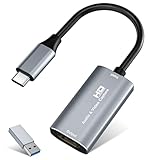
- 【4K HDMI Input, 2K@30Hz Recording】Powered by a true USB 3.0 high-speed interface, the capture card supports up to 4K@30Hz HDMI input and records at 2K@30Hz or 1080P@60Hz. Perfect for gamers, streamers, and professionals who need crisp, smooth video for live streaming, gameplay recording, or online meetings.
- 【Ultra Low Latency Screen Sharing】Built with a premium aluminum alloy shell and advanced chipset for stable heat dissipation, ensuring ultra-low latency transmission. Capture high-quality video and dual-channel audio in real time—no lag, no frame drop—ideal for Twitch, YouTube, or OBS streaming.
- 【Easy Plug and Play, Compact & Portable】No driver or external power required—just plug and play via USB 3.0 or Type-C connection to your Windows or macOS computer. Lightweight and compact design makes it easy to carry for outdoor streaming, live shows, or mobile recording setups.
- 【Wide Compatibility & Multi-Device Support】Compatible with Windows 7 8 10 11, macOS, Linux,Android and supports most popular software such as OBS, Zoom, VLC, Twitch Studio, and more. Works seamlessly with PS4, PS5, Xbox, Switch, DSLR cameras, TV boxes, and other HDMI-output devices for streaming to YouTube, Twitch, etc.
- 【What You Get】Includes: HDMI Capture Card, USB 3.0 to USB-C Adapter, User Manual. Tips: Make sure your tablet’s OTG function is enabled before connecting. Test your HDMI device with a monitor first to confirm video and audio output, then connect to the Video Capture Card for recording.
Capture screenshots continuously
One image per second
ffmpeg -i input.ts -vf 'fps=1' shots-%04d.jpgFFmpeg writes files such as shots-0001.jpg. The image2 muxer creates one image per frame and expands the numbered filename pattern.
One image every five seconds
ffmpeg -i input.ts -vf 'fps=1/5' shots-%04d.jpgLimit a finite run by duration:
ffmpeg -i input.ts -t 00:01:00 -vf 'fps=1' shots-%04d.jpgOr limit it to a known number of output frames:
ffmpeg -i input.ts -frames:v 60 -vf 'fps=1' shots-%04d.jpgIf filenames must reflect presentation timestamps instead of simple sequence numbers, use the image2 muxer’s frame_pts option and a filename pattern supported by that muxer. Timestamp-based names are useful when a downstream process must correlate an image with stream time.
Send a screenshot to another program
Use the image2pipe muxer when the consumer expects an image on standard output rather than a file pattern:
ffmpeg -i input.ts -frames:v 1 -f image2pipe -vcodec png pipe:1 > screenshot.pngIn automation, capture both standard output and standard error, check FFmpeg’s exit status, and treat a nonzero status as a failed capture. A successful process does not necessarily mean the requested wall-clock moment existed in a live source; log the input URL, selected stream, seek position and output path so failures can be reproduced.
Crashes, No Sound, or Screen Glitches?
Random freezes, missing sound and display glitches usually trace back to one bad driver. Find and replace yours safely.Free scan · under a minuteWindows Errors? Fix Them Before They Spread
Repair common Windows errors and clear accumulated junk for a smoother, more stable PC - no reinstall needed.Free scan · no reinstallTroubleshoot common failures
“No such file or directory” or an unreadable URL
Check the path, shell quoting and permissions. For URLs containing &, question marks or brackets, quote the entire URL. Run ffprobe against the same input to separate input-access problems from image-writing problems.
FFmpeg exits without an image
The input may contain no decodable video, may have ended before the requested timestamp, or may be a live source that has not delivered a complete frame. Remove -ss for a live first-frame test, wait for packets, and verify that ffprobe -show_streams reports a video stream.
The wrong channel or camera appears
Map the intended stream explicitly with -map 0:v:0 or the video stream index identified by ffprobe. Multi-program transport streams often contain several video PIDs.
The frame is near, but not exactly at, the timestamp
Move -ss after -i and allow FFmpeg to decode and discard intervening frames. Long GOPs and missing indexes can still make seeking slower or less predictable.
Do these 3 things before closing this tab:
1Clear out junk files and repair common Windows errors2Fix the driver behind crashes, sound loss and screen glitches3Repair Windows errors before they cause bigger problemsRank #4

- High-Quality Video Capture, 4K HDMI Capture Card Ready: Capture smooth and vibrant video with this 4K HDMI capture card, engineered for gamers and content creators who demand crisp 1080P 60FPS video quality. Whether you're streaming to Twitch or recording gameplay for YouTube, your footage will look professional and detailed
- Plug-and-Play USB Capture Card, No Drivers Needed: Designed as a USB capture card for streaming, this device works instantly out of the box, just plug into your PC or laptop and start capturing. Fully compatible with popular software like OBS Studio, Streamlabs, and XSplit, making setup quick and stress-free for beginners and pros alike
- Universal Compatibility PS5, Xbox, Switch & More: Stream or record gameplay from virtually any HDMI-enabled device including Nintendo Switch, PS5, Xbox Series X, DSLR cameras, and PCs. The video capture card for gaming supports seamless passthrough so you can play without lag while your audience watches every frame in real time
- Low-Latency Performance for Smooth Streaming: This capture card for streaming minimizes delay between gameplay and broadcast, so you get reliable, low-latency capture that works well for competitive gaming, live broadcasts, and podcast sessions. Suitable for those building their channel with high-quality, engaging content
- Compact & Portable Design for Content Creators: Lightweight and portable, this USB 3.0 capture card works well for creators who travel or switch gaming setups often. Throw it in your bag and stream or record wherever you are, at home, events, LAN parties, streaming or studio sessions
The command hangs on a live URL
Live streams do not provide a finite duration. Add a short capture window such as -t 00:00:10, enforce a process-level timeout, and make your supervisor terminate and retry stalled jobs. Keep stderr because it records network, demuxer and decoder diagnostics.
The still has combing or motion artifacts
The source is likely interlaced. Apply -vf 'yadif' before writing the image, and do not deinterlace automatically if the source is progressive.
The output is unexpectedly large or soft
Use PNG only when lossless pixels are required. For JPEG, set a quality option such as -q:v 2 and resize with scale when the display does not need the source resolution. Compare representative frames, because fine text and fast motion respond differently to compression.
Performance and reliability choices
- Latency: input-side seeking is normally faster on files; output-side seeking trades startup time for more dependable placement.
- Decode cost: one frame still requires decoding from a usable seek point through the target frame. Long GOPs increase that work.
- Network behavior: UDP may lose packets and has no rewind operation. A capture service should retry, record diagnostics, and distinguish “no frame arrived” from “image encoding failed.”
- Storage: periodic capture can create many files quickly. Choose an interval, output dimensions and retention policy together.
- Stream selection: explicit
-mapmakes jobs deterministic when a transport stream changes its program layout. - Validation: verify that the output file exists and has a nonzero size before publishing it. For critical workflows, decode the produced image or inspect its dimensions as a second check.
Or skip the browser setup
If your MPEG-TS feed is displayed by a public web page and you need a screenshot of that page rather than a decoded raw transport-stream frame, ScreenshotNeo provides a website screenshot API. It is not a replacement for FFmpeg’s MPEG-TS decoder; use the FFmpeg commands above for direct file or UDP capture.
A single GET request returns a PNG, JPEG, WebP or PDF. The API documentation is at https://screenshotneo.com/docs/.
cURL
curl -G "https://api.screenshotneo.com/v1/shot" -d access_key=YOUR_API_KEY --data-urlencode url=https://example.com/player -o shot.webpPython
import requests
r = requests.get("https://api.screenshotneo.com/v1/shot", params={"access_key": "YOUR_API_KEY", "url": "https://example.com/player"}, timeout=90)
open("shot.webp", "wb").write(r.content)
Node.js
const q = new URLSearchParams({ access_key: 'YOUR_API_KEY', url: 'https://example.com/player' });
const res = await fetch(`https://api.screenshotneo.com/v1/shot?${q}`);
Before capture, ScreenshotNeo accepts the cookie or consent banner like a visitor and removes more than 60 known consent platforms, newsletter popups and chat widgets; each cleanup step can be turned off. Bot checks and CAPTCHAs, blank pages, timeouts, failed loads and cache hits are not billed as clean shots, and response headers report the page verdict and billing status. Its MCP server gives Claude, Cursor and other MCP clients take_screenshot, get_page_info and capture_pdf tools.
The Free plan includes 1,000 shots per month with no card. Paid plans start at $5 for 3,000 shots; every feature is included on every plan, and yearly billing gives two months free. Create a free ScreenshotNeo account.
Frequently Asked Questions
Can I capture a frame from an encrypted MPEG-TS feed?
Only if FFmpeg receives a stream it can legally and technically decrypt. The commands here assume the input is available as a decodable MPEG-TS source; encryption and key acquisition are outside this workflow.
Free tools Windows power users keep installed
One-click scans. No signup required.
Does a still-image command include the stream’s audio?
No. The -frames:v 1 option limits video output to one image; audio is not written to a JPEG, PNG or WebP file.
Why does a live capture sometimes show a later frame than expected?
A live UDP input can only use packets that arrive after FFmpeg joins. Network jitter, decoder startup and the next available keyframe determine which decodable frame is first.
Quick Recap
Product prices and availability are accurate as of the date/time indicated and are subject to change. Any price and availability information displayed on Amazon at the time of purchase will apply.

