
Do these 3 things before closing this tab:
1Scan for outdated or missing drivers - takes under a minute2Clear out junk files and repair common Windows errors3Fix the driver behind crashes, sound loss and screen glitchesThe easiest way to hide TV wires depends on which wires you have and how much wall work you want to do. For most finished walls, use a paintable surface raceway. For HDMI, Ethernet, coaxial, optical, USB, or speaker cables, in-wall low-voltage plates provide a cleaner result. If AC power must disappear inside the wall, use a purpose-built, appropriately listed in-wall TV power kit or have an electrician add or relocate an outlet. Never bury a normal extension cord or appliance power cord inside a wall.
Other good solutions include routing cables through or behind a media console, covering a short visible run with a sleeve or clips, using the baseboard, or protecting a cable that must cross a walkway with a floor cord cover. The right goal is not always “invisible”: some methods hide wires completely, while others organize, protect, or visually blend them with the room.
Choose the right method first
Before buying a cable hider or cutting drywall, identify every cable that needs routing:
- TV power: an AC power cord has different safety requirements from signal cables.
- HDMI, Ethernet, coaxial, optical audio, USB, antenna, and speaker cables: these are generally low-voltage or signal connections, but they still need suitable cable paths and protection.
Then use this decision framework:
| Your situation | Best starting point | Why |
|---|---|---|
| You want a fast retrofit with little or no wall damage | Paintable surface raceway | It mounts over the finished wall, hides a bundle, and can often be painted. |
| You rent or cannot drill | Peel-and-stick concealer | It avoids anchors, although adhesive performance varies. |
| You only need to hide HDMI, Ethernet, coax, or audio cables | In-wall low-voltage brush plates | They create a tidy cable path without treating a power cord as low voltage. |
| You need AC power concealed behind a wall-mounted TV | Listed in-wall TV power kit or professional electrical work | These systems are designed for concealed power; an extension cord is not. |
| The TV is above a console | Furniture routing, console openings, clips, or a sleeve | The furniture can hide the lower portion while keeping connections accessible. |
| The cable must cross a walkway | Floor-rated cord cover | It protects the cable and reduces the trip hazard. |
The comparison below summarizes the trade-offs. “Power-cord suitable” means suitable only within the limits of the product and its instructions; it does not mean that any ordinary cord may be buried in a wall.
| Method | Wall cutting | Best use | Power-cord suitable? | Reversibility |
|---|---|---|---|---|
| Paintable surface raceway | No or minimal | Most finished-wall retrofits | Only for an exposed, on-wall application permitted by the product | High |
| Adhesive concealer | No | Renters and short runs | Only where the product is intended for that exposed application | High |
| Low-voltage brush plates | Yes | HDMI, Ethernet, coax, optical, and speaker cables | No | Medium |
| In-wall TV power kit | Yes | Concealed AC power | Yes, when installed as instructed | Medium |
| recessed TV connection box | Yes | Power plus AV connections | Yes, as a listed system | Medium |
| Media box | Yes | Streaming devices and cable storage | Only through compatible listed power provisions | Medium |
| Sleeve or clips | No | Console and short exposed runs | Exposed cords only | High |
| Baseboard or furniture routing | No or minimal | Long horizontal runs | Keep ordinary power cords accessible and exposed | High |
| Floor cord cover | No | Cross-room cable paths | Use a cover rated for floor traffic | High |
| New or relocated outlet | Yes | Permanent remodels | Yes, with compliant permanent wiring | Low |
13 ways to hide TV cords and wires
1. Install a paintable surface raceway
A surface raceway is the best all-purpose retrofit for a finished wall. The channel attaches to the wall, the cables sit inside it, and a cover snaps over the top. Many systems can be cut to length and painted so the route blends into the wall.
For a typical installation, measure the route, cut the base and cover to length, mark the attachment points, install the recommended anchors or screws, place the cables inside, and snap on the cover. A paintable TV cord hider or wall cable raceway is particularly useful when the TV is already mounted and you do not want to open the drywall.
Choose a raceway with enough internal capacity for the entire bundle, including any connectors that must pass through it. Check whether the adhesive, anchors, fittings, and paint compatibility match your wall. A raceway hides the run visually, but it is still an on-wall route—not permission to bury a power cord inside the wall.
#1 Best Overall

- Passing the UL94 V-0 Rating test, a plastics flammability standard released by Underwriters Laboratories of the United States, UL94 V-0 Rating is defined as Burning stops within 10 seconds on a vertical part allowing for drops of plastic that are not inflames, which means it's safer than ordinary materials because of the higher flame retardancy and brings greater security to your daily use
- Upgraded Snap Structure for Easier Setup: Delamu TV Cord Hider is SUPER EASY to set up. Delamu wall cable hiders for dorm essentials feature Attach & Snap design, making installation easier with click-on-and-off technology that makes opening & closing a snap. Organizing the clutter of cables in your home or office will be easier with our TV cord hider for wall mounted TV
- Organize Messy Cables Neatly: Use the Delamu wall cord hider for home office essentials, a cord covers for 2-4 wires on wall that will make your house look neat, to hide and organize conspicuous cords in your home and office. After installing Delamu cable cover management, you'll love having a tidy home or office with more room to move around, and Delamu wire hider wall will turn out to be your favorite wall cable cover raceway set
- Premium PVC: Delamu TV cord hiders are not just empty words. Delamu wall cable cover management uses high-quality plastic material. Our TV cable hiders are sturdier, unbreakable, free of impurities, no color differences, etc. Cord organizer is even easier when you choose Delamu wire covers wire hiders for cord management
- Simple and Easy Installation: No need for professional help, with its easy-to-use cord concealer instructions, all the messy wire problems in your space can be solved with Delamu home office essentials wire covers for cords on wall. With just one small change, your living room gets a new look. With the Delamu TV cord hider wall, this is possible! You can't go wrong when you choose Delamu TV cord hider for wall mounted TV
2. Use a peel-and-stick cable concealer
Adhesive-backed raceways are a drill-free version of the surface-raceway approach. They work well for short runs and light bundles on smooth, clean, painted drywall. Many have snap-on fittings and paintable covers.
Recommended Free Tools
This is a practical renter-friendly choice, but it is not universally damage-free. Adhesion depends on wall texture, paint condition, dust, humidity, temperature, and the weight of the cables. Clean and dry the surface according to the manufacturer’s instructions, avoid overloading the channel, and test a small inconspicuous area if protecting the paint matters.
3. Run low-voltage cables between two brush plates
For HDMI, Ethernet, coaxial, optical audio, USB, antenna, or speaker cables, two in-wall low-voltage brush plates can create a clean pass-through: one behind or near the TV and one near the outlet, console, or equipment shelf.
A brush plate has an opening rather than a power receptacle, allowing connectors and cable bundles to pass through without a large visible hole. Kits designed for wall-mounted TVs may accommodate several low-voltage cables, including HDMI, coax, and Cat5e/Cat6.
Critical limitation: a low-voltage brush plate does not make an ordinary TV power cord safe to conceal inside the wall. Keep the power cord outside the wall or use a purpose-built in-wall power system.
The Tool Desk
Outbyte PC Repair FREEClear out junk files and repair common Windows errorsFree Scan →Outbyte Driver Updater FREEFix the driver behind crashes, sound loss and screen glitchesFind Drivers →A useful low-voltage brush plate or in-wall cable management kit should be selected for the cable types, connector sizes, wall construction, and installation method involved.
4. Install a listed in-wall TV power kit
If the outlet is below the wall-mounted TV and you want the AC power run hidden, use an in-wall TV power kit designed for that purpose. These kits use purpose-built in-wall power components and normally provide an upper connection point behind the TV and a lower connection point near the existing receptacle or equipment.
Manufacturer examples include systems from Legrand and SANUS. Specifications differ: one example lists a 15-amp, 125-volt recessed indoor system, while another describes an in-wall cable and a separate supply cord. Treat those as product-specific examples, not universal specifications. Verify the exact product’s certification or listing, ratings, included parts, wall requirements, and installation instructions before purchasing.
Rank #2

- Kit Content: Each cable raceway comes with dimensions of 0.57 inch inner height, 0.96 inch inner width, ensuring a total length of 116 inches. The cable cover channel kit includes 6 couplings, 2 L-elbows, 1 T-fattings & 1 instruction, for maximum cable concealment
- EASY TO Use: Say goodbye to complex installations, no screws required, without drilling, strong adhesion, one tear and one paste, easy to complete. All the messy wire problems in your space can be solved with our wire covers for cords and your living room will gets a new look. Attention: tape should not be used on textured walls
- Safety & Durability: The wire covers for cords achieves the UL94 V-0 high flame retardancy rating, these materials guarantee higher levels of safety and durability compared to regular materials, ensuring reliable protection for wires and circuits. Because of the higher flame retardancy and brings greater security to your daily use
- Cuttable & Paintable: If you think the wire cover is too long, you can easily cut cord hiders with sharp scissors or a saw. You can paint the cable cover the same color as your walls to blend in seamlessly with your home decor, adding a touch of aesthetics to your home
- Safety First for Kids and Pets: Untidy cables can be dangerous to your family, especially kids and pets. Wire covers not only help with home decor and overall appearance but are also a great protector for you and your family
Inspect the wall for studs, wiring, plumbing, insulation, and fire blocking. Follow local electrical requirements and permitting rules. If the project involves modifying permanent wiring, uncertain conditions, a fire-rated assembly, or an exterior wall with difficult insulation, use a qualified electrician.
Do not substitute a normal extension cord, power strip, or appliance cord. Extension cords are temporary-use devices and should not be run through walls or ceilings or used as permanent wiring.
5. Use a combined power-and-cable retrofit box
A recessed TV connection box combines AC power with low-voltage cable access in one wall location. This can produce a polished result behind a wall-mounted TV, especially when the TV, soundbar, streaming player, or other equipment needs a recessed connection point.
Some retrofit boxes are designed for standard 2-by-4 wall construction and include features such as a recessed TV box, tamper-resistant receptacle, and low-voltage access. Confirm the box’s wall-depth requirements, cable capacity, mounting method, and electrical rating. A recessed box must not be installed where it conflicts with studs, plumbing, wiring, insulation, or required clearances.
6. Add an in-wall media box
An in-wall media box provides a cavity for a small streaming player, network switch, or similar device while routing cables behind the TV. It can reduce the collection of boxes and dongles hanging below the display.
What’s actually slowing this PC down?
Pick the symptom - the matching free tool is one click away.
Before choosing one, check the device dimensions, heat dissipation, ventilation requirements, remote-control or wireless signal needs, and access for future replacement. Do not assume every streaming device belongs in a sealed wall cavity. Keep equipment within the enclosure’s stated limits and use only compatible, listed power provisions for AC connections.
A TV media box is most useful when the TV is mounted close to the wall and the device can remain accessible enough for service. Leave room for connectors and avoid crushing cables behind the display.
7. Route cables through the wall behind a console
When the TV is directly above a media console, a pair of carefully positioned low-voltage openings can route signal cables from the TV down to equipment hidden inside the furniture. Use low-voltage-rated pass-through or brush plates rather than leaving rough drywall openings.
Before cutting, use a stud finder and inspect the proposed locations. Avoid studs, electrical wiring, plumbing, and fire blocking. Measure the TV mount, console height, cable lengths, and connector clearance together; an opening that is technically hidden may still be too close to the mount or impossible to reach once the television is installed.
This method is best for signal cables. Handle AC power separately with an accessible on-wall route, a listed in-wall power kit, or compliant electrical work.
Rank #3
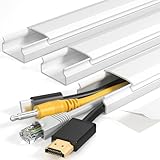
- Bye bye messy TV wires! Hung your TV up but the HDMI and Internet cords are dangling down. The clutter of wires is really hard to look at. The wires are directly exposed and inadvertent touch can be easily tangled with the cords, a potential electrical hazard. Don't want something bulky and not in a position to put the wires behind the wall, so the Yecaye TV cord hider is a good option
- Good for length for TV walls! Whether you have a high or low hanging wall mounted TV, the Yecaye CMC02 cord hider will work well for your wall mounted TV hidden wire needs. You can use three cable raceways separately or directly splice three cable raceways together seamlessly
- Easy to use in tight spaces! Yecaye TV cord hider is designed to be more suitable for flexible and comfortable installation or cable change under the TV or other small spaces. It namely can slide on or snap on directly so as to choose a comfortable way to complete the cord cover wall installation in different installation spaces
- Large capacity for 3-4 wires! Our cable hider can hold 3-4 wires depending on most TV wire sizes and number of wires. Our cord cover is suitable for hiding various wires under TV, such as HDMI cable, TV power cable, Ethernet cable. The cable hider internal length is 1.1in and internal width is 0.52in. Please measure the number of wires you need to hide first when choosing our cord covers
- Easy tool-free use! It's so easy to use TV cord hider to install. Pre-adhesive tape is applied and installation is completed with just one peel and stick. This cord cover wall are also no other troublesome accessories to fix, and you can seamlessly connect the cord hider
8. Bundle exposed cables in a sleeve
A cable sleeve or braided wire wrap combines several loose cables into one orderly run. It does not make the cables invisible, but it reduces tangling and makes the installation look intentional.
Use a sleeve behind a TV stand, beside a console, or along a short exposed route where you need to disconnect equipment occasionally. Group cables by destination, leave enough slack to move the TV or components safely, and keep ventilation openings and removable connections accessible.
A TV cable sleeve or braided cable management sleeve is an organization solution, not an in-wall safety solution. It should not be used to conceal a power cord inside a wall, ceiling, floor, or other inaccessible space.
Quick wins for a faster PC:
Repair Windows errors before they cause bigger problemsFix Now →Scan for outdated or missing drivers - takes under a minuteDriver Scan →Clear out junk files and repair common Windows errorsFree Scan →9. Add cable clips or adhesive wire holders
Small clips are useful for routing one or two lightweight cables along the back of furniture, a TV stand, or a baseboard. They also provide strain relief so an HDMI, Ethernet, optical, or speaker cable does not hang from its connector.
Choose clips sized for the cable and surface, and space them closely enough to prevent sagging without crushing the insulation. Adhesive clips are convenient but depend on the condition of the surface and the cable’s weight.
Never use staples, nails, or other fasteners that can pierce or compress an electrical cord. Damaged insulation creates a shock and fire risk.
10. Route low-voltage cables along the baseboard or trim
If the source device or outlet is far from the TV, a horizontal baseboard route can be less conspicuous than a long vertical strip from the television to the floor. Run low-voltage cables along the baseboard, behind removable trim where appropriate, or inside a dedicated trim channel, then bring them upward near the TV.
Free tools Windows power users keep installed
One-click scans. No signup required.
A paintable surface raceway can blend with the baseboard or be painted to match. Avoid pinching cables behind trim, making sharp bends, or trapping connectors where they cannot be serviced. Keep ordinary power cords accessible and exposed; do not use trim as a way to bury an extension cord.
11. Use the furniture to hide the lower run
A console, bookcase, cabinet, or media wall can hide much of a cable route without any drywall work. Use built-in cable-management channels when the furniture has them, route cables by destination, and secure loose runs so they do not snag when a drawer or component moves.
Rank #4

- Hide Ugly Wires Instantly: This sleek TV cord hider hides 2-4 messy cables on walls (W0.95in×H0.55in) , turning cluttered TV wires into a clean & streamlined look. Perfect as TV cord hider for wall mounted TV, the cord covers for wires on wall blends seamlessly into your decor while preventing tripping hazards
- 113.4in 8-Pack Cord Hider Kit: Includes 8 raceways + 5 couplings + 2 elbows + 1 T-connector for full cord cable management. Wire covers for cords on wall easily handle complex layouts like 90-degree turns and T-splits, keeping all wires neatly organized and completely out of sight
- Peel & Stick in Seconds– No Tools Needed: Featuring a strong 8MM adhesive backing, this wall TV cable hider installs instantly—no drilling or tools required. Installation has never been easier. Ideal for cord covers for 2-4 wires on wall, this cord hider cable hider also works great for concealing light cables, HDMI, Ethernet, monitoring, and speaker wires (Note: Cannot be used on textured walls)
- Snap-On or Slide-On Mounting: This upgraded wire cover, cord covers for wires on wall provides you with two easy installation options—just snap it in or slide it into place. Setup is quick and easy, and you can effortlessly access wires whenever you need to make changes with TV cord hider wall kit
- Paintable & Cuttable: Paint TV cord hider wall to perfectly match your wall, or cut it to fit any space. However you imagine, this cord cover cable management kit adapts effortlessly to your unique décor style, turning unsightly cables into an invisible part of your home’s aesthetic. Achieve that clean, built-in look without a single compromise
This works especially well for a TV above a console. Leave service slack behind the equipment and preserve access to power plugs, HDMI connections, routers, and streaming devices. Furniture should conceal the cable—not compress it against a sharp edge or block ventilation.
12. Protect a cross-room cable with a floor cord cover
Sometimes the TV cannot be placed near the existing outlet or media source. If a cable must cross a walkway, use a floor cord cover or floor-rated cable protector designed for foot traffic. It protects the cable and reduces the chance that someone will trip over a loose run.
Select a cover with a suitable channel size and traffic or load rating. Follow its installation instructions, keep the route as short as practical, and do not create a raised edge in a place where people will stumble. This is an exposed-path solution, not a substitute for relocating the outlet or running compliant permanent wiring.
13. Relocate or add the outlet professionally
For a remodel, new installation, or long-term home theater setup, the cleanest result may be a new or relocated receptacle behind the TV, with separate low-voltage cable access for HDMI, Ethernet, coax, and audio.
An electrician can determine the appropriate wiring route, receptacle location, box type, and local code or permit requirements. A recessed outlet may also work better with a low-profile TV mount, provided the mount and box have compatible clearances.
This approach costs more and is less reversible than a raceway, but it avoids a long visible power run and creates a durable installation. It is the appropriate direction when you want concealed AC power rather than a temporary workaround.
Crashes, No Sound, or Screen Glitches?
Random freezes, missing sound and display glitches usually trace back to one bad driver. Find and replace yours safely.Free scan · under a minutePC Slower Than It Used to Be?
A free scan shows the junk files, broken settings and background clutter dragging Windows down - then fixes them in one click.Free scan · Windows 10 & 11Safe installation checklist
- Inventory the cables. Separate TV power from HDMI, Ethernet, coaxial, optical, USB, antenna, and speaker cables before choosing a method.
- Map the route. Mark the TV, mount, outlet, console, and cable endpoints. Account for connector length and service slack.
- Inspect before drilling or cutting. Use a stud finder and check for electrical wiring, plumbing, insulation, and fire blocking. Do not assume an empty-looking section of wall is safe.
- Keep ordinary power cords out of concealed spaces. Do not run a standard extension cord or appliance power cord through a wall, ceiling, floor, or carpeted concealed space.
- Use the correct in-wall product. Concealed AC power requires a purpose-built, appropriately listed in-wall power kit or compliant permanent electrical wiring. Follow the exact instructions.
- Keep signal and electrical wiring appropriately separated. Follow the product instructions and applicable local code, particularly where low-voltage cable paths approach electrical wiring.
- Protect the cables. Do not staple, nail, sharply bend, pinch, crush, or tightly bind cords.
- Plan for service. Leave enough slack to remove the TV, soundbar, router, or streaming device without pulling on connectors.
- Check enclosure and mount clearance. Recessed boxes and media enclosures need adequate wall depth and room for plugs, connectors, ventilation, and the TV mount.
- Stop when the wall is uncertain. Masonry, plaster, fire-rated assemblies, insulated exterior walls, and unknown wiring conditions are good reasons to hire an experienced installer or electrician.
What not to do
- Do not run an extension cord behind drywall. It is not permanent wiring and can be damaged or overheat where you cannot inspect it.
- Do not put a power cord through a low-voltage brush plate. A plate intended for HDMI or Ethernet does not change the electrical classification of the cord.
- Do not assume “cord hider” means “in-wall rated.” Many cord covers are intended only for exposed wall or floor applications.
- Do not fasten cords with nails or staples. Fasteners can damage insulation.
- Do not seal electronics into an unsuitable media box. Check heat, ventilation, dimensions, wireless performance, and future access.
- Do not promise yourself a completely invisible result. A raceway hides a cable visually; a sleeve organizes it; a floor cover protects it. Only suitable in-wall construction fully conceals it.
Which option should you choose?
Choose a paintable surface raceway if you want the lowest-risk, fastest retrofit and can accept a narrow visible channel. It is usually the best balance for a finished wall.
Choose in-wall low-voltage plates if the problem is HDMI, Ethernet, coax, optical audio, USB, or speaker wiring and you are comfortable inspecting and opening the wall.
Best Value
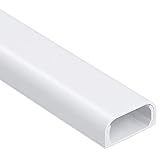
- Fits 2-3 Cords: Measuring 0.95 in W x 0.47 in H, this wire cover accommodates multiple cable combinations, such as 2 extension cords, 1 extension cord + 1 HDMI cable, or 1 Cat6/8 cable + 2 lamp power cords. Includes 5 raceway sections, each 14.57 in long, for a total length of 73 in
- Simple & Fast Installation: Features pre-applied adhesive tape and a flexible snap-on or slide-in cover design. Just follow 3 steps: Insert the wires, close the cover, then peel and stick the cable cover onto the wall. (Adhesive tape is not suitable for textured walls or surfaces.)
- Clean & Easy Cable Management Kit: Hide messy cables easily without drilling holes. The flat-cut ends allow seamless connections between sections for a clean, professional look. Note: Removing adhesive tape may damage painted surfaces. For best results, apply to clean, smooth surfaces and remove carefully to minimize potential damage
- Enhanced Safety and Quality: Made from quality PVC material with an odorless, smooth glazed finish and enhanced fire resistance for improved safety. ZhiYo cord hider provides lasting durability and resists yellowing over time
- Keep Your Children and Pets Safe: Nothing ruins your home decor more than messy dangling wires, which can also create tripping hazards and safety risks for children and pets. Our wall cord cover helps keep your living space organized and clutter-free while providing a more secure cable management solution for your home
Choose an in-wall TV power kit or an electrician if AC power must disappear behind the TV. This is the key safety decision, not an optional upgrade.
Choose furniture, baseboard routing, clips, or a sleeve when the TV is above a console, the run is short, or you need easy access to the equipment.
Choose a floor cord cover when the cable must cross a walkway and relocating the TV or outlet is not practical.
For DIY preparation, a stud finder and drywall saw can help with low-voltage plate or retrofit-box work, but tools do not replace inspection or electrical knowledge. If the job involves permanent wiring or you are unsure what is inside the wall, professional installation is the safer choice.
Frequently Asked Questions
Can I run my TV’s power cord through the wall?
Not if it is an ordinary TV power cord, extension cord, or appliance cord. Use a purpose-built, appropriately listed in-wall TV power kit installed according to its instructions, or have an electrician install compliant permanent wiring.
Can HDMI and Ethernet cables go inside a wall?
They can often be routed through a suitable low-voltage in-wall path, such as brush plates or a pass-through system, provided the cable, wall construction, and installation comply with the product instructions and applicable requirements. This does not make an AC power cord suitable for the same opening.
What is the easiest way to hide TV wires without cutting drywall?
A paintable surface raceway is usually the best option. A peel-and-stick concealer works for shorter, lighter runs on smooth painted walls, while furniture routing, clips, and sleeves work well when the TV is above a console.
Is a cable sleeve the same as hiding wires?
No. A sleeve bundles and organizes visible cables; it does not make them invisible or safe to conceal inside a wall. It is useful behind a console or TV stand where connections remain accessible.
Should I hire an electrician to hide TV wires?
Hire one when AC power must be concealed, an outlet must be added or moved, the wall may contain wiring or plumbing, the assembly is fire-rated, or you are not confident inspecting and cutting the wall. Low-voltage routing is simpler, but it still requires careful wall inspection.
The Bottom Line
For most finished-wall installations, start with a paintable surface raceway. Use low-voltage brush plates for signal cables, and use only a purpose-built in-wall power kit or compliant electrical work for concealed AC power. If the TV is above a console, furniture routing, clips, or a cable sleeve may give you the cleanest practical result without opening the wall.
Recommended Free Tools
Quick Recap
Product prices and availability are accurate as of the date/time indicated and are subject to change. Any price and availability information displayed on Amazon at the time of purchase will apply.

