
Free tools Windows power users keep installed
One-click scans. No signup required.
iTechGuides is reader-supported. When you buy through links on our site, we may earn an affiliate commission. As an Amazon Associate I earn from qualifying purchases. Learn more
Sales intelligence tools began as a way to look up company and contact details. Most products sold today go further: they combine firmographic and contact data with buying signals, push that context into the CRM, and in some cases draft the next outreach message. For buyers, the useful question is no longer simply which tool holds the most records. It is whether a tool’s data can be checked against your own records, whether it reaches the people who will act on it, and whether its AI features and commercial terms are clear enough to hold a vendor to.
How the category got here
The product shapes in current vendor material follow a rough three-stage progression. This is an editorial way of reading that material, not a measured market history.

Stage 1: Manual account research
Sellers searched company websites, business directories, and social profiles by hand. Whatever they found was only as current as the moment they looked, and it lived in notes or spreadsheets rather than in the systems where deals were managed.
Stage 2: Data joined to the CRM
Contact and company databases began feeding customer relationship management systems, so a seller working an opportunity could see company size, industry, and a contact’s role without leaving the record. The central problem shifted from finding information to keeping it accurate inside the CRM.
#1 Best Overall
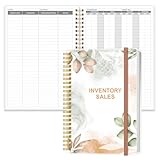
- EASY TO USE - The inventory and sales log book are easy-to-use inventory books that help you track inventory, purchases, sales, balances, unit and total costs, and manage reorders - all in one place. Easy track your inventory for small businesses.
- MONITOR YOUR DATAS - Using a sales inventory book to store all your data, you can consult your records whenever needed. Optimize your business and generate the most benefit.
- UNIQUE DESIGN - We make sure you can tailor this inventory log book to your enterprise business needs to take full advantage of its capabilities. It will work for online, consignment, home or in-store businesses.
- HIGH QUALITY - This sales book for your business, sales book size of 5.8" x 8.5", just the perfectly size to fit in your backpack, purse or laptop case. Is used to high quality 100gsm pure white paper, elastic band and a back pocket for extra space.
- THE PERFECT GIFT - Use inventory and sales log book for your personal or samll business finances, give it to your friends, family as a gift for Birthday| Easter|Children's Day|Halloween|Thanksgiving|Christmas|Back to school and New Year's Day.
Stage 3: Signals, analytics, and AI-assisted action
Current products increasingly describe a move from finding information to interpreting it and initiating a next step. They combine profiles with event triggers such as funding, hiring, and leadership changes, with buyer activity, conversation analysis, forecasting, and generated email drafts. Salesforce’s own description of the category captures this shift, and the questions buyers ask have changed with it.
What a sales intelligence tool includes today
Salesforce defines the category this way: “Sales intelligence is the collection of data and insights used to make informed and strategic decisions throughout the sales process.” That definition comes from an article by Belal Batrawy, founder of learntosell.io, dated January 27, 2025, on Salesforce’s site. The same article lists the functions a modern product may include:
- Company-level and person-level profiles.
- Buyer signals and event triggers.
- Real-time news.
- Conversation insights.
- AI-assisted analysis.
- Contextual email generation.
- CRM integration.
No single product delivers every item on that list, and an AI layer does not make underlying data accurate on its own. Treat the list as a menu to check against each tool, not a checklist every product meets.
Rank #2

- 6-PACK/50 Sets (300 Total Sets): Six 4-1/8 x 7-3/16" Sales Order Books with two-part forms which produce two identical records of each sales transaction, one for the customer and one for your business
- CARBONLESS COPY: No carbon paper! Each 2-part set features a white top sheet for recording each transaction and a bottom canary yellow sheet that captures written text from top sheet.
- CONSECUTIVE NUMBERS: Effortlessly identify the chronological order of transactions in each book by the pre-printed number on each sales order set
- WRAPAROUND DIVIDER FLAP: A thick, folded paperboard divider is integrated into the back of each book to use between each 2-part sales order form.
- PERSONALIZE: Each sales order form sheet contains space at the top to add a company stamp or sticker
Two product shapes buyers are choosing between
Current vendor material points to two broad shapes. Salesforce presents sales analytics and revenue intelligence as part of a larger Sales Cloud portfolio, with features distributed across editions and add-ons. SalesIntel presents a specialized pipeline-generation platform that combines contact and firmographic data, intent and growth signals, buying-committee identification, AI-generated messaging, and integrations with CRM and marketing platforms. The comparison below uses only what each vendor’s own pages describe. This article did not test either product, and where a vendor page is silent, the table says so.
| Comparison point | Salesforce (CRM-centered suite) | SalesIntel (specialized pipeline platform) |
|---|---|---|
| Primary shape | Analytics and revenue intelligence within Sales Cloud | Prospecting and pipeline generation |
| Data described | Company- and person-level intelligence, entered into the CRM | Contact and firmographic data, with claimed verified mobile numbers and 200M+ contacts (vendor figure) |
| Signals described | Buyer signals, event triggers, real-time news, conversation insights | Intent and growth signals; a claimed 30+ signal categories (vendor figure) |
| CRM integration | Described as a core function; specific objects and fields not stated on the cited article | CRM and marketing-platform integrations described; named platforms not stated on the cited page |
| Data provenance and refresh evidence | Not stated in the cited material | Claimed 95% accuracy and a 90-day refresh cycle (vendor claims) |
| AI features | AI-assisted analysis, forecast and pipeline insights, contextual email generation | AI-generated messaging and AI-supported workflow activation |
| Pricing disclosure | Prices shown by edition on the pricing page, described as informational and subject to change; UK revenue intelligence page lists separate per-user annual-billing options | Not stated in the cited material |
| Deployment effort | Not stated in the cited material | Not stated in the cited material |
Neither vendor’s material establishes that it outperforms the other. Choose based on whether your sales motion starts inside the CRM or in outbound prospecting, and then test each shortlisted tool against your own records.
What to evaluate, and what to ask
Data quality and freshness
Ask how records are verified, refreshed, sourced, and corrected. Ask whether a record shows its last verification date, how coverage varies by geography, company size, role, and industry, and how often the tool’s data matches your known records. A headline accuracy percentage is only useful when the vendor defines the method and the population it covers. HubSpot’s buyer guidance stresses accurate, regularly verified data as a core requirement.
Rank #3

- Duplicate Receipt Book with a Canary Copy: Write once and each carbonless set makes its own copy. Tear off the white original for your customer and keep the canary duplicate bound in the book for your records.
- Sales Order Book Layout with 15 Item Lines: Every form has Date, M, Address, Reg. No., Clerk and Account Forward fields, and red consecutive numbers keep orders, payments and transactions in sequence.
- Wraparound Cover Stops Write-Through: The cover folds behind the set you are writing on, so pen pressure never marks the forms below. Printed on SFI certified sourcing paper and made in the USA.
- Pocket Size Receipt Book, 8.5 x 14.3 cm: Each book is 3 11/32 x 5 5/8 inches with a 3 11/32 x 5 1/8 inch detached form, small enough to carry in a pocket. This pack holds 10 books of 50 sets, 500 receipts in total.
- Office Supplies for Retail and Service Calls: Use it as a bill book for billing invoices, a guest check or a sales slip at a register, vendor booth or job site. Stamp your company name in the blank top area.
CRM and stack integration
Confirm which objects and fields sync in each direction. Ask whether enrichment can be configured to avoid overwriting fields your team treats as authoritative, how duplicate records and account ownership are handled, and whether signals arrive where sellers actually work. HubSpot recommends native CRM integration, while Salesforce describes entering company- and person-level intelligence into the CRM. Ask each vendor to demonstrate the exact sync behavior rather than accept the general description.
Signal value and timing
Separate descriptive data, which tells you who an account is, from signals, which suggest why a moment may be relevant. For signals, ask which sources are covered, how quickly an event appears after it happens, how a signal is matched to the correct account when company names are similar, and how false positives are filtered. Common signal examples in vendor material include funding, hiring, leadership changes, technology changes, website activity, and intent data.
AI you can inspect
Ask what data each AI feature uses, whether it exposes the source evidence behind a suggestion, whether a person must review an action before it is taken, how it handles stale or conflicting records, and whether it improves a workflow you have measured before and after. Feature descriptions are not evidence of results for your team. Salesforce describes AI analysis and contextual email generation, and SalesIntel describes AI-supported workflow activation; neither vendor’s material reports measured outcomes for a particular buyer.
Privacy and governance
Ask the vendor to document data origins, the vendor’s role as controller or processor, retention periods, opt-out handling, access controls, and the responsibilities that fall on your organization in each jurisdiction. HubSpot calls for transparent handling of consent, data, and opt-outs, along with Do Not Call screening and privacy rules such as GDPR and CCPA. Those are checklist items, not legal conclusions. Have counsel review the vendor’s documentation against the markets you sell into.
Total cost and fit
Compare per-seat and usage-based charges, add-ons, minimum commitments, implementation work, data limits, and tools you already pay for that overlap with the new one. Price pages change, so note the date you captured any figure and confirm it with a written quote.
Do these 3 things before closing this tab:
1Fix the driver behind crashes, sound loss and screen glitches2Repair Windows errors before they cause bigger problems3Scan for outdated or missing drivers - takes under a minuteReading vendor statistics
Vendors and their partners publish many figures about scale and accuracy. The table shows the statistics that appear in current material and how to read each one.
| Statistic as published | Publisher and date | How to read it |
|---|---|---|
| 88% of revenue and sales leaders say their sales process would benefit from a single, integrated platform | HubSpot, 2026 sales intelligence article | A HubSpot-reported survey figure. The survey method was not verified for this article. |
| 72% say their current tools do not provide access to the complete, accurate revenue data they need | HubSpot, 2026 sales intelligence article | A HubSpot-reported figure, not an independently validated market estimate. |
| 200M+ verified B2B contacts, 54M+ verified mobile numbers, 2,000+ human researchers, 30+ signal categories | SalesIntel, undated vendor page, accessed 2026 | Vendor-published figures. Definitions of “verified” and “signal category,” and any independent validation, were not established. |
| 95% data accuracy, and a guarantee of 95% accuracy on AI- and human-verified contacts | SalesIntel, undated vendor page, accessed 2026 | A vendor claim. Ask which population of records the guarantee covers, how accuracy is tested, and what remedy applies if it is missed. |
| Records refreshed on a 90-day cycle | SalesIntel, undated vendor page, accessed 2026 | If the cycle applies to every record, a record can go up to about three months without refresh. Ask whether high-activity accounts refresh more often. |
A buyer-side test before you sign
A demonstration shows the best case. A short controlled test shows how the tool performs on your data. Run the following steps on each shortlisted product:
- Build a sample from your own records. Pull a few hundred accounts and contacts you already know are correct, spread across your main regions, company sizes, and buyer roles, so the test reflects your segments rather than the vendor’s best segment.
- Enrich a copy, not production. Run the sample through the tool in a sandbox or a duplicated object, with overwrites disabled, so an error cannot reach your authoritative data.
- Score errors by segment. Record whether the company, the contact’s current role, the email address, and any phone number are correct, and note the last verified date each record shows. Compare error rates across segments, not just overall.
- Test signals against known events. Pick accounts with a publicly known funding round, hire, or leadership change in the last 30 days. Check whether the tool surfaced each event, and how many days passed before it appeared.
- Review AI output against facts. Have sellers check each generated message for claims the source record does not support, and count how many need correction.
- Get the terms in writing. Obtain written answers on data retention, opt-out handling, Do Not Call screening, GDPR and CCPA responsibilities, the accuracy guarantee’s scope, and the price for the seats and usage you actually need.
Keep the test results with the purchase file. When a vendor later changes its data sources, pricing, or AI features, your own baseline is the only figure you can compare against.
Quick Recap
Product prices and availability are accurate as of the date/time indicated and are subject to change. Any price and availability information displayed on Amazon at the time of purchase will apply.
Recommended Free Tools

