
What’s actually slowing this PC down?
Pick the symptom - the matching free tool is one click away.
iTechGuides is reader-supported. When you buy through links on our site, we may earn an affiliate commission. As an Amazon Associate I earn from qualifying purchases. Learn more
To track your time in a way that can support productivity, first record how you actually spend a few representative workdays. Then use what you learn to plan realistic work blocks, try timed focus sessions where they fit, and adjust your next plan. These methods can make time use more visible and intentional, but none guarantees better performance.
What time tracking can—and cannot—do
Time tracking is useful when it helps answer a practical question: Where is my work time going? Which tasks take longer than expected? When do interruptions derail my plans? A record can make patterns easier to see, but recording time is not, by itself, a productivity intervention.
A 2021 meta-analysis by Brad Aeon, Aïda Faber, and Alexandra Panaccio combined findings involving 53,957 participants. It found that time management was moderately associated with job performance, academic achievement, and wellbeing, and moderately negatively associated with distress. This is evidence of relationships across studies, not proof that any one tracking method causes better results. The relationship with wellbeing—particularly life satisfaction—was stronger than the relationship with performance. The authors wrote, “That means time management may be primarily a wellbeing enhancer, rather than a performance booster.” Read the meta-analysis in PLOS ONE.
Quick wins for a faster PC:
Fix the driver behind crashes, sound loss and screen glitchesFind Drivers →Repair Windows errors before they cause bigger problemsFix Now →Other findings are a reason to avoid guarantees. A study involving 353 employees found that some time-management behaviors could benefit tension and job satisfaction, but did not find an effect on job performance; time-management training was not effective in that study. Neither this finding nor the meta-analysis establishes a universal winner among time audits, work blocks, timed intervals, and reviews.
#1 Best Overall
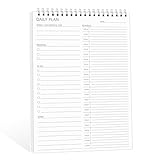
- ✔This daily plan pad features detailed hourly schedule timelines from 12 AM to 11 PM, perfectly segment your morning, afternoon and evening hours. Track meetings, appointments and fixed tasks hour by hour to eliminate procrastination and boost your daily time management efficiency.
- ✔ 1.Put an end to the time black hole: Every hour of activity is recorded, so you always know where your time goes and bid farewell to "being busy yet achieving nothing". 2.Cure procrastination: Visual time grids have an inherent sense of supervision; blank time slots serve as a direct reminder, with more binding power than phone alerts. 3.Gain instant a sense of accomplishment: Check off completed tasks with a simple tick. A filled time axis page by page delivers physical feedback that digital tools cannot match, making it easier to keep going the more you use it.
- ✔ 1.Students & Exam Takers: Plan class, review and practice time; allocate study hours for each subject precisely for targeted exam preparation. 2.Professionals: Schedule meetings, work projects and commute time; prioritize tasks clearly and bid farewell to chaotic overtime. 3.Freelancers & Stay-at-Home Parents: Clearly divide work/childcare/personal time to avoid blurring the boundaries between life and work. 4.Self-Discipline Enthusiasts: Check in on fitness, reading and learning; develop regular routines with hourly scales to build good habits effortlessly.
1. Audit where your time actually goes
A short audit gives you a baseline before you change your routine. For a few representative workdays, note what you work on and approximate start and end times. Choose categories that will help you answer a real question, such as focused work, meetings, email or administration, interruptions, and breaks.
- Use a notebook, spreadsheet, calendar, or timer app—whichever is easiest to keep up with.
- Record enough detail to reveal patterns; minute-by-minute precision is unnecessary.
- Include interruptions and breaks rather than treating them as invisible time.
- Choose ordinary workdays, not only unusually quiet or unusually busy ones.
At the end, look for useful signals: recurring meeting-heavy periods, tasks that regularly overrun, or email that fragments work. Treat the log as an estimate, not a verdict on how well you worked. If tracking itself becomes a distraction, simplify it or stop.
Rank #2

- TASK PLANNER NOTEPAD FOR WORK – Structured task planner and productivity planner designed as a task organizer and workflow planner with expanded layout
- REDUCE OVERWHELM & IMPROVE EXECUTION – Use this task planner, productivity planner, and task tracker to organize workflow and improve execution
- TASK PLANNING + ACTIVITY TRACKING IN ONE FORMAT – Use as a productivity planner, task organizer, and workflow planner to manage tasks and execution
- ANALOG TASK & ACTIVITY SYSTEM THAT WORKS – Writing tasks improves memory and reduces missed steps
- STRUCTURED CHECKLIST + LOG FORMAT – Combines task planning and activity tracking with expanded space for detailed workflow management
2. Plan work blocks with room for interruptions
Use your priorities and the audit’s patterns to plan a few blocks of work. Write down the most important tasks, estimate how long they may take, and decide when and how you will work on them. Reserve focused blocks for tasks that need concentration, while leaving open space for overruns, routine work, and unexpected requests.
Do these 3 things before closing this tab:
1Fix the driver behind crashes, sound loss and screen glitches2Clear out junk files and repair common Windows errors3Scan for outdated or missing drivers - takes under a minute- Choose a few priorities. Identify what matters most rather than filling every available hour.
- Estimate and schedule. Put the work into calendar blocks or a written plan, with realistic time for the task.
- Leave slack. Avoid scheduling every minute; interruptions and tasks that run long are part of many workdays.
- Adapt when reality changes. Move or resize a block when needed instead of treating the calendar as a contract.
A study on daily planning distinguished ordinary time-management planning—task lists, prioritizing, and deciding when and how to work—from contingent planning that anticipates interruptions. Its authors proposed that frequent interruptions may weaken the benefits of ordinary planning, while contingency planning can help people stay engaged and perform well despite interruptions. This is a conditional finding, not a promise that a particular schedule will work in every job. See the study’s PubMed record.
Rank #3

- Made in USA. Veteran-Owned and Proudly Produced in Ohio.
- THIS IS ESSENTIAL FOR LAWYERS AND CONSULTANTS: BookFactory Time Tracking book is a necessary addition to any attorney’s office, small business or freelance assignment. It’s a fundamental part of any business like. A simple and easy way track your billable hours
- TRACK BILLABLE HOURS BY DAY OR BY CLIENT: For business or personal use, time tracking is shown across a 2-page spread, on the left side, you have days and each hour, where you can write quick details about who you worked for. On the right side of the page you can keep more detailed track of the specific tasks you worked on and what client it was for – what breaks you took, and when, as well as the specific amount of time you spent on each task
- EXCELLENT VISUAL TO SHOW HOW YOU’RE SPENDING YOUR TIME: You may wonder where your day is going, or how you still have so much to do when you’ve already been working for hours. You may just need to be able to give your client an itemized invoice of work provided… either way, this book will be a help to you
- BUS-100-69CW-PP-(Time-Tracker)
3. Try timed focus intervals when they suit the task
Timed focus intervals give a work session a clear beginning and end: choose a manageable period for focused work, then take a break. You can use a phone, computer, or basic physical timer; a special device is not required. Select an interval and break length that suit the work, then adjust based on experience. The familiar 25-minute-work, five-minute-break pattern is a popular convention, not an evidence-based standard established by the sources cited here.
- Try intervals for tasks that benefit from a short, defined push or when getting started is difficult.
- Use a longer uninterrupted stretch if a timer would break concentration or interrupt deep work.
- Stop or change the interval if watching the clock becomes more distracting than helpful.
A peer-reviewed case study examined adoption of a Pomodoro tool at a digital marketing agency implementing a four-day workweek. It describes personalized approaches to productivity and examples of collective work toward better work-life balance. That workplace case offers context for how a team used the tool; it does not demonstrate that Pomodoro improves output for everyone. Read the case study at Copenhagen Business School’s Research Portal.
Rank #4

- SIMPLE, ATTRACTIVE DESIGN - The notepad flaunts a design that's both stylish and fun, making it the perfect backdrop to track your daily tasks and other deliverables.
- 8.5" X 11": LETTER SIZE - With ample space for jotting down your activities/tasks, projects and deliverables, this notepad ensures you never miss a beat. The larger size offers room to log all your work.
- DOUBLE-WIRE SPIRAL BINDING - Tear off sheets as needed or keep them intact to be able to look back on your prior tasks. Whether you're at your desk, in a meeting, or on the go, your notepad is ready for you to use as you see fit.
- 50 SHEETS - Created so you can list all your tasks onto one sheet in order to keep track of time stamps as you note how you spend your time each day.
- VERSATILE FOR TRACKING ALL YOUR TASKS - Whether you're a professional who bills for your time, a student recording time spent on studies, or a volunteer tracking your hours, this notepad can help you record your time spent on any and all activities throughout your day.
4. Review the record and adjust your next plan
At the end of a workday or week, compare what you intended to do with what actually happened. Use the difference to make a more workable next plan, not to criticize yourself for every deviation.
- Notice repeated interruptions and decide whether to reserve time for them, change when you tackle focused work, or plan a backup task.
- Resize blocks for tasks that consistently take longer or shorter than you expected.
- Reconsider priorities when low-value work repeatedly crowds out important tasks.
- Ask which few tasks matter most. The 80/20 principle can serve as a prompt for prioritizing; it is not a guaranteed or universally measured ratio for your workload.
Reviewing a log is practical guidance, not an intervention shown by the cited studies to produce productivity gains on its own. Its value is that it gives you information to shape a better-fitting plan.
Best Value

- Plan Smarter, Stress Less: Our undated planner has 50 daily planning sheets per planning pad to help you keep your notes organized all in one place. Track important projects, tasks, time blocking, and goals with our planner.
- Enhance Your Productivity: The simple solution for managing your daily schedule. Helps you focus, especially those with ADHD. With our daily planner you can track your appointments and meetings throughout the week, organize your tasks in order of priority, jot down thoughts or ideas, and record when projects are due.
- Upgrade Your Office Supplies: The minimal design makes this a stylish and practical addition to your work from home essentials for both women and men. This to-do list notepad looks professional and keeps you organized.
- Give The Gift Of Organization: The sleek design makes this a beautifully practical gift for moms and dads who need a little extra help keeping track of soccer games, field trips, and doctor’s appointments. Also makes a wonderful gift for college students, coworkers, your boss, or the entrepreneur in your life to help them stay on top of busy schedules.
- Cultivate Healthy Habits: Plan and track your meals and water intake each day and use the checkbox as a visual reminder. Take a minute each day to write down something good that happened. Practicing gratitude is proven to increase happiness!
Which method should you start with?
Choose based on the problem you want to solve. The four approaches do different jobs, and there is no direct comparative trial establishing a best method or ranking.
| Method | Best starting point when you need to… | Watch for… |
|---|---|---|
| Time audit | See where time is going before changing your routine. | Too much detail can make tracking burdensome. |
| Planned work blocks | Decide when and how to tackle priorities. | A rigid schedule can fail when interruptions or overruns are common. |
| Timed focus intervals | Give one work session a defined structure. | A timer can interrupt tasks that need longer concentration. |
| Review and reprioritize | Use what happened to adjust future priorities and block sizes. | A log does not automatically tell you which work matters most. |
Work that is interruption-heavy may call for contingency planning and flexible blocks. Tasks that need long, uninterrupted stretches may be a poor fit for short timed intervals. If you do not yet know what is disrupting your day, start with an audit; if you already know your priorities but struggle to make room for them, try planning blocks. You can combine methods—for example, audit briefly, plan the next day, and review once a week—while keeping the routine simple enough to maintain.
Quick Recap
Product prices and availability are accurate as of the date/time indicated and are subject to change. Any price and availability information displayed on Amazon at the time of purchase will apply.

