
Artificial intelligence can make data center infrastructure management (DCIM) more predictive, helping teams spot anomalies, anticipate capacity and maintenance needs, and identify energy or cooling inefficiencies. That is a significant improvement in how operators use DCIM—not proof that AI can run a data center on its own. Its usefulness depends on the quality and reach of the underlying measurements, the systems it can integrate with, and how much control operators are willing to delegate.
What DCIM manages—and what AI adds
DCIM brings information about IT equipment together with facility infrastructure. In practice, that means a shared view of physical assets, power, space, cooling, environmental conditions, capacity, and equipment health. Cisco defines DCIM as an integration of IT and facility management that helps teams understand performance, energy use, and physical asset health.
AI does not replace this operational data layer. It analyzes telemetry from equipment and sensors, then presents findings to operators or, in some deployments, control systems. Platforms from Schneider Electric and Eaton illustrate the broader DCIM role: monitoring, capacity planning, predictive maintenance, energy analysis, alerts, visualization, and reporting. Those are platform capabilities, not evidence that every installation uses AI or delivers the same results.
Where AI can make DCIM more useful
The most practical AI-related gains begin with interpreting operational data: identifying patterns and anomalies, forecasting capacity requirements, flagging possible maintenance issues, and surfacing thermal or energy inefficiencies. These tools can help teams decide where to investigate sooner; the output still needs to be understood in the context of the site.
Recommended Free Tools
#1 Best Overall

- Save valuable floor space: 6U wall mount server cabinet Dimensions: 13.78" H x21.65" W x17.72" D.Maximum mounting depth is 14.2"
- Keep critical network equipment secure: glass door and side panels are lockable to prevent unauthorized access. Front door can be installed on either side of the front of the cabinet to satisfy your door swing orientation preference
- Easy equipment configuration: Fully adjustable mounting rails and numbered U positions, with square holes for easy equipment mounting with top and bottom punch-out panels for easy cable access
- Durability: Made of high quality cold rolled steel holds up to 110lb (50kg) (Easy Assembly Required)
- PCI & HIPPA and EIA/ECA-310-E compliant
Monitoring GPU and liquid-cooling environments
In a February 25, 2025 announcement, AMI described version 6.0 of its Data Center Manager as offering GPU health and power monitoring, liquid-cooling support, thermal and utilization monitoring, and real-time PUE and CUE calculation. These are vendor-reported product capabilities; the announcement does not independently establish how accurately they work or what results a particular facility will achieve. AMI’s announcement is an example of how DCIM products are addressing GPU-heavy infrastructure.
Moving from alerts toward recommendations
There is a meaningful difference between software that reports a current condition, software that predicts a future one, and software that recommends a response. Schneider Electric’s EcoStruxure IT brochure, dated July 15, 2026, frames its AI-enabled DCIM as a move from monitoring to prediction and advice: “Traditional DCIM tells you what is happening. AI-powered DCIM tells you what will happen and what to do next.” That is Schneider Electric’s product positioning, not a universal rule about DCIM systems. Read the brochure.
Rank #2

- Universal 19” Rack Mount Compatibility – Perfect for pro audio, video, IT, and network gear. Compatible with mixers, routers, patch panels, servers, power amps, and more.
- Heavy-Duty Load Capacity – Built to support up to 550 lbs. Ideal for studio gear, DJ setups, server equipment, and AV components that demand serious stability.
- Robust Steel Frame & Design – Made with 1.5mm thick steel and weighs 36 lbs for maximum durability, reduced vibration, and long-term reliability in any setting.
- Mobile & Secure – Preinstalled with 3” industrial-grade caster wheels (lockable), making it easy to move and position your rack exactly where you need it.
- All-In-One Setup Kit Included – Comes with 34 rack screws (5mm & 6mm), a 1U blank spacer, and an assembly tool—ready for fast installation out of the box.
Why AI does not automatically revolutionize data center operations
An AI system can only reason from the information it can access. Missing sensors, unreliable readings, or incomplete visibility into power and cooling limit what it can detect or forecast. In a physical facility, instrumentation is part of the system’s foundation: a rack temperature sensor, for example, is useful only when selected, installed, and integrated according to the facility’s engineering requirements.
- Incomplete data: Unmeasured conditions remain blind spots, and inaccurate telemetry can undermine conclusions.
- False positives: Poorly tuned analytics can overwhelm teams with alerts and make important events easier to miss, a risk Cisco identifies in its DCIM explainer.
- Integration limits: Proprietary equipment protocols can restrict what a platform can observe or control. Hybrid environments may expose less detail through cloud-provider APIs than an operator can obtain from on-premises infrastructure.
- Added operational burden: Real-time analytics require computing resources and can add infrastructure costs, integration work, tuning, training, and ongoing maintenance.
Most importantly, better advice is not the same as safe autonomy. A human can review, question, or override a forecast or recommendation. Automatically changing cooling or power settings can affect uptime, equipment health, and safety, so operators need to know exactly what actions software may take, the guardrails in place, how actions are logged, and how a person can intervene. Cisco describes autonomous cooling as a future trend; prediction and autonomous control should not be treated as interchangeable capabilities.
Rank #3

- ADJUSTABLE DEPTH: 4- Post 22U 19" server rack enclosure with 4 vertical rails and adjustable mounting depth 5.7" to 33.0" (14,4cm to 83,8cm); IT rack is compatible with various servers / switches / data / video / AV and other IT networking equipment
- EASY SHIPPING AND ASSEMBLY: Enclosed 22U data rack cabinet ships compact flat-packed to avoid damage and facilitate installation; Include wheels & levelling feet to offer more stability; Home server rack cabinet is only 46.6in (118,3cm) in height
- DESIGN AND VENTILATION: Half height server rack cabinet has lockable and removable door and side panels with vented top allowing airflow; 4 Post 19" rack with 1764lb (800kg) weight capacity (stationary); Computer cabinet rack is EIA/ECA-310-E Compliant
- HARDWARE INCLUDED: Rolling home network rack includes rack mounting and equipment mounting hardware, such as 20 M6 cage nuts / screws, PVC cup washers; Front/rear doors and side panels Keys, 2x allen keys; Rack assembly hardware; Casters and leveling feet
- THE IT PRO'S CHOICE: Designed and built for IT Professionals, this 22U IT Server Cabinet is backed for life, including free lifetime 24/5 multi-lingual technical assistance
Uptime Institute Intelligence’s 2024 report is cited for the view that DCIM software alone is unlikely to produce Level 4 or Level 5 autonomy. Because the report passage could not be directly verified in the available material, treat that specific characterization cautiously. The broader operational point is clear: software cannot establish autonomy without the data, integrations, controls, and operational safeguards needed to support it. Uptime Institute’s research and reports.
Independent reader supportYour contribution helps us test, update, and keep practical guides available for everyone.How to evaluate an AI-DCIM claim or pilot
Ask what the system can actually see and do, and what evidence supports the claimed outcome. A useful evaluation distinguishes a feature description from a measured result at a comparable site.
Rank #4
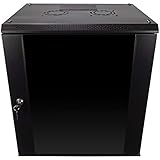
- DURABLE BUILD: Constructed from high-quality Cold Rolled Steel, the NavePoint Consumer Series 12U network cabinet boasts a sturdy, welded frame. Fitting EIA standard 19” networking equipment, this server cabinet confidently supports up to 110 lbs, providing a resilient base for your vital IT gear and equipment
- CONVENIENT DESIGN: This 12U cabinet features a reinforced, heat-treated, tempered glass front door with a security lock. Perfect for applications requiring both security and accessibility, its compact design of 17.72"L x 21.65"W x 24.42"H offers a practical solution for space-constrained settings.
- EASY & CUSTOMIZABLE EQUIPMENT SET UP - The 12U IT cabinet, with removable side panels and security locks, offers customization at its finest. Whether it's for an efficient device or cable management, this data cabinet ensures secure, adaptable configurations that suit your networking server requirements
- ENHANCED VENTILATION & SECURITY - Built-in fans and flow-through ventilation work to prevent overheating, ensuring optimal operation of your equipment. The reinforced, lockable tempered glass front door not only boosts security but also facilitates easy monitoring of installed equipment.
- SAFETY & COMPLIANCE - All NavePoint products are built to industry standards.
- Map data coverage. Identify the equipment, sensors, locations, and operating conditions included—and document what is not visible.
- Classify the capability. Determine whether the system displays status, detects anomalies, forecasts conditions, recommends action, or changes controls automatically. Do not treat these as equivalent.
- Check interoperability. Confirm which equipment protocols and building, IT, and operational systems are supported, and where integration gaps remain.
- Ask for evidence. Compare results with a stated baseline at a comparable site. Separate measured outcomes from product features, forecasts, and vendor expectations.
- Keep operator control explicit. Check whether recommendations are explainable, actions are logged, and operators can override them.
- Count the operating effort. Include compute, integration, configuration, tuning, staff training, and ongoing maintenance in the evaluation.
What the energy-savings figures do—and do not—show
Schneider Electric’s DCIM page associates an expected 5–10% saving in power and energy with Wellcome Sanger Institute. The page does not state the year, methodology, timeframe, or a clear causal link between those savings and AI. It should not be read as a measured, universal AI benefit. The available claim is not enough to establish a broadly comparable savings figure for AI-enabled DCIM. Schneider Electric’s DCIM page.
The practical verdict
AI can improve how DCIM turns operational measurements into patterns, forecasts, maintenance signals, and optimization advice. That is a meaningful evolution, particularly as facilities manage demanding workloads and more complex cooling needs. But whether it becomes transformative at a particular site depends on data coverage, reliable integration, measured results, and an operator’s chosen level of automation. Until those pieces are in place, AI is best understood as decision support—not a substitute for operational expertise or proof of a self-running data center.
Crashes, No Sound, or Screen Glitches?
Random freezes, missing sound and display glitches usually trace back to one bad driver. Find and replace yours safely.Free scan · under a minutePC Slower Than It Used to Be?
A free scan shows the junk files, broken settings and background clutter dragging Windows down - then fixes them in one click.Free scan · Windows 10 & 11Quick Recap
Product prices and availability are accurate as of the date/time indicated and are subject to change. Any price and availability information displayed on Amazon at the time of purchase will apply.

