
Do these 3 things before closing this tab:
1Clear out junk files and repair common Windows errors2Scan for outdated or missing drivers - takes under a minute3Repair Windows errors before they cause bigger problemsiTechGuides is reader-supported. When you buy through links on our site, we may earn an affiliate commission. As an Amazon Associate I earn from qualifying purchases. Learn more
For high-tech companies, the next competitive edge may come not from adopting AI agents first, but from deciding which work they can do on their own—and building the controls that make that delegation safe. Autonomy can speed up multi-step work and reduce routine handoffs, but it is not a proven shortcut to better business performance. The advantage depends on matching an agent’s permissions to the task, its risks, and the organization’s ability to oversee it.
What autonomy means inside a high-tech company
For an AI agent, autonomy is the amount and type of work it can complete with limited human input. That may include using software, making decisions, and carrying out tasks that involve multiple steps. The key distinction is between capability—what the system can technically do—and permission—what it is authorized to do in a particular workflow.
Autonomy is not a binary switch. The World Economic Forum and Capgemini describe agents in terms of their role, autonomy, predictability, and context, and propose progressive governance rather than a single control model for every system. A predictable agent handling a narrow, low-impact task is a different governance problem from one operating across varied situations with broad access and consequential actions. World Economic Forum and Capgemini, AI Agents in Action: Foundations for Evaluation and Governance.
That distinction also clarifies what “granting autonomy” means in practice: granting a defined set of permissions in a defined workflow, not handing a system unrestricted authority. The International Telecommunication Union identifies traceability, coordination, security, oversight, and liability as concerns as agents enter enterprise workflows. ITU, AI Agents.
#1 Best Overall
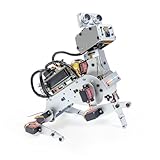
- AI-Powered Raspberry Pi Robot Dog — PiDog: Powered by Raspberry Pi (5/4B/3B+/3B/Zero 2W), OpenClaw, and multi-LLMs like ChatGPT, Gemini, Grok, DeepSeek, Qwen & Ollama. With 12 servos, camera, gyroscope, hearing & touch sensors, PiDog can see, listen, talk, move, and interact intelligently. Supports OpenCV, MediaPipe, TTS & STT, app control, FPV & Python. A great STEM robotics gift for students, makers & tech enthusiasts—perfect for birthdays and holidays. (Raspberry Pi not included)
- Realistic Dog-like Movements: PiDog's 12 powerful servos enable 32 dog-like actions, including walking, sitting, standing, shaking its head, wagging its tail, and performing playful tricks, closely mimicking a real dog and providing an engaging experience. This is an AI development robot product designed for engineers, suitable for ages 15 and above
- Rich Sensor Suite for Interactive Experiences: PiDog features ultrasonic, touch, gyroscope, sound, camera, speaker and microphone. These provide it with advanced hearing, vision, and touch, enabling it to see, detect obstacles, respond to touch, and recognize sounds, making interactions highly engaging
- AI-Powered Interactions with OpenClaw & Multi-LLMs. PiDog combines voice, vision, and gesture recognition for immersive AI experiences. Powered by OpenClaw and multi-LLMs like ChatGPT, Gemini, Grok, DeepSeek, Qwen, Doubao, and Ollama (local LLMs), it can understand questions, respond naturally through TTS & STT, recognize math problems, interpret hand gestures, and hold smart conversations. OpenClaw also enables customizable AI behaviors and personalized robotics development, helping users create their own intelligent robotic companion
- Comprehensive Learning Resources and Support: PiDog offers detailed online documentation, video tutorials, prompt technical support, and an active forum community, ensuring beginners can easily complete all projects and enjoy a great experience
Why autonomy could create an advantage—and why it is not guaranteed
An agent that can complete a bounded, multi-step process may reduce the need for people to move routine work between tools or wait for each step to be approved. If a company can delegate such work without losing control of outcomes, it may be able to operate faster or direct employees toward work that requires human judgment. Those are plausible mechanisms for advantage, not proof that any particular deployment will improve productivity, profit, or competitive position.
McKinsey frames an agentic organization around five connected pillars: business model; operating model; governance; workforce, people, and culture; and technology and data. The implication is that model capability alone is not the whole strategy. A company also needs workflows, ownership, skills, and reliable data suited to the work it delegates. McKinsey, “The agentic organization”.
Rank #2

- Optimized AI Arm Kit for LeRobot & Hugging Face Projects – The SO-ARM101 is an upgraded low-cost robotic arm servo motor kit designed for AI robotics enthusiasts and developers. Fully compatible with LeRobot and Hugging Face frameworks, it supports imitation learning and reinforcement learning, making it ideal for real-world robotics applications. (3D-printed parts not included.)
- Enhanced Wiring & Performance – Compared to the SO-ARM100, the SO-ARM101 features improved wiring to prevent disconnection at joint 3 and eliminates range-of-motion limitations. The leader arm uses optimized gear ratio motors for smoother performance—no external gearboxes required.
- Real-Time Leader-Follower Functionality – New real-time tracking allows the leader arm to follow the follower arm, enabling human intervention and correction during reinforcement learning (RL) training. Perfect for hands-on AI robotics development and research.
- Open-Source, DIY-Friendly & Nvidia-Compatible – Developed by TheRobotStudio, this open-source AI Arm kit integrates seamlessly with the LeRobot platform, offering PyTorch-based datasets, simulation, training, and deployment tools. Fully compatible with Nvidia Jetson edge devices, including reComputer Mini J4012 Orin NX 16 GB.
- Comprehensive Learning Resources – Includes detailed open-source assembly and calibration guides, testing tutorials, and deployment instructions. From wiring to AI training, get everything you need to start building, teaching, and optimizing your robotic arm for grasping and placing tasks.
Current adoption figures show interest, not realized results. The World Economic Forum and Capgemini report that 82% of executives plan to adopt agents within one to three years; that is a stated plan, not evidence the deployments occurred or produced returns. UiPath reported that, in an October 2024 survey of 252 US IT executives at companies with more than $1 billion in revenue, 90% said their business processes could be improved by agentic AI and 77% said they were prepared to invest in it in 2025. Those responses record executive assessments and intentions, not measured business outcomes. UiPath, 2025 survey findings.
The available evidence supports a strategic thesis, not a universal rule that greater autonomy makes a company more competitive. It does not establish that autonomy by itself causes superior firm performance, nor does it justify extending survey findings to every technology subsector or geography.
Rank #3
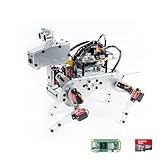
- Raspberry Pi AI Robot: powered by Raspberry Pi (5/4B/3B+/3B/Zero 2W), features 12 servos and sensors for vision, hearing, and touch. Integrated with ChatGPT-4o, it responds to complex queries. With app control and FPV, users can manage and see its view in real-time. It supports Python programming
- Realistic Movements: 12 powerful servos enable 32 actions, including walking, sitting, standing, shaking its head, wagging its tail, and performing playful tricks, closely mimicking a real and providing an engaging experience
- Rich Sensor Suite for Interactive Experiences: features ultrasonic, touch, gyroscope, sound, camera, speaker and microphone. These provide it with advanced hearing, vision, and touch, enabling it to see, detect obstacles, respond to touch, and recognize sounds, making interactions highly engaging
- Engaging Interactions with ChatGPT-4o: with ChatGPT-4o enables voice interactions and visual recognition, making it smarter and more responsive. Users can have natural conversations, solve math problems via the camera, and interpret gestures, creating diverse and fun interactions
- Comprehensive Learning Resources and Support: offers detailed online documentation, video tutorials, prompt technical support, and an active forum community, ensuring beginners can easily complete all projects and enjoy a great experience
How to decide what an agent may do
Set permissions around the work and the consequences of error, rather than choosing a company-wide autonomy setting. These questions help determine whether a task is suitable for delegation and what oversight it needs:
- Role and scope: What job is the agent responsible for, what decisions may it make, and which data or systems can it access?
- Predictability and context: Does the task follow repeatable rules, or does it involve changing conditions that could alter the right action?
- Impact and reversibility: What could go wrong, who could be affected, and can the resulting action be rolled back?
- Monitoring and escalation: Can operators trace actions, detect exceptions, stop the agent, and route uncertain cases to a person?
- Ownership and readiness: Who is accountable for the outcome, and do the operating model, governance, workforce, and data support the workflow?
These are decision axes, not a ranking that makes broad autonomy inherently better than bounded autonomy. As the agent’s access, range of decisions, or potential impact grows, the case for stronger monitoring and clearer intervention paths grows with it.
Rank #4
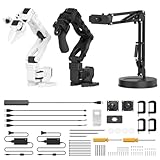
- 【End-to-End Imitation Learning】Hiwonder SO-ARM101 robot arm is an embodied intelligent hardware platform compatible with the Lerobot open-source framework. It provides developers with streamlined access to shared code, templates, and pre-trained models to explore the latest advancements in AI research.
- 【Dual-Camera Vision System】Equipped with both a gripper-mounted camera and an external camera, the system supports both precise manipulation and environmental awareness for accurate imitation learning.
- 【Hiwonder High-Performance Bus Servos】Featuring 12 high-torque bus servo motors with magnetic feedback, the Hiwonder SO-Arm101 robotic arm delivers smooth, stable motion, eliminating issues like power deficiency and jitter.
- 【Professional Control & Debugging】Integrated with the Hiwonder BusLinker V3.0 debugging board, the system supports servo scanning, real-time status monitoring, and trajectory control. The professional PC software simplifies device calibration and debugging, making it accessible for both researchers and hobbyists.
- 【Open-Source Compatibility】The SO-ARM101 robotic arm is designed to be fully compatible with the LeRobot open-source project. We acknowledge the contributions of the open-source community; all trademarks and copyrights belong to their respective owners.
Governance is part of the competitive capability
Permission without accountability is not a sound delegation model. Gartner warns against applying identical controls regardless of an agent’s autonomy and scope. It says the organization remains accountable for outcomes and recommends governance proportionate to risk, including monitoring, guardrails, rollback mechanisms, circuit breakers, and clear ownership for high-autonomy systems. Gartner, February 18, 2026.
Gartner also forecasts that 40% of enterprises will demote or decommission autonomous agents by 2027 because governance gaps are identified after production incidents. This is a forecast about a future outcome, not a measured rate of current failures. Its practical warning is that weak oversight can erase the value of delegation: an agent that cannot be understood, interrupted, or held to a clear operating boundary can create costs that outweigh any speed gained.
For high-tech leaders, the strategic question is therefore not simply how much work AI can do. It is whether the company can define and enforce the boundaries of delegated work, observe what happens, and remain accountable when the system acts.
A practical path to granting autonomy
- Choose a bounded workflow. Start with a task whose role, inputs, expected actions, and acceptable outcomes can be described clearly. Avoid granting broad access just because an agent can technically use more systems.
- Set the permission boundary. Specify which decisions and actions the agent may take, what data it may use, and which cases require human approval. Align those limits to the task’s predictability and potential impact.
- Build oversight before expanding authority. Establish traceability, monitoring, escalation, and a way to stop or reverse actions where possible. Define who owns the workflow and its outcomes.
- Expand only when the organization is ready. Review operating processes, governance, workforce needs, and technology and data arrangements alongside agent performance. Increase scope only when the oversight model can support it.
For readers translating this strategy into an organizational next step, the relevant capability is enterprise AI governance and agent oversight—not simply access to a more capable model. Genpact’s research page describes contributions from more than 500 senior executives at enterprises with revenues ranging from $1 billion to over $50 billion; the page does not establish a publication year in the surfaced material, so those contributions should not be read as a dated adoption statistic. Genpact, “How to scale AI for enterprise value”.
Quick Recap
Product prices and availability are accurate as of the date/time indicated and are subject to change. Any price and availability information displayed on Amazon at the time of purchase will apply.
Free tools Windows power users keep installed
One-click scans. No signup required.

