
There is no single answer to “the first binary computer” unless you specify what counts as a computer. The Z3 is a strong answer for a working, programmable binary machine; Iowa State calls the ABC the first electronic digital computer; and the earlier Z1 was a mechanical, programmable binary machine.
What does “first binary computer” mean?
Binary represents information using two states, commonly written as 0 and 1. But that describes how a machine represents values, not whether it is electronic, programmable, or general-purpose. Different definitions of “computer” therefore produce different historical firsts.
- Binary: the machine represents numbers or other information using two states.
- Programmable: it can follow an encoded sequence of operations, rather than being limited to one fixed task.
- Electronic: it uses electronic components. Relay-based machines are electromechanical, not fully electronic.
Those distinctions matter: an electronic equation solver, a mechanical programmable calculator, and a working programmable relay computer do not meet the same test.
Which machine was first? It depends on the criterion
| Machine | Construction and capability | Priority claim and qualification |
|---|---|---|
| Z1 | Mechanical, binary, and program-controlled. | An early programmable binary machine, but not electronic. The German Patent and Trade Mark Office describes it as built in 1938: Konrad Zuse. The Deutsches Technikmuseum describes its binary and mechanical features: Computers. |
| Atanasoff-Berry Computer (ABC) | An electronic digital machine built by John Vincent Atanasoff and Clifford Berry to solve equations; it was not programmable. | Iowa State University Library calls it the world’s first electronic digital computer: John Vincent Atanasoff Collection: About. The Computer History Museum identifies its equation-solving role and says it was not programmable: Atanasoff-Berry Computer. |
| Z3 | Relay-based and electromechanical; it performed floating-point binary arithmetic and had a 22-bit word length. | The Deutsches Museum calls it the world’s first programmable binary computer: Computers. The Computer History Museum dates its completion to 1941 and lists 2,300 relays: Timeline of Computer History. It was programmable, but not fully electronic. |
Why the Z1, ABC and Z3 claims can all be true
The Z1: an early programmable binary machine
The Z1 fits a definition that prioritizes binary representation and programmability, without requiring electronic construction. Its mechanical design rules it out if “computer” in the question specifically means an electronic machine.
The Tool Desk
Outbyte Driver Updater FREEScan for outdated or missing drivers - takes under a minuteDriver Scan →Outbyte PC Repair FREEClear out junk files and repair common Windows errorsFree Scan →#1 Best Overall

- Spacious Design: Measuring 21.1" wide and 14.1" deep, our lap desk comfortably fits most laptops up to 15.6". Extra room for accessories ensures convenience.
- Enhanced Functionality: Packed with handy features, including a 5x9" precision tracking mouse pad and a built-in phone slot for seamless work or video calls. Plus, enjoy ergonomic support with the integrated cushioned wrist rest.
- Cool Comfort: Enjoy a stable surface with our lap desk's dual bolster cushion, designed for comfort and airflow, keeping your lap cool during extended use.
- Durable Surface: Work with confidence on our lap desk's solid surface, featuring a sleek black carbon color, ensuring optimal air circulation to prevent your laptop from overheating.
- On-the-Go Convenience: With an integrated handle and lightweight design (2.8 lbs), our lap desk is portable for travel or moving around the house, offering flexibility in any space.
The ABC: first under an electronic-digital definition
Atanasoff began developing concepts for an electronic computing machine at Iowa State in 1937, later working with graduate student Clifford Berry on the ABC. Iowa State’s collection uses the “first electronic digital computer” characterization. The Computer History Museum’s account supplies an important qualification: the ABC solved equations but was not programmable.
The Z3: a working programmable binary computer
Konrad Zuse completed the Z3 in 1941. Its relays made it electromechanical, while its binary arithmetic and ability to execute programs support the “first programmable binary computer” description used by the Deutsches Museum. The German Patent and Trade Mark Office likewise describes the Z3 as the first functional freely programmable computer based on the binary number system and circuitry: Konrad Zuse.
Rank #2

- 5-in-1 Connectivity: Equipped with a 4K HDMI port, a 5 Gbps USB-C data port, two 5 Gbps USB-A ports, and a USB C 100W PD-IN port. Note: The USB C 100W PD-IN port supports only charging and does not support data transfer devices such as headphones or speakers.
- Powerful Pass-Through Charging: Supports up to 85W pass-through charging so you can power up your laptop while you use the hub. Note: Pass-through charging requires a charger (not included). Note: To achieve full power for iPad, we recommend using a 45W wall charger.
- Transfer Files in Seconds: Move files to and from your laptop at speeds of up to 5 Gbps via the USB-C and USB-A data ports. Note: The USB C 5Gbps Data port does not support video output.
- HD Display: Connect to the HDMI port to stream or mirror content to an external monitor in resolutions of up to 4K@30Hz. Note: The USB-C ports do not support video output.
- What You Get: Anker 332 USB-C Hub (5-in-1), welcome guide, our worry-free 18-month warranty, and friendly customer service.
How to answer the question precisely
Attach the criterion to the name rather than presenting “first computer” as an unqualified title:
- For an early mechanical programmable binary machine: the Z1.
- For the first electronic digital computer in Iowa State’s account: the ABC, noting that it was not programmable.
- For a working programmable binary computer: the Z3, noting that it used electromechanical relays.
These labels reflect the specific claims made by the cited institutions. They are not interchangeable, and the phrase “first binary computer” alone does not identify which test is intended.
Quick Recap
Best Value

- Spacious Design: Measuring 21.1" wide and 12" deep, our lap desk comfortably fits most laptops up to 15.6". Extra room for accessories ensures convenience.
- Enhanced Functionality: Packed with handy features, including a 5x9" precision tracking mouse pad and a built-in phone slot for seamless work or video calls. Plus, enjoy laptop support with the integrated device ledge.
- Cool Comfort: Enjoy a stable surface with our lap desk's dual bolster cushion, designed for comfort and airflow, keeping your lap cool during extended use.
- Durable Surface: Work with confidence on our lap desk's solid surface, featuring a blush pink color, ensuring optimal air circulation to prevent your laptop from overheating.
- On-the-Go Convenience: With an integrated handle and lightweight design (2.14 lbs), our lap desk is portable for travel or moving around the house, offering flexibility in any space.
Rank #4

- Anti-Slip Surface - Transform your laptop into a mobile workstation with the AboveTEK portable laptop lap desk. The anti-slip surface provides a strong grip for laptops up to 15.6 inches(Diagonal), while the double rubber strip on the bottom ensures a stable display or typing experience on your lap, couch, or bed.
- Retractable Mouse Pad - Retractable laptop mouse pad extends on both directions for the left/right handed with elevation along the edges for stopping mouse from falling off. The size of laptop tray is 14" X 9.7" and the size of mouse pad is 7.4" X 6.1".
- Effective Heat Shield - The effective heat shield made of sturdy and thick material protects your laptop from overheating. Prioritizes your comfort and safety, an ideal lap pad or board for working anywhere.
- EASY to Carry and Store - With an ergonomic and simplistic design, the lap desk is portable to store in a backpack. Only 15" in size, 2.2 lb of weight and with slim 0.6 inch thickness, it is ready to be easily carried around.
- Widely Applicable - The smooth platform accommodates laptops and tablets up to 15.6 inches(Diagonal), making it a versatile accessory and one of the best gifts for mom, dad, students and professionals. Perfect for use as a laptop bed tray or tablet holder anywhere at home, library, or park.
Rank #3
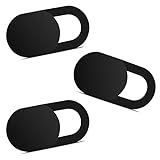
- Note: Not suitable for MacBooks released after 2023 or devices with a protruding front camera; Not applicable to full-screen or notch-style tempered glass screen protectors; Do not use on the rear camera of the phone.
- 💻 Why Do You Need a Webcam Cover Slide? — Safeguard your privacy by covering your webcam with our reliable webcam cover when not in use. Don't let anyone secretly watch you. Stay protected!
- ✅ Thin & Stylish — Enhance your laptop's functionality and aesthetics with our 0.027" ultra-thin webcam covers. Seamlessly close your laptop while adding a touch of sophistication.
- ✅ Fits Most Devices — Compatible with laptops, phones, tablets, desktops! Keep your privacy intact on Ap/ple, Mac/Book, iPh/one, iP/ad, H/P, L/novo, De/ll, Ac/er, As/us, Sa/msung devices.
- ✅ 365 Days Protection — Our upgraded 3.0 adhesive ensures a strong hold that won't damage your equipment. Experience reliable, long-term privacy protection day in and day out.
Product prices and availability are accurate as of the date/time indicated and are subject to change. Any price and availability information displayed on Amazon at the time of purchase will apply.

