
iTechGuides is reader-supported. When you buy through links on our site, we may earn an affiliate commission. As an Amazon Associate I earn from qualifying purchases. Learn more
Rank scanned PDFs using both the text OCR recognized and evidence about how uncertain that recognition is—but keep OCR confidence separate from relevance. A questionable word can still point to the right document, while a perfectly recognized word can appear in an irrelevant one. Preserve the source page and location, test alternatives to exact OCR matches, and judge ranking changes on the collection and queries that matter to your system.
Why can a relevant scanned PDF rank poorly when OCR is wrong?
Search over scanned PDFs depends on text extracted from page images. If OCR changes a word, drops it, or reads it in the wrong order, the search system may fail to match a query or may rank another document higher. This can happen even when the collection’s average retrieval score changes little: a modest aggregate difference can conceal important changes in which relevant documents appear near the top.
A 1996 vector-space study found ranking divergence across weighting combinations and identified cosine normalization as one contributor in its experiments. That work helps explain how recognition errors can affect ranking, but it predates current neural retrieval methods and does not establish how a modern retriever will behave. A 2020 study published through PubMed Central reported significant retrieval impacts beginning at a 5% error rate in its own experiments; that result is not a universal failure threshold.
What’s actually slowing this PC down?
Pick the symptom - the matching free tool is one click away.
OCR quality alone is also an incomplete measure of search quality. The 2026 ACL benchmark covers 11 challenging document types, including complex layouts, historical reading order, tables, and mathematical formulas. It reports that structural and semantic errors can cause problems for retrieval-augmented generation (RAG) even when a conventional transcription score looks good.
#1 Best Overall

- OUR MOST ADVANCED SCANSNAP. Large touchscreen, fast 45ppm double-sided scanning, 100-sheet document feeder, Wi-Fi and USB connectivity, automatic optimizations, and support for cloud services. Upgraded replacement for the discontinued iX1600
- CUSTOMIZABLE. SHARABLE. Select personalized profiles from the touchscreen. Send to PC, Mac, mobile devices, and clouds. QUICK MENU lets you quickly scan-drag-drop to your favorite computer apps
- STABLE WIRELESS OR USB CONNECTION. Built-in Wi-Fi 6 for the fastest and most secure scanning. Connect to smart devices or cloud services without a computer. USB-C connection also available
- PHOTO AND DOCUMENT ORGANIZATION MADE EFFORTLESS. Easily manage, edit, and use scanned data from documents, receipts, photos, and business cards. Automatically optimize, name, and sort files
- AVOIDS PAPER JAMS AND DAMAGE. Features a brake roller system to feed paper smoothly, a multi-feed sensor that detects pages stuck together, and skew detection to prevent paper damage and data loss
What should OCR confidence mean in a search system?
OCR confidence estimates whether recognized text is correct; relevance estimates whether a document answers a query. These are different questions, so a system should not treat a low OCR confidence value as though it were a low relevance score.
- A low-confidence word may be the crucial term that identifies a relevant document.
- A high-confidence word may be accurately recognized but unrelated to the query’s intent.
- A confidence value is useful only to the extent that it reflects recognition reliability for the OCR engine, document type, and collection in use.
Microsoft Research has studied uncertainty in relevance scores and risk-aware reranking, while OCR benchmarks document recognition errors and downstream retrieval problems. Taken together, this supports preserving the two kinds of uncertainty rather than collapsing them into one score. It does not provide a universal formula for converting an OCR engine’s confidence values into ranking weights.
Rank #2
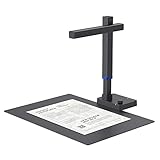
- Design and Speed: Work with Windows XP/7/8/10/11 AND macOS 10.13 or later. Not compatible with Android and iOS. Designed for A3&A4(11.69*16.53 & 8.27*11.75 inch) document, any objects smaller than A3 size can be scanned with Ultra-fast scanning speed, about 1 second per page. Perfect device to scan FLAT papers
- USB Document Camera & Scanner: Work as both a document camera for remote teaching&learning compatible with ZOOM; Goole Meet and a document scanner to scan papers and convert/OCR files. OCR supports 180+ languages for text recognition. Please note that Thai, Hebrew, and Arabic are currently not supported. If you need the complete OCR language support list, please feel free to contact us for more details
- Patented Flattening Curved Book Page Technology: Shine Ultra applies CZUR’s patented technology to flatten the curved surface after pixel transformation to flattening of the book page (Only suitable for thinner books, ET series is recommended for thicker books)
- High Resolution & AI Tech: CMOS 13MP (4160*3120, A4≈340 AND A3≈245 DPI) camera. Smart Paging and Auto Cropping; Combine Sides; Stamp Mode; and Multiple Color Modes
- Height Adjustable & Portable: 2-level height adjustable neck. 90 degree foldable and lightweight 4 lbs with foot pedal for convenient operation
How should a system preserve uncertain OCR?
Keep recognized text connected to its confidence and to the page evidence from which it came. A practical record can retain the text, a token-, span-, or region-level confidence value when available, page number, location, and access to the source image. This is implementation guidance, not a storage format mandated by the cited studies.
Free tools Windows power users keep installed
One-click scans. No signup required.
- Retain the recognized text. Search still needs usable text; uncertainty is not a reason to discard every imperfect recognition.
- Keep uncertainty at a useful granularity. A page-wide score may hide a single ambiguous name or a badly read table. Preserve token, span, or region detail when the OCR system provides it.
- Keep page and location provenance. A result should be traceable to the page and area that supplied the match.
- Keep the source image available. A reader or later processing stage can inspect ambiguous text instead of relying on a silently rewritten transcript.
- Do not silently turn a guess into fact. If the system stores alternate readings, keep them identifiable as alternatives rather than replacing the original recognition with one apparently certain version.
Should low-confidence OCR matches be penalized?
Not by default. A fixed penalty can demote the right document simply because its scan is poor, and a high confidence score cannot make irrelevant content useful. Use OCR confidence as evidence that can inform candidate generation, alternate-token expansion, review prioritization, or a calibrated reranker. If testing a direct penalty, treat it as a hypothesis to validate—not a general rule.
Rank #3

- FAST SPEEDS - Scans color and black and white documents a blazing speed up to 16ppm (1). Color scanning won’t slow you down as the color scan speed is the same as the black and white scan speed.
- ULTRA COMPACT – At less than 1 foot in length and only about 1. 5lbs in weight you can fit this device virtually anywhere (a bag, a purse, even a pocket).
- READY WHENEVER YOU ARE – The DS-640 mobile scanner is powered via an included micro USB 3. 0 cable allowing you to use it even where there is no outlet available. Plug it into you PC or laptop and you are ready to scan.
- WORKS YOUR WAY – Use the Brother free iPrint&Scan desktop app for scanning to multiple “Scan-to” destinations like PC, Network, cloud services, Email and OCR. (2) Supports Windows, Mac and Linux and TWAIN/WIA for PC/ICA for Mac/SANE drivers. (3)
- OPTIMIZE IMAGES AND TEXT – Automatic color detection/adjustment, image rotation (PC only), bleed through prevention/background removal, text enhancement, color drop to enhance scans. Software suite includes document management and OCR software. (4)
There is no universal conversion from an OCR engine’s confidence output to a ranking weight established by the cited work. Confidence may be poorly calibrated, and its meaning can vary across engines and document conditions. Check whether scores correspond to observed recognition correctness before relying on them for ranking decisions.
Can alternate readings help more than exact OCR matching?
They can be worth testing, particularly when OCR exposes plausible alternatives or likely character confusions. The NIST record of the TREC-5 Confusion Track reports that methods attempting probabilistic reconstruction generally performed better than methods that simply accepted corrupted text. This supports evaluating probabilistic term evidence or alternate readings; it does not guarantee improvement for every collection.
Rank #4

- FITS SMALL SPACES AND STAYS OUT OF THE WAY. Innovative space-saving design to free up desk space, even when it's being used
- SCAN DOCUMENTS, PHOTOS, CARDS, AND MORE. Handles most document types, including thick items and plastic cards. Exclusive QUICK MENU lets you quickly scan-drag-drop to your favorite computer apps
- GREAT IMAGES EVERY TIME, NO EXPERIENCE REQUIRED. A single touch starts fast, up to 30ppm duplex scanning with automatic de-skew, color optimization, and blank page removal for outstanding results without driver setup
- SCAN WHERE YOU WANT, WHEN YOU WANT. Connect with USB or Wi-Fi. Send to Mac, PC, mobile devices, and cloud services. Scan to Chromebook using the mobile app. Can be used without a computer
- PHOTO AND DOCUMENT ORGANIZATION MADE EFFORTLESS. ScanSnap Home all-in-one software brings together all your favorite functions. Easily manage, edit, and use scanned data from documents, receipts, business cards, photos, and more
The NIST comparison used a 55,600-document corpus with known underlying text and 49 known-item tasks. It compared original text with OCR-corrupted versions: one was estimated at approximately 5% character error rate and a down-sampled version at approximately 20%. These figures describe that experiment, not recommended limits or universal points at which search fails.
Recommended Free Tools
Correction is not automatically beneficial either. The 1996 vector-space study found that relevance feedback could not compensate for OCR errors in badly degraded documents. A 2023 study reported little average change in retrieval metrics across its full set of query topics after error correction. The practical implication is to test correction and alternate-reading methods on the target task rather than assume that either will help.
Best Value
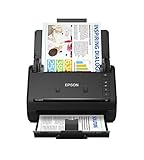
- FAST DOCUMENT SCANNING — Document scanner with feeder allows you to speed through stacks with a 50-sheet Auto Document Feeder (ADF); Efficient office scanner to help you scan more productively
- INTUITIVE, HIGH-SPEED SOFTWARE — Quickly scan with this desktop document scanner; Epson ScanSmart Software lets you easily preview scans, email files, upload to the cloud, and more; Plus, automatic file naming saves even more time
- SEAMLESS INTEGRATION — Easily incorporate your data into most document management software with the included TWAIN driver; Office document scanner integrates seamlessly with business workflows
- EASY SHARING — Duplex scanner allows you to scan straight to email or popular cloud storage2 services like Dropbox, Evernote, Google Drive, and OneDrive for simple storage and sharing
- SIMPLE FILE MANAGEMENT — Scanner allows the creation of searchable PDFs with Optical Character Recognition (OCR) and convert scans to editable Word or Excel files effortlessly; Designed for home and office document scanning
How should you evaluate uncertainty-aware ranking?
Compare approaches on the same corpus, queries, and relevance judgments. Include pages with varied scan quality and layouts, then measure the stages that matter to your application rather than treating OCR accuracy as a proxy for search success.
- Establish a baseline. Measure the ranker using the OCR text as it is currently indexed.
- Change one uncertainty strategy at a time. Compare the baseline with variants that retain confidence, add plausible alternate readings, or use uncertainty-aware reranking. Keep the evaluation set fixed so differences are interpretable.
- Check OCR quality against ground truth where available. This identifies recognition errors, but does not by itself establish whether search results improved.
- Measure retrieval effectiveness and rank stability. Use judged queries to see whether relevant documents are found and whether important results move in the ranking. Inspect individual query failures as well as aggregate metrics.
- Check calibration and risk. Determine whether confidence estimates correspond to observed recognition correctness or ranking risk on the evaluated material.
- For RAG, inspect the evidence and the answer separately. Check whether retrieved passages actually contain the needed support, then assess answer quality and whether the system avoids unsupported answers.
- Record operational cost and latency. Candidate expansion and extra scoring add work; the cited studies do not establish a generally cheapest or fastest approach.
The ICCV 2025 work separates OCR quality, retrieved evidence, and generation measures, while the ACL 2026 benchmark cautions that conventional OCR scores can miss downstream failures. Evaluating the full path—recognition, retrieval, evidence selection, and answer generation where applicable—makes it easier to identify which stage needs attention.
What does good OCR fail to tell you?
A transcription score says how closely recognized text matches a reference; it does not show whether the search system ranks the right PDF, retrieves the page with the needed evidence, or generates a supported answer. Layout and reading-order mistakes can disrupt useful evidence even if many words are recognized correctly. For scanned-PDF search, OCR accuracy is one diagnostic, not the verdict on retrieval quality.
Do these 3 things before closing this tab:
1Clear out junk files and repair common Windows errors2Fix the driver behind crashes, sound loss and screen glitches3Repair Windows errors before they cause bigger problemsQuick Recap
Product prices and availability are accurate as of the date/time indicated and are subject to change. Any price and availability information displayed on Amazon at the time of purchase will apply.

