
iTechGuides is reader-supported. When you buy through links on our site, we may earn an affiliate commission. As an Amazon Associate I earn from qualifying purchases. Learn more
The Indy Autonomous Challenge (IAC) is a university-centered competition in which student teams develop software to pilot autonomous racecars. Organized by Energy Systems Network (ESN), it uses racing conditions to challenge automated driving systems and give students practical STEM experience. It is a competition, not a consumer car model.
What is the Indy Autonomous Challenge (IAC)?
The IAC brings university teams together to develop and demonstrate software for fully autonomous racecars. ESN, an Indianapolis-based nonprofit and a branded initiative of the Central Indiana Corporate Partnership and CICP Foundation, organizes the program with academic institutions and public- and private-sector partners. The IAC describes its mission as advancing autonomous-vehicle technology and advanced driver-assistance systems (ADAS), tackling difficult driving situations, and supporting STEM education.


In this context, “autonomous” refers to software and vehicle systems controlling the racecar rather than a human driver steering it. Teams work on the technology that lets the car perceive and respond to its environment and execute driving maneuvers. The IAC presents high-speed racing as a proving ground for difficult scenarios; its stated ambitions for transportation safety and commercialization are goals, not proof that the competition has independently improved road-safety outcomes.
What cars does the competition use?
Current racecar: AV-24
The IAC identifies the AV-24 as its current racecar. It is an IAC-built vehicle retrofitted with automation hardware and controls, using a modified Dallara Indy NXT chassis. Dallara’s Italian headquarters and its IndyCar factory in Speedway, Indiana, collaborated on the car. The IAC racecar page provides its current description.
Inaugural car: modified Dallara IL-15
The inaugural 2021 competition used an earlier modified Dallara IL-15, not the AV-24. According to the IAC’s historical media FAQ, students from Clemson University’s Deep Orange 12 program retrofitted the IL-15 with hardware and controls for automation. The two car generations should not be treated as the same vehicle.
How the IAC competition has changed
The inaugural Indianapolis event
The first IAC competition took place at Indianapolis Motor Speedway on October 23, 2021. The organization’s overview reports that 21 universities from nine countries formed nine teams, and that TUM Autonomous Motorsport won. The overview calls the grand prize $1 million, while the historical media FAQ describes the event as a $1.5 million prize competition. The pages do not explain the difference, so those figures should be understood as separate descriptions rather than interchangeable totals.
Rank #2
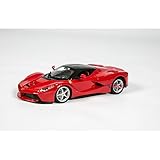
- 1/24 scale model
- Diecast metal body with plastic parts
- Packaging: Original factory window retail box
- 1/24 scale diecast car with metal body and plastic parts, opening engine compartment and full function steering by Bburago.
- Full function steering
Head-to-head passing and the 2026 Laguna Seca event
The IAC later developed head-to-head passing competitions. In the Laguna Seca event announced for September 3, 2026, two cars alternated attacker and defender roles through progressively demanding rounds. The IAC described it as the first road-course adaptation of its passing competition. Its media archive reports that UNIMORE Racing won with a pass into Laguna Seca’s Zanardi Corkscrew.
The format tests more than outright pace: cars must negotiate a road course while reacting to another autonomous car. In the event announcement, IAC Technical Lead Janam Sanghavi said the drivers had to manage changing corner geometries, braking zones, limited sightlines, and rapid elevation changes while anticipating and responding to another racecar. The IAC’s July 29, 2026 announcement also quoted CEO Paul Mitchell describing the competition as a proving ground for the goal of safe high-speed autonomous driving. These are the organization’s descriptions of the challenge and its aims.
Independent reader supportYour contribution helps us test, update, and keep practical guides available for everyone.Why race autonomous cars?
Racing creates demanding conditions in which automated systems must make decisions at speed, including responding to obstacles and other cars while maintaining control. The IAC says work on these edge cases can contribute to autonomous-vehicle development, ADAS, and safety and performance in motorsports and commercial transportation. It also positions the competition as a hands-on STEM platform for university students. Those are the program’s stated objectives; they do not establish that technology developed for the race has been deployed in ordinary road cars or produced measurable safety gains.
Quick Recap
Best Value

- LAMBORGHINI REVUELTO SUPERCAR MODEL CAR KIT - Build the cutting-edge Lamborghini Revuelto, the brand’s first hybrid V12 supercar, recreated in highly detailed 1:24 scale for collectors and car enthusiasts.
- HIGHLY DETAILED 101-PIECE KIT - Includes multi-piece interior, detailed chassis, and precision-molded components that bring this next-generation supercar to life.
- REALISTIC V12 ENGINE DETAIL - Features a highly detailed hybrid V12 engine with opening engine cover, allowing you to showcase the heart of Lamborghini performance.
- POSEABLE & CUSTOM FEATURES - Front wheels can be positioned left or right, and the interior includes optional left- or right-hand drive configuration for added realism.
- AUTHENTIC INTERIOR DESIGN - Detailed cockpit with sport bucket seats and driver-focused layout, inspired by the real Revuelto’s aerospace-style interior.
Product prices and availability are accurate as of the date/time indicated and are subject to change. Any price and availability information displayed on Amazon at the time of purchase will apply.

