
The Tool Desk
Outbyte PC Repair FREERepair Windows errors before they cause bigger problemsFix Now →Outbyte Driver Updater FREEFix the driver behind crashes, sound loss and screen glitchesFind Drivers →For one Radeon HD 5770 paired with an Intel Core i5-2500K, use a reputable power supply rated at least 450 W continuous output with a native 6-pin PCIe power connector. Gigabyte and HIS both publish that baseline for single-card HD 5770 systems. The exact PSU still depends on the card variant, the rest of the components, and the condition of the unit.
Single-card PSU requirement
Gigabyte’s GV-R577 series manual requires “at least 450-watt” and one 75 W 6-pin PCIe power connector for a single HD 5770. HIS gives the same 450 W-or-greater, one 6-pin recommendation for its HD 5770 Fan. See the Gigabyte GV-R577 manual and HIS HD 577 specifications.
| Configuration | Published PSU guidance | PCIe connectors |
|---|---|---|
| One Radeon HD 5770 | 450 W or greater | One 6-pin (75 W) connector |
| Two HD 577 cards in CrossFireX | 600 W | Two 6-pin connectors |
The 600 W figure is specifically for Gigabyte’s CrossFireX configuration; it is not the requirement for a normal single-card build.
What the Core i5-2500K specification means
Intel lists the Core i5-2500K with a 95 W TDP on its processor specification page. TDP describes the processor’s thermal-design rating; it is not a complete-system power measurement and is not a PSU recommendation. Do not size the supply by simply adding 95 W to an assumed graphics-card wattage. Drives, fans, the motherboard, USB devices, overclocking, efficiency, and the PSU’s age also matter.
Recommended Free Tools
#1 Best Overall
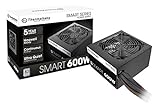
- Delivers 600W Continuous output at plus 40℃. Compliance with Intel ATX 12V 2. 31 and EPS 12V 2. 92 standards
- 80 PLUS Certified – 80% efficiency under typical load. Power good signal is 100-500 millisecond
- Supports (2) PCI-E 6 plus 2pin Connectors. Active (PFC) Power Factor Correction, MTBF: 100, 000 hours
- Industry Grade Protections: (OPP) Over Power Protection, (OVP) Over Voltage Protection, (SCP) Short Circuit Protection
- Hold up time is 16 millisecond minimum within 60 percent load. Input frequency range 50 - 60 in Hz
How to check a candidate PSU
- Confirm continuous wattage. A genuine 450 W-or-higher rating should be continuous output, not a short-lived peak claim.
- Check the 12 V specification. The manufacturer should publish the unit’s 12 V capability. A wattage label without verifiable electrical specifications is a warning sign.
- Locate the graphics connector. The card needs one native 6-pin PCIe plug. A manufacturer’s 6+2 PCIe plug can be used as a 6-pin when the two-pin section is left aside; do not confuse it with a CPU/EPS connector.
- Match the exact board. Cooler, factory-overclocked, and vendor-specific HD 5770 versions can have different requirements. Follow the card’s own manual when it differs.
- Consider the complete build. Add the motherboard, storage, memory, fans, optical drives, USB-powered devices, and any overclocking when judging headroom.
- Inspect age and condition. A dusty, damaged, heavily used, or unknown-brand unit is not made safe by a 450 W label. Replace questionable hardware rather than relying on adapters or splitters.
Why some references say 500 W
An MSI forum FAQ lists 500 W and 34 A as a more conservative cross-check for graphics-card power requirements: MSI power-requirements FAQ. That secondary figure does not establish a universal requirement for every HD 5770 board and system. For a single card, the board-specific 450 W guidance from Gigabyte and HIS is the applicable starting point; choosing a quality 500 W unit can simply provide additional margin.
Connector and build pitfalls
- No 6-pin plug: Do not assume a SATA or peripheral-to-PCIe adapter is equivalent to a properly wired PCIe output, especially on an old or low-quality supply.
- Overclocking: The unlocked 2500K can be overclocked, increasing consumption and heat. Leave more headroom and verify cooling.
- Multiple graphics cards: Re-evaluate wattage and connector count for CrossFireX; use the 600 W/two-6-pin guidance only for that two-card scenario.
- Unknown used PSU: Capacitor aging and prior stress can reduce dependable output even when the printed rating looks adequate.
Legacy-platform caveat
The HD 5770 is a legacy product. AMD’s support page lists old driver releases, including Catalyst 15.7.1 WHQL dated July 29, 2015. A PSU that meets the electrical requirement does not guarantee drivers or operating-system compatibility on a current PC.
Rank #2

- Delivers 500 Watt Continuous output at plus 40 degree. Compliance with Intel ATX 12 Volt 2.31 and EPS 12V 2.92 standards
- 80 PLUS Certified, 80 percentage efficiency under typical load
- Supports (2) PCI E 6plus2pin Connectors. Active (PFC) Power Factor Correction, MTBF: 100,000 hours
- Industry Grade Protections: (OPP) Over Power Protection, (OVP) Over Voltage Protection, (SCP) Short Circuit Protection
- High Quality Components
What is needed for a model-specific verdict
To judge whether a particular unit is suitable, provide its exact make and model, age, 12 V rating, available PCIe connectors, the exact HD 5770 variant, motherboard, drives, fans, and any CPU or GPU overclock. Without those details, the defensible answer is the 450 W single-card baseline with one 6-pin PCIe connector—not a guarantee that every 450 W supply will work safely.
Quick Recap
Best Value

- 80 PLUS Certified with Efficiency of up to 86%
- Continuous Power Design
- Has well Ready
- Ultra Quiet 120mm Fan for excellent airflow
- 5 Year Warranty
Rank #4

- 80 PLUS GOLD CERTIFIED
- 10-year limited warranty, guaranteeing long term reliable operation
- Fully modular design
- ATX 3.1 & PCIE 5.1
Rank #3

- 80 PLUS GOLD CERTIFIED
- 10-year limited warranty, guaranteeing long term reliable operation
- Fully modular design
- ATX 3.1 & PCIE 5.1
Product prices and availability are accurate as of the date/time indicated and are subject to change. Any price and availability information displayed on Amazon at the time of purchase will apply.
Quick wins for a faster PC:
Clear out junk files and repair common Windows errorsFree Scan →Scan for outdated or missing drivers - takes under a minuteDriver Scan →Repair Windows errors before they cause bigger problemsFix Now →
