
There is no universally best RAID stripe size. For a new array with no measured workload, use the controller’s documented default or benchmark candidates such as 64 KiB and 256 KiB. Small random I/O often favors smaller stripe units; large sequential transfers often favor larger units. On RAID 5 or RAID 6, alignment with a full stripe and avoidance of parity read-modify-write operations can matter more than choosing a particular number.
This guide uses “stripe size” for storage RAID. Controller vendors may instead call the per-disk value the strip size, chunk size, element size or stripe unit, so verify the definition before comparing settings.

Stripe unit, full stripe and stripe width
Seagate defines the stripe size as the amount written to one drive before the controller moves to the next drive. In this article, that per-disk amount is the stripe unit. A full stripe is the complete data span across all data disks, plus parity where the RAID level uses it. Vendors are inconsistent: some interfaces label the per-disk chunk “stripe size,” while others use that term for an aggregate width. SNIA’s RAID terminology likewise distinguishes chunks distributed across disks from the resulting stripe.
For parity RAID:
full-stripe data width = stripe unit × number of data disks
#1 Best Overall

- Compatible with: LSI 9300-8i; Controller: LSI/Broadcom SAS3008 (12Gb/s SAS)
- Firmware (FW): HBA IT Mode (Non-RAID); Data Transfer Rate: up to 12Gbps SAS, SATA 6Gbps
- Host Interface: PCIe 3.0 x8; Internal Connectors: 2× Mini-SAS HD SFF-8643. --Direct attach up to 8 drives, and expand via external SAS Expander for large arrays
- PERFECT FOR: ZFS, FreeNAS/TrueNAS, unRAID, Proxmox, ESXi home-lab & NAS storage
- Packing List: HBA Card ×1; 2× SFF-8643 to 4× SATA cables (8× SATA ends). --Cables in box are for SATA drives. They are not compatible with SAS drives. To connect SAS drives, use SFF-8643 to 8482 SAS cables (sold separately) or our matched HBA + cable kit.
| RAID level | Total members | Approximate data members | Full-stripe data width with 64 KiB units |
|---|---|---|---|
| RAID 5 | 5 | 4 | 256 KiB |
| RAID 5 | 6 | 5 | 320 KiB |
| RAID 6 | 6 | 4 | 256 KiB |
| RAID 6 | 10 | 8 | 512 KiB |
| RAID 10 | Varies | Depends on layout | Vendor-specific |
Nested RAID, distributed parity, hot spares and controller-specific layouts can change the exact interpretation. Record whether a displayed value is per disk or aggregate before calculating anything.
See Seagate’s RAID concepts, SNIA’s RAID terminology and HPE’s strip-size documentation.
Starting points by workload
| Workload | Reasonable starting point | What to validate |
|---|---|---|
| RAID 10, random database or VM I/O | 64–256 KiB candidate | Latency, tail latency, queue depth and guest or database request sizes |
| RAID 5/6, large sequential files or media | 256 KiB–1 MiB where supported | Full-stripe transfer size, parity behavior and rebuild impact |
| RAID 5/6, small random writes | Benchmark smaller and moderate units | Read-modify-write frequency and aligned full-stripe writes |
| Mixed or unknown workload | Vendor default, then 64 and 256 KiB tests | Representative application mix rather than a single synthetic test |
| Cloud-managed disks | Often not user-configurable | Disk tier, VM size, disk count, filesystem layout and queueing |
These are test candidates, not promises. Microsoft Azure documents 64 KB as an SQL Server OLTP example and 256 KB for data warehousing on premium storage; those examples demonstrate workload dependence, not a universal rule. HPE documentation describes strip sizes from 64 KiB to 1 MiB and advises matching strip and stripe behavior to application I/O size and alignment.
How RAID level changes the answer
RAID 0
RAID 0 has no redundancy. Larger units can suit sequential transfers; smaller units can distribute some requests more broadly but may split individual requests unnecessarily. Use it only when another protection or replication strategy exists.
Free tools Windows power users keep installed
One-click scans. No signup required.
Rank #2
RAID 1 and RAID 10
Mirroring reduces the parity concerns that make stripe tuning difficult. Read distribution, write-back cache, controller firmware and drive latency may have a larger effect than nearby stripe-unit choices. RAID 10 is often easier to tune for random transactional or virtual-machine workloads, but benchmark it if performance is important.
RAID 5 and RAID 6
Parity makes stripe size more consequential. A write smaller than a full stripe can require reading old data and parity, calculating new parity and writing the result. An aligned full-stripe write can avoid some of that read-modify-write work. RAID 6 adds a second parity calculation and is generally more sensitive to sustained writes and controller implementation.
If a workload is write-heavy and latency-sensitive, changing to RAID 10 may produce a larger improvement than trying to optimize a parity array’s stripe unit. IBM Storage Scale warns that a filesystem block size that is not equal to or a multiple of the RAID stripe size can severely degrade write performance through additional read-modify-write operations.
Stripe size by application
OLTP databases
Online transaction processing usually issues small, random, latency-sensitive requests. Start with smaller or moderate candidates, such as 64 KiB and 256 KiB, and measure actual database I/O. Microsoft’s 64 KB Azure SQL OLTP guidance is a platform-specific example, not a prescription for every database or controller. RAID 10 commonly avoids parity-update overhead. Durability settings, protected write-back cache and log-device behavior can matter more for database logs, which are primarily sequential writes.
Outdated Drivers Are Slowing You Down
One free scan finds every outdated or missing driver and matches the right update for your exact hardware.Free scan · exact hardware matchPC Slower Than It Used to Be?
A free scan shows the junk files, broken settings and background clutter dragging Windows down - then fixes them in one click.Free scan · Windows 10 & 11Rank #3

- LSI 9211-8I SAS2008 CHIP
- (LSI 9211-8i) FW: P20 IT Mode
- 6Gbps PCI E X8 2.0
- ZFS FreeNAS unRAID
- Packing List: HBA Card ×1,High and low bracket*1,2*SFF-8087-SATA Cable
Data warehouses and analytics
Scans and bulk loads issue larger, more sequential transfers. A larger unit may reduce request splitting and improve sustained throughput. Microsoft documents 256 KB for SQL Server data warehousing on Azure Premium Storage; test that value against your array, filesystem and query workload. Oracle ASM has its own stripe-depth considerations, so do not blindly translate filesystem or hardware-RAID advice; consult Oracle’s I/O configuration guidance.
Virtual machines
A VM datastore combines guest filesystems, metadata, snapshots and many unrelated queues. A sequential benchmark cannot represent it. Test the real guest mix with production-like block sizes, concurrency and snapshots. Record average and 95th, 99th and 99.9th-percentile latency, not only throughput. RAID 10 is often simpler to size for mixed random writes than RAID 5/6.
File servers, media and backups
Video, graphics, backup streams and archival transfers are generally large and sequential, so larger units can be appropriate. Small office files, directory operations and metadata are much less sequential. File size alone does not determine the right setting; measure the actual request pattern and concurrency. Seagate describes larger stripe sizes as generally suitable for large sequential transfers and smaller sizes as potentially better for smaller mixed workloads.
NAS and homelab arrays
First identify whether you are using a hardware controller, Linux software RAID, ZFS, Storage Spaces, a parallel filesystem or a managed service. ZFS RAIDZ, erasure coding, Lustre and GPFS/Storage Scale expose different concepts and tuning controls. A hardware-RAID number is not automatically applicable to them. With no workload data, retain the documented default and test before rebuilding a pool or array.
What’s actually slowing this PC down?
Pick the symptom - the matching free tool is one click away.
Rank #4

- Part Number: 5FMY4
- 8GB Nonvolatile Cache
- Supports 12Gb/s SAS and 6Gb/s SATA
- RAID levels: 0, 1, 5, 6
- RAID spans: 10, 50, 60
Filesystem, database and partition alignment
A filesystem allocation unit or database block is a higher-layer unit; it is not automatically the RAID stripe unit. If a logical request crosses stripe boundaries, the controller may touch more disks or perform extra parity work. Check all layers together:
- RAID stripe unit and full-stripe data width.
- Partition start offset and virtual-disk alignment.
- Filesystem allocation unit.
- Database block size or ASM stripe depth.
- Hypervisor datastore and guest-filesystem alignment.
- SSD erase-block or flash-translation behavior where relevant.
Do not apply the slogan “make the filesystem block equal to the stripe size” without defining which stripe value is meant and confirming the platform’s documented relationship. IBM’s Storage Scale guidance specifically calls for the RAID stripe size to be equal to or a multiple of the filesystem block size.
Why small-versus-large rules conflict
Small units reduce the amount of data touched by some small random requests, but units that are too small can split a single request across many disks. Large units favor sequential transfers and fewer splits, yet can be a poor match for small random operations. On parity RAID, the best value may be the one that makes the workload’s common writes full-stripe operations. Controller cache, queue handling, SSD or HDD latency and workload concurrency can amplify or hide these effects.
A benchmark result is meaningful only when its block size, queue depth, read/write ratio, dataset size and cache state resemble production. A few percent of synthetic throughput is rarely worth a risky migration.
The Tool Desk
Outbyte PC Repair FREEClear out junk files and repair common Windows errorsFree Scan →Outbyte Driver Updater FREEFix the driver behind crashes, sound loss and screen glitchesFind Drivers →Best Value
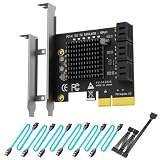
- 6-PORT SATA EXPANSION CARD: Adds 6 SATA III (6Gbps) drives to your desktop at once, turning one PCIe x4 slot into a 6-bay storage pool for unRAID, TrueNAS, ZFS, Proxmox or Windows Storage Spaces software RAID. Hardware RAID is not supported.
- 277MB/S ON EVERY PORT: PCIe 3.0 X2 upstream runs at 16GT/s, and each of the 6 SATA ports delivers up to 277MB/s, so large multi-drive transfers, media libraries and backup jobs finish fast with no bottleneck.
- NO DRIVER, WIDE COMPATIBILITY: Plug and play on Windows (except XP), Mac OS, Linux and NAS systems. Set SATA mode to AHCI in BIOS or UEFI before first install. This is a data storage HBA and does not boot an operating system.
- 6 BUILT-IN LED INDICATORS: A steady red LED means the drive is powered, a flashing LED means it is reading or writing, so you can check every SATA drive at a glance without opening the case.
- FITS X4/X8/X16 SLOTS, FULL KIT INCLUDED: Ships with 6 x SATA III cables (350mm/13.5in), a 1:5 SATA power splitter cable, and both a 12cm regular and an 8cm low-profile bracket for any PC or NAS case.
A practical selection procedure
- Characterize the workload. Measure read/write ratio, random/sequential mix, request sizes, queue depth, concurrency, latency target, hot-set size and degraded-mode requirements. Do not classify a workload only by its application label.
- Confirm the controller’s terminology. Determine whether the interface asks for strip size, stripe size, chunk size, element size or stripe width, and whether the number is per disk or aggregate.
- Build a small test matrix. Try 64, 128, 256 and 512 KiB, plus 1 MiB where supported and relevant. The objective is to find a meaningful trend, not false precision.
- Benchmark realistically. Use production-like I/O sizes, read/write ratios and queue depths; a dataset larger than cache; and sustained runs long enough to expose cache exhaustion. Measure IOPS, throughput, average latency, tail latency, CPU, cache hit rate and drive endurance indicators.
- Check alignment. Verify partition offsets, filesystem and database units, virtual disks, full-stripe width and any array page or extent size.
- Test failure conditions. Repeat key tests during rebuild, a failed-disk state, parity verification, SSD garbage collection, near-full capacity and concurrent snapshots or backups. HPE notes that smaller strip sizes can increase the duration and host impact of background parity scans and rebuilds.
- Choose the smallest operationally justified change. If nearby values perform similarly, prefer the vendor-supported default and simpler migration.
Microsoft’s storage-performance guidance likewise emphasizes workload-appropriate benchmarking rather than a universal stripe number.
Common mistakes
- Treating 64 KiB as a law: it is common in examples and defaults, but Microsoft also documents 256 KB for data warehousing.
- Confusing stripe unit with full stripe: “256 KB stripe” is incomplete unless you state per disk or across data disks.
- Ignoring parity: healthy sequential throughput can conceal poor small-write and degraded-mode behavior on RAID 5/6.
- Testing only sequential transfers: include random I/O, latency percentiles, realistic queues and a cache-sized dataset.
- Ignoring controller cache: write-back policy, battery or flash protection, firmware and queue handling can outweigh a nearby stripe-size choice.
- Applying hardware-RAID advice to other systems: ZFS, mdraid, Storage Spaces, vSAN, Lustre and GPFS have different layout controls.
- Changing a production array casually: changing stripe configuration commonly requires recreating or migrating the array, with a tested backup and downtime plan.
When stripe-size tuning is the wrong solution
Reconsider the larger design when the real bottleneck is the RAID level, disk count, controller cache protection, drive type or endurance, queue depth, dataset placement, database indexing, snapshot architecture or cloud disk tier. Managed cloud disks may expose no RAID stripe setting at all; the practical choices are often VM size, disk tier, disk count, filesystem layout and workload distribution. Hardware RAID vendors such as HPE, Seagate and Dell sell complete controller-and-drive platforms, so cache protection and compatibility deserve at least as much attention as stripe size.
Pre-creation checklist
- Have you measured real I/O sizes, concurrency and read/write mix?
- Do you know whether the selected value is per-disk strip size or aggregate stripe width?
- Have you calculated full-stripe data width from the number of data disks?
- Are partition, filesystem, database, hypervisor and RAID boundaries aligned?
- Have you tested random, sequential, latency-sensitive and degraded workloads?
- Is the chosen RAID level appropriate, or would RAID 10 solve the write workload more directly?
- Do you have a backup, migration and downtime plan if the array must be recreated?
The Bottom Line
Bottom line: choose stripe size from measured I/O behavior, not a universal chart. For an uncharacterized array, keep the vendor default or benchmark 64 KiB and 256 KiB first; then select the value that delivers the required latency and throughput with correct alignment and acceptable rebuild behavior.
Quick Recap
Product prices and availability are accurate as of the date/time indicated and are subject to change. Any price and availability information displayed on Amazon at the time of purchase will apply.
Do these 3 things before closing this tab:
1Fix the driver behind crashes, sound loss and screen glitches2Clear out junk files and repair common Windows errors3Scan for outdated or missing drivers - takes under a minute
