
Crashes, No Sound, or Screen Glitches?
Random freezes, missing sound and display glitches usually trace back to one bad driver. Find and replace yours safely.Free scan · under a minutePC Slower Than It Used to Be?
A free scan shows the junk files, broken settings and background clutter dragging Windows down - then fixes them in one click.Free scan · Windows 10 & 11iTechGuides is reader-supported. When you buy through links on our site, we may earn an affiliate commission. As an Amazon Associate I earn from qualifying purchases. Learn more
A wireless USB hub lets USB peripherals connect to a computer without each device running a direct USB cable to it. The name can describe two different setups: standards-oriented Wireless USB hardware, or a hub or device server that shares USB devices over Wi-Fi or another IP network. They work differently, so check a product’s connection method, host requirements, and supported peripherals before buying.
What does “wireless USB hub” mean?
A USB hub expands the number of USB peripherals a host can access. “Wireless” describes how the devices communicate with that host; it does not guarantee a universal replacement for USB cables. In particular, the phrase can refer to either Wireless USB hardware or network-based USB sharing. Those are distinct approaches, not interchangeable product descriptions.
How does a wireless USB hub work?
Standards-oriented Wireless USB
USB-IF lists the USB hub device class separately from Wireless USB-related host and device wire-adapter interfaces. This distinction matters: a hub is a USB device class, while Wireless USB describes related wireless interfaces. The product’s documentation should say which standard and architecture it uses. USB-IF’s class-code reference distinguishes these categories.
A USB-IF white paper on wireless HID implementations says the goal is for a wireless HID device to appear to the USB host like a wired device. That statement concerns HID devices and should not be treated as a promise that every kind of USB peripheral works wirelessly without limitations. The USB-IF paper, “An Analysis of Wireless Device Implementations on Universal Serial Bus” (1997), describes that HID premise.
#1 Best Overall

- Cable-Free Convenience: Say goodbye to tangled cables and reduce visual clutter in your video conferencing, streaming, or broadcasting setup with this wireless extender for USB cameras.
- Wireless Freedom: Transform your wired USB camera into a wireless one, extending its range up to 82 ft. (25m) without the limitations of cables.
- Seamless Audio and Video Transmission: Experience low-latency audio and video transmission via USB, ensuring synchronized and high-quality performance for your camera setup.
- Versatile Compatibility: This compact and lightweight camera extender is compatible with Windows, macOS, and Chrome OS computers, making it suitable for a wide range of meeting rooms, streaming setups, and similar environments.
- Stable Connection and Enhanced Performance: With its 5 GHz frequency, the extender ensures a stable and reliable wireless connection, delivering consistent video streaming and supporting popular video formats like H.264 and MJPEG. [Please use this wireless extender set in the same space to avoid having the signal obstructed by walls. If you experience unstable transmission or poor image quality, please check for any other wireless signals that may be causing interference.
Network-based USB sharing
Some products share attached USB devices over Wi-Fi or another IP network. They may be described as USB device servers or network-based USB sharing stations. This is different from Certified Wireless USB: do not assume a product uses that standard unless its documentation says so. Network-sharing products can require their own software, network setup, power, and compatible operating systems, and their support for peripherals varies by model.
Wireless docks are adjacent, not automatically equivalent
Microsoft’s USB documentation includes a wireless dock that supports USB devices as an example of USB use. A wireless dock may serve a similar practical need, but it is not necessarily a USB hub or device server. Check the dock’s own connection method and supported functions. Microsoft’s USB documentation provides the example.
Rank #2

- Multi-Function Device: Serves as both a USB server and print server, enabling multiple computers on the same network to share USB devices, such as printers, scanners, or storage devices, eliminates direct computer-to-device cabling
- Compatible with Printers: Converts USB printers into wireless printers. Added printers via using an IP address or hostname, supports RAW and IPP printing protocols. Compatible with printers from HP, Canon, Epson, and others. Can also connect printers using virtual USB connect software. Note: Mobile printing and AirPrint are not supported.
- Compatible with USB Devices: Integrates software and hardware to wirelessly connect USB devices like printers, scanners, and dongles; our virtual USB software simulates a direct USB connection, just like physically plugging the device into the computer.
- Network Connection Options: Flexible deployment via 2.4GHz Wi-Fi or Ethernet port; maintains stable connectivity for devices located anywhere within Local network coverage areas, whether at home or in a small office.
- Multi-system compatibility: Works with Windows, Linux, and macOS through lightweight client software; Please refer to user guide before use, and our dedicated tech support team is available to assist you with any setup or usage queries.
What did early Wireless USB hardware look like?
D-Link documented a historical Wireless USB setup comprising its DUB-2240 four-port hub and a separate DUB-1210 host adapter. The adapter datasheet says it is used with the DUB-2240 to connect conventional USB devices wirelessly. D-Link’s DUB-2240 datasheet specifies a wireless frequency range of 3.1 GHz to 4.8 GHz. These are specifications for those models, not evidence of current stock, compatibility, or performance.
Recommended Free Tools
USB-IF’s compliance page uses the phrase “It’s USB, but without the cable” as shorthand for Wireless USB. Treat it as a description of the idea, not a guarantee that any USB device will work over any wireless link. USB-IF compliance information provides the wording.
Rank #3
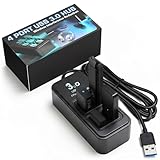
- AVOID WIRELESS LAG & STUTTER: Don’t lose matches to frustrating dropouts. This performance hub is engineered with upright, wide-spaced ports that shield gaming peripherals and vive dongle connections from disruptive USB 3.0 noise and cross-anti-interference, ensuring rock-solid stability for your mouse, keyboard, and headset.
- GAMERS, STREAMERS & POWER USER ESSENTIALS: Whether you’re into esports, streaming, or cockpit sims, this performance hub provides a stable foundation for demanding setups. It keeps audio, video,VR trackers and peripherals running smoothly, delivering lag-free performance essential for competitive gaming.
- WIDELY USED BY THE VR COMMUNITY: Built for full-body VR tracking, this performance hub has earned praise for handling multiple high-bandwidth devices without issue. With proven reliability, it manages Tundra trackers, wireless dongles, and peripherals, making it ideal for both VR and streaming builds.
- HIGH-SPEED USB 3.0 & OPTIMIZED POWER: Four USB 3.0 ports deliver up to 5Gbps for external drives while maintaining signal integrity for wireless dongles. Includes a robust power adapter so even demanding devices like VRchat rigs stay consistently powered for smooth and uninterrupted performance.
- COMPACT, DURABLE & READY TO GO: Designed with a weighted non-slip base and rugged build, this USB 3.0 hub stays put during heavy use. Completely plug-and-play, it works with Windows and Mac setups, keeping your desk organized while ensuring seamless connectivity for all your devices and accessories.
What should you check before choosing one?
Start with the function you need—connecting peripherals wirelessly to one host, or sharing them over a network—then verify the exact product documentation:
- Connection method: Determine whether it is standards-oriented Wireless USB or network/IP-based USB sharing.
- Host requirements: Check whether it needs a matched host adapter, drivers, utility software, or network configuration.
- Peripheral support: Confirm that the specific device type and function are supported; a general claim about USB compatibility is not enough.
- Compatibility: Verify operating-system support and host-port requirements for the exact model.
- Power and placement: Check whether the hub needs external power and where it must sit relative to the computer or network.
- Included components and condition: Some older systems require a separate adapter. Confirm that a listing includes the matched pieces you need and check the item’s condition and present availability.
USB-IF’s document library lists Wireless USB-related material, including a host-side connection-context document dated 2008 and a radio-frequency-interference paper dated 2012. Those listings establish that the documents exist and their dates; they do not establish present-day product support. USB-IF’s document library is the reference.
Quick Recap
Best Value

- Smart Charging Ports: 2 Extra 5V/2.4A charging ports supporting 2.4A output specially designed for smart charging. Charges most USB charging equipment, regardless of large batteries such as smartphones or tablets, or mini-battery equipment such as smart portable devices, at full speed.
- Faster Speed with USB 3.0: USB 3.0 ports offer transfer speeds of up to 5Gbps, 10 times faster than USB 2.0. This 7-port USB 3.0 data hub can instantly expand 1 USB 3.0 port to 7 USB 3.0 data ports for keyboard, mouse, printer, hard drivers and other USB devices.
- TP-Link Charging technology intelligently identifies connected devices, automatically delivering the smart charge to your smartphones, tablets or devices with a USB charging connector, minimizing charging time.
- Protect Both Your Equipment and Your Data: UH720 has a sophisticated circuit design with multiple overheat, overload, overvoltage and short circuit protections. A built-in surge protector keeps both your devices and your data safe in the data transfer process.
- UH720 supports hot-swap USB ports that can be safely connected and disconnected while the computer is on and running.
Rank #4

- [7-Port USB 3.0 Hub] ONFINIO USB hub turns one USB port into Seven, support for USB Flash drive, Mouse, Keyboard, Printer, or any other USB Peripherals. And it's backward compatible with your older USB 2.0 / 1.0 devices.
- [5Gbps Data Transfer Speed] This USB hub splitter 3.0 syncs data at blazing speeds up to 5Gbps, which is more than 10 times faster than USB 2.0, fast enough to transfer an HD movie in seconds.
- [Easy to Use] This USB port hub has a built-in high-performance chip to keep your devices and data safe, and supports hot swapping. No need for installation of any software, drivers, plug and play. Please offer extra power supply when the power-hungry devices are connected.
- [Compact & Portable] The USB extension cable multiple port has been intelligently designed to be as slim and light as possible, ideal for your working and traveling with ultrabook. Exquisite gift box packaging, easy to store and use.
- [Wide Compatibility] ONFINIO usb hub for laptop is compatible with Windows 10/8/8.1/7 / Vista / XP and Mac OS X, Linux, and Chrome OS. USB expander applies to various devices: laptop, pc , XBOX, PS4, flash drive, printer, mouse, card reader, HDD, keyboard, camera, console, USB fan.
Product prices and availability are accurate as of the date/time indicated and are subject to change. Any price and availability information displayed on Amazon at the time of purchase will apply.

