
iTechGuides is reader-supported. When you buy through links on our site, we may earn an affiliate commission. As an Amazon Associate I earn from qualifying purchases. Learn more
A stand-alone access point is a Wi-Fi access point configured and managed independently rather than as a member of an access-point cluster or a shared configuration. It commonly connects to an existing wired router or network to add Wi-Fi; it is not necessarily a router or internet gateway itself.
What “stand-alone” means
In this context, “stand-alone” describes the access point’s operating and management mode—not whether it is disconnected from the rest of the network. USRobotics defines standalone mode as an access point that is not part of a cluster and does not share the cluster’s configuration; settings must be configured manually for that access point. USRobotics’ access-point and cluster documentation describes that product-specific distinction.
A stand-alone AP can still connect to a router or LAN. Zyxel’s setup guidance shows a stand-alone AP joining a router’s network, while DrayTek describes an AP as a way to provide wireless connectivity for a router or network that lacks it. Zyxel’s configuration example and DrayTek’s VigorAP example illustrate these uses.
Outdated Drivers Are Slowing You Down
One free scan finds every outdated or missing driver and matches the right update for your exact hardware.Free scan · exact hardware matchPC Slower Than It Used to Be?
A free scan shows the junk files, broken settings and background clutter dragging Windows down - then fixes them in one click.Free scan · Windows 10 & 11How it differs from a clustered or centrally managed AP
With an independently configured AP, changes may need to be made on that AP itself. In a cluster or another shared-management arrangement, configuration can be coordinated across multiple access points, depending on the manufacturer and system. D-Link’s administrator guide, for example, describes an AP changing from standalone status to cluster status when added to a cluster: D-Link Unified Access Point Administrator’s Guide.
#1 Best Overall

- Free Omada Essentials Cloud Management: Free cloud management with no additional fees, everything is managed in the cloud without the need for hardware or software controllers. Simply launch the Omada app, scan the S/N code on the package, and you're ready to deliver
- Ultra-Fast True Wi-Fi 6 Speeds: Designed with the latest wireless Wi-Fi 6 technology featuring 1024-QAM, HE60 and Long OFDM Symbol, the EAP650 boosts dual-band Wi-Fi speeds up to 2976 Mbps
- Ultra-Slim Design: Compact design ensures simple installation while saving space. The elegant appearance makes EAP650 blend into any modern office, hotel, classroom, or cafe
- Integrated into Omada SDN: Omada Software Defined Networking (SDN) platform integrates network devices including access points, switches and gateways with multiple control options offered - Omada Hardware controller, Software Controller or Cloud-based controller. Standalone mode also supported
- Cloud Access Omada Compatibility: Remote Cloud access and Omada app enables centralized cloud management of the whole network from different sites, all controlled from a single interface anywhere, anytime
Do not assume that “stand-alone” always means a device is incapable of centralized management. The term and available modes vary by product. HPE’s 670 Series documentation describes access points that can operate standalone or with a gateway and can also be managed through cloud or on-premises solutions. Check the documentation for the specific model and mode you plan to use: HPE Aruba Networking 670 Series QuickSpecs.
What a stand-alone AP can add to a network
Its common role is to extend Wi-Fi coverage or provide wireless access where the existing wired router or network does not provide it. The AP connects to that network; the router or gateway typically remains responsible for routing traffic and providing internet access. The exact arrangement depends on the device and network.
Rank #2

- FREE Omada Essential Platform Centralized Remote Management: Unlock numerous advanced features by integrating with Omada Cloud Management Platform, such as network monitoring, remote network configuration, AI features, ZTP (Zero Touch Provisioning) etc. More possibilities you can find with your network management
- Dual-Band 4-Stream Wi-Fi 7: Up to 5.0 Gbps, 4324 Mbps on 5 GHz + 688 Mbps on 2.4 GHz. Powered by Wi-Fi 7 technology, enjoy faster speeds with Multi-Link Operation, increased reliability with Multi-RUs, and 120% more data capacity with 4K-QAM, delivering enhanced performance for all your devices
- Future Proof 2.5G Port: Equipped with a 2.5 Gigabit Ethernet port to support high-speed networking and future broadband upgrades-no hardware replacement required when switching to multi-gig internet plans
- Abundant Networking Features Available to Develop: Network monitoring, VLAN segmenting, Bandwidth management, Schedule Setup, Security features, PPSK all seated and right there waiting to be developed for you
- Premium WiFi Experience: Seamless roaming, Mesh, Airtime fairness and other business level wifi experience features are provided here
A stand-alone AP may support features such as multiple SSIDs or VLAN-tagged networks, but those capabilities are model-specific. DrayTek’s product example ties VLAN use to an 802.1Q-capable connected network, so the AP alone may not be sufficient: the router or switch and the rest of the network must support the intended configuration too.
Free tools Windows power users keep installed
One-click scans. No signup required.
What to check before setup
- Management mode: Confirm whether the AP will be configured on its own, join a cluster, or use a gateway, cloud, or on-premises management system.
- Network connection and power: Check the model’s connection and power requirements, along with what your router or switch can provide.
- Wi-Fi settings: If you want devices to use a unified Wi-Fi network, Zyxel’s example uses the same SSID, password, and encryption settings on the router and AP. Treat this as that guide’s setup approach, not a universal requirement; follow the instructions for your equipment and security configuration.
- Advanced features: Verify support across the AP and connected network for any required separate SSIDs, VLAN tagging, or other features. For VLANs, check whether the connected network supports 802.1Q.
- Number of APs: Consider how many access points you will maintain and whether you want to repeat configuration changes on each one or use a supported shared-management arrangement.
When this mode makes sense
A stand-alone AP can be a practical choice when you need Wi-Fi from an existing wired network and are comfortable configuring and maintaining the access point independently. If you have several APs or need settings coordinated across them, investigate the specific product’s cluster or centralized-management options instead. These modes describe management choices; the cited documentation does not establish a universal cost, speed, or performance advantage for either one.
Quick Recap
Best Value
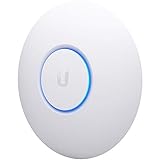
- Four stream 802.11AC Wave2 technology
- Supports 200+ concurrent users
- 802.3af PoE compatibility
- Optional covers (sold separately) allow the Unifi nanohd AP TO discreetyly blend into its setting
Rank #4

- Free Omada Essentials Cloud Management: Free cloud management with no additional fees, everything is managed in the cloud without the need for hardware or software controllers. Simply launch the Omada app, scan the S/N code on the package, and you're ready to deliver
- Ultra-Fast True Wi-Fi 6 Speeds For Your Business: Designed with the latest wireless Wi-Fi 6 technology featuring 1024-QAM and Long OFDM Symbol, the EAP610 boosts dual-band Wi-Fi speeds up to 1800 Mbps. With 4 Spatial streams, multi-user throughput is incredibly increased to drive more applications
- Ultra-Slim Design: Compact design ensures simple installation while saving space. The elegant appearance makes EAP610 V2 blend seamlessly into any modern office, hotel, classroom, or cafe
- Integrated into Omada SDN: Omada Software Defined Networking (SDN) platform integrates network devices including access points, switches and gateways with multiple control options offered - Omada Hardware controller, Software Controller or Cloud-based controller. Standalone mode also applies
- Cloud Access Omada Compatibility: Remote Cloud access and the Omada app enable centralized management of your entire network across multiple sites. Control everything from a single interface, anywhere and anytime. Please verify device compatibility with SDN firmware in the product documentation or manufacturer's technical specifications
Rank #3
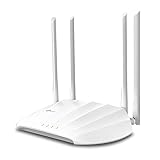
- Superior Speeds with MU-MIMO: Outfitted with the latest 802.11ac Wave 2 MU-MIMO technology, the TL-WA1201 easily delivers dual-band Wi-Fi speeds of up to 1200 Mbps to multiple devices at the same time
- Multi-Mode 4 in 1: Supports Client, Multi-SSID, Range Extender, and AP operation modes to enable various wireless applications to give users a more dynamic and comprehensive experience when using your AP
- PoE for Easy Installation: TL-WA1201 supports Passive PoE power supplies, can be powered by the provided PoE adapter, making deployment effortless and flexible
- Boosted Wi-Fi Coverage: Four external antennas equipped with Beamforming technology concentrate Wi-Fi signals towards your devices to extend reliable Wi-Fi to every corner of your home or office, even over long distances
- Gigabit Ethernet Port: Features a Gigabit Ethernet port that provides high-speed wired connectivity for devices requiring stable and fast network connections
Product prices and availability are accurate as of the date/time indicated and are subject to change. Any price and availability information displayed on Amazon at the time of purchase will apply.

