
Free tools Windows power users keep installed
One-click scans. No signup required.
iTechGuides is reader-supported. When you buy through links on our site, we may earn an affiliate commission. As an Amazon Associate I earn from qualifying purchases. Learn more
A data center in space is computing and storage equipment carried by one or more satellites, where it processes data in orbit rather than sending everything to Earth for processing. The term covers very different scales: it can mean a satellite doing a limited onboard task, or a proposed larger orbital system. The first is not automatically a full, general-purpose data center.
What does a data center in space do?
At its simplest, an orbital data center processes information where it is collected. Earth-observation satellites and space telescopes can generate more data than they can conveniently transmit at once. Onboard computing could filter or analyze those raw observations and send selected results to Earth instead. The U.S. Government Accountability Office (GAO) describes the concept broadly as satellite-based data processing and storage systems. GAO’s overview explains that the equipment would process data in space rather than on Earth.
More ambitious proposals envision energy-intensive cloud or AI computing in orbit. Those are proposed applications, not proof that large-scale orbital facilities are operating. Whether they make sense depends on the workload, the time it can tolerate before returning a result, communications capacity, and cost. JLL Research has described a potential division of labor in which orbital systems handle delay-tolerant, energy-heavy work while Earth-based facilities remain better suited to real-time computing. JLL’s discussion treats this as a possible use, not an established industry outcome.
Do these 3 things before closing this tab:
1Clear out junk files and repair common Windows errors2Scan for outdated or missing drivers - takes under a minute3Repair Windows errors before they cause bigger problemsHow is it different from a regular satellite?
Many satellites already carry computers, but that alone does not make each one a data center. A communications satellite primarily relays signals; an Earth-observation satellite gathers images or measurements. Either can perform onboard processing without being a large, general-purpose facility. The distinction is one of scale and purpose: a data-center-grade processor handling a specific onboard workload is an early form of orbital computing, while a large data center implies a broader system for substantial computing and storage.
#1 Best Overall

- HOBBY MODEL KIT – Unassembled model packed in an envelope with easy to follow instructions. Ideal for ages 14 and up.
- NO GLUE OR SOLDER NEEDED – Parts can be easily clipped from the metal sheets. Tweezers are the recommended tool for bending and twisting the connection tabs.
- VOYAGER – 1.5 Sheet Model with a moderate difficulty level. Assembled Size: 1.38 x 1.77 x 6.70 inches.
- FROM STEEL SHEETS TO 3D – Pop out the pieces and connect using tabs and holes. Includes illustrated instructions.
- HIGHLY DETAILED ETCHED MODEL – Display your 3D model once completed - collect and build them all.
In a May 2026 interview, Starcloud CEO Philip Johnston made this distinction while discussing company plans for larger systems. His comments are company views and plans, not independent confirmation of future deployments. The interview also reports his statement that energy output per square meter can be about eight times that on Earth; this is an attributed executive claim, not a universal, independently verified measurement.
Why put computing equipment in orbit?
- Process data near its source: Filtering or analyzing satellite observations in orbit could reduce the volume of raw data that must be downlinked.
- Use solar power in selected orbits: Some sun-synchronous orbits can provide near-continuous sunlight, which may benefit solar-powered systems. Actual power depends on the orbit and system design.
- Explore a different location for energy-intensive work: Companies have proposed orbital computing for workloads that can tolerate delay. That potential must be weighed against launch, communications, cooling, and replacement costs.
For context on terrestrial demand, GAO reported a U.S. Department of Energy projection that data centers could account for up to 12 percent of U.S. electricity demand by 2028, driven by AI development. That is a projection for the United States, not a measurement of current consumption or a forecast about orbital facilities. JLL Research separately estimated that nearly 100 GW of additional global data-center capacity could come online by 2030; that is a global market projection, not a figure for space-based capacity.
Rank #2

- Model Kit
- May Require Paints and Glues to Assemble
- Accurate Scale Model
- Detailed Instructions Provided
- Decals/Transfers Included
What makes a space data center difficult?
Power and orbit
Solar power is attractive in principle, but large computing loads need large generating systems. GAO’s April 2026 assessment says large orbital data centers would require solar arrays larger than any launched and assembled in space as of that assessment. Orbit also affects sunlight, eclipses, communication distance, and the cost of reaching the system. Low Earth orbit is common in proposals because it is less costly to reach than higher orbits and can support faster communications with Earth, but it does not remove the other engineering constraints.
Cooling in a vacuum
Space is not a cold-air cooling system for servers. In a vacuum, equipment cannot shed heat through ordinary air or water convection; waste heat must be carried to radiators and emitted as thermal radiation. GAO says large-scale cooling solutions for orbital data centers remain unproven. Radiators also add design, mass, and deployment demands, so the heat-rejection system is part of the facility’s core architecture, not an afterthought.
Rank #3

- HOBBY MODEL KIT – Unassembled model packed in an envelope with easy to follow instructions. Ideal for ages 14 and up
- NO GLUE OR SOLDER NEEDED – Parts can be easily clipped from the metal sheets. Tweezers are the recommended tool for bending and twisting the connection tabs
- APOLLO CSM – 3.5 Sheet Model with a challenging difficulty level. Assembled Size: 5.07 L x 2.28 W x 3.45 H inches.
- FROM STEEL SHEETS TO 3D – Pop out the pieces and connect using tabs and holes. Includes illustrated instructions
- HIGHLY DETAILED ETCHED MODEL – Display your 3D model once completed - collect and build them all
Communications and workload timing
Computing results are useful only if they can reach the people or systems that need them. Data-heavy workloads may require high-capacity links to Earth or between satellites, and transmitting input data or results can constrain both design and economics. A workload that must respond in real time may be a poor fit; one that can wait, or that reduces a much larger raw dataset to a compact result, may be more plausible.
Radiation, repairs, and replacement
Radiation can corrupt stored data and degrade electronics. Shielding, error correction, or other mitigation may increase cost or reduce performance. Hardware that fails in orbit is also harder to repair than equipment in a terrestrial facility: in-space servicing remains underdeveloped, while manufacturing and launching replacements are expensive. Lifespan and replacement cadence therefore affect how much useful computing can be delivered over the system’s lifetime.
Rank #4

- HOBBY MODEL KIT – Unassembled model packed in an envelope with easy to follow instructions. Ideal for ages 14 and up.
- NO GLUE OR SOLDER NEEDED – Parts can be easily clipped from the metal sheets. Tweezers are the recommended tool for bending and twisting the connection tabs.
- JAMES WEBB SPACE TELESCOPE - 2.75 Sheet Model with a moderate difficulty level. Assembled Size: 4.13 L x 2.75 W x 2.75 H inches. 1:221 Scale. 62 Pieces
- FROM STEEL SHEETS TO 3D – Pop out the pieces and connect using tabs and holes. Includes illustrated instructions.
- HIGHLY DETAILED ETCHED MODEL – Display your 3D model once completed - collect and build them all.
Economics and orbital impacts
The business case depends on more than the cost of a processor. Launch mass, solar arrays, radiators, communications, utilization, operating lifetime, and the cadence of replacement all matter. GAO identifies economic viability as unresolved. Large constellations would also raise concerns about collision risk and debris, possible interference with astronomy, and coordination of radio frequencies.
What’s actually slowing this PC down?
Pick the symptom - the matching free tool is one click away.
Is the technology ready?
As of its April 2026 assessment, GAO said that the component technologies for power, cooling, and communications are mature, but integrating and operating them to support data centers in space is unproven. Smaller systems that process data generated in space appear closer to maturity than large facilities intended to train AI models. GAO noted planned satellite deployments in the mid-2030s; a plan or schedule is not a completed deployment.
Best Value
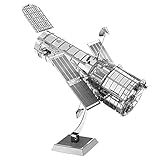
- HOBBY MODEL KIT – Unassembled model packed in an envelope with easy to follow instructions. Ideal for ages 14 and up.
- NO GLUE OR SOLDER NEEDED – Parts can be easily clipped from the metal sheets. Tweezers are the recommended tool for bending and twisting the connection tabs.
- HUBBLE TELESCOPE – 1 Sheet Model with a moderate difficulty level. Assembled Size: 3.00 x 2.00 x 2.50 inches.
- FROM STEEL SHEETS TO 3D – Pop out the pieces and connect using tabs and holes. Includes illustrated instructions.
- HIGHLY DETAILED ETCHED MODEL – Display your 3D model once completed - collect and build them all.
Regulatory filings also need to be read precisely. On February 4, 2026, the FCC Space Bureau accepted SpaceX’s application for filing and sought public comment on a proposed non-geostationary system of up to one million satellites. Acceptance for filing is a procedural step, not approval to deploy the proposed constellation. The FCC public notice describes the proposal and the comment process.
How to judge an orbital-computing proposal
There is no meaningful one-number test for whether an orbital data center is better than a terrestrial facility. Compare the complete workload and system, including:
- Where the data originates and whether it can be processed in orbit before downlink.
- How much computing and power the task requires, and whether it can tolerate communication delays.
- The proposed orbit’s sunlight and eclipse profile, alongside its communication needs.
- The mass and area required for solar power and radiators.
- Launch and replacement costs, expected operating lifetime, servicing options, and likely utilization.
- For Earth-based alternatives, grid access, water, land, and permitting constraints.
- For orbital systems, collision and debris risks, astronomy impacts, and spectrum coordination.
This comparison helps separate a focused satellite-processing use from claims about moving general-purpose computing to orbit. A promising onboard task does not by itself establish that a large orbital facility is practical.
Quick Recap
Product prices and availability are accurate as of the date/time indicated and are subject to change. Any price and availability information displayed on Amazon at the time of purchase will apply.

