
Recommended Free Tools
iTechGuides is reader-supported. When you buy through links on our site, we may earn an affiliate commission. As an Amazon Associate I earn from qualifying purchases. Learn more
An incident agent can make a better recommendation when its memory includes failed interventions, their causes, and the conditions in which they failed—not just a list of successful fixes. In a CausalOps example, Karnati Balaji describes Hindsight surfacing a past pod restart that relieved symptoms for 11 minutes before the incident returned. The example illustrates a design, not a measured proof that memory improves incident outcomes.
What happened in the checkout incident example?
Balaji describes CausalOps as an incident-response system that collects service, deployment, error-rate, latency, and database-saturation context, then retrieves relevant history from Hindsight. It scores prior interventions and asks an LLM to produce a structured analysis: a root-cause hypothesis, causal chain, counterfactual branches, and uncertainties. The system stops for human approval; its prompt forbids operational execution. Balaji’s account presents this as an application design.


In the reported regression scenario, checkout version v4.7.2 had a 37% error rate, 4.8-second p95 latency, and 96% database connection saturation. Hindsight brought three earlier cases into view:
- A rollback that had worked.
- A pod restart after which the problem returned in 11 minutes.
- A database scale-up that failed because an application connection leak consumed the added capacity.
The agent recommended rollback and used the prior cases to explain why restarting pods or scaling the database might not resolve the underlying problem. “Restarting the checkout pods bought us eleven minutes” captures the distinction between temporary relief and a fix.
#1 Best Overall
All figures and outcomes above are details reported by the author in an example; they are not independently validated production measurements. The article does not identify a year for the scenario.
Why retain failed interventions?
A record that says only “failed” is difficult to reuse. A more useful incident memory connects the intervention to its result, the reason it failed, and the conditions in effect. That context can help an agent distinguish a genuinely comparable case from one that merely shares a symptom.
For example, a restart followed by recurrence may indicate that restarting processes did not remove the cause. A scale-up that failed because a connection leak consumed the extra capacity says more than “scaling did not work”: it warns that repeating the intervention under similar conditions may only add temporary headroom. Conversely, a prior successful rollback is evidence to consider, not a guarantee that rollback is right for every incident.
The Tool Desk
Outbyte Driver Updater FREEFix the driver behind crashes, sound loss and screen glitchesFind Drivers →Outbyte PC Repair FREERepair Windows errors before they cause bigger problemsFix Now →Balaji’s design describes outcome records that can include status, observed result, failure reason, side effects, operating conditions, and runbook steps. Preserving those details makes the memory useful for both recommendations and their explanations.
How the example combines recall and scoring
Memory retrieval and deterministic ranking serve different purposes. Recall may find a causal match even when labels such as service or conditions differ between incidents. A structured score gives the application an explicit, easier-to-explain way to rank candidates.
In the described implementation, the recall query is built from current symptoms, conditions, service, and suspected cause. The application also calculates a weighted relevance score using conditions, service, deployment, causal relation, and recency, then gives recalled history an additional boost. Balaji notes that the boost is hand-tuned and that matching recall results back to database rows by substring is brittle. Those are implementation-specific trade-offs, not documented Hindsight defaults.
Rank #4
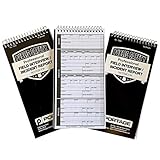
- THE IDEAL SIZE - The field interview and incident report notebook is a slim 3.75” x 6” pocket sized police notebook that fits easily and comfortably in a uniform pocket
- TAKE NOTES ON THE GO - This professional reporter’s notebook makes it easy taking notes in the field. we use a .75mm thick cover, twice as rigid as most competitors. The extra stability provides a sturdy writing surface, so you are always prepared
- FORM KEEPS YOU ORGANIZED - This notebook includes a simple, yet comprehensive form for recording key notes, ensuring you don’t miss important details. Each report has individual sections for case numbers, time, date, location, etc
- DURABLE CONSTRUCTION - Our appointment planners are made with extra thick covers, bound with coated spiral bindings, and rounded page corners, that make for a professional and durable notebook that stands the test of time. Portage is built to last
- TRIED AND TESTED DESIGN - Our Notepads have been tested and perfected by the professionals that use them daily. This notebook has been designed to keep all cases and information organized and accessible
Hindsight itself is an agent-memory system with retain, recall, and reflect operations. Its official quickstart describes storing information with retain, retrieving memories with recall, and generating insights with reflect. The recall documentation says retrieval combines semantic, keyword, graph, and temporal strategies in parallel and returns structured facts. The application’s incident scoring, audit ledger, approval gate, and failure fallback are separate design choices made in CausalOps.
What happens if memory is unavailable?
The author says the wrapper aborts retain and recall calls after 3.5 seconds and returns null on failure, allowing analysis to continue using the structured score alone. That timeout is the author’s wrapper behavior, not a Hindsight product default. The intended boundary is summed up in Balaji’s words: “Memory advises. It doesn’t gate.”
This fallback matters during an incident: an optional memory service should not become a dependency that prevents all analysis from proceeding. It also means a recommendation made without recalled history should be understood as having less historical context, rather than as evidence that no relevant prior case exists.
What the example establishes—and what it does not
The account is a design case study, not a controlled evaluation. Balaji writes, “I haven’t run a systematic evaluation of recommendation quality with and without memory.” It reports no measured percentage improvement or benchmark showing that Hindsight improves incident outcomes. The example supports a practical design lesson—store the conditions and causes of failures and make historical context available to a human reviewer—but it does not establish how often that approach prevents a bad action in production.
Deployment options for Hindsight
The official project documents self-hosted, Cloud, and Enterprise routes. Its quickstart includes a Docker-based self-hosting path. Hindsight Cloud documentation describes a managed service; the CausalOps example does not establish that it used Cloud, describing Hindsight as its own service instead. Choose a deployment based on operational and data-handling requirements; the incident account does not compare the options.
Quick Recap
Product prices and availability are accurate as of the date/time indicated and are subject to change. Any price and availability information displayed on Amazon at the time of purchase will apply.

