
Data centers use electricity to run servers, storage, and networking equipment, plus the cooling and power-distribution systems that keep that IT equipment operating. Water is chiefly tied to cooling at sites that use evaporative heat rejection; electricity generation can add a separate, indirect water footprint. To compare impacts fairly, distinguish those boundaries, specify geography and year, and report total use alongside efficiency ratios.
What do data centers use electricity and water for?
A data center’s electricity use has two broad parts: energy consumed by IT equipment and energy used by facility infrastructure. The first runs digital services; the second supports the equipment and moves heat out of the building.
IT equipment: compute, storage, and networking
- Servers perform computation, including the processing behind websites, cloud services, and AI workloads.
- Storage systems write, retain, and retrieve data.
- Networking equipment moves data within the facility and between it and external networks.
In the U.S. Department of Energy (DOE) and Lawrence Berkeley National Laboratory (LBNL) 2025 update, networking accounted for 4.5% of U.S. data-center electricity in 2024. That is a modeled U.S. estimate, not a universal share for every facility. DOE/LBNL, United States Data Center Energy Usage Report: 2025 Update
Facility infrastructure: cooling and power delivery
Facility infrastructure includes cooling and the equipment that distributes power to IT systems. Electrical equipment also loses some energy as heat during power conversion and distribution. In the DOE/LBNL 2025 modeled estimates, infrastructure represented 31% of total U.S. data-center electricity in 2024, down from 36% in 2018. Those figures describe a national estimate, not a fixed overhead rate for an individual data center.
#1 Best Overall

- An ultra quiet fan system designed for cooling cabinets that requires minimal noise.
- Features a multi speed controller to set the fans speed to optimal noise and airflow levels.
- Contains a CNC machined aluminum frame with a modern brushed black finish.
- Powered by wall outlet or USB port, included Turbo Adapter increases performance by 25 percent.
- Dimensions: 4.6 x 4.6 x 1.3 in. | Airflow: 26 CFM | Noise: 17 dBA | Bearings: Dual Ball
Cooling’s share also varies by facility type and efficiency. The International Energy Agency (IEA) reports a range from about 7% of electricity in efficient hyperscale data centers to more than 30% in less-efficient enterprise data centers. This variation is one reason a single assumed cooling percentage is not a reliable way to estimate every site’s use. IEA, Energy and AI: Energy demand from AI
Water: cooling at the site and electricity generation upstream
Water use depends in part on how a facility rejects heat. In evaporative cooling, water evaporates to carry heat away, so the system needs makeup water. Cooling towers can also discharge blowdown to remove water containing concentrated dissolved minerals. The cooling design, climate, and operating conditions all affect the balance between water and electricity use. DOE Federal Energy Management Program, Cooling Water Efficiency Opportunities for Federal Data Centers
There is also water consumed beyond the facility: power plants may use water to generate the electricity a data center buys. LBNL distinguishes this electricity-related water from water used directly at the site. The two amounts should not be added or compared without making the accounting boundary clear. LBNL, 2024 United States Data Center Energy Usage Report, section 4
Rank #2

- 【better after-use experience】 Temperature reduction provides an expected longevity extension and higher performance of a critical network component,These fans are overall very helpful for devices that get a bit hot and start to throttle down.
- 【choice of most users】It works great ,for DIY cooling fan or as an additional cooling ,fan for your gaming needs. like as router, cabinet, Modem, DVR, Receiver, Streaming ,boxes, x-box, SSD, Security Camera NVR, andriod box, stereo, T-Mobile gateway. Good balance of quiet and airflow. keeping electronics cool .Three specifications of fans, suitable for more usage scenarios .
- 【Custom shock absorbing feet】 four feet using environmentally friendly rubber, after testing, the softness of the feet that can smoothly grab the desktop, not too hard and desktop resonance .
- 【Fan parameters】Connecter: USB; Cable Length: 55cm Or 21 inches; Bearing type: Sleeve ; Life: 35000 hours / Dimension: 360mm(L) x 120mm(W) x 25mm(H) / 4.7x4.7x1 in. per fan; Rated Voltage:5V 0.2A; Speed: 1500RPM; Air flow: 56.7CFM; Noise:23dBA .
- 【Warranty & Packing List】Warranty: One-year quality assurance. Please contact us, If the product has any quality problems, it will be refunded within 90 days or replaced within one year | Packing list: A finished product .
How large is data-center electricity use?
Figures are meaningful only with their geography, year, and status attached. The IEA estimated that data centers worldwide used 415 terawatt-hours (TWh) of electricity in 2024, about 1.5% of global electricity. This is a global estimate for that year. IEA, Energy and AI: Energy demand from AI
Recommended Free Tools
For the United States, the DOE/LBNL 2025 update’s central modeled forecast is that data centers could use 11.8% of total U.S. electricity by 2030. Its modeled scenario range is 9.5% to 15.3%. These are forecasts, not observed consumption or a certainty about what will happen. DOE, Powering America’s AI Future—Data Center Resource Hub
The earlier DOE/LBNL 2024 report estimated U.S. data centers used 176 TWh, or about 4.4% of U.S. electricity, in 2023. It projected 325–580 TWh by 2028, but that projection has been superseded for current U.S. forecasting by the 2025 update. DOE, announcement of the 2024 U.S. data-center report, December 20, 2024
Rank #3
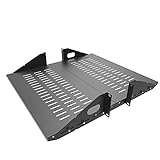
- Compatible with all 19” racks and cabinets to hold various IT, network and other equipment.
- Dimensions: W 19" x D 10" x H 2U per shelf ; 2 Shelves as set
- This Vented Center Weighted Mounting Rack Shelf fits the mounting posts in different deepth from 75 mm to 125mm.
- Max Weight Capacity: 110 Pounds; Center weighted.
- Slotted Venting to Improve Air flow and Help Prevent Overheating of Your Equipment
How can you compare their impact?
Start by asking what is counted, then pair efficiency measures with absolute use and local context. A low ratio does not, by itself, show that a facility uses little energy or water, or that its water use is harmless in its location.
1. Match the accounting boundary
- IT electricity: energy used by servers, storage, and networking equipment.
- Facility electricity: total site electricity, including IT equipment and infrastructure such as cooling and power distribution.
- Direct or site water: water consumed at the data center, commonly associated with cooling.
- Indirect or source water: water consumed in generating electricity supplied to the data center.
Do not compare an IT-only electricity figure with a full-facility figure, or direct water with a total that also includes electricity-related water, as if they measured the same thing.
2. Pair totals with efficiency ratios
Power Usage Effectiveness (PUE) compares total facility energy with IT equipment energy. A lower PUE indicates less facility energy overhead relative to IT energy, but the ratio does not state the facility’s absolute electricity use.
Rank #4

- Space-Saving Design: Measures 19.0"H x 21.7"W x 17.7"D with a 14.2" max mounting depth, our 9U rack fits tight spaces while holding full 19" gear—ideal as a server cabinet or wall mount network cabinet for home offices and small server rooms
- Full Security: Both the lockable glass door and side panels protect your hardware from theft or tampering. This 9U wall mount rack gives you peace of mind in public or shared environments, ensuring your equipment rack stays safe and secure
- Active Cooling: The built-in cooling fan prevents overheating, keeping your wall mount server rack running reliably. Perfect for active networks, this 9U network rack extends the life of switches, routers, and PDUs by maintaining consistent airflow
- Heavy-Duty Build: Cold-rolled steel construction supports up to 110 lbs of 19" IT and A/V devices. Whether you need a wall mount server cabinet for shallow servers or a wall mount network rack for patch panels, this delivers years of reliable use
- Easy Installation: Pre-marked mounting holes and top/bottom cable ports make setup fast. Adjustable rails and numbered U positions allow precise rack mounting of your gear. This turns any wall into a tidy, professional server room in minutes
Water Usage Effectiveness (WUE) compares water consumption with IT electricity and is usually reported in liters per kilowatt-hour (L/kWh). Check whether the reported water numerator is direct/site water or includes indirect/source water. A WUE value without that boundary is difficult to compare fairly.
For a useful comparison, report total electricity and water for the same period as the ratios, and identify the WUE boundary and denominator. PUE and WUE describe efficiency; they are not substitutes for totals or measures of local water stress. DOE Federal Energy Management Program, Cooling Water Efficiency Opportunities for Federal Data Centers
3. Include cooling design and operating conditions
Identify the heat-rejection approach—such as an evaporative cooling tower, air-side economizing, direct liquid cooling, or another arrangement. Different systems can change both electricity and water use. Outdoor conditions and how the system is operated also matter, so a facility’s design label alone does not establish its actual consumption.
Do these 3 things before closing this tab:
1Fix the driver behind crashes, sound loss and screen glitches2Clear out junk files and repair common Windows errors3Scan for outdated or missing drivers - takes under a minuteBest Value

- Color LCD control panel. Simplifies operation, clearing of codes and easier to read.
- Matte black cabinet brings stylish utility to the workplace.
- Added bumpers enable safer handling and movement around your facility.
- Larger casters makes rolling and navigation easier.
- Cools to mid-60s °F — for effective heat control around electronics, servers, and computers.
4. Put the grid and location in context
Indirect water use depends on how electricity is generated; direct water use has consequences shaped by local conditions. National and global averages cannot tell you the impact of a specific site. For comparisons intended to assess local effects, identify the facility’s location and keep site water distinct from water associated with its electricity supply.
5. Label the year and whether a figure is observed or forecast
State the reporting organization, geography, year, and whether a number is measured, modeled as a historical estimate, or forecast under a scenario. For example, the IEA’s 415 TWh figure is a 2024 global estimate, while DOE/LBNL’s 11.8% figure is the central value in a modeled 2030 U.S. forecast. They have different geographies and periods, so they are not directly comparable measures.
Independent reader supportYour contribution helps us test, update, and keep practical guides available for everyone.What the available figures do—and do not—show
The published figures establish substantial electricity demand and show that facility overhead, cooling, and networking are relevant parts of the total. They do not establish one current global water total that can be fairly applied to all data centers, or a comparable ranking of local water impacts. A meaningful water comparison needs a stated boundary, cooling information, electricity-supply context, and location-specific conditions.
Quick Recap
Product prices and availability are accurate as of the date/time indicated and are subject to change. Any price and availability information displayed on Amazon at the time of purchase will apply.
What’s actually slowing this PC down?
Pick the symptom - the matching free tool is one click away.

