
The Tool Desk
Outbyte PC Repair FREERepair Windows errors before they cause bigger problemsFix Now →Outbyte Driver Updater FREEFix the driver behind crashes, sound loss and screen glitchesFind Drivers →iTechGuides is reader-supported. When you buy through links on our site, we may earn an affiliate commission. As an Amazon Associate I earn from qualifying purchases. Learn more
In common U.S. retail usage, “shop vac” usually means a wet/dry shop vacuum; Shop-Vac is also a specific brand. The terms do not reliably describe two different types of machine. Choose by the cleanup you need to do, then compare capacity, portability, filtration, hose and attachments, and wet-pickup instructions on the specific models.
Are wet/dry vacs and shop vacs different?
Usually, no. “Wet/dry vac” describes a vacuum intended to collect dry debris and, when its instructions allow, liquids. “Shop vac” is often a generic name for this kind of vacuum in U.S. retail usage. Shop-Vac, with a hyphen and capital letters, is also a brand. Lowe’s explains the distinction in its shop vacuum and wet/dry vacuum guide.
That overlap means the label alone is not a useful buying distinction. Check what a particular model can collect and whether its capacity, filter, hose, and accessories suit your work.
Which size and format suits your work?
Tank capacity is a tradeoff: a larger tank can mean fewer emptying breaks, but it takes up more space and can be less convenient to move. Lowe’s describes roughly 1/2–3-gallon models as suitable for small projects and vehicle detailing, and 4–16-gallon models for larger garage or workshop jobs. Those are retailer guidelines, not fixed category boundaries.
#1 Best Overall

- Beast Series High-Performance Motor with 320 Air Watts of Power, 20kPa
- Equipped with High-Efficiency Cartridge Filter & Dust Bag for Capturing Fine Dust Particles Down to 1 Micron in Size
- 25-Feet of Cleaning Reach with Premium Kink-Resistant Hose and Power Cord
- 9 Accessories, including a Car, Utility, and Crevice Tool for Various Tasks
- Complete Vac Organization with On-Board Hose, Cord and Accessory Storage
| Choice | Often suits | What to weigh |
|---|---|---|
| Compact or handheld | Cars, small spills, quick cleanups, and tight storage | Carrying ease, hose reach, storage, and a crevice or claw tool |
| Cordless | Quick jobs or places without convenient outlet access | Portability against the need to manage battery runtime |
| Larger wheeled, corded | Recurring garage, workshop, or renovation cleanup | Tank capacity, storage footprint, hose size, and useful attachments |
These formats and use cases follow Lowe’s buying guidance; the right size depends on how much debris you collect and how often you want to empty the tank.
What should you compare between models?
Airflow and suction—not peak horsepower alone
Peak horsepower is a comparison label, not the motor’s actual operating horsepower. Shop-Vac says system performance also depends on the hose, accessory, and filter system, and that a dirty filter can reduce airflow and suction. Where manufacturers publish them, compare measures such as CFM (airflow), sealed pressure, and air watts, but only treat a comparison as meaningful when the test setup is similar. Shop-Vac’s FAQ describes these measures and notes that its product guidance considers more than 75 inches of sealed pressure high-end utility-vacuum territory; that is the manufacturer’s rule of thumb, not an independent standard.
Rank #2

- HEAVY-DUTY: Powerful 6.5 Peak HP provides extra power for large projects in the garage, shop and on the jobsite
- BUILT-IN BLOWER PORT: Rear blowing port on this wet dry shop vac allows for quick cleaning of leaves and grass clippings in your garage and outdoors
- OVERSIZED DRAIN: Built-in oversized drain on the wet/dry vac allows for convenient emptying of liquids
- DUAL-FLEX TECHNOLOGY: 2-1/2 in. diameter shop vacuum hose features Dual-Flex technology for 180-degree mobility at each end to resist kinking
- ACCESSORIES INCLUDED: 2-1/2 in. x 7 ft. POS-I-LOCK Dual-Flex Hose, 2 Extension Wands, Utility Nozzle, Car Nozzle, Wet Nozzle, Qwik Lock Filter and Dust Collection Bag
For scale, Shop-Vac lists maximum airflow of 65 CFM and sealed pressure of 55 inches for its 6-gallon, 3.5 Peak HP wet/dry model, tested with a 1.25-inch Shop-Vac hose. Those are that model’s stated specifications, not category averages. Its product page also says airflow varies with the hose, tool, filter system, and filter cleanliness.
Filter and bag suitability
Choose a filter or collection bag rated by the manufacturer for the material you intend to collect and for that vacuum model. Fine dust may call for a high-efficiency or HEPA option, where available; Shop-Vac notes that such options are not offered for every vacuum. Wet pickup may require a different filter arrangement, such as a foam sleeve on models whose directions call for one. A mismatched filter can let dust or water blow back into the room.
Rank #3

- COMPACT AND PORTABLE: Equipped with balanced top handle to clean up small messes on the go!
- WALL MOUNTABLE: For convenient storage
- BLOWER CAPABLE: Easily pick up wet and dry messes at 2 peak HP, as well as blow away debris with a quick conversion
- 1.5-GALLON* TANK: The tough polypropylene tank is constructed to last
- INTEGRATED STORAGE: Store attachments on the powerhead for easy access
Hose diameter, length, and tool fit
A hose that is easy to store and maneuver can be useful for a car or small spaces. For larger debris, Shop-Vac recommends a 2.5-inch hose and warns that a narrower one can clog more readily. Check hose diameter, length, and accessory compatibility for the exact model; a nozzle or adapter that fits one vacuum may not fit another. Crevice tools help reach vehicle gaps, while floor tools, wands, and saw adapters are more relevant to larger shop tasks.
Wet pickup and practical extras
Wet/dry on the label is not permission to collect every liquid or material. Confirm that the model supports wet pickup, follow its manual’s filter instructions, and use it only for materials it is designed to collect. If you expect frequent or larger water pickups, a tank drain can make emptying easier. A blower port, detachable blower, accessory storage, or tool adapter is worth considering when it serves a regular task—not simply because it is listed.
Rank #4
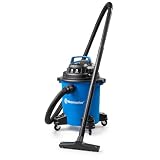
- MADE FOR: Everyday wet and dry pick-up
- POWERFUL AIRFLOW: 65 CFM easily sucks up more debris
- EXTENDED CLEANING REACH: 16-feet of cleaning reach with hose and power cord
- FEATURES: 8 accessories, including a cartridge filter for dry pick-up and a foam wet filter for wet pick-up
- COMPLETE VAC ORGANIZATION: On-board hose, cord and accessory storage
Which type should you buy for your job?
- Car detailing or small spills: Start with a compact portable or cordless model. Prioritize manageable weight, hose reach, easy storage, and a crevice or claw attachment.
- Workshop or garage cleanup: Consider a larger wheeled model if the debris volume makes frequent emptying inconvenient. Check that the hose suits the debris and that the filter and accessories match the job.
- Woodworking or renovation debris: Look for an appropriate filter or bag, compatible tool adapter if needed, and a hose wide enough for the material. Shop-Vac recommends 2.5 inches for large debris; verify the model’s fittings before buying.
- Water pickup: Verify wet-use support and the required filter setup in the model’s instructions. A tank drain is useful when you expect larger or repeated liquid pickups.
- Fine dust: Use a filter or bag specifically rated for that dust and vacuum model. Do not assume a general-purpose shop vacuum is suitable for hazardous materials; Lowe’s warns against using one to clean hazardous materials.
How to make a fair model-to-model comparison
- Write down the job: Identify the material, whether it is dry or liquid, expected quantity, and how often you will use the vacuum.
- Set practical constraints: Decide how much space you have, how often you will carry the vacuum, whether a cord is convenient, and how much capacity you need before emptying.
- Check the manual and filter options: Confirm the model supports the intended pickup and identify the required filter or bag for that material.
- Match the hose and attachments: Check diameter, length, and manufacturer compatibility for the tools you expect to use.
- Compare published performance figures carefully: Look for airflow and suction measures, then check the hose, tool, and filter setup behind each figure. Do not use peak horsepower by itself as a proxy for pickup performance.
- Choose only useful extras: Consider a tank drain, blower feature, accessory storage, or tool adapter when it addresses a task you actually have.
For current model formats and capacities beyond one brand, RIDGID’s wet/dry vac category listing provides another manufacturer’s range of general-purpose options.
Do these 3 things before closing this tab:
1Repair Windows errors before they cause bigger problems2Fix the driver behind crashes, sound loss and screen glitches3Clear out junk files and repair common Windows errorsQuick Recap
Best Value

- PORTABLE: Lightweight, 2.5-gallon wet dry shop vac offers unparalleled mobility
- IDEAL FOR SMALL MESSES: Perfect for the home, garage, cars, trucks and vans
- EASY TO STORE: Compact size, carry handle and cord wrap feature allow for easy storage
- TWO-IN-ONE CAPABILITY: Shop vacuum can be used as a blower for added versatility
- DESIGNED FOR TIGHT SPACES: 1-1/4 in. shop vacuum accessories allow for maneuverability in tight areas
Product prices and availability are accurate as of the date/time indicated and are subject to change. Any price and availability information displayed on Amazon at the time of purchase will apply.

