
Do these 3 things before closing this tab:
1Clear out junk files and repair common Windows errors2Scan for outdated or missing drivers - takes under a minute3Repair Windows errors before they cause bigger problemsShort answer: Feed the first D5 directly from the reservoir, use the inlet and outlet markings on each pump top, and place the second pump wherever tubing, filling and maintenance are easiest. Two D5 pumps in series do not have to be immediately adjacent. The evidence available does not establish a universal radiator-before-block order that produces a meaningful temperature improvement once the loop reaches equilibrium.
Connect the reservoir to the first pump
The reservoir outlet should feed the inlet of the first pump. This keeps the pump supplied with coolant during filling and priming. EKWB’s EK-XTOP D5 installation and mounting manual states: “Use reservoir to feed the pump in order to prime it: Connect reservoir outlet port with EK-XTOP D5 inlet port!”
Do not assume every D5 top has the same port layout. On the EK-XTOP D5 covered by that manual, the side G1/4 opening is the outlet (pressure port), the central opening on the front face is the inlet (suction port), and the front plate also has an additional outlet. Check the diagram for your exact pump top before connecting tubing.
- Reservoir outlet → first D5 inlet
- First D5 outlet → the next loop component or the second pump’s inlet
- Second D5 outlet → the remaining blocks, radiators and return to the reservoir
Never run a D5 dry. EKWB explains in its loop-order guide that flowing coolant is needed for optimal operation because the liquid helps lubricate and cool the pump.
#1 Best Overall

- The WCP D5-VARIO is a DC pump using the spherical motor design
- Self-adjusting bearing design
- All parts in contact with the medium are corrosion resistant
- Max. flow rate: 1500 l/h
- Dimensions (L x W x H): 65 x 65 x 57 mm
Where should the second D5 go?
For two pumps in series, adjacency is optional. An Alphacool staff response says pump position in the circuit does not matter: the pumps may be directly behind one another or separated elsewhere in the loop. Put them together when that simplifies mounting and tubing, but do not redesign the whole build just to make them physically adjacent.
Keep the flow direction correct at both tops. In a conventional series arrangement, the outlet of pump one feeds the inlet of pump two. A distribution plate or dual-pump top can make this connection neat, but the accessory must be compatible with the specific D5 pumps and mounting pattern.
Rank #2

- Optimized Cooling Performance: Embracing a rapid flow of up to 650L/H and an extended pump head of up to 3.5 meters, this computer pump ensures efficient heat dissipation.
- Enhanced Functionality with DC5V RGB LED Power Indicator: Augmenting its functionality, this water pump incorporates an LED power indicator that provides clear communication of the power-on status. This not only adds a practical dimension but also enhances the visual intuitiveness of your cooling setup.
- Effortless Installation with Standard Interface: Designed with an integrated water tank and pump, featuring a standard G1/4 thread, this system ensures easy and straightforward installation for a clean and streamlined appearance. The compact size, with dimensions of OD 50mm, ID 40mm, and a length of 54mm, enhances its versatility while maintaining a concise aesthetic.
- Comprehensive Protection for Safe Operation: Operating within the range of DC12V-13.5V, this water-cooled pump incorporates multi-level protection measures. These safeguards ensure the pump's secure and reliable operation, prioritizing the safety of your cooling system.
- Integrated 65ml Reservoir: Features a built-in reservoir with a 65ml capacity for efficient water storage, optimizing the cooling system's performance. The reservoir measures 50mm (1.9 inches) in height, the pump measures 65mm (2.5 inches), and the total height of the setup is 115mm (4.5 inches), enhancing the overall functionality and compact design of the unit.
| Placement choice | When it makes sense | What it does not prove |
|---|---|---|
| Pumps next to each other | Shared mounting, short connection and easy access to both pumps | It is not established as universally cooler or faster |
| Pumps separated in the loop | The chassis layout, tubing runs or service access require it | Separation is not established as harmful when ports and flow direction are correct |
| Dual-D5 distribution plate | A clean, purpose-built series installation | The product configuration does not mean every loop needs two pumps |
A Singularity Computers dual-D5 distribution-plate manual documents a real two-D5-in-series arrangement. It demonstrates one supported product layout, not a requirement for all custom loops.
Does radiator or block order change temperatures?
Use the order that gives you short, untangled and serviceable tubing. EKWB illustrates a typical reservoir → pump → blocks → radiator → reservoir path. In contrast, an Alphacool forum discussion says radiator and block sequence generally does not matter to coolant temperature after the loop reaches equilibrium. That is forum guidance rather than a controlled comparative test, so it should not be turned into a promise that one sequence always performs better.
Free tools Windows power users keep installed
One-click scans. No signup required.
Rank #3

- 8-24V Power: 18W
- Port: big 4 pin
- M 1200-1300L/H
- M head: 4-5M
- ximum Speed: 5900rpm
The practical rules are narrower and more reliable:
- Keep the reservoir feeding the first pump.
- Follow the inlet and outlet markings on every pump top.
- Choose radiator and block order for filling, bleeding, draining and future maintenance.
- Leave enough access to remove a pump, clean a filter or disconnect a drain line.
What two D5 pumps in series are—and are not—for
Series pumps are a design choice when the loop has substantial restriction, long tubing runs, multiple blocks or a redundancy objective. The available sources do not provide controlled figures that quantify the gain, so do not expect a specific flow-rate or temperature improvement from a second pump.
Rank #4
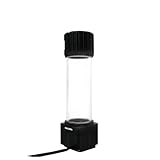
- POWERFUL & HIGH FLOW COOLING PERFORMANCE – Delivering 780L/H flow rate and a 5–6 meter head, this 12V DC brushless water cooling pump keeps CPUs and GPUs stable under heavy gaming, rendering, or overclocking loads. Precise microprocessor control and optimized water channel design maximize efficiency for reliable high-performance cooling.
- BRUSHLESS, MICROPROCESSOR CONTROLLED MOTOR – Engineered for long-lasting performance, the 18W pump’s microprocessor-regulated brushless motor ensures efficient, quiet, and durable operation. Large 4P + small 4-pin connectors offer stable power delivery, while silicone seals ensure a reliable leak-resistant loop, supporting continuous high-demand system operation.
- UNIVERSAL G1/4” THREAD COMPATIBILITY – Featuring 5 G1/4” inlet/outlet ports, this pump-reservoir combo supports flexible custom loop designs. Compatible with all major radiators, reservoirs, and water blocks, it allows seamless integration into PC builds of any scale, from compact cases to full towers, giving users freedom to expand and customize their cooling setup.
- FLEXIBLE TANK OPTIONS – Choose between 100ml, 200ml, 400ml, or 600ml reservoirs crafted from acrylic and POM with aluminum alloy reinforcement. Tank height options of 153mm, 203mm, 303mm, or 403mm adapt easily to different case layouts, while a 60mm body diameter and 69mm cover provide durability and a professional look.
- DURABLE & LEAK-RESISTANT DESIGN – Constructed with premium acrylic, POM, and aluminum alloy, this combo is designed for corrosion resistance and long-term durability. Integrated silicone seals create a secure, leak-proof connection. The complete installation kit includes mounting plates, sealing rings, shock pad, screws, and stop plugs for quick setup.
Compare one pump with two using the actual requirements of your loop:
| Consideration | One D5 | Two D5s in series |
|---|---|---|
| Restriction and required head pressure | Lower hardware and control complexity | More pumping capacity may suit a highly restrictive or expansive loop; no universal numeric gain is established here |
| Redundancy | A single failure stops circulation | Two pumps provide a second pump, but the loop still needs appropriate control and monitoring |
| Space and tubing | Simpler installation | Requires another pump, mount or dual top and additional connections |
| Noise and controls | One speed-control setup | Two pumps may require coordinated speed control and can add noise or heat |
| Serviceability | Fewer parts to isolate and remove | Can be convenient when mounted together, but adds another component to maintain |
Do the pumps need to be speed-matched?
Questions about one pump “pushing against” the other often arise in community discussions. The retrieved material does not establish a requirement for exact speed matching between two D5 pumps. Set speeds according to the pump controller, noise target and desired monitoring behavior, and verify that both pumps are actually powered and circulating coolant.
Quick wins for a faster PC:
Clear out junk files and repair common Windows errorsFree Scan →Fix the driver behind crashes, sound loss and screen glitchesFind Drivers →Best Value

- [D5-Compatible Performance] – High-flow D5-style design ensures stable, powerful circulation, ideal for large CPU/GPU loops and multi-reservoir setups.
- [PWM Speed Control] – 4-pin PWM header allows precise speed control through the motherboard or fan controller, giving you full control over performance and noise.
- [SATA Power Connection] – Powered via standard SATA connector for improved reliability and compatibility with modern PC builds.
- [Ultra-Quiet Ceramic Shaft] – Precision-engineered ceramic shaft reduces vibration and operating noise while ensuring long-term durability.
- [Custom Loop Ready] – Designed for easy integration into high-end liquid cooling systems and fully compatible with D5-style pump tops and reservoirs.
Do not generalize advice about mixing pump models. In an Alphacool forum response about a VPP655 D5 used with a DC-LT, staff said the smaller pump should remain powered; leaving it off adds resistance. That is guidance for the specific mixed-pump situation, not blanket compatibility approval for every combination of pumps.
A practical filling and routing sequence
- Install the reservoir above or directly feeding the first pump inlet where practical.
- Confirm each pump-top port from its model-specific manual; do not rely on the appearance of another D5 top.
- Connect the first pump outlet to the second pump inlet if the pumps are arranged consecutively, or route through the intervening loop components if they are separated.
- Plan a drain point and leave access for removing the pump or disconnecting fittings.
- Fill the reservoir before powering the pumps, then pulse the pumps briefly while keeping the inlet supplied with coolant.
- Inspect every fitting for leaks and continue bleeding air before operating the system normally.
The exact electrical control method depends on the pump and controller, so follow those component instructions. A pump that is powered without coolant can be damaged; stop immediately if the reservoir level falls below the pump feed.
Common mistakes to avoid
- Using the wrong port: inlet and outlet locations vary by pump top.
- Putting the reservoir after the first pump: this makes priming harder and can starve the pump during filling.
- Running a pump dry: coolant lubricates and cools the pump.
- Assuming adjacency is mandatory: manufacturer forum guidance allows separated placement.
- Repeating unverified forum numbers: flow and thermal figures in the AnandTech discussion are community claims, not documented controlled measurements. See the thread at AnandTech Forums.
- Choosing loop order for a supposed temperature rule: prioritize routing and serviceability unless a component manufacturer requires a particular connection.
Bottom line for a two-D5 build
Start with reservoir outlet → first D5 inlet, then follow the marked flow path through both pumps and the rest of the loop. Mount the pumps together if that is convenient, or separate them when the chassis layout demands it. There is no established universal radiator-before-block sequence that overrides good tubing, filling and maintenance practice.
Quick Recap
Product prices and availability are accurate as of the date/time indicated and are subject to change. Any price and availability information displayed on Amazon at the time of purchase will apply.

