
PC Slower Than It Used to Be?
A free scan shows the junk files, broken settings and background clutter dragging Windows down - then fixes them in one click.Free scan · Windows 10 & 11Outdated Drivers Are Slowing You Down
One free scan finds every outdated or missing driver and matches the right update for your exact hardware.Free scan · exact hardware matchThere is no universal Vulkan-versus-OpenGL ES winner for Android machine learning. The right choice depends first on the runtime and backend your app actually supports. LiteRT/TensorFlow Lite documents an Android GPU delegate based on OpenGL ES 3.1 compute shaders or OpenCL; MediaPipe describes GPU APIs as implementation-specific, with different nodes potentially using different APIs. Check the backend, model coverage, and device support for your chosen runtime before comparing performance.
Which GPU API does Android on-device ML use?
There is no single Android-wide API choice for on-device ML. A framework or runtime determines which GPU backends are available, and a particular model may use only a subset of them.
LiteRT and the TensorFlow Lite GPU delegate
LiteRT’s project documentation lists OpenCL and OpenGL among its Android GPU APIs (LiteRT project documentation). The TensorFlow Lite GPU delegate documentation is more specific: its Android backend uses OpenGL ES 3.1 compute shaders or OpenCL (TensorFlow Lite GPU delegate documentation). These statements describe that delegate, not every Android ML runtime. They do not establish that Vulkan is unavailable to all Android ML applications.
MediaPipe
MediaPipe names OpenGL ES, Metal, and Vulkan as mobile GPU APIs, but says it “does not attempt to offer a single cross-API GPU abstraction.” The API therefore depends on the implementation or node path rather than one universal MediaPipe switch (MediaPipe GPU framework concepts). Its documentation specifies OpenGL ES 3.1 or greater for Android/Linux ML inference calculators and graphs. Identify the calculator and graph you intend to use, and check current guidance: the repository notes that primary MediaPipe documentation moved to developers.google.com in 2023.
#1 Best Overall

- 【Strong Adsorption】The inspiration of the silicone phone suction case comes from the adhesive force of the octopus. Each suction cup phone mount is 3.15 inches long and 2.17 inches wide, with 24 independent suction cups providing a stronger and more stable suction force, so you don't have to worry about your phone falling during use.
- 【Back of Phone Suction Grip】Remove the adhesive film on the phone suction cup and stick it on the phone case. You can then fix the phone on any smooth surface, which is very convenient. (The phone suction cup cannot be removed and reused after being attached to the phone case. It is recommended to attach it to a regular phone case, not a valuable one.)
- 【Widely Used】Our non-slip silicone phone sticky grip mount attaches to almost any flat phone case and make it compatible with common mobile phones such as iPhone and Android.You can shoot, watch videos or video calls in the kitchen, gym, dance studio, bathroom and other places.
- 【Capture the Wonderful Picture】Whether you are a TikTok creator or just like to share videos and photos, this phone suction cup can help you hands-free capture wonderful videos and photos for sharing with friends.
- 【Note】You can fix the phone suction cup on a smooth surface such as a mirror or glass. If necessary, wipe the suction cup with a damp cloth to obtain stronger suction. Before releasing your hand, make sure the phone is firmly fixed. (Not applicable to rough walls, wooden surfaces, and other uneven surfaces)
What should you compare?
Compare Vulkan and OpenGL ES head-to-head only if your specific app or runtime provides both implementations for the same workload. Otherwise, compare the backend choices that the runtime actually supports, and treat a separate Vulkan implementation as a separate engineering path.
| Decision factor | What to verify |
|---|---|
| Runtime support | Whether the selected Android runtime exposes the backend for your app and model. LiteRT/TensorFlow Lite GPU documentation names OpenGL ES and OpenCL; MediaPipe describes API-specific implementations. |
| Model coverage | Which graph operations run on the GPU, which remain outside the delegate, and what precision modes are supported. A finite supported-operator list is not a guarantee that an arbitrary graph will be fully accelerated. |
| Device and driver | Whether the exact GPU, Android version, driver, and runtime combination works. LiteRT samples point to modern Pixel, Samsung, and Qualcomm/MediaTek devices as examples, not a certification of every model or configuration (LiteRT samples and project guidance). |
| Data movement | Copies, synchronization, context switches, and CPU/GPU or GPU/GPU transfers across the full camera-to-inference-to-render pipeline. MediaPipe identifies efficient data transfer as a design concern. |
| Measured app behavior | End-to-end latency, throughput, power use, thermal behavior, memory, and accuracy on representative target devices. The cited official documents do not provide a Vulkan-versus-OpenGL ES Android ML benchmark. |
| Integration cost | Backend setup, context and thread lifecycle, native library access, error handling, and CPU fallback behavior. Details vary by framework and version. |
Check model and operator coverage before optimizing
The TensorFlow Lite GPU delegate documentation lists supported operators and specifies FP16 and FP32 precision scope. Its examples include convolution, depthwise convolution, fully connected, pooling, common activations, reshape, resize-bilinear, and softmax. Treat this as documented delegate coverage, not a promise that every operator in a converted model will execute on the GPU (TensorFlow Lite GPU delegate operator list).
Rank #2

- SUPERIOR COMFORT — Unlike traditional circular ear buds, the design of EarPods is defined by the geometry of the ear. Which makes them more comfortable for more people than any other ear bud–style headphones.
- HIGH-QUALITY AUDIO — The speakers inside EarPods have been engineered to maximize sound output and minimize sound loss, which means you get high-quality audio.
- BUILT-IN REMOTE — EarPods with USB-C plug also include a built-in remote that lets you adjust the volume, control the playback of music and video, and answer or end calls with a pinch of the cord.
- COMPATIBILITY — Works with all devices that have a USB-C port.
- INTEGRATED MICROPHONE — A built-in microphone precisely captures your voice while you’re on the phone, taking a FaceTime call, or summoning Siri — so you’re always heard loud and clear.
For the model you plan to ship, verify the exact graph and runtime behavior. Partial delegation can change where computation runs; measure the actual execution path rather than assuming that selecting a GPU backend accelerates the entire model.
Account for framework-specific Android setup
TensorFlow Lite GPU delegate context and thread rules
The delegate documentation requires a consistent EGL context for graph modification and invocation. If the delegate creates the context, it says to invoke on the same thread used for graph construction or modification. This is TensorFlow Lite GPU delegate guidance; do not assume it applies unchanged to other runtimes or backends (TensorFlow Lite GPU delegate Android guidance).
The Tool Desk
Outbyte Driver Updater FREEScan for outdated or missing drivers - takes under a minuteDriver Scan →Outbyte PC Repair FREERepair Windows errors before they cause bigger problemsFix Now →Rank #3

- Secure Hold: Our PopSockets adhesive phone grip gives your cell phone a secure, comfortable hold in hand to help prevent drops while texting, taking photos, or scrolling on the go. Designed to stick firmly to most phone cases and devices.
- Hands-Free Made Easy: Easily turn your PopSocket into a phone stand to prop up your phone anywhere, perfect for watching videos, video calls, or following recipes. A must-have phone holder that keeps your device secure and ready for anything.
- Compatibility: Works with all phones, tablets, and Kindles. Sticks best to smooth, hard plastic cases and may not adhere to silicone or textured cases. Easily swap your PopTop to change up your style.
- Black PopSockets: Simple, refined, and endlessly versatile. A timeless essential for any phone.
- Travel Must-Have for People On the Go: A must-have travel accessory for flights, flying, airports, air travel, airplanes, planes, international trips, cruises, and long travel days. Key gadget for your airport haul, travel accessories and must-haves.
LiteRT-LM native libraries and initialization
LiteRT-LM’s Kotlin Android guide presents CPU, GPU, and NPU as backend configuration choices. For its documented Android GPU setup, the guide says the app must request optional libvndksupport.so and libOpenCL.so native libraries in the manifest. It also advises initializing the engine away from the UI thread because loading a model can take significant time. These are LiteRT-LM integration details, not requirements for every LiteRT API (LiteRT-LM Kotlin getting started guide).
Benchmark the complete app on target devices
- Confirm the available backend. Read the current documentation for the exact runtime and version. Do not infer Vulkan support from Android’s GPU capabilities or from another framework’s API list.
- Validate the model path. Check operator and precision coverage, then verify which parts of the graph actually execute on the chosen backend.
- Test representative hardware. Include the target GPU, Android version, and driver combinations. Device-family examples in framework samples are not blanket compatibility guarantees.
- Measure the full pipeline. Include initialization as appropriate, camera input, transfers, inference, post-processing, and rendering. Record latency and throughput alongside memory, power, heat, and output accuracy.
- Check fallback and failure behavior. Confirm what happens when the GPU backend cannot initialize, a device is unsupported, or an operation is not delegated; test the app’s intended fallback path.
- Repeat under realistic conditions. Test more than one run and account for warm-up and sustained thermal behavior. Compare results only under equivalent workloads and app conditions.
The official documents cited here provide backend and integration guidance, but no head-to-head result establishing that Vulkan or OpenGL ES is universally faster or more power-efficient for Android ML. A benchmark on the intended app and devices is necessary to make that call.
Quick Recap
Best Value
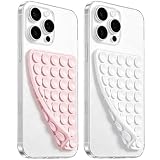
- 【PKYAA Double Sided Silicone Suction Phone Case Mount】PKYAA With Double Sided 40 Strong and Reliable individual suction cups, PKYAA provides a thicken and upgraded universal silicon suction mount for your phone.
- 【Friendly to Content Creators】If you are a content creator or an online influencer, you can create videos anywhere with this suction mount completely hands free with this silicone cell phone mount for cases.
- 【HANDS-FREE & Adhere to Mirrors】This Double Sided silicone suction phone case mount allows you to stick your phone to the mirror easily. No longer holding your phone in one hand to watch video tutorials while making up.
- 【Strong Grip on the Smooth Surface】You can easily hang your phone anywhere with a smooth surface. All you do is you clean off your phone and smooth surface. It is STURDY and it not only sticks to mirrors, it also sticks to windows, it sticks to refrigerators, tiles and other clean, flat surfaces.
- 【Press Down Firmly Every 30 Minutes】Use your palm or fingers to press the phone down firmly and check it's secure before letting go. Apply even pressure for a few seconds to allow the suction cup to adhere properly. To maintain the grip and prevent accidental falls, it's a good practice to periodically reapply pressure to the suction cup.
Rank #4

- [360 ° Flexible Rotation Design] Comes with a rotatable lanyard ring that supports 360 ° free rotation, effectively solving the problem of twisted and tangled lanyards
- [Wide compatibility] The ultra-thin 0.02-inch design does not block the charging port at all, and both wired and wireless charging can be used directly without removing the pad. Compatible with most smartphones such as iPhone, compatible with various wristbands, lanyards, crossbody straps, and keychains
- [Durable and Portable Material] Premium rust-resistant stainless steel material with good flexibility, which not only avoids scratching the phone case, but also has excellent anti rust and anti fading performance
- [Multi scenario Practical] Paired with a lanyard or wristband, hands-free use can be achieved. The phone is within reach and not easily dropped, ideal for daily commuting and outdoor activities. Suitable for full coverage phone cases, does not support half coverage phone cases
- [Quality Service] If you find any damage or other issues with the product upon receipt, please contact us immediately. We will handle it quickly
Product prices and availability are accurate as of the date/time indicated and are subject to change. Any price and availability information displayed on Amazon at the time of purchase will apply.

