
Windows Errors? Fix Them Before They Spread
Repair common Windows errors and clear accumulated junk for a smoother, more stable PC - no reinstall needed.Free scan · no reinstallCrashes, No Sound, or Screen Glitches?
Random freezes, missing sound and display glitches usually trace back to one bad driver. Find and replace yours safely.Free scan · under a minuteiTechGuides is reader-supported. When you buy through links on our site, we may earn an affiliate commission. As an Amazon Associate I earn from qualifying purchases. Learn more
Can light change a chemical reaction without adding a conventional catalyst? Experiments in optical cavities have reported changes to reaction rates and product distributions, but some prominent rate effects have not been reproduced. Vacuum-field catalysis is therefore an intriguing experimental proposal—not a reliable way to predict or control reactions.
What is vacuum-field catalysis?
Researchers place molecules inside a small optical cavity, commonly a Fabry–Pérot arrangement, that confines light. When a cavity mode resonates with molecular vibrations, light and molecular motion can couple to form hybrid states called vibrational polaritons.



The proposal is that this changed light–matter environment can affect reaction dynamics even when researchers do not externally pump the cavity. That is different from conventional catalysis: no added reagent binds the substrate to lower its reaction barrier. Marissa Weichman, a physical chemist at Princeton University, summarized the cavity’s role in a 2023 Chemistry World overview: “The cavity field confines light.”
Quick wins for a faster PC:
Repair Windows errors before they cause bigger problemsFix Now →Fix the driver behind crashes, sound loss and screen glitchesFind Drivers →Clear out junk files and repair common Windows errorsFree Scan →What reaction changes have researchers reported?
The reports span slower and faster reactions, as well as changes in product distributions. They are individual experimental claims under particular conditions, not evidence that cavities generally accelerate or redirect chemistry.
#1 Best Overall
| Reported result | Source and qualification |
|---|---|
| Slower spiropyran photoisomerisation | A 2012 demonstration, as recounted in Chemistry World’s 2023 overview. The overview also describes later work on named reactions and biochemical systems. |
| 92 meV Rabi splitting; reported rate enhancements of 102-fold for cyanate-ion hydrolysis and 104-fold for ammonia-borane hydrolysis | Hidefumi Hiura and Atef Shalabney’s 2021 working-paper version on ChemRxiv. These are the authors’ reported results, not independently established performance figures. The paper’s version history begins in 2018; the 2021 version should not be described as a 2021 journal publication. |
| An 80% decrease in phenyl isocyanate alcoholysis rate | The figure reported in Chemistry World’s 2023 account of the Simpkins and Herrera team’s study. It applies to that study’s conditions, not to reactions generally. |
The 2023 overview describes reported changes in reaction rates and product distributions, as well as reports involving solvent polarity and material properties. It says most experiments had shown rate or product-distribution changes rather than an entirely different product. Those reports should not be treated as settled general laws.
Can researchers reproduce cavity-catalysis results?
Not consistently. A 2022 conference abstract by Mario Imperatore, John B. Asbury and Noel Giebink reports reproducing the vacuum Rabi splitting and the out-of-cavity rate for cyanate-ion hydrolysis, but not a significant rate change as cavity thickness was tuned into and out of the strong-coupling regime. It is a specific account of a failed kinetic reproduction, but it is a conference abstract, not a full paper.
Rank #2
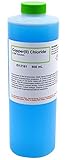
- 500mL bottle of copper (II) chloride
- Chemical for general purpose lab and educational use
- Used as a catalyst
- Perfect for use in any chemistry lab or classroom
- Includes directions for safe storage and SDS is available on product page and by request
Chemistry World’s 2023 overview also recounts Wei Xiong’s failed attempt to reproduce an ester-hydrolysis rate enhancement and a separate failed attempt to reproduce a reported 100-fold acceleration of cyanate hydrolysis. These accounts reinforce why reproducing the spectral signature of coupling and reproducing a reaction-rate effect are distinct tests.
Why are results difficult to compare?
Cavity-catalysis experiments use apparatus that is not standardized, and cavity volumes are tiny. Choices in construction, measurement and kinetic analysis can affect results or introduce artifacts. The sources do not establish a community-wide protocol specific to cavity catalysis.
General catalysis guidance emphasizes describing procedures and using controls that distinguish intrinsic reaction kinetics from transport and apparatus effects. A 2025 paper on catalysis data workflows offers a broader example of how documented workflows and packaged provenance can support reproducibility; it is not a cavity-catalysis standard.
How might a cavity affect a reaction?
There is no consensus mechanism and no reliable method for predicting which reactions will respond. Proposed explanations include changes in vibrational energy flow or populations, but connecting theory to experiment remains difficult.
A 2020 theoretical paper by Li, Nitzan and Subotnik examined transition-state-theory effects on the potential of mean force. Under its assumptions—including classical nuclei and photons, and no charge overlap between molecules—it found the effect negligible for usual micron-length cavities. That conditional result addresses a particular theoretical treatment; it does not rule out every proposed mechanism or experimental effect.
What would make a future claim more convincing?
A useful comparison should make the experimental and analytical choices explicit, rather than relying on a reported rate change alone. Look for:
Best Value

- Application Field : Potassium iodide is a white crystalline or powder form, soluble in water, exhibiting alkalinity. Potassium iodide finds widespread applications in various fields including chemistry, water treatment, and optics.
- Potassium Iodide Powder 99.9% Purity: High-purity potassium iodide powder can provide more accurate, reliable, and efficient experimental results, meeting the demands and requirements of experiments.
- Elephant Toothpaste Experiment: In this experiment, potassium iodide powder is used as a catalyst to accelerate the reaction rate, leading to the generation of more gas and foam, thereby enhancing the visual appeal and effectiveness of the experiment.
- Teaching Chemistry Principles: Conducting experiments using potassium iodide can help students learn about solutions, ion reactions, acid-base properties, and other aspects of chemistry. Students can directly observe the occurrence and outcomes of chemical reactions.
- Avoid Skin And Eye Contact: Potassium iodide powder may cause irritation to the skin and eyes, so please avoid direct contact with the skin and eyes. If contact occurs, rinse immediately with plenty of water.
- The reaction and what was measured: rate, product distribution, or another property.
- The cavity design and tuning, alongside evidence that the intended coupling occurred.
- Controls and an out-of-cavity baseline measured in a way that supports a fair comparison.
- The kinetic-analysis method and enough procedural detail to assess possible apparatus or analysis effects.
- Independent replication, distinguishing a reproduced spectral splitting from a reproduced kinetic effect.
- A clear label for the evidence: experimental result, conference abstract, working paper, or theoretical prediction.
Could this become a practical technology?
Researchers have proposed possibilities such as controlling selectivity, using microfluidic flow reactors, or slowing material degradation. These are prospective applications, not established industrial uses. Without reproducible effects and a way to predict which reactions respond, vacuum-field catalysis remains a research question rather than a practical substitute for conventional catalysts.
Quick Recap
Product prices and availability are accurate as of the date/time indicated and are subject to change. Any price and availability information displayed on Amazon at the time of purchase will apply.

