
What’s actually slowing this PC down?
Pick the symptom - the matching free tool is one click away.
Using PostgreSQL as a vector database in RAG is a production-ready approach when your documents, permissions, metadata, and application records already live in PostgreSQL. With the open-source pgvector extension, PostgreSQL supports exact and approximate similarity search, metadata filters, hybrid retrieval, transactions, backups, joins, and row-level security—but it is not the best fit for every vector-heavy workload.
PostgreSQL is often the simplest RAG retrieval layer for small-to-medium systems and multi-tenant applications that need relational filtering and authorization during retrieval. A dedicated vector database can be a better choice when vector search dominates the workload, independent horizontal scaling is essential, or your team wants vector-specific managed operations.


This guide covers the architecture, schema, installation, retrieval SQL, HNSW and IVFFlat tuning, hybrid search, tenant isolation, benchmarking, operations, failure recovery, and the signals that indicate it is time to consider a separate vector service.
Key takeaways
- PostgreSQL becomes a vector-search database through
pgvector, which supports exact search, HNSW, IVFFlat, multiple vector types, common distance metrics, SQL filters, and full-text search. - PostgreSQL is a strong default when document chunks, embeddings, tenant permissions, and application data need to remain in one transactional system.
- HNSW is a useful first approximate-index candidate for production RAG, while IVFFlat can reduce memory and build costs when its lists and probes are properly benchmarked.
- Approximate vector search can return too few qualifying rows after a selective metadata filter, so filtered workloads require iterative scans, higher search settings, partitioning, partial indexes, or exact-search comparisons.
- RAG quality depends on ingestion, chunking, embedding versioning, hybrid retrieval, reranking, authorization, and evaluation—not on the vector index alone.
How does PostgreSQL fit into a RAG system?
PostgreSQL acts primarily as the retrieval store and query layer in a retrieval-augmented generation system. An application still needs separate components for document parsing, chunking, embedding generation, prompt construction, language-model inference, and RAG evaluation.
#1 Best Overall
- Ingest source documents from files, websites, APIs, or business systems.
- Normalize the content and extract useful text, headings, tables, code, and source locations.
- Split the content into semantically useful chunks.
- Generate an embedding for each chunk with an embedding model.
- Store documents, chunks, embeddings, versions, tenants, permissions, and metadata in PostgreSQL.
- Embed the user’s query.
- Retrieve the nearest chunks with vector search, keyword search, or both.
- Optionally rerank the candidates with a cross-encoder or another ranking model.
- Pass authorized, selected context to the language model.
- Generate the answer and evaluate retrieval quality, source accuracy, and faithfulness.
PostgreSQL does not automatically parse documents, choose chunk boundaries, refresh embeddings after a source change, construct prompts, run an LLM, or prevent hallucinations. Those responsibilities belong in the ingestion and application workflows around the database.
What is pgvector?
pgvector is an open-source PostgreSQL extension for storing vectors and performing similarity search. The upstream pgvector documentation describes support for single-precision vector, half-precision halfvec, binary bit, and sparse sparsevec representations, along with exact search and approximate HNSW and IVFFlat indexes.
Depending on the vector type and operator class, pgvector supports L2, inner-product, cosine, L1, Hamming, and Jaccard distance operations. PostgreSQL itself remains a general-purpose relational database; PostgreSQL gains vector-database capabilities through the extension rather than changing into a vector-native product in the same sense as Pinecone, Qdrant, Milvus, or Weaviate.
How do you install and verify pgvector?
The extension must be installed at the PostgreSQL server level and enabled separately in each database that uses it:
Crashes, No Sound, or Screen Glitches?
Random freezes, missing sound and display glitches usually trace back to one bad driver. Find and replace yours safely.Free scan · under a minuteWindows Errors? Fix Them Before They Spread
Repair common Windows errors and clear accumulated junk for a smoother, more stable PC - no reinstall needed.Free scan · no reinstallCREATE EXTENSION IF NOT EXISTS vector;Verify that the extension is available and check the version enabled in the current database:
SELECT *
FROM pg_available_extensions
WHERE name = 'vector';

SELECT extversion
FROM pg_extension
WHERE extname = 'vector';
Installation differs between self-hosted PostgreSQL, Docker images, Linux packages, and managed providers. Confirm that your provider supports pgvector, the required PostgreSQL major version, HNSW and IVFFlat if needed, extension installation permissions, replicas, backups, and the memory and storage limits of the selected plan.
For the August 16, 2026 snapshot used by this article, the upstream pgvector repository shows v0.8.6 in its examples. PostgreSQL separately announced pgvector 0.8.2 on February 26, 2026, including a security fix for a parallel HNSW index-build buffer overflow. Verify the latest compatible upstream and provider-supported version before installation rather than copying either version number blindly; see the PostgreSQL announcement for pgvector 0.8.2 and the current upstream repository.
Why use PostgreSQL instead of a separate vector database?
PostgreSQL is especially attractive when vector retrieval must use the same documents, permissions, tenants, and business records as the rest of the application.
Quick wins for a faster PC:
Scan for outdated or missing drivers - takes under a minuteDriver Scan →Clear out junk files and repair common Windows errorsFree Scan →Fix the driver behind crashes, sound loss and screen glitchesFind Drivers →One source of truth
A single PostgreSQL schema can contain the canonical document, its chunks, embeddings, source version, tenant ID, access-control attributes, source URI, timestamps, and application relationships. Avoiding a second vector store removes a synchronization pipeline and reduces the chance that a deleted or restricted document remains searchable elsewhere.
Relational filtering and joins
RAG retrieval commonly needs conditions such as tenant, department, publication state, document ID, region, or entitlement. SQL expresses those conditions directly:
SELECT id, document_id, content
FROM document_chunks
WHERE tenant_id = $1
  AND document_id = ANY($2)
  AND visibility = 'internal'
  AND published_at <= now()
ORDER BY embedding <=> $3::vector
LIMIT $4;
Joins also make it possible to retrieve a chunk while checking document status, user permissions, source versions, or related business data in the same query.
Transactions and existing operations
A document update can coordinate the canonical document, chunks, embedding model identifier, indexing status, and permissions in one transaction or job workflow. The pgvector project documentation also highlights PostgreSQL capabilities such as ACID transactions, point-in-time recovery, and joins.
Teams may already have PostgreSQL backups, point-in-time recovery, replication, monitoring, connection pooling, migration tooling, network controls, role management, SQL analytics, and ORM support. Reusing those systems can be simpler than operating a second database and duplicating metadata.
Hybrid retrieval in one database
PostgreSQL full-text search can search exact terms while pgvector searches semantic similarity. That combination is useful for product codes, error messages, version numbers, legal phrases, names, API identifiers, and newly introduced terminology that an embedding search may underweight. PostgreSQL’s full-text-search documentation covers tsvector, tsquery, ranking, dictionaries, stemming, and language configuration.
When is a dedicated vector database a better choice?
A dedicated vector database deserves serious consideration when vector retrieval is the dominant workload, the corpus is very large, independent horizontal scaling is central, or vector-specific managed features would otherwise require substantial PostgreSQL tuning.
| Decision factor | PostgreSQL plus pgvector | Dedicated vector database |
|---|---|---|
| Existing application data | Strong fit when documents, permissions, and business records already use PostgreSQL | Usually requires synchronizing metadata or keeping PostgreSQL as a second system |
| Filtering and joins | Natural SQL predicates, joins, transactions, and row-level security | Often strong vector-native filtering, but relational joins may need application logic |
| Operational model | Reuse PostgreSQL backups, monitoring, roles, and migrations | Separate vector-focused service and operational surface |
| Scaling | Vertical scaling, replicas, partitioning, and selected sharding strategies | Usually designed around independently scaling vector retrieval |
| Write workload | Updates create normal PostgreSQL WAL, vacuum, bloat, and index-maintenance work | May be optimized around vector ingestion, depending on the service |
| Authorization | Can enforce tenant predicates and PostgreSQL RLS during retrieval | Requires a second authorization and metadata-consistency design |
| Best reason to choose it | One consistent relational data layer is more valuable than vector specialization | Vector throughput, managed scaling, or vector-native operations dominate |
Do not reduce the decision to “small corpus versus large corpus.” Corpus size, vector dimensionality, filter selectivity, query concurrency, update rate, replication requirements, freshness, memory budget, team expertise, and compliance requirements matter together. Do not claim that PostgreSQL is universally faster or cheaper, or that a separate vector service is automatically more scalable. Compare total cost of ownership, including duplicate data pipelines, backups, network traffic, observability, support, and engineering time.
The Tool Desk
Outbyte Driver Updater FREEFix the driver behind crashes, sound loss and screen glitchesFind Drivers →Outbyte PC Repair FREERepair Windows errors before they cause bigger problemsFix Now →How should you design a PostgreSQL RAG schema?
Separate document identity from chunk retrieval records. Store the model and source version explicitly so that an embedding can be traced, replaced, and rolled back.
CREATE EXTENSION IF NOT EXISTS vector;

CREATE TABLE documents (
    id              bigint GENERATED ALWAYS AS IDENTITY PRIMARY KEY,
    tenant_id       bigint NOT NULL,
    source_uri      text NOT NULL,
    title           text,
    content_hash    text NOT NULL,
    version         integer NOT NULL DEFAULT 1,
    updated_at      timestamptz NOT NULL DEFAULT now(),
    metadata        jsonb NOT NULL DEFAULT '{}'::jsonb
);

CREATE TABLE document_chunks (
    id              bigint GENERATED ALWAYS AS IDENTITY PRIMARY KEY,
    document_id     bigint NOT NULL REFERENCES documents(id) ON DELETE CASCADE,
    tenant_id       bigint NOT NULL,
    chunk_number    integer NOT NULL,
    content         text NOT NULL,
    token_count     integer,
    embedding_model text NOT NULL,
    embedding       vector(1536),
    textsearch      tsvector GENERATED ALWAYS AS (
        to_tsvector('english', content)
    ) STORED,
    metadata        jsonb NOT NULL DEFAULT '{}'::jsonb,
    created_at      timestamptz NOT NULL DEFAULT now(),
    UNIQUE (document_id, chunk_number, embedding_model)
);
The vector(1536) dimension is only an example. The column dimension must match the embedding model. If multiple models or dimensions must coexist, use separate columns, separate tables, or an unconstrained vector column with explicit model tracking. Do not mix incompatible models in one fixed-dimension column.
Fields for production traceability can include source offsets, a parent section, embedding timestamps, and processing status:
ALTER TABLE document_chunks
ADD COLUMN source_start integer,
ADD COLUMN source_end integer,
ADD COLUMN parent_chunk_id bigint,
ADD COLUMN embedding_updated_at timestamptz,
ADD COLUMN embedding_status text NOT NULL DEFAULT 'pending';
Useful ordinary indexes include:
CREATE INDEX document_chunks_tenant_idx
    ON document_chunks (tenant_id);

CREATE INDEX document_chunks_document_idx
    ON document_chunks (document_id);

CREATE INDEX document_chunks_textsearch_idx
    ON document_chunks USING gin (textsearch);

CREATE INDEX document_chunks_metadata_idx
    ON document_chunks USING gin (metadata);
Index filter columns deliberately. A vector index alone is not a substitute for ordinary relational indexes on tenant IDs, document IDs, status fields, or other frequently used predicates.
Rank #2

- 4-POST 18U RACK CABINET: Wall-Mount Server Rack w/ adjustable mounting depth 2.4" to 16" (6.0cm to 40.6cm) is ideal for installing network switches, patch panels and other rackmount equipment in your warehouse, home / office, store location or server room
- EASY ACCESS: Wall-mount data rack features a 180° hinged, enclosed and lockable rack design with easy access to the rear of the mounted devices; Flexible locking server cabinet with reversible and removable front door and removable side panels
- BUILT TO LAST: The 18U wall-mounted network cabinet offers a 4 post design for additional support of your equipment; Constructed of high-quality SPCC cold-rolled steel for strength and durability with a maximum weight capacity of 198lb (90kg)
- FULLY ASSEMBLED: Swinging network cabinet ships fully assembled with all of the rack screws and cage nuts required to mount your equipment; Includes a shelf and a roll of hook-and-loop fastener; Wall-mount equipment cabinet is EIA/ECA-310-E Compliant
- DESIGNED FOR COOLING: Vented IT rack enclosure features mesh front doors and side panels for passive airflow and supports active cooling with up to four optional 120mm fans (e.g., ACFANKIT12 – available in US/CA only)
How should documents, chunks, and embeddings be prepared?
Chunking should follow the source structure rather than a universal character or token count. Split by headings, paragraphs, pages, code blocks, or other meaningful boundaries; use moderate overlap only when overlap preserves context; and retain parent-document or parent-section references.
Keep titles, headings, table context, source identifiers, and access-control metadata available to retrieval. Whether metadata belongs inside the embedded text depends on the field: semantic content can be embedded, while strict authorization and filtering attributes should remain explicit database columns or controlled JSONB fields.
Store the exact source span used to create each chunk. Source spans make citations, debugging, deletion, and document-version comparisons more reliable. Avoid chunks that combine unrelated sections, and do not assume that a fast index can compensate for poor boundaries.
How should embedding-model changes be migrated?
Embedding-model changes require an explicit migration because vectors from incompatible models should not be compared. A safe process is:
Do these 3 things before closing this tab:
1Clear out junk files and repair common Windows errors2Scan for outdated or missing drivers - takes under a minute3Repair Windows errors before they cause bigger problems- Add a new embedding column or model-versioned table.
- Backfill embeddings asynchronously from the current source text.
- Build a new vector index after representative data is available.
- Evaluate old and new retrieval on the same test set.
- Switch reads to the new model and index.
- Remove the old data only after the rollback window has ended.
The same migration discipline applies when preprocessing, chunking, language configuration, or source normalization changes.
How do you retrieve similar chunks with PostgreSQL?
Insert a validated embedding with its model identifier and source version:
INSERT INTO document_chunks (
    document_id,
    tenant_id,
    chunk_number,
    content,
    token_count,
    embedding_model,
    embedding
)
VALUES (
    $1,
    $2,
    $3,
    $4,
    $5,
    $6,
    $7::vector
);
The application should validate the embedding dimension, model identifier, source-document version, non-empty content, successful embedding generation, and compatibility with the selected distance metric.
A cosine-distance query with an explicit tenant filter looks like this:
Recommended Free Tools
SELECT
    id,
    document_id,
    content,
    1 - (embedding <=> $1::vector) AS similarity
FROM document_chunks
WHERE tenant_id = $2
ORDER BY embedding <=> $1::vector
LIMIT $3;
The <=> operator is cosine distance. The pgvector operator documentation also defines <-> for L2 distance, <#> for negative inner product, and <+> for L1 distance.
A distance-derived similarity is not a universal probability or relevance percentage. Calibrate thresholds on your own evaluation set, and keep the metric, embedding model, and threshold together when interpreting results.
Which approximate index should you choose: HNSW or IVFFlat?
HNSW and IVFFlat both trade some exactness for faster nearest-neighbor retrieval, but they have different build, memory, and tuning characteristics.
| Criterion | HNSW | IVFFlat |
|---|---|---|
| Initial starting point | Often the first production index to test | Useful when memory or build speed matters |
| Training data before creation | Does not require a training phase before index creation | Needs representative data for useful list assignments |
| Primary query setting | hnsw.ef_search |
ivfflat.probes |
| Recall trade-off | Higher search breadth generally improves recall and latency cost | More probes generally improve recall and latency cost |
| Memory and maintenance | Can be memory-intensive and more demanding to build and maintain | Generally builds faster and uses less memory, subject to total PostgreSQL overhead |
| Filtered workloads | Test iterative scans, partial indexes, partitioning, and exact search | Test probes, list design, filtering, and candidate sufficiency |
How do you create and tune an HNSW index?
Create an HNSW index with an operator class matching the distance metric:
CREATE INDEX document_chunks_embedding_hnsw_idx
ON document_chunks
USING hnsw (embedding vector_cosine_ops);
Increase the query-time search breadth when recall needs improvement:
SET hnsw.ef_search = 100;The upstream pgvector documentation gives a default hnsw.ef_search value of 40. Higher values generally improve recall while increasing query work and latency. Treat 100 as a test setting, not a universal recommendation.
For filtered searches, test iterative scans:
SET hnsw.iterative_scan = strict_order;

-- Or, where slightly relaxed distance ordering is acceptable:
SET hnsw.iterative_scan = relaxed_order;
Iterative scans can continue scanning until enough rows satisfy the filter, subject to scan limits. Relaxed ordering can improve recall but may return rows slightly out of exact distance order. A materialized CTE can restore strict ordering when necessary:
WITH relaxed_results AS MATERIALIZED (
    SELECT id, document_id, content, embedding
    FROM document_chunks
    WHERE tenant_id = $1
    ORDER BY embedding <=> $2::vector
    LIMIT 100
)
SELECT id, document_id, content
FROM relaxed_results
ORDER BY embedding <=> $2::vector
LIMIT 10;
Relevant HNSW scan controls include:
SET hnsw.max_scan_tuples = 20000;
SET hnsw.scan_mem_multiplier = 2;
These values are starting points for experiments. The correct settings depend on filter selectivity, data distribution, concurrency, memory, and the required recall.
How do you create and tune an IVFFlat index?
Load representative data before creating an IVFFlat index:
CREATE INDEX document_chunks_embedding_ivfflat_idx
ON document_chunks
USING ivfflat (embedding vector_cosine_ops)
WITH (lists = 100);
At query time, control how many lists are searched:
SET ivfflat.probes = 10;More probes generally improve recall at the cost of latency. The upstream IVFFlat guidance describes heuristics such as approximately rows / 1000 lists up to one million rows and approximately sqrt(rows) lists for larger datasets. Those are heuristics, not capacity guarantees; benchmark list counts and probes using representative vectors and production-like filters.
Creating IVFFlat before loading sufficient data can produce poor list assignments. For a large initial import, bulk-load the rows first, then create the index or rebuild it after representative data is present.
Free tools Windows power users keep installed
One-click scans. No signup required.
Rank #3
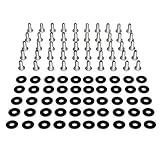
- Threaded hole hardware kit - 50 each #12-24 screws
- Fastens equipment to threaded hole rack mount rails
- Compatible with all #12-24 threaded hole racks
Why can metadata filtering reduce approximate-search recall?
With an approximate index, the database may find a limited candidate set and apply a metadata predicate while producing the final result. If only a small fraction of vectors match the filter, too few qualifying rows may survive.
For example, a tenant or document-type filter that matches roughly 10% of the corpus can require a much larger candidate search than an unfiltered query. The pgvector filtering guidance documents this class of behavior and recommends techniques such as iterative scans and higher candidate settings.
Use these mitigations:
- Enable HNSW iterative scans where supported.
- Increase
hnsw.ef_searchor IVFFlat probes. - Create ordinary indexes on filter columns.
- Create partial vector indexes for a small number of common filter values.
- Partition by tenant, region, corpus, or another high-value dimension.
- Use exact search when the filtered subset is small enough.
- Over-fetch candidates and filter or rerank them in a controlled workflow.
- Benchmark each important filter pattern separately instead of testing only unfiltered queries.
How should PostgreSQL enforce tenant isolation in RAG?
Authorization must happen during retrieval, before retrieved context reaches the language model. Application-side filtering alone is risky because a missed tenant_id predicate can expose another customer’s content to the prompt.
Use explicit tenant predicates, PostgreSQL row-level security, separate schemas or tables, partitioning, or separate databases according to the required isolation boundary. A basic RLS policy is:
ALTER TABLE document_chunks ENABLE ROW LEVEL SECURITY;

CREATE POLICY tenant_chunk_isolation
ON document_chunks
USING (tenant_id = current_setting('app.tenant_id')::bigint);
According to the PostgreSQL row-security documentation, USING controls which existing rows can be read. RLS design still requires care: superusers and roles with BYPASSRLS need separate handling, and administrative access should not be confused with tenant-scoped application access.
Connection pooling creates a session-state hazard. Set the tenant context safely for every request or transaction, prevent state from leaking between pooled connections, and test rejected cross-tenant queries. The pgvector documentation also warns that sharing one approximate index among tenants can allow vectors from one tenant to affect another tenant’s recall and speed; partitioning or separate tables can reduce that interference.
How do you add hybrid keyword and vector search?
Hybrid retrieval runs a semantic branch and a keyword branch, then combines their ranked candidates. Hybrid search can improve retrieval for exact identifiers while retaining semantic matching for paraphrased questions.
The keyword branch uses PostgreSQL full-text search:
WITH query AS (
    SELECT websearch_to_tsquery('english', $1) AS q
)
SELECT
    id,
    content,
    ts_rank_cd(textsearch, query.q) AS keyword_score
FROM document_chunks, query
WHERE tenant_id = $2
  AND textsearch @@ query.q
ORDER BY keyword_score DESC
LIMIT 50;
The vector branch retrieves semantic candidates:
SELECT
    id,
    content,
    embedding <=> $1::vector AS vector_distance
FROM document_chunks
WHERE tenant_id = $2
ORDER BY embedding <=> $1::vector
LIMIT 50;
Combine the result lists with Reciprocal Rank Fusion or pass the candidates to a learned reranker such as a cross-encoder. Do not add cosine scores and full-text scores without normalization: the two scores have different meanings and scales. The pgvector hybrid-search documentation describes PostgreSQL full-text search combined with Reciprocal Rank Fusion and cross-encoder approaches.
How should chunking and embedding quality be evaluated?
Build a representative evaluation set containing user questions, expected source chunks or documents, authorization conditions, and difficult exact-term queries. Compare changes to chunking, embedding models, filters, candidate counts, rerankers, and prompts against the same set.
Measure retrieval metrics such as recall@k, precision@k, MRR, and nDCG. Also measure answer-level outcomes such as faithfulness, source or citation accuracy, answer completeness, p50 and p95 retrieval latency, end-to-end latency, and failure rates.
Chunking quality often matters more than index selection. Preserve headings, table context, code boundaries, parent sections, and source identifiers. Avoid embedding unrelated content together. Use overlap only where it preserves necessary context, because excessive overlap can increase storage and return redundant evidence.
Do these 3 things before closing this tab:
1Fix the driver behind crashes, sound loss and screen glitches2Repair Windows errors before they cause bigger problems3Scan for outdated or missing drivers - takes under a minuteHow do you compare approximate retrieval with exact search?
Every production evaluation should include exact nearest-neighbor search as a recall baseline. For a diagnostic query, temporarily discourage ordinary index scans:
BEGIN;

SET LOCAL enable_indexscan = off;
SET LOCAL enable_bitmapscan = off;

SELECT id, document_id, content
FROM document_chunks
WHERE tenant_id = $1
ORDER BY embedding <=> $2::vector
LIMIT 10;

COMMIT;
The pgvector documentation recommends exact-search comparisons for monitoring recall. Use the exact result set as the reference when changing HNSW search breadth, IVFFlat probes, filters, dimensions, quantization, or reranking.
Inspect actual plans and buffer behavior with PostgreSQL’s EXPLAIN documentation:
EXPLAIN (ANALYZE, BUFFERS)
SELECT id, document_id, content
FROM document_chunks
WHERE tenant_id = $1
ORDER BY embedding <=> $2::vector
LIMIT 10;
Benchmark realistic concurrency, filter combinations, newly inserted data, updates, deletes, replica lag, and cold and warm cache behavior. A benchmark using only an unfiltered nearest-neighbor query does not represent a multi-tenant RAG workload.
Recommended Free Tools
How much storage do PostgreSQL vectors require?
The pgvector documentation estimates ordinary single-precision vector storage at approximately 4 × dimensions + 8 bytes per vector before tuple, alignment, metadata, table, WAL, and index overhead. A 1,536-dimensional vector therefore has approximately 6,152 bytes of raw vector value storage, while one million such vectors have approximately 6.1 GB of raw vector values. Ten million have approximately 61.4 GB. These are raw-vector estimates, not database capacity requirements.
Actual capacity must include chunk text, JSONB metadata, indexes, WAL, replicas, backups, free space, vacuum overhead, and temporary query memory. Measure the live database:
SELECT
    pg_size_pretty(pg_relation_size('document_chunks')) AS table_size,
    pg_size_pretty(pg_indexes_size('document_chunks')) AS index_size;

SELECT pg_size_pretty(
    pg_relation_size('document_chunks_embedding_hnsw_idx')
);halfvec, lower-dimensional embeddings, quantization, and binary representations can reduce the working set, but they may introduce approximation or recall trade-offs. Test retrieval quality after any precision or quantization change, and consider reranking candidates with higher-precision values where appropriate.
How should PostgreSQL be operated under RAG load?
Bulk loading and index creation
For initial ingestion, load rows with COPY, create vector and text indexes after the initial data load, and build indexes with carefully chosen maintenance memory. The PostgreSQL COPY documentation covers bulk loading, while pgvector recommends creating indexes after the initial load and using concurrent index creation in live production where blocking writes is unacceptable.
Vector indexes compete with relational queries for CPU, RAM, storage, and I/O. Separate retrieval and transactional workloads when necessary, use connection-pool limits, monitor p95 latency and wait events, and avoid assuming that a larger LIMIT is free.
Updates, deletes, vacuum, and reindexing
Frequent updates and deletes create dead tuples, WAL volume, vacuum work, and possible index bloat. Track source versions and embedding versions explicitly, avoid rewriting large rows unnecessarily, and decide deliberately between hard deletes and soft deletes.
When HNSW vacuum operations become slow, the pgvector documentation recommends reindexing before vacuuming:
REINDEX INDEX CONCURRENTLY document_chunks_embedding_hnsw_idx;
VACUUM document_chunks;
Use this as an operational procedure to test, not a command to run blindly. Confirm index validity, lock behavior, disk headroom, replication impact, and maintenance-window requirements.
The Tool Desk
Outbyte PC Repair FREERepair Windows errors before they cause bigger problemsFix Now →Outbyte Driver Updater FREEFix the driver behind crashes, sound loss and screen glitchesFind Drivers →Scaling beyond one primary
Possible strategies include vertical scaling, read replicas, partitioning by tenant or corpus, separating retrieval from transactional traffic, table or database separation, and sharding approaches such as Citus or PgDog where appropriate. Read replicas do not solve every vector-scaling problem: replication lag can make newly ingested content unavailable to retrieval queries that require immediate freshness.
Move to a separate vector service when PostgreSQL capacity, index maintenance, operational coupling, or scaling constraints become more expensive than operating two systems. Make that decision from production measurements rather than a generic row-count threshold.
What are the common PostgreSQL RAG failure modes?
| Symptom | Likely causes | Recovery steps |
|---|---|---|
| “The extension is not available” | pgvector is not installed on the server or the provider does not support it | Check pg_available_extensions; install the provider package or select a supported managed PostgreSQL service |
| “Operator does not exist” | Missing ::vector cast, wrong operator class, incompatible vector type, or dimension mismatch |
Inspect the table definition with d+ document_chunks, cast parameters explicitly, and match the index operator class to the type and metric |
| Vector index is ignored | Small table, restrictive filter, poor estimates, mismatched ORDER BY, invalid/building index, or exact search is cheaper |
Run EXPLAIN (ANALYZE, BUFFERS), inspect estimates and index validity, and compare exact and approximate plans |
| Recall decreases after HNSW | Approximation settings, selective filters, stale embeddings, dead tuples, wrong metric, NULL vectors, or zero cosine vectors | Increase hnsw.ef_search, test iterative scans, inspect data quality, and compare against exact search |
| Filtered query returns fewer than k rows | Candidate search is too narrow before the metadata filter is applied | Use iterative scans, higher candidate settings, partial indexes, partitioning, over-fetching, or exact search |
| Index build runs out of memory | Large HNSW graph, high dimensions, excessive parallelism, or insufficient maintenance memory | Reduce parallelism, schedule the build, consider IVFFlat, use half precision or quantization, lower dimensions, or partition the corpus |
| Answers are poor despite fast retrieval | Bad chunking, unsuitable embeddings, excluded metadata, weak prompts, stale data, missing hybrid search, or no reranker | Evaluate the whole RAG pipeline rather than tuning only the database index |
NULL embeddings are not indexed, and zero vectors are not indexed for cosine distance according to the pgvector documentation. Validate embedding status and dimensions during ingestion instead of discovering invalid rows through recall tests.
What security and governance controls does production RAG need?
Use least-privilege database roles, encryption in transit and at rest, secrets management, audit logging, PII controls, deletion propagation, backup-retention policies, data-residency checks, and a policy for logging prompts and retrieved context.
What’s actually slowing this PC down?
Pick the symptom - the matching free tool is one click away.
Authorization must be applied before context reaches the LLM. A post-generation check cannot undo the exposure of restricted text to the model or to prompt logs. Test cross-tenant retrieval explicitly, including pooled connections, administrative roles, stale permissions, deleted documents, and documents whose access changed after embedding.
RLS can be a strong control, but RLS does not automatically guarantee tenant safety. Policy definitions, role attributes, superusers, BYPASSRLS, connection-pool state, and administrative query paths all matter. Keep tenant identifiers explicit in retrieval code even when RLS is enabled because explicit predicates improve readability, diagnostics, and defense in depth.
Which managed PostgreSQL or vector service should you consider?
Commercial choices should be evaluated by workload and operational fit rather than by a free tier or headline monthly price. Pricing and included limits change, so verify current terms on each provider’s live page.
| Option | Best fit | Important trade-off | Observed pricing or availability signal |
|---|---|---|---|
| Self-hosted PostgreSQL plus pgvector | Teams with PostgreSQL expertise, private-cloud requirements, or infrastructure control | Your team operates extensions, ANN tuning, backups, upgrades, monitoring, and capacity | No pgvector license fee; compute, storage, operations, and engineering still cost money |
| Supabase | Teams wanting managed PostgreSQL with application services and a rapid RAG path | Plan limits and provider-specific controls may not suit highly customized or large vector deployments | The reviewed Supabase pricing page showed Free at $0/month, Pro at $25/month, Team at $599/month, and Enterprise custom; observed limits must be rechecked |
| DigitalOcean Managed PostgreSQL | Teams already using DigitalOcean that want managed PostgreSQL and documented vector or hybrid search | Advanced vector-native scaling may require another service or more PostgreSQL architecture | The DigitalOcean pricing page did not expose a reliable single vector-specific starting price in the reviewed content; use its live calculator |
| Pinecone | Teams wanting a vector-native managed service and separate vector scaling | Introduces duplicated metadata, synchronization, authorization, observability, and backup concerns | The reviewed Pinecone pricing page showed Starter free, Builder at $20/month, Standard with a $50/month minimum, and Enterprise with a $500/month minimum; usage beyond allowances and other application costs may apply |
| Qdrant Cloud | Teams wanting managed vector-native filtering and scaling | PostgreSQL may remain necessary as the authoritative relational system | The reviewed Qdrant pricing page described a free-forever single-node tier with 1 GB RAM and 4 GB disk, usage-based Standard, and Premium minimum-spend features |
Supabase is a natural fit when PostgreSQL, authentication, APIs, storage, and a quick application backend belong together. DigitalOcean is a practical option for teams already operating there and provides documentation for PostgreSQL vector search and PostgreSQL hybrid search. Pinecone or Qdrant becomes more attractive when vector retrieval is the primary workload and independent vector operations justify the additional system.
Production decision checklist
Choose PostgreSQL plus pgvector when most answers below are “yes”:
- Does the application already use PostgreSQL as its authoritative database?
- Do retrieval queries need joins, tenant predicates, permissions, document status, or business metadata?
- Would duplicating documents and authorization metadata into another service create meaningful synchronization risk?
- Can the team operate PostgreSQL indexes, vacuuming, backups, replicas, monitoring, and upgrades?
- Can the measured corpus size, concurrency, ingest rate, and memory budget fit a tested PostgreSQL topology?
- Do compliance, residency, or private-infrastructure requirements favor keeping data in the existing database environment?
Test a dedicated vector database when most answers below are “yes”:
- Is high-volume vector retrieval the dominant database workload?
- Does the retrieval tier need to scale independently from transactions and relational queries?
- Does the team need vector-native managed operations that PostgreSQL would require partitioning, sharding, replicas, or extensive tuning to provide?
- Can the organization maintain a reliable synchronization, authorization, deletion, backup, and observability design across two data systems?
- Do production benchmarks show that PostgreSQL cannot meet recall, p95 latency, concurrency, freshness, or maintenance requirements at an acceptable total cost?
Run a proof of concept with real documents, real authorization filters, representative queries, exact-search recall baselines, HNSW and IVFFlat alternatives, hybrid retrieval, realistic concurrency, updates, deletes, and failure recovery. The result should be a workload decision, not a database-fashion decision.
Frequently Asked Questions
Can PostgreSQL replace a dedicated vector database for RAG?
Yes, PostgreSQL can replace a dedicated vector database for many RAG applications when pgvector, relational filtering, authorization, and existing PostgreSQL operations meet the measured workload. A dedicated vector database is preferable when vector retrieval needs independent scaling or specialized managed operations that PostgreSQL cannot provide economically.
Quick wins for a faster PC:
Clear out junk files and repair common Windows errorsFree Scan →Fix the driver behind crashes, sound loss and screen glitchesFind Drivers →Repair Windows errors before they cause bigger problemsFix Now →Is HNSW or IVFFlat better for PostgreSQL RAG?
HNSW is often the first index to test because it offers a useful speed-recall trade-off without requiring training data before index creation. IVFFlat can be preferable when memory usage and build speed matter more, but lists and probes must be benchmarked on representative data.
Does a PostgreSQL WHERE clause guarantee accurate filtered vector search?
No. Approximate vector indexes can retrieve too few candidates before a selective metadata filter removes them. Iterative scans, higher HNSW search settings or IVFFlat probes, partial indexes, partitioning, candidate over-fetching, and exact search can improve filtered recall.
Does pgvector generate embeddings or answer user questions?
No. pgvector stores embeddings and performs similarity search inside PostgreSQL. Document parsing, chunking, embedding generation, prompt construction, LLM inference, and RAG evaluation remain application or platform responsibilities.
The Bottom Line
Bottom line: PostgreSQL plus pgvector is a legitimate production foundation for RAG, especially when relational data, document permissions, tenant isolation, and embeddings need one source of truth. Start with exact-search evaluation, test HNSW and IVFFlat against real filtered queries, add full-text search for exact terms, and monitor storage, recall, latency, writes, and maintenance. Choose a dedicated vector database only when measured workload requirements justify the extra system and synchronization complexity.
Windows Errors? Fix Them Before They Spread
Repair common Windows errors and clear accumulated junk for a smoother, more stable PC - no reinstall needed.Free scan · no reinstallCrashes, No Sound, or Screen Glitches?
Random freezes, missing sound and display glitches usually trace back to one bad driver. Find and replace yours safely.Free scan · under a minuteQuick Recap
Product prices and availability are accurate as of the date/time indicated and are subject to change. Any price and availability information displayed on Amazon at the time of purchase will apply.

