
iTechGuides is reader-supported. When you buy through links on our site, we may earn an affiliate commission. As an Amazon Associate I earn from qualifying purchases. Learn more
CCD size refers to the sensor’s physical imaging area—not its megapixel count. To compare CCDs accurately, look at active width and height, diagonal, pixel pitch, and active pixel count as separate specifications. A format label such as APS-H or “1/2.3-inch type” is useful shorthand, but it is not an exact measurement of the light-sensitive area.
What does CCD size mean?
A charge-coupled device (CCD) converts incoming light into an electronic image. When a manufacturer specifies a CCD’s size, it may mean the dimensions of its light-sensitive area, its diagonal, or a nominal format category. Those descriptions are related, but they are not interchangeable.
- Active image area: the light-sensitive width and height, usually stated in millimetres.
- Active diagonal: the diagonal across that area, also usually in millimetres. It does not reveal the sensor’s aspect ratio by itself.
- Pixel pitch: the physical width and height of an individual pixel, usually stated in micrometres (µm).
- Active pixel count: the number of pixels across and down. Their product gives the total active pixel count, often used to describe resolution.
- Optical format: a format convention or category—not necessarily the sensor’s actual width, height, or diagonal.
Kodak discusses optical-format conventions and sensor-area trade-offs in its CCD technology paper. The practical rule is to use the manufacturer’s active dimensions when you need physical measurements, and treat a format name as a label rather than a precise dimension.
Do these 3 things before closing this tab:
1Repair Windows errors before they cause bigger problems2Fix the driver behind crashes, sound loss and screen glitches3Clear out junk files and repair common Windows errorsIs CCD size the same as megapixels?
No. Sensor size describes physical area; pixel count describes how many active picture elements sample the image. Pixel pitch describes the dimensions of each pixel. These specifications answer different questions, and a datasheet should be read across all of them rather than reduced to a single number. Panasonic also distinguishes CCD pixel count from pixel size in its CCD pixel information.
#1 Best Overall
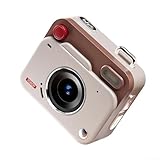
- [LIGHTWEIGHT AND COMPACT] The CCD for MINI Retro Digital Camera is lightweight at just 5 x 7.4 x 3.6cm, making it the perfect accessory for travelers want to document their adventures effortlessly.
- [HIGH DEFINITION VIDEO AND PHOTOS] Enjoy capturing every moment in HD 1080P quality; ideal for creating memorable social for MEDIA content.
- [SIMPLE OPERATION] The intuitive design ensures that anyone can take amazing photos with ease; suitable for all skill levels.
- [SIZING REMINDER] Remember to refer to your size chart before making a purchase.
Two sensors can have different physical areas and pixel pitches while having similar pixel counts. Conversely, a sensor with more pixels can have a smaller active area. The manufacturer specifications below illustrate that distinction:
| CCD example | Active pixels | Pixel pitch | Active image area | Diagonal or format |
|---|---|---|---|---|
| onsemi KAF-16801 | 4096 × 4096 | 9.0 × 9.0 µm | 36.88 × 36.88 mm | 52.1 mm diagonal; “645 1.3x Optical Format” |
| onsemi KAI-16050 | 4896 × 3264 | 5.5 × 5.5 µm | 26.93 × 17.95 mm | APS-H format; diagonal not stated in the cited datasheet |
These are manufacturer specifications, not representative figures for all CCDs. The KAI-16050 has more active pixels than the KAF-16801 example, but a smaller active area. The KAF-16801’s datasheet lists its active dimensions, diagonal, and optical-format label as distinct values (KAF-16801 datasheet, 2017); the KAI-16050 datasheet lists its active pixels, pitch, and area (KAI-16050 datasheet, 2015).
Rank #2

- 8x Optical Zoom with Optical Image Stabilizer helps you capture images with flexibility and ease
- 20.0 Megapixel CCD sensor combines with the DIGIC 4 plus Image Processor to help deliver stunning image quality
- 720p HD video capabilities. Focusing range: Normal: 2.0 inch - infinity (W), 4.3 feet (1.3 meter) - infinity (T)
- Smart auto intelligently selects the proper settings based on predefined shooting situations
- Digital IS helps reduce the effect of camera shake and subject movement. Operating temperature: 32-104°F / 0-40°C. Compatible with Android devices version 4.0 or later
What does a 1/2.3-inch CCD sensor mean?
A fractional-inch label such as “1/2.3-inch type” is a nominal optical-format designation, not a promise that the active sensor measures 1/2.3 inch across or diagonally. The same caution applies to other type labels: do not convert the fraction directly into an active width or diagonal. For a camera or component comparison, find the datasheet’s active width and height in millimetres; if those are not given, the label alone does not establish the exact imaging dimensions.
Format names such as APS-H also identify categories rather than replacing the actual active dimensions. For example, onsemi’s KAI-16050 is called APS-H, while its datasheet separately gives an active image area of 26.93 × 17.95 mm.
Rank #3

- WHAT CAUSES DUST SPOTS & HOW THIS FIXES IT: Dark spots appear when dust stick to your camera sensor, especially after lens changes. Our alcohol-free sensor cleaner safely lifts dust and smudges without harming coatings, and each 24mm full-frame swab is individually vacuum-sealed to ensure it is completely free of dust and debris before use.
- PROVEN, TRUSTED & SAFE FOR OVER A DECADE: UES sensor cleaning kits have been on the market for more than 10 years and are trusted by thousands of photographers worldwide. Our proven, gentle formula is completely safe for sensitive CMOS & CCD sensors and in-body image stabilization (IBIS) systems used by Sony, Canon, and Nikon.
- SAFE EVEN FOR FIRST-TIME CLEANING The flexible swab handle provides controlled, even pressure across the full-frame sensor, helping prevent streaks and scratches. Clear, predictable movement makes it easy to safely clean your camera at home without special tools or prior experience.
- NO STREAKS, NO LINT, NO FIBERS The precisely sized 24mm swab head perfectly matches full-frame sensors for simple, one-direction cleaning. Ultra-fine microfiber and individual vacuum sealing help prevent lint, streaking, or introducing new dust during the cleaning process.
- FAST, PROFESSIONAL-GRADE MAINTENANCE: Keep your camera gear in peak condition without the wait. Whether you are managing a camera rental fleet, running a photography studio, or maintaining your personal gear at home, this kit provides a quick, reliable solution for routine maintenance after lens changes, travel, or outdoor shooting.
How does CCD size affect what the camera sees?
With the same focal-length lens and camera position, a larger active sensor area captures a wider portion of the image projected by the lens than a smaller area. The resulting framing also depends on sensor aspect ratio, the lens’s usable image circle, and the camera’s optical design. A format label by itself does not tell you exactly what framing a particular camera-and-lens combination will produce.
Sensor area does not determine image quality on its own. Pixel pitch, pixel count, sensor architecture, lens and optical design, and the imaging task all matter. More pixels packed into a limited area affect design trade-offs, but there is no universal rule that the physically larger sensor always produces the better result. Kodak’s discussion of optical format and pixel size provides context for these interacting constraints.
Rank #4

- SAY GOODBYE TO EXPENSIVE REPAIRS! - Even a speck of dust can ruin your shots or worse—damage your sensor. Our upgraded dual-head swabs give you a deep, effective clean every time, saving you from costly maintenance and keeping your camera protected
- GET MORE VALUE WITH AOCII SENSOR CLEANING KIT. - Our set includes 20x 24mm Full Frame dual-head swabs and 20ml of cleaning solution, giving you long-lasting use without the need for constant refills. Keep your camera in top shape for a fraction of the cost
- PRO-LEVEL CLEANING FOR CRYSTAL-CLEAR SHOTS. - The 20ml sensor cleaner and advanced swab design remove even the toughest dirt and grime. Whether you're shooting outdoors or in the studio, your sensor stays spotless, delivering pristine images every time
- NO MORE ANXIETY ABOUT DAMAGING YOUR GEAR. - Worried about cleaning your sensor wrong? Our easy-to-use, gentle tools make it simple and safe, even for beginners. Get pro-level results without the fear of scratching or damaging your camera
- CLEAN ON THE GO, ANYTIME, ANYWHERE. - With our compact, travel-friendly storage pouch, you can take your cleaning kit anywhere. Whether you’re on a photo shoot in the wild or traveling for fun, you’ll always have the tools you need to keep your sensor clean
How to compare CCD sizes in a datasheet
- Record active width and height in millimetres. This is the clearest measure of imaging area and shows the sensor’s aspect ratio.
- Note the active diagonal, if listed. Use it for format comparisons, but not as a substitute for width and height.
- Copy the manufacturer’s optical-format label exactly. Treat it as shorthand, not an exact physical measurement.
- Check pixel pitch in both dimensions. This gives the physical size of each pixel; do not confuse it with total sensor area.
- Check active pixel count across and down. This describes sampling resolution, not the physical size of the CCD.
- Read the architecture and intended application. Different sensor designs and camera tasks can prioritize different properties, so compare relevant specifications rather than relying on size alone.
The KAF-16801 and KAI-16050 specifications show why these fields belong together: dimensions, pitch, pixel count, and format each describe a different part of the sensor.
Are CCD sensors still used?
CCD remains relevant in specialized imaging, including scientific and astronomy systems. Teledyne describes CCD sensor products and ground-based astronomy cameras using CCD and EMCCD sensors. That establishes continuing specialized applications, not how common CCDs are across the entire current camera market.
Best Value
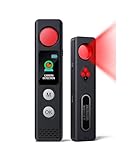
- 【LED Display & Easy to Use】Our hidden camera detector features a large color screen that clearly displays the current mode, battery level, and sensitivity settings. Operation is simple—just turn it on, scan the surrounding area, and receive alerts via LED flash, strong vibration, or beeping tones to stay informed of potential threats. Its compact size makes it extremely portable and concealment
- 【7-in-1 Multi-Function Detector】This 7-in-1 detector integrates RF signal scanning, lens detection, infrared detection, magnetic tracking, vibration alert functions, auto-detection and SOS. Built-in rechargeable battery, it supports 1-hour fast charging and delivers up to 25 hours of usage. Whether you're checking into a hotel, working in a private office, or parking your car, it provides comprehensive protection against eavesdropping and covert recording devices
- 【Visual Detection】By the viewing window to spot reflective points from lenses, you can "see with your own eyes" the potential threats around you. Switch to IR mode to detect night-vision cameras that record in complete darkness. Say goodbye to guesswork and false alarms—you get intuitive visual confirmation
- 【"Sentinel Mode" Anti-Theft Alarm】The camera detector also functions as a smart anti-theft alarm. Simply place it on your luggage, laptop bag, or hang it on a hotel door handle—if someone touches or moves the device, it instantly triggers a loud alarm. Whether at an airport, train station, or resting in unfamiliar surroundings, it's the ideal choice for protecting your valuables
- 【High-Precision RF & Magnetic Sensor】Equipped with a wide-band RF antenna and high-sensitivity sensor, this detector locates hidden threats with exceptional accuracy. It detects not only GPS trackers, wireless bugs, and Wi-Fi cameras but also concealed devices disguised as smoke detectors, wall chargers, or picture frames
Consumer imaging technology has also shifted substantially. Sony Semiconductor Solutions says its business made a major shift from CCD to CMOS image sensors in 2004, while describing its own company history—not the whole industry’s market share today—on its Common Technology of Image Sensors page. Sensor format remains a specification used in camera systems, but a format listing alone does not identify whether a sensor is CCD or CMOS.
Quick Recap
Product prices and availability are accurate as of the date/time indicated and are subject to change. Any price and availability information displayed on Amazon at the time of purchase will apply.

