
iTechGuides is reader-supported. When you buy through links on our site, we may earn an affiliate commission. As an Amazon Associate I earn from qualifying purchases. Learn more
A 2011 Stanford prototype showed how a lithium-ion battery could be made partly see-through by arranging its electrodes as fine grids in clear material. It did not demonstrate a commercial solar-window battery: pairing transparent storage with transparent solar cells was presented as a possible future use.
How does a transparent lithium-ion battery work?
Conventional battery electrodes are opaque. The Stanford team’s approach was to pattern the electrode materials into fine grids, leaving open areas through which light could pass. Chemistry World’s 2011 account describes the grids as trenches formed in clear polydimethylsiloxane (PDMS), a transparent polymer.
The reported cathode used LiMn₂O₄ nanorods, and the anode used Li₄Ti₅O₁₂ nanopowder. A 100 nm gold layer on the PDMS collected current. Water-based electrode slurries flowed into the patterned trenches by capillary action. The electrodes were stacked and aligned, with a clear electrolyte between them; a clear polymer bag enclosed the device, and aluminium strips served as terminals.
Free tools Windows power users keep installed
One-click scans. No signup required.
In short, the device did not make the electrode materials themselves transparent. It reduced their visible footprint by arranging them in narrow patterned lines within a clear structure.
#1 Best Overall

- 【200W N-Type 16BB High Efficiency】Built with advanced N-type monocrystalline cells and 16BB busbar technology, the Callsun 200 watt solar panel delivers up to 25.6% conversion efficiency. N-type cells provide excellent power generation and reliability, while the 16BB design helps reduce hot spots and microcrack risks for dependable long-term performance.
- 【400W Series Connection for Portable Power Stations】Pair two Callsun 200W panels in series to reach 400W total power, 47.48V Vmp and 54.62V Voc while maintaining 8.43A operating current. This configuration is well suited for many portable power stations with 60V-class solar input limits, helping maximize solar charging within supported voltage and current ranges.
- 【Boost Energy with Bifacial Technology】The Callsun 200W bifacial solar panel features a transparent backsheet that captures sunlight from both the front and rear sides. By utilizing direct, reflected and diffuse light, the bifacial design can generate additional energy from the rear side under suitable installation conditions, helping maximize overall solar output.
- 【TwinCell Anti-Shading Design】The Callsun 200W solar panel features a dual-module parallel design that divides the panel into two independently operating sections. When one section is partially shaded by trees, buildings or other obstacles, the other section can continue generating power. This design helps reduce the impact of partial shading and maintain more consistent energy production.
- 【Compact Design for RVs, Vans & Off-Grid Use】Each panel measures 51.3 × 30.3 × 1.4 inches and weighs 23.8 lbs, delivering strong power output in a compact footprint. This 200W solar panel is ideal for Class B vans, RVs, marine applications, rooftops and other space-conscious off-grid solar systems. Pre-drilled mounting holes make installation with compatible mounting hardware straightforward.
How transparent was the prototype, and how much energy did it store?
Chemistry World reported three prototype configurations. Their measurements show a trade-off: the more transparent version stored less energy per unit of volume.
| Reported optical transparency | Reported energy density |
|---|---|
| 78% | 5 Wh/L |
| 60% | 10 Wh/L |
| 30% | 20 Wh/L |
These figures are the prototype results reported in the 2011 Chemistry World account, not specifications for a product sold today. The report also compared the 60%-transparent configuration with an average smartphone battery of around 100 Wh/L, saying it had about one tenth the energy density. That comparison was attributed to the account’s 2011 reporting and should not be read as a current, matched test of battery products.
Rank #2

- High Power Output - The flexible solar panel can provide an average of 500 Watt-hours of electricity per day (depending on sun availability).
- Easy to Transport, Carry and Install - The 100 watt solar panel suits most curved surfaces as it is bendable within 240 degrees. the flexible 100 watt solar panel weighs only 1/3 of the rigid panel and presents an all-black glare-free appearance.
- Industry-leading Tech - Renogy 100w solar panel is equipped with half-cut PERC cell technology that enhances solar light capture and electrical performance, therefore improving the output efficiency.
- Reliable & Durable - This solar panel 100w accomplishes with IP67 rated waterproof junction box and solar connectors. Withstand up to 5400 Pa of heavy snow load and up to 2400 Pa of high wind.
- Ready for Installation - Renogy flexible solar panels come with pre-drilled mounting holes and 2.3 feet long solar connector cables for quick and easy installation.
How should the 50 Wh/L and 150 Wh/L figures be understood?
Neither figure was a reported measurement of the prototype. They were forward-looking statements attributed to group leader Yi Cui in the 2011 account.
- About 50 Wh/L: Cui said this could be achievable at that stage through optimization and industrial approaches. It was an estimate, not a demonstrated device result.
- Up to 150 Wh/L: Cui associated this potential with advanced electrode materials. It was a projection, not an achieved result.
These historical estimates do not establish present-day battery benchmarks or the performance of a commercial transparent battery.
Rank #3
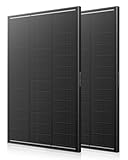
- TÜV Certified to IEC 61215, IEC 61730 & UL 61730: Independently tested and certified to recognized photovoltaic module standards for design durability, electrical safety, and mechanical safety, providing added confidence for RV, marine, rooftop, and off-grid installations.
- Expandable 200W Solar Power: This set includes two 100W solar panels for a combined 200W output, making it easy to expand an existing system or build a balanced 12V solar setup for RVs, boats, cabins, and off-grid use.
- Up to 25.8% N-Type Efficiency: Advanced N-Type monocrystalline cells deliver up to 25.6% conversion efficiency, providing strong energy production, reliable low-light performance, and consistent output in changing weather conditions.
- Advanced 16BB Cell Design: The precision 16-busbar structure improves current collection while reducing internal resistance, micro-cracks, and hot spots for more stable performance and long-term reliability.
- Flexible Series or Parallel Wiring: Connect the two panels in series or parallel to adjust voltage and current for your system. Compatible with most 12V batteries, MPPT/PWM charge controllers, and portable power stations.
Can solar windows store electricity?
The proposed idea was to combine a transparent battery with transparent solar cells. A window could then capture some incoming sunlight and store energy for later use, such as low-power lighting. Chemistry World described this as a possible application; it did not report an installed system, a product launch, an efficiency figure for an integrated window, or current market availability.
Transparent energy storage and transparent solar generation are separate components in this concept. The battery prototype alone does not show that a window can generate and store electricity as a functioning building product.
Rank #4
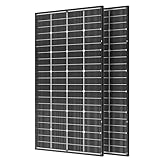
- [Bifacial Technology]: This package contains the solar panel only. This improved model of 200W solar panel features a transparent backsheet design that can produce electricity from both the front and the back, in contrast to conventional panels
- [16BB N-type Solar Cells]: The advanced 16BB N-type solar cells are used to make these 25%+ high efficiency 200W solar panels. They are more compact and less affected by shadows compared to common 9BB/10BB solar cells
- [Durable and Reliable Construction]: These 200 watt solar panels feature a black corrosion-resistant aluminum frame, which can withstand strong winds of 2400Pa and snowload of 5400Pa. Both the IP67 solar connectors and the IP65 junction box have outstanding waterproof capabilities, provide complete protection for the panels against environmental particles and low-pressure water jets
- [Easy Installation and Transport]: Pre-drilled holes on the back of solar panels for easy installation. Weighing just 24.3lbs, these 200W solar panels are easy to transport and mount, suitable for a wide range of applications, from residential rooftops to off-grid systems for RVs, boats, and more
- [Industry-Leading Warranty]: JJN Solar offers 10-year workmanship warranty and over 88.9% output warranty at 30 years for its bifacial solar panels
What did the 2011 report establish—and what did it not?
The report documented a laboratory prototype and a method for reducing the visible area of opaque electrode materials. It also described a potential smart-window application. It did not establish that the prototype was ready for retail, that it had been integrated with transparent solar cells, or that a commercial solar-window battery is available today.
The account is Kate McAlpine’s Chemistry World article, published 26 July 2011. It cites Y. Yang et al., Proceedings of the National Academy of Sciences (2011), DOI 10.1073/pnas.1102873108. The construction details and reported performance figures above are attributed to the Chemistry World account.
Quick Recap
Product prices and availability are accurate as of the date/time indicated and are subject to change. Any price and availability information displayed on Amazon at the time of purchase will apply.

