
iTechGuides is reader-supported. When you buy through links on our site, we may earn an affiliate commission. As an Amazon Associate I earn from qualifying purchases. Learn more
To see how much time recurring work takes, log each occurrence over a defined period: what the task is, how long it took, and whether it was a normal instance or an exception. Once you have frequency and duration, you can decide whether to simplify the process, delegate it, or automate it. Measuring and changing are separate steps, and it helps to finish the first before committing to the second.
What counts as recurring work
Recurring work is any task you repeat on a regular basis, often in small pieces that are easy to overlook one at a time. Common examples in UK public-sector evidence include:
- Data entry and record keeping
- Appointment booking
- Email handling that repeats the same replies or follow-ups
- Photocopying and filing
- Re-entering the same paperwork into two or more systems
- Recruitment administration and booking travel
The mix of tasks differs by role and organisation. The examples above come from specific studies, so treat them as prompts for your own list rather than a description of what every worker does.
What the public evidence shows
The Office for National Statistics (ONS) ran a Great Britain public-sector time-use pilot that used an online diary to capture work activities. Participants generally regarded their administrative responsibilities as important, but described difficulties with the volume of administration, the systems they used, and the procedures they had to follow.
#1 Best Overall
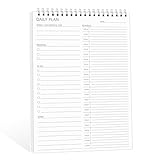
- ✔This daily plan pad features detailed hourly schedule timelines from 12 AM to 11 PM, perfectly segment your morning, afternoon and evening hours. Track meetings, appointments and fixed tasks hour by hour to eliminate procrastination and boost your daily time management efficiency.
- ✔ 1.Put an end to the time black hole: Every hour of activity is recorded, so you always know where your time goes and bid farewell to "being busy yet achieving nothing". 2.Cure procrastination: Visual time grids have an inherent sense of supervision; blank time slots serve as a direct reminder, with more binding power than phone alerts. 3.Gain instant a sense of accomplishment: Check off completed tasks with a simple tick. A filled time axis page by page delivers physical feedback that digital tools cannot match, making it easier to keep going the more you use it.
- ✔ 1.Students & Exam Takers: Plan class, review and practice time; allocate study hours for each subject precisely for targeted exam preparation. 2.Professionals: Schedule meetings, work projects and commute time; prioritize tasks clearly and bid farewell to chaotic overtime. 3.Freelancers & Stay-at-Home Parents: Clearly divide work/childcare/personal time to avoid blurring the boundaries between life and work. 4.Self-Discipline Enthusiasts: Check in on fitness, reading and learning; develop regular routines with hourly scales to build good habits effortlessly.
A further ONS analysis of the same pilot, published in 2024, found that 20% of time spent on general administration was considered to take too much time. That figure describes public-sector workers in the pilot, not the workforce as a whole, and it does not tell you how much of any one person’s week is affected.
The same report reproduces an anonymised participant from the education sector, who described the problem in these words:
“Paperwork based tasks, tasks that were repetitive, but had to be inputted into two different systems.”
What’s actually slowing this PC down?
Pick the symptom - the matching free tool is one click away.
Rank #2

- Stay Organized and Focused: This planner is specifically designed to help individuals with ADHD or busy lifestyles prioritize their day with clear prompts, ensuring that the most important tasks are tackled first
- Comprehensive Layout: With 100 thoughtfully designed pages, including sections for daily scheduling, task prioritization, self-care, and brain dumps, this planner helps reduce distractions and keep your thoughts organized
- Motivation Through Rewards: Keep yourself engaged and motivated with built-in checklists and reward systems that make completing tasks more satisfying
- Flexible and Undated Design: Use this planner at your own pace—it's undated, so you can start anytime without worrying about wasted pages
- Durable and Convenient: Featuring a 7" x 10" size, a sturdy hardcover, and spiral binding for durability, this planner is easy to carry and perfect for daily use
Specific general-administration activities that participants said took too long included recruitment administration, photocopying, and booking travel.
How to measure recurring work
A short log over a representative period is enough to turn a vague sense of “too much admin” into numbers. The steps below work with a spreadsheet, a notes app, or paper.
- Choose a defined period. Pick a stretch that includes an ordinary week and, if relevant, a busy one such as month-end or a peak booking period. Write the start and end dates at the top of your log.
- Build a candidate list. Start from your inbox, calendar, and the history of the systems you use. Look for anything you have done more than once in the period.
- Record each occurrence. For every instance, note the task name, the date, the duration in minutes, and whether it was a normal instance or an exception, such as a rushed batch or a correction.
- Summarise frequency and total time. For each task, count the occurrences and calculate the weekly total: average minutes per occurrence multiplied by occurrences per week.
- Check the constraints. Note whether the task needs a particular level of accuracy, a quality check, a legal or contractual step, or human judgement. These limits decide which changes are realistic later.
The table below shows a layout you can copy. The values are placeholders for illustration only, not measured results.
Rank #3

- BOOST YOUR PRODUCTIVITY – Turn your to-do list into a clear daily schedule with a simple 3-step time blocking method: Brain Dump, Prioritize, then Time Block your day. A practical time management planner for work, school, and busy routines.
- CLEAR YOUR MIND – The Brain Dump section helps you get tasks, appointments, and ideas out of your head and onto paper. Designed as an ADHD-friendly planner for adults who want more structure and less overwhelm.
- VISUALIZE YOUR TIME – The daily hourly planner layout helps reduce procrastination by giving each task a clear place in your schedule. Time slots make it easier to plan work blocks, study sessions, appointments, errands, and focus time.
- FLEXIBILITY – 180 undated pages let you start anytime, skip days, and plan without wasting pages. Monthly pages provide a big-picture view of deadlines and goals, while flexible daily scheduling works for early birds and night owls.
- QUALITY – Durable hard cover with vegan leather finish, 100 GSM high-quality paper, elastic closure, and 2 bookmarks. Portable A5 size is perfect for your desk, backpack, work bag, or school bag.
| Task | Occurrences per week | Average minutes per occurrence | Weekly total (minutes) | Normal or exception notes | Accuracy or judgement limits |
|---|---|---|---|---|---|
| Re-keying an intake form into two systems | 15 | 6 | 90 | Month-end batch took about 40 minutes extra | Figures must match in both systems |
| Booking meeting rooms and travel | 4 | 12 | 48 | Exceptions when bookings clash | Travel policy checks |
A paper planner or time-tracking notebook can serve as the physical log if you prefer writing by hand. Its only job is to hold the task, duration, and tally for each occurrence. Nothing in the evidence cited here shows that a particular notebook, or any notebook, improves productivity, so choose one for convenience rather than expecting it to change how much you get done.
Measurement is not intervention
Once the log shows which tasks repeat and how long they take, you have three broad options. They are not mutually exclusive, and each carries different costs.
Simplify the process
Simplifying means removing steps, combining forms, or changing the sequence so that the same outcome needs less repetition. It is often the cheapest option because it asks for process change rather than new tools. Its limits are that existing procedures may be set by policy or by another team, and simplifying a step can quietly remove a check you still need.
Rank #4

- Easily Stay On Track & Make The Most Of Your Time: ZICOTOs’ daily planner makes it easier than ever for you to stay organized, reduce stress & enjoy more free time! Arrange your schedule, priorities, to do’s and jot down plans & ideas on the daily notes section
- Smartly Plan Ahead & Boost Your Productivity: Absolutely clever & efficient! With the to do list notebook / notepad you can break down your daily tasks into half-hourly focus blocks and map out priorities & follow-up duties to keep your day on track and enhance productivity
- Plenty Of Space For Efficient Planning: Stay focused & manage your time wisely! The 8.4x6.1” work planner & organizer notebook offers ample space for 105 days of life-changing planning with each day being spread across 2 pages - set yourself up for purposeful days
- Now Is The Best Time To Start: The daily planner is undated so you can start to add structure to your schedule and cultivate new planning habits right away! Beat procrastination, boost happiness & make each day count with the hourly planner
- Adds Beauty To Daily Planning: A luxury sage hard cover, chic golden letters, a gold ring wire and a clean, easy-to-use layout, elastic band - enjoy the lovely and modern design of the undated daily planner!
Delegate the task
Delegating moves a task to another person, such as a dedicated administrative or support colleague. The ONS public-sector management questionnaire asked organisations whether they would consider hiring dedicated administrative or support staff as one route to less administrative burden. Delegation shifts the time cost rather than removing it, and it adds supervision, handover, and training effort.
Automate the task
Automation covers software that performs a repeated step, from a scheduled export to a workflow that moves data between systems. The ONS questionnaire also listed automated computer processes as an option. Automation carries the highest setup and maintenance effort, and it needs careful checking of errors, access rights, and data protection before it replaces a manual check.
The table compares the three options on the same axes. These are practical questions to ask, not measured outcomes.
Best Value

- Plan Smarter, Stress Less: Our undated planner has 50 daily planning sheets per planning pad to help you keep your notes organized all in one place. Track important projects, tasks, time blocking, and goals with our planner.
- Enhance Your Productivity: The simple solution for managing your daily schedule. Helps you focus, especially those with ADHD. With our daily planner you can track your appointments and meetings throughout the week, organize your tasks in order of priority, jot down thoughts or ideas, and record when projects are due.
- Upgrade Your Office Supplies: The minimal design makes this a stylish and practical addition to your work from home essentials for both women and men. This to-do list notepad looks professional and keeps you organized.
- Give The Gift Of Organization: The sleek design makes this a beautifully practical gift for moms and dads who need a little extra help keeping track of soccer games, field trips, and doctor’s appointments. Also makes a wonderful gift for college students, coworkers, your boss, or the entrepreneur in your life to help them stay on top of busy schedules.
- Cultivate Healthy Habits: Plan and track your meals and water intake each day and use the checkbox as a visual reminder. Take a minute each day to write down something good that happened. Practicing gratitude is proven to increase happiness!
| Question | Simplify | Delegate | Automate |
|---|---|---|---|
| Setup and maintenance effort | Mainly process redesign and agreement | Recruitment or reassignment, then handover | Configuration, testing, and upkeep when systems change |
| Error risk | Can remove a useful check if steps are cut carelessly | Depends on the person’s training and supervision | Errors can repeat at speed until someone spots them |
| Privacy and access | Usually unchanged | New person may need access to records | Tools may need access to data and must meet data protection rules |
| Integration with existing systems | Usually minimal | Usually minimal | Depends on whether systems can connect |
| Training needs | Staff must learn the new sequence | New person needs onboarding | Users and administrators need training |
| Human review | Keep checks that protect accuracy | Supervisor review of output | Decide which outputs a person still checks |
Reading published time-saving figures
Several UK government evaluations report specific time savings. Each one is tied to a defined population, software, and method, so the figures should not be applied to your own work without checking those conditions.
| Figure | Source and date | What was measured | What it does not show |
|---|---|---|---|
| 33 hours saved per business per year (95% confidence interval 26 to 40 hours) | HM Revenue & Customs, 2025, Making Tax Digital report | Estimated average change in time spent on business finances and record keeping by VAT businesses using fully functional Making Tax Digital software | Savings for other tasks, other types of business, or other software |
| 26 minutes saved per day on average | UK Government cross-government Microsoft 365 Copilot experiment, 2025 | Average saving reported by trial users | A guaranteed daily saving. The experiment had constraints, and the report notes limitations with complex data and nuanced work, plus the need for human oversight and training. It did not establish how the saved time was spent. |
| 89% reallocated saved time to other work | Department for Work and Pensions, 2025, Copilot trial survey | Share of respondents to that specific trial survey who said they used saved time on other work tasks | Any general figure for AI tool users |
The Department for Work and Pensions evaluation reports that trial users applied Copilot to drafting documents, summarising meetings, and retrieving information. The figures above come from pilot conditions, so they describe what happened in those trials rather than what a comparable tool will deliver in your organisation.
Saved time is not the same as less work
A time saving on one task only lowers total workload if the freed time is not filled with other demands. In the DWP trial, most respondents reported putting saved time to other work rather than reducing their hours, so an estimate of minutes saved per task is a different measure from a reduction in overall workload or headcount.
Do these 3 things before closing this tab:
1Fix the driver behind crashes, sound loss and screen glitches2Repair Windows errors before they cause bigger problems3Scan for outdated or missing drivers - takes under a minuteWhen you compare a new process or tool with your log, record two numbers separately: the time saved on the specific task, and whether your total weekly load has changed after a few weeks of use. The first is what the log can show directly. The second tells you whether the change is actually giving you back time.
The ONS questionnaire offers a prompt you can reuse in a team meeting: “How could administration work in your organisation be done in a more efficient way?” It is a survey question, not evidence of which answer is most common, but it turns the log’s findings into a concrete discussion about which task to change first.
Quick Recap
Product prices and availability are accurate as of the date/time indicated and are subject to change. Any price and availability information displayed on Amazon at the time of purchase will apply.

