
iTechGuides is reader-supported. When you buy through links on our site, we may earn an affiliate commission. As an Amazon Associate I earn from qualifying purchases. Learn more
ThinCI’s $65 million Series C was a 2018 growth round intended to expand the AI-chip startup’s operations and advance its Graph Streaming Processor (GSP) technology. The financing did not establish that ThinCI’s planned cards, modules, or appliances were commercially available, and the report did not provide independent performance results.
What the $65 million round was for
ThinCI Inc., an AI processor company based in El Dorado Hills, California, closed an oversubscribed $65 million Series C, according to Junko Yoshida’s September 5, 2018, report for EE Times. CEO Dinakar Munagala said ThinCI had raised about $20 million before that round. The earlier amount is his statement as reported by EE Times, not a separately detailed financing tally.
The company described the new money as growth capital for expanding offices and facilities in the U.K., Silicon Valley, Utah, India, and El Dorado Hills. Munagala said ThinCI wanted to “remain super capital-efficient.” The report named Denso, NSITEXE, and Temasek as lead investors. Temasek led a consortium that included GGV Capital, Wavemaker Partners, and SGInnovate; Mirai Creation Fund, Daimler, and an unnamed major Asia-based electronics company were also connected to the round.
EE Times reported that ThinCI had about 180 employees worldwide, including 30 in the U.K., at the time. These are figures from 2018, not current staffing information.
#1 Best Overall

- ✅Powered by 26 Tera-Operations Per Second (TOPS) Hailo-8 AI Processor. 2.5W typical power consumption
- ✅Scalable, enabling simultaneous processing of multi-streams & multi-models
- ✅Enabling real-time, low latency and high-efficiency AI inferencing on the edge devices
- ✅Supports TensorFlow, TensorFlow Lite, ONNX, Keras, Pytorch frameworks
- ✅Supports Linux and Windows. Supports the temperature range of -40°C to 85°C
What ThinCI was building
Founded in 2010, ThinCI presented its Graph Streaming Processor (GSP) as an architecture for AI, machine learning, neural-network, and vision-processing tasks. The company’s explanation was that GSP could process tasks and data in parallel and reduce the need for intermediate buffers compared with sequential processing. Those were company claims and technical explanations in the 2018 report, not independently verified performance findings.
The company said its software kit supported TensorFlow, Caffe2, PyTorch, C, and C++. Its target applications included automotive systems, surveillance and security, retail, industrial systems, edge computing, and broader AI and vision workloads. ThinCI’s chief software architect, Val Cook, described its intended market position this way: “We see our sweet spot in the middle,” between lower-cost edge ASICs and data-center AI.
Rank #2
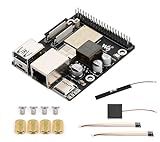
- High-Performance Dual-Core with Ample Memory--- Equipped with a 360MHz dual-core RISC-V processor, 32MB of onboard PSRAM, and 32MB of Flash memory, providing powerful processing capabilities and ample runtime for complex multimedia applications and edge computing.
- Powerful Multimedia Processing Center--- Integrated with a dedicated image processor (ISP), H.264 video encoder, and JPEG codec, perfectly supporting camera input and video processing, making it an ideal choice for developing smart displays, video surveillance, and other projects.
- Hardware-Level Security Protection--- Built-in digital signature, encryption accelerator, and key management unit, providing a one-stop hardware-level security solution from secure boot and data encryption to access control management, ensuring the security of your products and data.
- Full Connectivity Coverage: Wi-Fi 6, Bluetooth, PoE Power Supply--- Onboard with an ESP32-C6 chip, supporting the latest Wi-Fi 6 and Bluetooth 5.0; it also integrates an Ethernet port with PoE functionality, providing high-speed, flexible, and stable network connectivity, and can be powered directly via Ethernet cable, simplifying deployment.
- Rich interfaces and strong expandability--- It provides a MIPI camera/display interface, high-speed USB, SD card slot, microphone/speaker interface and a large number of programmable GPIOs, which greatly facilitates the expansion of external devices and meets the needs of various human-computer interaction and Internet of Things applications. Supports AI Speech Interaction: Allows access to online large model platforms such as ChatGPT, DeepSeek, Doubao, etc.
What the silicon and product roadmap did—and did not—show
EE Times reported that ThinCI had working first silicon fabricated on a 28-nanometer process and that it was with customers for validation and benchmarking. That meant evaluation was underway; it did not amount to published independent benchmark results or demonstrate competitive performance.
The Tool Desk
Outbyte PC Repair FREERepair Windows errors before they cause bigger problemsFix Now →Outbyte Driver Updater FREEScan for outdated or missing drivers - takes under a minuteDriver Scan →The report also described a roadmap that could include GSP system-on-chip modules, PCIe cards, M.2 cards, and appliances. It did not establish that these products were available for ordinary retail purchase. ThinCI reported revenue from automotive design-ins, but the customers were not named as confirmed. The article speculated that the design-ins might be Denso’s, while noting that Munagala declined to comment; Denso therefore should not be treated as a confirmed ThinCI customer on this evidence.
Rank #3

- Powered by 26 Tera-Operations Per Second (TOPS) Hailo-8 AI Processor.
- 2.5W typical power consumption
- Enabling real-time low latency and high-efficiency AI inferencing on the edge devices
- Supports TensorFlow TensorFlow Lite, ONNX, Keras, Pytorch frameworks
- Supports Linux and Windows.
Why performance claims were difficult to assess
The central distinction in the 2018 coverage is between having working silicon under customer evaluation and demonstrating how well it performs. Analyst Linley Gwennap said performance per watt had not been disclosed and that the company had released too few details to assess the design: “[Because] ThinCI has released few details on its architecture or products, assessing the pros and cons of its design remains impossible.”
Kevin Krewell, principal analyst at Tirias Research, said: “I cannot corroborate ThinCI claims at this point, but I will allow that data flow (graph processing) architectures will be major competitors for machine-learning designs.” He also highlighted the importance of development tools and Nvidia’s CUDA advantage. These comments underscore why an architecture description alone could not establish how a chip would fare in real workloads.
Rank #4

- High-Performance AI Processing: The MX3 is designed to handle the most demanding AI computer vision workloads, delivering exceptional performance and efficiency.
- Flexible Integration: The MX3 can be easily integrated into your existing systems via its M.2 M-key form factor and support for Linux operating systems.
- Energy Efficient: The MX3 is designed to provide high performance while minimizing power consumption.
- Comprehensive Software Development Kit (SDK): The MX3 is supported by a comprehensive SDK that simplifies development and deployment.
- Hardware compatability: The MX3 is compatible with the PCI-SIG M.2 M-key 2280 Specification. It can be used with the Raspberry Pi 5 with a M-key 2280 HAT.
The report also mentioned a possible buffer-size comparison of about 1%, but analyst Rob Lineback presented it as his supposition—“At least that’s what I think”—not as a measured company result. It should not be read as evidence of a verified 99% memory reduction.
Do these 3 things before closing this tab:
1Repair Windows errors before they cause bigger problems2Fix the driver behind crashes, sound loss and screen glitches3Clear out junk files and repair common Windows errorsGwennap called AI accelerators “at the frontier of processor design — a Wild West, if you will.” In that setting, meaningful comparison would require comparable workload results, performance-per-watt data, memory behavior, software and development-tool support, available silicon, and evidence from customer validation. The 2018 account did not provide enough information to establish ThinCI’s competitive standing across those measures.
Independent reader supportYour contribution helps us test, update, and keep practical guides available for everyone.What the announcement meant in 2018
The financing indicated that investors were backing ThinCI’s effort to develop AI-processing hardware and build its presence across multiple regions and markets. SGInnovate founding CEO Steve Leonard framed the broader opportunity as a mismatch between growing data and algorithmic demands and slower hardware development: “In the last few decades, we have seen an explosive growth in data collected and increasingly sophisticated algorithms to derive meaningful information from this data more quickly. Unfortunately, the evolution of hardware has progressed at a much slower pace.”
That was the rationale for the opportunity, not proof that ThinCI’s processor had met it. The EE Times article is a contemporaneous account of the 2018 round, product ambitions, and reported validation activity; it does not establish the later commercial availability or success of the planned hardware.
Quick Recap
Product prices and availability are accurate as of the date/time indicated and are subject to change. Any price and availability information displayed on Amazon at the time of purchase will apply.

