
Recommended Free Tools
iTechGuides is reader-supported. When you buy through links on our site, we may earn an affiliate commission. As an Amazon Associate I earn from qualifying purchases. Learn more
There is no documented single best VHF marine antenna for every boat. The right choice depends on where and how high you can mount it, the space and clearance available, the antenna’s stated specifications, and whether you need it for voice VHF or AIS. Installation quality—including compatible mounts, sound coax and secure outdoor connections—matters alongside the antenna itself.
What matters most when choosing a marine VHF antenna?
Start with mounting height and an unobstructed position. VHF communication is fundamentally line-of-sight, so an antenna’s dB gain label alone cannot predict how far a particular boat will communicate. The U.S. Coast Guard says AIS coverage is similar to other VHF applications and depends essentially on antenna height; its nominal at-sea coverage figure is context, not a guarantee for an individual installation. USCG Navigation Center: How AIS Works.
Then compare the physical fit and system compatibility. A longer antenna may have a higher manufacturer-stated gain, but it also needs suitable mounting space and clearance. Check that the antenna, mount, coaxial cable, connector and radio work together, and consider whether the cable supplied is long enough for the intended route.
Free tools Windows power users keep installed
One-click scans. No signup required.
- Installation position: Favor height and an unobstructed location consistent with the boat and antenna maker’s instructions.
- Space and storage: Ensure the antenna’s length and mounting arrangement suit the vessel.
- Electrical specifications: Check stated gain and maximum input power against the intended radio or AIS equipment.
- Feedline and hardware: Confirm cable type and length, connector style and mount compatibility; inspect outdoor connections and coax condition.
- Use case: Do not assume an antenna labeled marine VHF is suitable for AIS solely on that basis.
How do the documented antenna examples compare?
The following are manufacturer specifications, not independent tests or evidence of tested range or overall superiority. The product pages were accessed in 2026 and do not state publication years.
#1 Best Overall

- Great Product
| Model | Length and stated gain | Maximum input | Cable and connector | Suggested mount or installation note | VSWR information |
|---|---|---|---|---|---|
| Shakespeare Galaxy 5225-XT | 8 ft; 6 dB | 100 W | 20 ft RG-8/X; screw-on PL-259 | 4187-HD or 5187 | Below 1.5:1 at 156.8 MHz |
| Shakespeare Classic 5104 | 4 ft; 3 dB | 50 W | 15 ft RG-58; PL-259 | 4187 or 4188-SL | Not stated on the cited product page |
| Shakespeare Galaxy 5400-XT | 4 ft; 3 dB | 50 W | Not stated on the cited product page | Does not include Easy Route hardware; requires solder-style PL-259 | Not stated on the cited product page |
Specifications are from the manufacturer’s Galaxy VHF antenna page and Classic VHF antenna page. A higher stated gain or longer antenna does not by itself establish better real-world communication on a particular boat.
Does antenna gain tell you the communication range?
No. Gain describes how an antenna system distributes radio energy relative to a reference; it is not a direct range measurement. Shakespeare’s FAQ gives an idealized rule of thumb: 3 dB corresponds to twice radio output power as ERP, 6 dB to four times, and 9 dB to eight times. That explanation does not promise a corresponding increase in received range or a universal real-world result. See the Shakespeare FAQ.
Rank #2
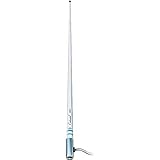
- Brass and copper elements
- Chrome-plated brass ferrule with standard 1
- Includes 15' RG-58 cable and a PL-259 connector
- Suggested mount: Style 4187 Ratchet Mount or use a 410 Mounting Kit plus a 410 Mounting Kit plus a 4008 Extension Mast to form a 16' antenna system
- 2 year
The Coast Guard’s Rescue 21 coverage plots model line of sight between a fixed antenna and an antenna six feet above the water, with assumptions about power and terrain. They illustrate why height and conditions matter rather than providing a boat-specific prediction. USCG Navigation Center: Rescue 21 Distress System Coverage.
Do these 3 things before closing this tab:
1Fix the driver behind crashes, sound loss and screen glitches2Clear out junk files and repair common Windows errors3Scan for outdated or missing drivers - takes under a minuteIs a VHF voice antenna the same as an AIS antenna?
AIS is a distinct application with specific frequencies and installation guidance. The Coast Guard’s international channel reference lists AIS 1 at 161.975 MHz and AIS 2 at 162.025 MHz; the reference is adapted from ITU Radio Regulations Appendix 18, including changes adopted in 2019. USCG Navigation Center: International VHF Marine Radio Channels and Frequencies.
Rank #3

- [ELECTRICAL SPECIFICATIONS] Frequency: 156-163MHz; Impedance: 50 Ohm; VSWR: Nominally 1.5:1 at 159.5MHz; Gain: 3dBi; Maximum Power Input-watts: 50W;
- [MECHANICAL SPECIFICATIONS] Height: 110±5 CM/44inch; Termination: PL259; Cable Length/Type: 7m Low loss RG-58U coaxial cable(white); Weight: 375g
- Anti-Corrosion Materials, fiberglass construction, smooth and high gloss finish, long-life use
- 180 degrees adjustable Nylon ratchet mount, sturdy and durable, easy to Install and operate
- Pretuned for all marine band frequencies, increases reception and range of radio; widely used in boat and offshore, motor boat, cruiser, sailboat, yacht, Truck, RV, Cruise Ship,Kayaking,etc.
IALA Guideline 1098, Edition 1.0 (May 2013), discusses AIS VHF antenna selection and recommends SWR below 1.5 for the AIS installations within its scope. It also discusses the AIS channel frequencies and typical marine VHF antenna frequency behavior. Apply that recommendation to the context covered by the guideline, not indiscriminately to every radio or installation. IALA Guideline 1098: AIS VHF Antenna Installations.
Quick Recap
Best Value

- Marine VHF Frequency Range: VHF Marine Antenna operates at 156-163MHz with 2 dBi signal gain and supports up to 50W of power for reliable marine communication
- Enhanced Signal Performance: VHF rubber antenna designed for any 156-163MHz device receivers to improve signal quality in both receiving and transmitting operations
- The HYS antenna (156-163Mhz)operates on the full VHF marine band (156-158 MHz) plus marine weather frequencies (162 MHz). As long as your mobile radio is a VHF marine transceiver with the standard SO239(UHF FEMALE) connector connector, it will work.
- Any fixed or mobile VHF transceiver with the Standard SO239(UHF FEMALE) connector Compatible Radios: For Uniden UM385BK Garmin 215 VHF (AIS-capable) iCom Cobra marine radios and any VHF radio with a SO239 connector, NOAA weather radios (162.400-162.550 MHz)
- High Quality Construction: Made of premium rubber material with integrated cable and clip to help achieve longer communication range and durability
Rank #4

- FREQUENCY RANGE: Operates in the marine VHF band of 156-163 MHz, perfect for ship-to-ship and ship-to-shore communications
- CONSTRUCTION: 48 inch fiberglass antenna Kit with base(antenna 43.5inch), provides durability and reliable performance in marine environments.
- CABLE INCLUDED: Comes with 23-foot (7m) RG-58U coaxial cable for flexible installation options
- MOUNTING SYSTEM: Features adjustable ratchet mount system for secure and customizable positioning on various boat surfaces
- WEATHERPROOF DESIGN: Built to withstand harsh marine conditions with waterproof construction for long-lasting performance
How should you check the antenna installation?
- Confirm the application and equipment requirements. Identify whether the antenna is for voice VHF or AIS, then check the equipment maker’s current specifications and installation instructions.
- Choose a suitable mounting position and hardware. Account for height, obstructions, antenna length, available clearance and compatibility with the mount.
- Check the coax route, cable and connector. Make sure the cable reaches without strain and the connector matches the equipment and antenna arrangement. Inspect the feedline and outdoor connections.
- For AIS installations, follow the scoped cable guidance. An IMO AIS installation circular hosted by the USCG recommends waterproof-by-design outdoor coax connectors. It also recommends separating AIS coax from high-power lines by at least one meter in the described installation, and crossing cables at 90 degrees. Follow the equipment maker’s current instructions as well. IMO SN/Circ.227, hosted by the USCG.
- Assess system matching using the relevant guidance. SWR or VSWR describes matching in the antenna system; it does not measure communication range. Use the equipment maker’s requirements and, for AIS, the IALA guidance applicable to that installation.
Product prices and availability are accurate as of the date/time indicated and are subject to change. Any price and availability information displayed on Amazon at the time of purchase will apply.

