
Quick wins for a faster PC:
Fix the driver behind crashes, sound loss and screen glitchesFind Drivers →Repair Windows errors before they cause bigger problemsFix Now →Scan for outdated or missing drivers - takes under a minuteDriver Scan →iTechGuides is reader-supported. When you buy through links on our site, we may earn an affiliate commission. As an Amazon Associate I earn from qualifying purchases. Learn more
The truth about arc detection is that it is an additional high-frequency event detector used during a hipot test—not a replacement for the ordinary leakage-current or dielectric-breakdown limit. It can identify brief corona or high-impedance arcing that a conventional hipot trip may miss, but its sensitivity is application- and instrument-specific.
“Arc detection” describes several unrelated technologies. AFCIs detect arcing in energized building circuits, arc-flash systems protect switchgear, photovoltaic arc-fault systems monitor solar strings, and welding systems sense welding arcs. This article addresses hipot arc detection: transient-event monitoring during dielectric-withstand testing.
Key takeaways
- Hipot arc detection adds a high-frequency signal path that can identify short current pulses associated with corona or high-impedance arcing.
- A product can pass the ordinary hipot leakage-current limit and still fail arc detection; that result requires investigation but does not automatically prove dielectric breakdown.
- Associated Research describes an example detector with a high-pass response above 10 kHz and arc-related pulses ranging from below 30 kHz to above 1 MHz, often lasting well under 10 microseconds.
- A sensitivity setting such as 5 on one tester is not a universal arc-current measurement or a portable limit that can be compared directly with another instrument.
- Arc detection is most valuable when intermittent arcing is a credible product or process failure mode and the organization has a validated response, retest, and disposition procedure.
What is the truth about arc detection?
The truth about arc detection is that hipot arc detection is an application-specific quality-control and diagnostic function. The detector looks for electrical signatures resembling brief arcing or corona during a dielectric-withstand test. The detector supplements the normal hipot limit; it does not replace the test that determines whether insulation sustains the applied voltage without excessive leakage or breakdown.
The distinction matters because a transient, current-limited arc may not draw enough sustained current to trigger the tester’s ordinary high-limit protection. Conversely, a detector response does not establish that the insulation has suffered catastrophic breakdown. The result is a signal for controlled investigation, not a complete diagnosis.
#1 Best Overall
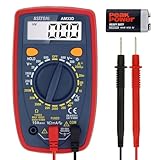
- Additional Tips - The following incorrect operations may cause the multimeter not to show results: Firstly, the plugs of test leads are not fully inserted or not inserted into the correct sockets. Secondly, the manual rotary switch is not placed in the correct position. In addition, this meter can not test all AC Current and below 100mV AC Voltage. Please check the user manual carefully before measurement.
- Versatile Digital Multimeter - Accurately measures AC/DC Voltage, DC Current, Resistance, and Diode. This Multimeter is a really useful tool for solving industrial and household electrical issues. Suitable for Household Outlets, Fuses, Batteries (including Vehicles), Automotive Circuit Troubleshooting, Charging Systems, Testing electronics in Cars etc.
- Troubleshooting with Accuracy - This Multimeter has a sampling speed of 2 times per second; Built-in a backlight LCD display with 3 ½ digits (1999 count) 0.6”, and high polarity including negative and positive readings.
- Ensures Safety - Double fuse is anti-burn and protects from overloading. The silicone cover can protect the multimeter from failing damage and prevent electric shocks. And low battery indication will be displayed when battery power is low.
- Ease of Use - Support Data Hold and Continuity Buzzer. Includes Convenient feature like LCD Backlit Screen makes it easy to use in dimly light areas. Batteries/Set of Test Leads/User Manual are Included.
The principal technical source for this explanation is an Associated Research/Ikonix vendor white paper. The paper appears to originate from a 2005 technical article, although the document remains hosted on the vendor’s current website. Use the implementation details as a vendor-described example, and confirm current compliance requirements against the exact product standard, certification procedure, tester manual, and test plan.
What does a hipot test measure?
A hipot, or dielectric-withstand, test applies a high voltage between selected conductors and accessible conductive parts, or between defined portions of a product, while checking that current remains below the permitted limit. The test stresses the insulation system rather than merely checking whether a circuit is electrically continuous.
A conventional high-limit failure generally indicates excessive leakage current or a dielectric breakdown path. Current Associated Research documentation lists AC hipot, DC hipot, ground continuity, insulation resistance, ground bond, and related functions as separate electrical-safety tests in its tester families. See the HypotULTRA product documentation for the functions and model combinations shown by the manufacturer.
Ordinary hipot testing remains the primary dielectric-withstand test. Arc detection adds another observation channel aimed at short-duration, higher-frequency activity that may be hidden within the normal test waveform or constrained by circuit impedance.
What is the difference between an arc and dielectric breakdown?
Corona or a high-impedance arc is not automatically the same event as sustained dielectric breakdown. The electrical behavior, likely duration, and implications can differ substantially.
| Condition | Typical electrical behavior | What the tester may report | What the result means |
|---|---|---|---|
| Corona or high-impedance arcing | Short current pulses or high-frequency spikes, sometimes limited by circuit impedance | Arc-detection failure or transient event | Possible spacing, insulation, contamination, assembly, connection, or damage problem; investigate rather than assume catastrophic failure |
| Dielectric breakdown | Large, sustained leakage current through the insulation or a low-impedance fault path | Ordinary hipot high-limit or breakdown failure | Insulation has failed the dielectric-withstand condition and the unit normally requires rejection or controlled engineering disposition |
| No detected event | Current remains below applicable limits and no detected transient exceeds the arc threshold | Pass, subject to the complete test recipe | The unit passed the configured test signals; the result does not prove that every possible insulation defect or future service event is absent |
Arcing is not automatically harmless. A small corona event might be treated differently from flashover or breakdown under a particular product standard, while the same physical behavior could reveal a manufacturing defect or develop into a reliability problem in another application. The Associated Research discussion cites IEC 60601-1, Section 20.4f, as an example of a standard distinguishing slight corona from flashover or breakdown; verify the applicable edition and exact clause before treating that example as a current compliance rule.
How does a hipot arc detector work?
A hipot arc detector typically separates high-frequency activity from the ordinary test waveform, compares the separated signal with a threshold, and interrupts the test when the configured threshold is exceeded. The precise circuit, bandwidth, algorithm, and reporting behavior vary by instrument.
The Tool Desk
Outbyte Driver Updater FREEScan for outdated or missing drivers - takes under a minuteDriver Scan →Outbyte PC Repair FREERepair Windows errors before they cause bigger problemsFix Now →- Apply the test voltage. The test current contains the normal lower-frequency AC or DC-related behavior of the test circuit, including charging and capacitive effects where applicable.
- Couple the transient signal. An arc or corona event can create brief high-frequency current components.
- Filter the signal. In Associated Research’s described example, a high-pass filter responds above 10 kHz.
- Compare against a setting. A comparator checks the filtered signal against the programmed arc sensitivity threshold.
- Stop and report. If the threshold is exceeded, the tester interrupts the test and reports an arc-detection failure.
Associated Research describes arc-related pulses ranging from less than 30 kHz to more than 1 MHz and often lasting well under 10 microseconds. Those figures describe the vendor’s example and should not be presented as the universal frequency range or pulse duration of every arc, every product, or every tester. The Associated Research explanation of arc detection provides the source context.
The detector therefore responds to a waveform signature, not to a universally calibrated “arc current” that can be measured independently of the test system. The applied voltage waveform, polarity, rise rate, output impedance, wiring, fixture, product geometry, and environment all affect what reaches the detector.
Rank #2
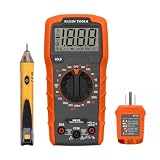
- VERSATILE MULTIMETER: Measures up to 600V AC/DC voltage, 10A DC current, and 2MOhms resistance
- CONTINUITY TESTING: MM320 multimeter with visual and audible indicators for testing continuity
- NON-CONTACT VOLTAGE TESTER: NCVT1P with bright LED indicating working status, changing to red and producing audible tones when voltage is detected
- HIGH-INTENSITY VOLTAGE DETECTION: NCVT1P with bright red LED and audible tone for detecting voltage in the range of 50 to 1000 VAC
- RELIABLE RECEPTACLE TESTER: Klein's Cat. No. RT110 detects wiring configurations, indicates correct wiring, and identifies common wiring faults
Why can ordinary hipot testing miss an arc?
Ordinary hipot protection can miss a current-limited arc when a series fault, loose connection, narrow spacing, or other defect constrains the sustained current below the ordinary leakage-current trip limit. A brief arc can still produce a detectable high-frequency transient even though the total current does not remain high enough to cause a conventional high-limit failure.
For example, a loose high-voltage connection may intermittently bridge a small gap. The circuit impedance can limit the current, while the rapid discharge and restriking behavior produces short pulses. The ordinary current limit sees the limited or averaged response; the arc detector may see the transient component.
Do these 3 things before closing this tab:
1Clear out junk files and repair common Windows errors2Fix the driver behind crashes, sound loss and screen glitches3Repair Windows errors before they cause bigger problemsThis does not mean that arc detection finds every dangerous defect. The detector can miss an event that remains below its threshold, falls outside its effective frequency response, does not occur during the test window, or is not coupled effectively into the measurement path. A defect that causes insulation-resistance degradation without detectable arcing may also require a different test.
Is arc detection required for certification?
There is no universal answer: whether hipot arc detection is required depends on the exact product, market, standard edition, certification agency, customer specification, and test procedure. The existence of an arc-detection feature on a tester does not by itself establish a legal or certification requirement.
Before adding a requirement—or claiming that a requirement exists—check:
- the exact safety standard and edition applicable to the product;
- the certification agency’s approved test procedure;
- customer or contract specifications;
- the manufacturer’s risk analysis and production-control plan;
- the test equipment manual and available configuration options; and
- the acceptance criteria for corona, partial discharge, flashover, and breakdown where those terms are used.
A vendor’s broad statement that arc detection is not generally required should not be expanded into “no standard anywhere references arcing.” Conversely, a product page or white paper mentioning arc detection should not be treated as proof that every product in a category must use it. The applicable compliance path has to be established for the specific product.
Crashes, No Sound, or Screen Glitches?
Random freezes, missing sound and display glitches usually trace back to one bad driver. Find and replace yours safely.Free scan · under a minutePC Slower Than It Used to Be?
A free scan shows the junk files, broken settings and background clutter dragging Windows down - then fixes them in one click.Free scan · Windows 10 & 11How should you interpret an arc-detection failure?
An arc-detection failure should be treated as a potentially meaningful quality signal, but not automatically as dielectric breakdown. The safest response is to stop or quarantine the unit under the site’s procedure, preserve the test record, and investigate the product and the measurement setup before authorizing a retest.
A practical investigation flow
- Make the workstation safe. Follow the tester’s discharge, interlock, and high-voltage safety procedure. Do not handle the DUT or fixture until the applied energy has been removed and the work area is safe.
- Preserve the evidence. Record the DUT serial number, operator, tester, recipe, voltage, ramp, dwell, mode, sensitivity, time of failure, and any displayed waveform or error information.
- Confirm the test configuration. Check that the correct product variant, wiring, polarity, AC or DC mode, connections, and programmed limits were used.
- Inspect the fixture first. Examine probes, contacts, cables, guarding, grounding, return paths, connectors, and nearby conductive or sharp surfaces. Fixture noise or a poor return path can create nuisance events.
- Compare with a known-good unit. Use the same tester, fixture, cable arrangement, voltage waveform, ramp, dwell time, and environmental conditions. A known-good comparison is more useful than comparing a numbered sensitivity setting with another instrument.
- Inspect the DUT. Look for inadequate spacing, sharp edges, damaged insulation, loose terminals, poor crimps, contamination, moisture, mechanical damage, displaced wires, and damaged high-voltage components.
- Retest only under an approved procedure. Repeatedly reapplying hipot voltage can stress or damage an already compromised product. Engineering should define when a retest is safe, what evidence is required, and how many attempts are permitted.
- Disposition the result. Repair, scrap, contain, change the assembly process, revise the fixture, or revise a validated test limit only when the evidence supports that action. Recurring failures should be escalated to engineering and quality.
An arc-detection failure can indicate a manufacturing defect, damaged insulation, poor spacing, a loose connection, contamination, or another condition worth investigating. It does not, by itself, prove catastrophic dielectric breakdown or automatic regulatory noncompliance.
Why are arc sensitivity settings not universal?
Arc sensitivity settings are not universal because the detected signal depends on both the physical event and the complete test circuit. Geometry, circuit impedance, distributed capacitance, applied voltage, rise rate, polarity, waveform, temperature, humidity, atmospheric pressure, cables, grounding, and tester circuitry can all change the signal presented to the detector.
Rank #3
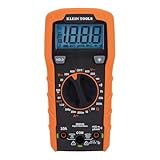
- VERSATILE FUNCTIONALITY: Measures AC/DC voltage up to 600V, 10A DC current, 2MΩ resistance; additional features include continuity, diode test and battery test
- LEAD-ALERT PROTECTION: LEDs on the meter illuminate to indicate proper test lead placement, enhancing accuracy and safety during measurements
- BACKLIT DISPLAY: LCD shows clear readings in low-light conditions for enhanced visibility
- BATTERY TEST: Battery test mode can be used for checking if batteries are working
- CONVENIENT FEATURES: Test lead holders on the back of the meter, kickstand and optional magnetic hanger (Cat. Nos. 69445 or 69417) for hands-free operation
Associated Research describes an example sensitivity scale from 1 to 9, with 1 as least sensitive and 9 as most sensitive. The Ikonix-hosted source says the example settings loosely correspond to approximately 20–2 mA, but the same source warns that the values should be treated as approximate arc-intensity levels rather than finite current measurements. See Ikonix’s explanation of the 1–9 arc-detection scale.
Recommended Free Tools
| Tempting interpretation | More accurate interpretation |
|---|---|
| “Level 5 means 5 mA.” | Level 5 is an instrument-specific sensitivity threshold; it is not inherently a 5 mA measurement. |
| “Level 5 on Tester A equals Level 5 on Tester B.” | Numbered settings should not be compared across brands or models without an engineering correlation study. |
| “The lowest setting is always the best setting.” | A more sensitive setting may increase nuisance trips from fixture noise, capacitance, corona, or environmental variation. |
| “The setting can be chosen by the operator.” | The setting should have a documented technical rationale, validation evidence, and a defined failure-response process. |
Producing a repeatable artificial arc for calibration can be difficult, and detector response depends on the instrument’s circuitry and output impedance. Establish settings with representative production units, known-good samples, controlled fixtures, and deliberately characterized defects where appropriate. Do not transfer a setting from a different tester merely because the number looks familiar.
What causes nuisance trips and missed events?
Potential nuisance-trip causes
- Electrical noise from the tester, fixture, nearby equipment, or switching systems;
- capacitive charging behavior from the DUT;
- sharp points or unintended corona in the product or fixture;
- long cables and distributed capacitance;
- differences in grounding and return paths;
- contamination, moisture, or changes in surface condition;
- humidity, temperature, or atmospheric-pressure changes; and
- a sensitivity threshold that is too aggressive for the validated setup.
A nuisance trip is not proof that the detector is defective. First determine whether the event is repeatable with the same DUT, follows the fixture, appears on a known-good sample, or changes with environmental conditions. Lowering sensitivity without understanding the cause can hide a real process problem.
Potential missed-event causes
By engineering inference from a threshold-and-frequency detector, an event may not be flagged when the signal is below the threshold, outside the effective bandwidth, intermittent outside the test window, poorly coupled to the sensing path, or masked by the test configuration. A non-arcing insulation defect may also require insulation-resistance, leakage-current, visual, mechanical, environmental, or other testing.
When is arc detection most valuable?
Arc detection is most valuable when the product’s credible failure modes include intermittent or current-limited arcing and the organization can investigate the additional failures. The feature is particularly relevant in the following situations:
- tight conductor-to-insulation spacing or difficult creepage and clearance geometry;
- high-voltage transformers, capacitors, connectors, or wire harnesses;
- assemblies vulnerable to loose terminals, poor crimps, or series faults;
- insulation systems sensitive to contamination, moisture, or assembly variation;
- products exposed to shipping or mechanical damage;
- aerospace wire-harness and other high-reliability applications;
- production lines where a more sensitive process screen can prevent escapes; and
- product-liability or failure-prevention programs where the risk reduction justifies equipment cost and investigation workload.
Arc detection is useful for process control only when the factory defines what an event means and what happens next. A detector that operators routinely override, retest without records, or bypass because the limit is unexplained is not a reliable quality-control system.
What should be established before production use?
Before enabling arc detection on a production hipot recipe, document the test system as a complete measurement setup rather than documenting only the sensitivity number.
| Control item | What to document |
|---|---|
| DUT definition | Product variant, insulation barriers, test connections, polarity, and any permitted configurations |
| Test recipe | AC or DC mode, voltage, ramp, dwell, frequency or waveform, ordinary leakage limit, and arc sensitivity |
| Measurement system | Tester model, firmware or instrument configuration, calibration status, fixture, cables, grounding, and interlocks |
| Environment | Relevant temperature, humidity, pressure, contamination controls, and environmental operating limits |
| Validation evidence | Known-good samples, representative failures or engineered challenge samples where safe, repeatability, and nuisance-trip results |
| Operator response | Safety steps, quarantine rules, inspection points, retest authorization, escalation, and final disposition |
| Records | DUT serial number, recipe revision, test result, failure type, operator, date, and investigation outcome |
The goal is not to create a universal acceptable-arc number. The goal is to demonstrate that the configured detector separates acceptable production variation from defects that the product and process must not release.
What can arc detection prove—and what can it not prove?
Arc detection can provide evidence that the configured tester observed a transient electrical signature above its threshold during the defined test. It cannot establish all of the following by itself:
Free tools Windows power users keep installed
One-click scans. No signup required.
Rank #4

- VERSATILE CLAMP METER: CL120 measures AC current and NCVT via clamp; AC/DC voltage, resistance, and continuity via test-leads
- ACCURATE MEASUREMENTS: Auto-ranging technology selects the appropriate measurement range for accurate results
- CONVENIENT FEATURES: Test lead holder on the side of the clamp and optional magnetic hanger (Cat. Nos. 69445 or 69417) for hands-free operation
- GFCI RECEPTACLE TESTER: Cat. No. RT210 detects common wiring issues in standard and GFCI receptacles, including open ground, reverse polarity, and more
- NON-CONTACT VOLTAGE DETECTOR: Cat. No. NCVT3P features dual-range capabilities to detect a wide range of AC voltages for various applications
- that the product is completely free of insulation defects;
- that the product will never arc under service voltage, vibration, humidity, contamination, aging, or another stress;
- that an arc-detection failure is dielectric breakdown;
- that a sensitivity number is comparable across instruments;
- that the test is equivalent to a calibrated partial-discharge measurement system; or
- that the test satisfies every applicable certification requirement.
Dedicated partial-discharge testing may be more appropriate when a product or applicable standard requires a formal, quantifiable partial-discharge measurement. Arc detection can complement standard AC or DC hipot, insulation-resistance, leakage-current, ground-continuity, ground-bond, visual, dimensional, connector, crimp, environmental, and mechanical controls, but it should not be represented as equivalent to all of them.
How does arc detection compare with complementary tests?
| Method | Primary purpose | Relationship to hipot arc detection |
|---|---|---|
| Standard AC hipot | Dielectric withstand under AC voltage and an ordinary leakage or breakdown limit | Required companion test; arc detection does not replace it |
| Standard DC hipot | Dielectric withstand under DC voltage, including controlled charging and leakage behavior | Companion test; detector response may differ from AC because the waveform and transient behavior differ |
| Insulation resistance | Measures resistance under a defined test voltage | Can identify degradation that does not produce a detectable arc |
| Leakage-current testing | Checks current under specified operating or test conditions | Addresses a different acceptance criterion from transient arc activity |
| Ground continuity or ground bond | Checks protective-conductor continuity or impedance under the defined test | Does not replace insulation or arc evaluation |
| Visual, magnified, X-ray, or microscopy inspection | Finds physical damage, spacing problems, contamination, workmanship defects, or hidden construction issues where applicable | Helps identify the physical cause of an arc-detection result |
| Dedicated partial-discharge testing | Provides a more formal, application-specific measurement when required | Not automatically equivalent to a general-purpose hipot arc detector |
| Process controls | Controls creepage, clearance, torque, routing, crimp quality, contamination, and assembly variation | Prevents or reduces the defects that arc detection may reveal |
How should you choose a tester with arc detection?
Choose equipment based on the complete production test plan, not the presence of an “arc detection” label alone. A dedicated hipot tester may be appropriate when dielectric withstand is the principal need. A multifunction tester is more defensible when the same station must also perform ground bond, insulation resistance, leakage current, functional-run tests, automation, and traceability.
| Equipment approach | Best fit | Main trade-off |
|---|---|---|
| Dedicated hipot tester with arc detection | Laboratory or production dielectric-withstand testing where intermittent or current-limited arcing is a credible failure mode | May provide fewer integrated production tests and may be excessive for a simple, low-throughput operation |
| Multifunction electrical-safety tester | Production lines needing arc-capable hipot testing plus ground bond, leakage, insulation resistance, functional run, automation, or traceability | Higher purchase price and greater recipe, training, validation, and maintenance complexity |
| Existing tester plus process and inspection controls | Products whose risk analysis does not justify arc detection, or operations that first need to improve fixture and assembly control | May not detect transient current-limited arcing that a dedicated detector could identify |
| Training, calibration, or validation support | Organizations with hardware but no defensible sensitivity rationale, stable setup, operator procedure, or failure-disposition process | Does not replace the organization’s responsibility to define product acceptance criteria and applicable compliance requirements |
Dedicated HypotULTRA testers
The Associated Research HypotULTRA series is positioned as a dedicated dielectric-withstand tester family, with model-dependent electrical-safety functions. The current product page shows capabilities including AC hipot up to 5.0 kVAC with a 12 mA AC trip current and DC hipot up to 6.0 kVDC with a 5 mA DC trip current; selected models also add ground bond and insulation resistance.
The supplied commercial research reports official-page price signals dated August 18, 2026: HypotULTRA 7820 at $4,119, 7850 at $5,149, 7800 at $6,499, 7804 at $8,239, and 7854 at $8,999. Confirm the live price, configuration, arc-detection availability, calibration options, and regional purchasing terms before budgeting; prices and configurations can change.
HypotULTRA is a poor fit when a small operation needs only a basic, low-throughput hipot test and cannot use the additional functions or justify the equipment cost.
Multifunction OMNIA II testers
The Associated Research OMNIA II series is positioned for manufacturers that need arc-capable hipot testing alongside combinations of ground bond, ground continuity, insulation resistance, leakage current, functional run, automation interfaces, and production traceability. The product page shows model-dependent combinations including 500-VA AC hipot, 5-kV AC output, 6-kV DC output, and built-in AC power-source functions.
The supplied commercial research reports official-page price signals dated August 18, 2026: OMNIA II 8254 at $14,499, 8256 at $16,499, and 8257 at $17,599. Confirm the exact model configuration and current price before making a purchase decision. Buyers who need only arc monitoring during a simple hipot test may pay for functions they will not use.
The current Ikonix white-paper index lists “The Truth About Arc Detection” as applicable to the OMNIA II series. That listing is evidence of the vendor’s product context, not proof that OMNIA II’s implementation or sensitivity scale is an industry-wide standard.
Used equipment and support services
A refurbished tester can reduce acquisition cost, but the buyer should verify calibration status, arc-detection implementation, service history, firmware, safety interlocks, test accuracy, and ongoing supportability. The Associated Research site exposes a refurbished instruments category, but no current refurbished prices were established in the supplied research.
Best Value

- 1 Kit, 3 Essential Tools – Unzip it to reveal your complete diagnostic setup: a digital multimeter, non-contact voltage pen, and GFCI outlet tester. No more wasted trips to the truck or fumbling for separate meters. Built for electricians, HVAC pros, and dedicated DIYers who value efficiency and need to get the job done right—without the downtime.
- Versatile Digital Multimeter: Measures AC/DC Voltage (600V), DC Current (10A), Resistance (20MΩ), Continuity, Diode & Batteries (1.5V/9V). Backlit LCD, Data Hold, auto-off & CAT III 600V safety.
- Smart Non-Contact Voltage Detector: No guess work! LCD gives live % and color read-outs, plus beeps and flashing LEDs when voltage is detected. Dual-range 12–1000 V AC / 70–1000 V AC. Built-in flashlight, auto-off. Highest Safety: CAT IV 600V/CAT III 1000V.
- Advanced GFCI Outlet Tester: Detects wiring configurations, confirms correct wiring & indentifies common wiring faults with crystal-clear LCD codes. Results automatically freeze for 5 min so you can read at a glance. Works on GFCI & standard outlets. CAT II 125V rated.
- Complete Kit: Includes Digital Multimeter, NCV Tester, GFCI Tester, 2 Test Leads, 6 AAA Batteries, User Manual, and Carrying Case. No extra purchases—everything you need is in the box.
When the real problem is nuisance failures, inconsistent operators, unstable fixtures, or undocumented sensitivity selection, training and validation may be more valuable than immediately buying a larger tester. Ikonix advertises on-site electrical-safety training, and its support and consulting offerings include calibration, repair, system validation, gap analysis, automation audits, multivendor training, and custom documentation. Verify the provider’s scope and independence if the organization needs a vendor-neutral compliance judgment or independent certification.
When should a factory enable arc detection?
Enable arc detection when the product’s risk analysis identifies plausible intermittent or current-limited arcing, the test setup can be validated, and the organization can investigate and disposition failures. The feature is especially compelling when ordinary hipot testing has produced unexplained escapes or field failures, when insulation spacing and assembly consistency are difficult to control, or when the consequences of an insulation-related defect are severe.
Be cautious when the DUT is highly capacitive or electrically noisy, the fixture contributes uncontrolled high-frequency noise, operators have no documented response procedure, or the team wants to compare sensitivity numbers across brands. Arc detection also becomes a poor investment when the organization intends to override nuisance failures instead of correcting the setup or defining an evidence-based limit.
What’s actually slowing this PC down?
Pick the symptom - the matching free tool is one click away.
The manufacturer generally determines whether arc detection is needed for the application and how it should be set. That decision should be supported by the applicable standard, customer requirements, risk analysis, product construction, known failure modes, validation data, and production capability—not by the feature’s existence on a product brochure.
Final verdict
Hipot arc detection is best treated as an application-specific early-warning and quality-control tool. It can reveal transient corona or high-impedance arcing that a conventional leakage-current limit may miss, while an arc-detection failure can expose a spacing, connection, contamination, insulation, fixture, or assembly problem before the problem becomes a conventional breakdown.
“Arc detection supplements dielectric-withstand testing; it does not replace the ordinary leakage-current or breakdown limit.” — Associated Research, The Truth About Arc Detection
Buy or enable the feature when the product’s failure modes justify the additional signal and the factory can validate the setup and act on failures. Do not treat a numbered sensitivity level as a universal current measurement, do not call every arc a dielectric breakdown, and do not claim certification compliance without checking the exact product standard and test procedure.
Do these 3 things before closing this tab:
1Repair Windows errors before they cause bigger problems2Scan for outdated or missing drivers - takes under a minute3Clear out junk files and repair common Windows errorsFrequently Asked Questions
Can a product pass a hipot test and still fail arc detection?
Yes. A product can remain below the ordinary sustained leakage-current limit while producing brief, current-limited, high-frequency pulses that exceed the arc-detection threshold. The result should be investigated, but it does not automatically prove dielectric breakdown.
Does an arc-detection failure mean the insulation has broken down?
No. An arc-detection failure indicates that the configured tester detected a transient electrical signature above its threshold; it does not automatically mean catastrophic dielectric breakdown. Inspect the DUT, fixture, connections, environment, and test record before deciding disposition.
Are arc sensitivity settings the same across different hipot testers?
No. Sensitivity settings are instrument-specific and depend on detector circuitry, output impedance, waveform, wiring, fixture, DUT geometry, capacitance, and environmental conditions. A level 5 on one tester should not be assumed to equal level 5 on another tester or to represent a universal current value.
Is hipot arc detection the same as an AFCI or arc-flash detector?
No. Hipot arc detection monitors transient electrical activity during a dielectric-withstand test. AFCIs protect energized building circuits, arc-flash detectors commonly protect switchgear using light and/or current sensing, and photovoltaic and welding systems use other application-specific detection methods.
Free tools Windows power users keep installed
One-click scans. No signup required.
The Bottom Line
Bottom line: Hipot arc detection adds useful information to a dielectric-withstand test, especially for intermittent or current-limited arcing. It is not a replacement for ordinary hipot breakdown protection, not a universal arc-current measurement, and not automatic proof of certification compliance. Use it when the product risk and process capability justify a validated additional screen.
Quick Recap
Product prices and availability are accurate as of the date/time indicated and are subject to change. Any price and availability information displayed on Amazon at the time of purchase will apply.

