
iTechGuides is reader-supported. When you buy through links on our site, we may earn an affiliate commission. As an Amazon Associate I earn from qualifying purchases. Learn more
The best 4K camera for most hybrid shooters is the Sony Alpha 7 V, while the Nikon Z8 is better suited to advanced photo-video work, the Panasonic LUMIX S1II to video-first production, and the DJI Osmo Pocket 3 to travel and solo vlogging. The right choice depends less on the words “4K” and more on lenses, frame rates, codecs, stabilization, audio, media, HDMI output, and the way you plan to shoot.
This guide compares six cameras using current manufacturer specifications. It is a use-case-led buying guide, not a laboratory test, and does not claim that one model has the best image quality, autofocus, or thermal performance in every situation.
Best 4K cameras at a glance
| Pick | Camera | Best for | Key reason to consider it |
|---|---|---|---|
| Best overall | Sony Alpha 7 V | Current full-frame hybrid shooting | 7K-oversampled 4K/60p and 4K up to 120p |
| Best advanced hybrid | Nikon Z8 | Serious photo/video users | 8K, 4K/120p, N-Log, HLG, waveform and time code |
| Best video-first | Panasonic LUMIX S1II | Production-focused video | High-bitrate codecs, ProRes, CFexpress and built-in fan |
| Best APS-C/high-speed | Fujifilm X-H2S | Action, wildlife and fast creator video | 6.2K/30p 10-bit and 4K/120p |
| Best creator-focused entry | Canon EOS R50 V | New creators entering an interchangeable-lens system | RF/RF-S lens support and 10-bit Log/HDR options |
| Best compact stabilized camera | DJI Osmo Pocket 3 | Travel, walking shots and solo vlogging | 1-inch sensor, integrated three-axis gimbal and 4K/120fps |
1. Sony Alpha 7 V: best overall 4K camera
Choose the Sony Alpha 7 V if you want one current full-frame interchangeable-lens camera for still photography, everyday video, creator work and high-frame-rate 4K.
Sony lists 3840×2160 recording at rates up to approximately 119.88p, with XAVC S 4K modes that include 4:2:2 10-bit options. Its headline capability is 7K-oversampled 4K/60p using full-pixel readout without pixel binning. It can also record 4K at up to 120p.
That combination makes the Alpha 7 V the broadest recommendation for buyers who want a full-frame hybrid rather than a dedicated video body or pocket camera. The 7K oversampling capability is particularly relevant when you want detailed 4K/60p footage, while 4K/120p provides slow-motion flexibility.
#1 Best Overall

- 4K & 64MP Video Camera Camcorder: Capture life in breathtaking detail with 4K Ultra HD recording and vibrant 64MP photos, powered by an advanced high-sensitivity CMOS sensor. Equipped for exploring the beautiful world, this video camera is your perfect companion! Ideal for video recording, travel vlogs, family activities, interviews, studying, and cherishing precious moments
- 18X Digital Zoom & Infrared Night Vision: This 4K camcorder powerful 18x digital zoom brings distant action right to you. Capture clear details of people and landscapes. With the push of “OK” button, activate the IR cut filter. This night vision camcorder delivers high-contrast black & white video in total darkness, providing a clearer image than standard low-light color mode
- 3.0 Inches Touchscreen with 270° Rotation: This camcorder features a brilliant 3-inch touchscreen that puts complete control in your hands. The screen rotates a full 270 degrees, making it a game-changer for vloggers. Easily frame yourself for solo shots, capture high-angle overhead videos, or get creative low-angle perspectives
- Webcam & Remote Control: Instantly transform your camcorder into webcam with a single USB cable. No complex drivers needed. Just connect and ready to go. Elevate your live streams and professional presentations with stunning 4K clarity. This video camera comes with a handy wireless remote to start/stop recording, and take photos without ever touching the device—ideal for solo creators, vloggers, and group shots
- Multifunctional Camcorder: This 4K camcorder is loaded with pro features. Like face detection, video pause, slow motion, continuous shooting, time-lapse, self-timer, recording while charging, date stamp. Resulting in consistently smooth, sharp, and stunning footage in every scene. The two high-capacity batteries and 32GB micro SD card ensure that you won't miss a single beautiful moment in life
What to check before buying
- Do not treat every 4K mode as identical. Oversampled 4K/60p and 4K/120p are different recording modes.
- Check the exact crop, codec, bitrate, autofocus behaviour, recording duration and HDMI output for the mode you intend to use.
- Remember that a full-frame body is only the starting point: suitable lenses can substantially change the size and total cost of the system.
Best for: buyers who want the most flexible full-frame hybrid brief in this guide.
2. Nikon Z8: best advanced hybrid
Choose the Nikon Z8 if you need a high-end hybrid camera with serious stills capability and production-oriented video tools.
Quick wins for a faster PC:
Scan for outdated or missing drivers - takes under a minuteDriver Scan →Clear out junk files and repair common Windows errorsFree Scan →Fix the driver behind crashes, sound loss and screen glitchesFind Drivers →Nikon lists 4K UHD recording at 120p, 100p, 60p, 50p, 30p, 25p and 24p, as well as 8K UHD recording up to 30p. Its video feature set includes N-Log, HDR HLG, waveform display, time code, focus peaking, zebras, RAW-video capability and proxy-video recording.
This makes the Z8 a strong choice for users who need more than a simple 4K capture mode. Monitoring tools such as waveform, zebras and focus peaking are useful when exposure and focus must be judged consistently. Log, HLG and RAW options also give advanced editors more ways to manage footage in post-production.
The HDMI limitation matters
Nikon specifies that HDMI output becomes Full HD when recording 8K or 4K/120p and 4K/100p. At 4K/60p, 4K can be output over HDMI. If you use an external monitor or recorder, this is a key workflow restriction rather than a minor specification detail.
Best for: experienced photographers, filmmakers and hybrid shooters who will use advanced monitoring, log, time-code or RAW-video features.
3. Panasonic LUMIX S1II: best video-first 4K camera
Choose the Panasonic LUMIX S1II if video production is the main reason you are buying a camera and recording formats, media, cooling and workflow tools matter more than having a general-purpose body.
Panasonic lists 4K and C4K recording at 120p and 100p, along with a broad range of high-bitrate ProRes modes, including 4K and higher-than-4K options. The body combines a CFexpress Type B slot with an SD card slot and includes time-code functions and a fan.
Those features position the S1II as a video-first recommendation. Rather than treating 4K as one feature among many, it offers a menu of recording formats and production functions intended for demanding workflows.
Rank #2
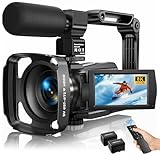
- Latest 8K Video Camera with Remote Control : This Video camera features 8K video resolution at 15FPS, with additional options for 6K at 30FPS, 5K at 30FPS, 4K at 30FPS, 1080P at 60FPS/30FPS, 720P at 60FPS/30FPS. With an impressive 88MP image resolution and 18X digital zoom, this camcorder delivers exceptional visuals. The included remote control allows for effortless self-recording and photography from any angle, making it an ideal 8K vlogging camera for bloggers and content creators.
- Experience Smooth and Stable Footage with Our 8K Camcorder : Featuring advanced 6-Axis anti-shake technology for high-precision stabilization. The 3-inch, 270-degree rotatable touch screen allows for effortless self-recording and framing, making it perfect for vlogging and self-blogging. Additionally, the digital video camera's intuitive interface and user-friendly navigation ensure easy operation, so you can focus on capturing stunning 8K video and photos.
- Infrared Night Vision Video Camera with WiFi : Stay connected and share your moments instantly with our 8K Camera's built-in Wi-Fi and companion app "iSmart DV2". Download the app on your Android/iOS device to easily transfer photos/videos, and share them directly to social media platforms like Facebook and YouTube. Additionally, this camera features infrared night vision, allowing you to capture footage in low-light environments, producing clear black and white images even in complete darkness.
- Dual-Functionality and Enhanced Audio : This 8K video camera for YouTube doubles as a high-quality webcam, simply connect via USB and switch to "Webcam" mode for seamless video calling, live streaming, vlogging, and online teaching. The included external X-Y stereo microphone reduces ambient noise and captures clear, stable audio, ensuring professional-grade sound quality for your recordings.
- Versatile camcorders video camera 8k for Every Adventure: This multifunctional camera features a range of creative modes, including continuous shooting, time-lapse, slow motion, and recording while charging. Perfect for capturing life's adventures, whether you're traveling, camping, hiking, or enjoying your favorite sports. Plus, our dedicated team is available to provide technical support, troubleshooting, and answers to any questions you may have after your purchase.
Plan the media before selecting a recording mode
Panasonic states that recording at 800 Mbps or higher, selected high-frame-rate modes and specified ProRes modes require CFexpress media. The camera also has different continuous and actual recording-time estimates depending on the configuration.
Do these 3 things before closing this tab:
1Fix the driver behind crashes, sound loss and screen glitches2Clear out junk files and repair common Windows errors3Scan for outdated or missing drivers - takes under a minuteThat means the card is part of the camera purchase. Do not assume an ordinary SD card will support every mode, and confirm the exact card requirement for the resolution, frame rate, codec and bitrate you intend to use.
Best for: creators and production teams who prioritize codecs, high frame rates, ProRes, time code and sustained video operation.
4. Fujifilm X-H2S: best APS-C and high-speed option
Choose the Fujifilm X-H2S if you want a compact interchangeable-lens APS-C system for sports, wildlife, action or fast-moving creator video.
Fujifilm lists a 26.1MP stacked BSI sensor, internal open-gate 6.2K/30p recording in 4:2:2 10-bit, 4K/120p high-speed recording and ProRes support. It also lists subject-detection autofocus and up to seven stops of in-body stabilization.
Crashes, No Sound, or Screen Glitches?
Random freezes, missing sound and display glitches usually trace back to one bad driver. Find and replace yours safely.Free scan · under a minuteWindows Errors? Fix Them Before They Spread
Repair common Windows errors and clear accumulated junk for a smoother, more stable PC - no reinstall needed.Free scan · no reinstallThe X-H2S gives this comparison a high-speed APS-C option for buyers who do not want to move to a larger full-frame system. Its 4K/120p mode is useful for slow motion, while open-gate 6.2K recording can offer additional framing flexibility for certain production and social-video workflows.
Why the quoted record time needs context
Fujifilm lists a figure of up to 240 minutes under specific conditions: a 25°C cool start, the High auto-power-off setting, 100 Mbps recording, a VG-XH battery grip and three batteries. The manufacturer also says heat may end filming automatically.
Do not interpret that number as a universal recording guarantee. Ambient temperature, bitrate, battery configuration, media and camera settings can all change practical recording time.
Best for: action-oriented shooters and creators who want high-speed recording in an APS-C interchangeable-lens system.
Rank #3

- 4K & 96MP Video Camera Camcorder: This 4K video camera is capable of capturing precious moments with 4K Ultra HD video and 96MP still photos. Equipped with a high-sensitivity CMOS sensor, this camcorder ensures vivid colour reproduction and crisp, sharp image detail. Suitable for a wide range of scenarios—from capturing travel scenery and family gatherings to everyday snapshots—this vlogging camera meets all your filming needs.
- 18X Digital Zoom & Infrared Night Vision: This 4K camcorder features 18X digital zoom, allowing you to easily zoom in on distant scenes and capture clear details from afar. Activate the IR cut filter with one click via the OK button. This 4K video camcorder’s professional infrared night vision mode allows it to record high-contrast black-and-white footage even in pitch-black conditions.
- 3.0 Inch Touchscreen & 270° Rotatable Design: This 4K camcorder is equipped with a 3.0-inch HD touchscreen, delivering sensitive response and intuitive operation for effortless setting adjustment. Featured with a 270° flip screen, this vlogging camcorder allows real-time scene preview anytime you record. Perfect for vlogging, selfie shooting and video blogging, it supports portrait close-up, high-angle overhead recording and low-angle creative framing.
- Webcam Function & Wireless Remote Control: This video camera camcorder can be used as a computer webcam by simply connecting with USB cable, no complicated driver installation required. This digital video camera supports 4K clear image quality for live streaming, online meetings and video calls. Equipped with wireless remote control, you can start or stop recording and take photos remotely, great for solo shooting, vlog creation and group photo taking.
- Multifunctional Camcorder with Full Accessories: Packed with practical professional functions: face detection, video pause, slow motion, time-lapse shooting, self-timer, recording while charging and date stamp. This 4K video recorder camera produces smooth, sharp and cinematic footage in various scenes. It comes with a full set of supporting accessories out of the box, including 2 rechargeable batteries and a 32G memory card, ready for you to start shooting right away.
5. Canon EOS R50 V: best creator-focused entry camera
Choose the Canon EOS R50 V if you are beginning a creator workflow and want an APS-C interchangeable-lens camera with access to Canon’s RF/RF-S lens system.
Canon identifies the R50 V as a 24MP APS-C mirrorless camera with an RF mount and a single SD card slot. It supports both RF and RF-S lenses. Its creator-focused video features include UHD 4K, UHD 4K Crop, 4K Crop recording up to 59.94p, and Canon Log 3, HLG, PQ and Canon709 options with recording up to 4:2:2 10-bit.
For a newer creator, this is a more expandable option than an integrated-lens compact camera. You can begin with a simple lens and later choose different focal lengths for talking-head video, travel, portraits or wider room shots.
Understand the 4K Crop mode
UHD 4K and UHD 4K Crop are distinct modes. A crop changes the effective framing, so the same lens will not necessarily look equally wide in both modes. Check the camera manual and the selected lens’s focal length before planning a setup for interiors, handheld vlogging or group shots.
The R50 V should not automatically be called the “best budget” camera without a current, country-specific price comparison. Prices, kits and availability change, and the cost of a lens system is more important than the body price alone.
Best for: new creators who want accessible controls and an RF/RF-S upgrade path.
6. DJI Osmo Pocket 3: best compact stabilized 4K camera
Choose the DJI Osmo Pocket 3 if portability, walking shots, travel, vertical video and solo operation matter more than interchangeable lenses.
DJI describes the Osmo Pocket 3 as a pocket gimbal camera with a 1-inch CMOS sensor, a 2-inch rotatable touchscreen, full-pixel fast focusing, 4K/120fps recording, 10-bit D-Log M and HLG, and integrated three-axis mechanical stabilization.
What’s actually slowing this PC down?
Pick the symptom - the matching free tool is one click away.
It also supports smart horizontal and vertical shooting, ActiveTrack 6.0 and compatibility with DJI Mic 2 and DJI Mic Mini systems. The integrated gimbal is the central advantage: it provides mechanical stabilization in a small all-in-one package without requiring a separate gimbal, lens and camera body.
This is not a substitute for a full-frame or APS-C interchangeable-lens camera when you need lens flexibility, a larger camera body or a production-oriented media workflow. It is the better tool when the camera must be small enough to carry and ready to shoot quickly.
Rank #4

- 4K sensor and DIGIC DV6 image processor deliver crisp, sharp 4K UHD images, while an 8-blade aperture achieves cinema-style out-of-focus highlights.
- On-Screen Display (OSD) “Time Stamp” Recording embeds date, time, timecode and other data in your original camera files.
- UVC Livestreaming - Stream HD video directly from the camera via UVC1 to a PC or Mac computer.
- Powerful 20x optical zoom and advanced image stabilization.
- Adjustable focusing speeds and advanced Hybrid AF system provide fast and precise focusing with face detection.
Best for: travel videos, walking footage, solo vlogs and creators who value convenience above system expandability.
Independent reader supportYour contribution helps us test, update, and keep practical guides available for everyone.How to choose the right 4K camera
1. Start with the shooting job
| Your priority | Most suitable pick | Why |
|---|---|---|
| One full-frame camera for photos and video | Sony Alpha 7 V | Broad hybrid feature set with oversampled 4K/60p and 4K/120p |
| Advanced hybrid and monitoring tools | Nikon Z8 | 8K, log/HDR, waveform, time code, proxy and RAW-video options |
| Video production and codecs | Panasonic LUMIX S1II | ProRes, high-bitrate modes, CFexpress and fan |
| Action in a smaller interchangeable-lens system | Fujifilm X-H2S | Stacked APS-C sensor, 6.2K and 4K/120p |
| Starting a Canon creator system | Canon EOS R50 V | RF/RF-S lens compatibility and 10-bit Log/HDR options |
| Smallest, simplest stabilized setup | DJI Osmo Pocket 3 | Integrated three-axis gimbal and pocket-sized body |
2. Choose the lens ecosystem deliberately
Five cameras in this list are body-and-lens systems: the Sony Alpha 7 V, Nikon Z8, Panasonic LUMIX S1II, Fujifilm X-H2S and Canon EOS R50 V. The lens mount affects your future choices, system size and total cost.
Recommended Free Tools
Consider the lenses you already own, the focal lengths you need and whether you prefer a lightweight APS-C setup or a larger full-frame system. The Canon EOS R50 V uses the RF mount and supports RF and RF-S lenses. The DJI Osmo Pocket 3 has an integrated lens instead, which simplifies the purchase but removes the option to change focal lengths.
3. Read the complete recording mode
“Records 4K” is not enough information to compare cameras. For the mode you plan to use, verify:
- Resolution and frame rate
- Whether the camera uses a crop or a full sensor area
- Bit depth and chroma subsampling
- Codec and bitrate
- Autofocus availability
- Maximum or expected recording duration
- Heat-management requirements
- HDMI output resolution
- Card requirements
The Nikon Z8 illustrates why this matters: its 4K/120p and 4K/100p modes reduce HDMI output to Full HD, while 4K/60p can output 4K over HDMI. A specification can therefore be excellent for internal slow motion but less suitable for an external-monitor workflow.
4. Budget for media, batteries and audio
High-data-rate recording can require more than the camera body and kit lens. The Panasonic LUMIX S1II explicitly requires CFexpress for certain 800 Mbps-or-higher, high-frame-rate and ProRes modes. Other cameras may also require particular card speeds for specific settings, so check the manual rather than choosing a card by capacity alone.
Free tools Windows power users keep installed
One-click scans. No signup required.
Audio is equally important for interviews, tutorials and vlogs. The DJI Osmo Pocket 3 is compatible with DJI Mic 2 and DJI Mic Mini systems, which may make it a practical solo-video setup when spoken audio is central. For every camera, confirm microphone connections, wireless compatibility, monitoring and any adapter requirements before buying accessories.
5. Treat record-time figures as conditional
Manufacturer record-time figures are not universal promises. Temperature, bitrate, card type, firmware, battery, screen use, power settings and optional cooling accessories can all affect how long a camera continues recording.
The Fujifilm X-H2S example is especially clear: its up-to-240-minute figure assumes a cool 25°C start, 100 Mbps, a VG-XH grip and three batteries, among other settings. Panasonic likewise lists different estimates by configuration for the S1II. For long events, plan for spare batteries, appropriate media and a cooling strategy rather than relying on a headline number.
Best Value

- Capture Stunning Footage - Osmo Pocket 3 vlogging camera features a 1-inch CMOS sensor and records in 4K resolution at an impressive 120fps. Capture breathtaking night views and sunsets with enhanced clarity.
- Effortlessly Frame Your Shots - Get the ideal composition with Osmo Pocket 3's expansive 2-inch touch screen that rotates for both horizontal and vertical shooting.
- Ultra-Steady Footage - Say goodbye to shaky videos! Osmo Pocket 3's advanced 3-axis mechanical stabilization delivers superb stability. Enjoy smooth footage while dancing, chasing pets, or hiking.
- Create Captivating Vlogs With ActiveTrack 6.0 - Stay effortlessly in focus as you record on the go. Set Osmo Pocket 3 up on a tripod and jump, dance, or spin, but remain center-frame.
- Fast and Accurate Focusing - Osmo Pocket 3 digital camera locks onto your subject for sharp, clear footage. Whether filming action-packed scenes or still shots, it ensures every detail is captured.
What “4K” does—and does not—tell you
4K describes the recorded resolution, not the complete shooting experience. Two cameras can both record 4K while differing substantially in sensor format, readout, crop, stabilization, autofocus, codec, bit depth, audio, heat management and lens options.
The Tool Desk
Outbyte Driver Updater FREEFix the driver behind crashes, sound loss and screen glitchesFind Drivers →Outbyte PC Repair FREERepair Windows errors before they cause bigger problemsFix Now →For example, the Sony Alpha 7 V’s 7K-oversampled 4K/60p is a different capability from its 4K/120p mode. The Canon EOS R50 V’s UHD 4K Crop mode changes framing. The Panasonic S1II’s high-bitrate and ProRes settings affect storage and card choice. The DJI Pocket 3’s integrated gimbal changes what is practical while walking. These differences are often more important than the shared resolution label.
Buying checklist
- Confirm the exact model and market version.
- Decide whether you need a body-only purchase or a kit lens.
- Check the lens mount and the price and size of the lenses you will actually need.
- Verify 4K frame rates, crop, autofocus and recording limits in the current manual.
- Check whether your preferred codec requires CFexpress or a particular SD-card speed.
- Confirm HDMI output if you use an external monitor or recorder.
- Plan audio, batteries, chargers, tripod or gimbal accessories.
- Check current firmware, availability, warranty and return terms before checkout.
Frequently Asked Questions
Which 4K camera is best for most people in 2026?
The Sony Alpha 7 V is the broadest overall choice in this guide for a current full-frame hybrid buyer. It combines 7K-oversampled 4K/60p with 4K recording up to 120p. It is not automatically the best choice for every workflow: the Nikon Z8 is more production-oriented, the Panasonic S1II is more video-focused and the DJI Pocket 3 is much more portable.
Is 4K/120p better than 4K/60p?
Neither is universally better. 4K/120p is useful for slow motion, while 4K/60p is often the more practical everyday frame rate. Check crop, codec, recording duration, autofocus, heat and HDMI output for the exact mode. On the Nikon Z8, for example, 4K/120p and 4K/100p limit HDMI output to Full HD.
Which camera is best for travel vlogging?
The DJI Osmo Pocket 3 is the most travel-oriented pick here because it combines a pocket-sized body, integrated three-axis mechanical stabilization, a rotatable screen and 4K/120fps. Choose an interchangeable-lens camera instead if you need different focal lengths, a larger system or more advanced production controls.
Do I need a full-frame camera for 4K video?
No. The Fujifilm X-H2S and Canon EOS R50 V are APS-C cameras that offer useful 4K capabilities, while the DJI Osmo Pocket 3 uses a compact 1-inch sensor. Full frame can be attractive for a hybrid system, but lens selection, stabilization, recording modes, audio and workflow may matter more for your project.
What memory card should I buy?
Choose the card based on the precise recording mode, bitrate and codec rather than the camera’s maximum resolution. Panasonic states that selected S1II modes, including 800 Mbps-or-higher recording and specified ProRes modes, require CFexpress Type B. Always verify the current manufacturer manual before purchasing media.
The Bottom Line
The best 4K camera is the one that matches your workflow. Choose the Sony Alpha 7 V for the broadest full-frame hybrid role, the Nikon Z8 for advanced hybrid tools, the Panasonic LUMIX S1II for video-first production, the Fujifilm X-H2S for APS-C high-speed work, the Canon EOS R50 V for entering an RF/RF-S creator system, and the DJI Osmo Pocket 3 for compact stabilized capture. Before checkout, verify the current price, kit contents, firmware, card requirements, availability and limitations of the exact recording mode you intend to use.
Quick Recap
Product prices and availability are accurate as of the date/time indicated and are subject to change. Any price and availability information displayed on Amazon at the time of purchase will apply.

