
Crashes, No Sound, or Screen Glitches?
Random freezes, missing sound and display glitches usually trace back to one bad driver. Find and replace yours safely.Free scan · under a minuteWindows Errors? Fix Them Before They Spread
Repair common Windows errors and clear accumulated junk for a smoother, more stable PC - no reinstall needed.Free scan · no reinstalliTechGuides is reader-supported. When you buy through links on our site, we may earn an affiliate commission. As an Amazon Associate I earn from qualifying purchases. Learn more
Supermicro announced that it was shipping its four-socket X14 servers in July 2025, positioning them for large databases, in-memory applications, HPC and other demanding enterprise workloads. The family’s headline capabilities include up to 16 TB of memory and, in the 4U model, support for as many as six double-width GPUs. Those are Supermicro’s configuration-dependent maximums—not specifications guaranteed for every system. The launch shows a push into high-capacity enterprise computing; it does not establish that customer trust has returned.
What Supermicro announced for four-socket X14
In a July 16, 2025 announcement, Supermicro said its four-socket X14 systems based on Intel Xeon 6 processors with P-cores were shipping. The company described them as platforms for large-scale database and enterprise applications, high-performance computing (HPC), mission-critical workloads, in-memory databases and applications with a very large memory footprint.
The specifications below are vendor-stated maxima for the announced systems. They should not be read as one configuration that combines every maximum, or as guarantees for every X14 model. Supermicro’s multi-processor product area and the selected chassis’ documentation are the places to confirm a particular system’s options.
Do these 3 things before closing this tab:
1Clear out junk files and repair common Windows errors2Fix the driver behind crashes, sound loss and screen glitches3Repair Windows errors before they cause bigger problems| Capability | What Supermicro stated | Qualification |
|---|---|---|
| CPU cores | Up to 344 cores per system | Maximum across the announced four-socket systems; the actual count depends on the processor configuration. |
| Memory | Up to 16 TB | System maximum stated by Supermicro; verify supported capacity and DIMM configuration for the selected model. |
| PCIe expansion | Up to 20 PCIe 5.0 slots across the systems | The slot count varies by system. Check the chassis specification rather than applying the family maximum to a single server. |
| GPU capacity | Up to six double-width GPUs in the 4U model | This maximum is specifically associated with the 4U system and depends on its configuration. |
Supermicro also advertised performance up to 50% higher than the previous generation of Intel processors. That is the vendor’s comparison, not an independently established result for a named customer workload; the announcement excerpt does not provide a like-for-like test result to apply to a buyer’s application.
#1 Best Overall
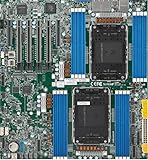
- Intel Xeon 6500/6700-series processors with E-cores and P-cores, Dual Socket LGA-4710 (Socket E2) supported, CPU TDP supports Up to 350W TDP
- Total up to 4TB ECC RDIMM DDR5-6400MT/s in 16 DIMM slots
- 3 PCIe 5.0 x8 via MCIO connectors
- M.2 Interface: 2 PCIe 5.0 x4M.2 Form Factor: 2280, 22110
- Dual LAN with 1GBase-T with Broadcom BCM5720
Which workloads could benefit from the platform?
Large-memory and in-memory databases
A system with a high memory ceiling may be relevant when an application’s working set is large and the software, operating system and server configuration can use that capacity. Supermicro argues that a large memory pool can allow some workloads to scale up within one node instead of scaling horizontally across networked systems, which it says can avoid network latency. That is a vendor positioning claim, not proof that a particular database will run faster or cost less on X14.
Supermicro says the servers are certified for SAP HANA and Oracle Linux. Certification is a useful starting point, not a blanket approval for every CPU, memory, storage or software combination. Confirm the current certification and supported configuration with Supermicro and the software provider before making it a procurement requirement.
Rank #2

- Intel Xeon 6700/6500 series processors with P-cores or 6700 series processors with E-cores, Dual Socket LGA-4710 (Socket E2) supported, CPU TDP supports Up to 350W TDP
- Total up to 4TB ECC RDIMM DDR5-6400MT/s in 16 DIMM slots
- 4 PCIe 5.0 x16 2 PCIe 5.0 x8 3 PCIe 5.0 x8 via MCIO connectors M.2 Interface: 2 PCIe 5.0 x4M.2 Form Factor: 2280, 22110
- Dual LAN with 10GBase-T with Broadcom BCM57416 6 USB 3.2 Gen1 (4 rear and 2 via header) 10 SATA3 ports
CPU-dense enterprise and HPC work
The advertised maximum of 344 cores and four processor sockets make CPU density a central part of the family’s pitch. Whether a high core count helps depends on the workload’s ability to use parallel processing, its memory needs and its licensing model. Buyers should compare the exact Xeon 6 P-core configuration against the application’s support matrix and licensing rules rather than treating the maximum core count as a performance result.
GPU-accelerated deployments
Supermicro’s claim of support for up to six double-width GPUs applies to its 4U system. A buyer considering GPU acceleration should verify the exact GPU models supported, available PCIe slots and other configuration constraints in the selected system documentation. The announcement’s maximum alone does not establish that a specific GPU mix is supported.
Rank #3

- Intel Xeon 6700/6500 series processors with P-cores or 6700 series processors with E-cores, Single Socket LGA-4710 (Socket E2) supported, CPU TDP up to 350W
- Up to 2TB ECC RDIMM DDR5-6400MT/s and up to 512GB MRDIMM DDR5-8000MT/s in 8 DIMM slots
- 6 PCIe 5.0 x8 via MCIO connectors (JNVME3–6 are enabled with the specific CPU** installed)
- 3 PCIe 5.0 x16 (SLOT6 is enabled with the specific CPU** installed), 3 PCIe 5.0 x8,M.2 Interface: 2 PCIe 5.0 x2 (Form Factor: 22110, M-Key)
- Dual LAN with 1GbE with IntelI210
Platform features are not proof of deployment outcomes
Supermicro’s X14 overview lists PCIe 5.0, DDR5, CXL 2.0, EDSFF E1.S and E3.S storage options, remote management, and hardware and silicon Root of Trust with component attestation among the family’s features. These are manufacturer descriptions. They do not, by themselves, independently validate security implementation or demonstrate a security outcome in a customer deployment.
For a purchase evaluation, ask the vendor to map each needed feature to the exact system and configuration under consideration. That is especially important where a requirement depends on a particular storage device, expansion card, management capability, certification or security control.
Rank #4
- Intel Xeon 6700/6500 series processors with P-cores or 6700 series processors with E-cores, Single Socket LGA-4710 (Socket E2) supported, CPU TDP up to 350W
- Up to 2TB ECC RDIMM DDR5-6400MT/s and up to 512GB MRDIMM DDR5-8000MT/s in 8 DIMM slots
- 6 PCIe 5.0 x8 via MCIO connectors (JNVME3–6 are enabled with the specific CPU** installed)
- 3 PCIe 5.0 x16 (SLOT6 is enabled with the specific CPU** installed), 3 PCIe 5.0 x8, M.2 Interface: 2 PCIe 5.0 x2 (Form Factor: 22110, M-Key)
- Dual LAN with 10GBase-T with IntelX550
What the latest filing says about Supermicro’s controls
Super Micro Computer, Inc.’s FY2026 Form 10-K says BDO audited the company’s financial statements and internal control over financial reporting for the fiscal year ended June 30, 2026. The filing says Supermicro remediated three material weaknesses reported for FY2025, but one weakness in IT general controls remained unremediated as of June 30, 2026.
What’s actually slowing this PC down?
Pick the symptom - the matching free tool is one click away.
That is relevant governance information for an enterprise vendor, but it is not a measure of customer sentiment and does not establish how a particular customer assesses supplier risk. The server launch and the filing address different questions: one describes a product offering; the other reports the company’s audit and control status.
Best Value

- Supermicro X14SBI-TF Intel Xeon Single Socket E2 (LGA-4710) DDR5 RDIMM ATX Motherboard
Earlier committee review, in context
On December 2, 2024, Supermicro announced that a board special committee had completed its review. The company’s account said the committee found that EY’s stated concerns and conclusions about its resignation were not supported by facts examined in that review, and it reported that the committee made control and governance recommendations. This is Supermicro’s published account of the committee’s work, not a neutral adjudication of every allegation. The FY2025 filing separately records the former auditor’s concerns and resulting filing delays.
Independent reader supportYour contribution helps us test, update, and keep practical guides available for everyone.How to assess an X14 system for a real workload
The family-level maximums are not enough to select a server. Build the comparison around a specific workload and orderable configuration, and ask the vendor or reseller to document the answers.
Quick Recap
- CPU and software fit: Identify the exact Xeon 6 P-core processors and core count, then confirm application support and licensing implications.
- Memory capacity and bandwidth: Specify the required capacity and configuration for the workload; do not assume every model reaches the family’s 16 TB maximum.
- GPU and I/O requirements: Confirm supported accelerator models, actual PCIe slot count and the expansion cards the design needs.
- Storage: Match the needed devices and capacity to the selected chassis, including whether the intended EDSFF form factor is available in that configuration.
- Certification: Confirm that the exact system and software versions meet current SAP HANA, Oracle Linux or other applicable certification requirements.
- Rack and operations fit: Validate power, cooling, rack space, serviceability and support terms against the deployment site and operations plan; the launch announcement does not provide a total-cost comparison for a defined configuration.
- Supplier governance: Evaluate the vendor’s controls, support commitments and risk posture under the buyer’s own procurement standards. Neither a product launch nor a financial filing can substitute for that assessment.
Product prices and availability are accurate as of the date/time indicated and are subject to change. Any price and availability information displayed on Amazon at the time of purchase will apply.
Free tools Windows power users keep installed
One-click scans. No signup required.

