
Build SMS OTP login and airline alerts as separate backend workflows: throttle code requests and guesses, consume each valid challenge once, persist flight events before acknowledging them, and send alerts through idempotent jobs. Treat SMS as a restricted authentication channel—not proof that a flight text reached a handset—and use authorized flight data with coverage and reuse rights appropriate to your routes.
How should the backend be divided?
Separate identity verification, flight-data ingestion, subscription matching, and SMS delivery. They can share infrastructure, but they have different permissions, abuse patterns, retry rules, and meanings of success.
- OTP service: issues and verifies short-lived challenges bound to a login attempt, account context, and normalized phone number.
- Flight-data adapter: authenticates an authorized upstream source, validates updates, and converts provider-specific messages into internal events.
- Subscription matcher: finds active passenger subscriptions affected by a new event and creates durable notification jobs.
- SMS worker: delivers jobs asynchronously, records provider responses and delivery callbacks, and handles bounded retries.
This separation keeps a slow SMS provider from blocking flight-event intake and prevents login-code rules from being confused with travel-alert preferences. Persist flight events and notification jobs before acknowledging work that must not be lost.
How should SMS OTP login work?
Issue a challenge without leaking account membership
- Normalize and validate the submitted phone number. Apply send limits before calling an SMS or verification provider.
- Create a challenge bound to the purpose (login), phone number, account or enrollment context, and login attempt. Store protected verifier material rather than logging or exposing the code.
- Send the code through the chosen provider. Return a generic response that does not reveal whether the number is registered; keep externally observable behavior as similar as practical for registered and unregistered numbers.
Keep login-code delivery separate from alert subscriptions. A request for a login code is not consent to receive flight alerts, and subscribing to alerts should not be a way to trigger login challenges.
The Tool Desk
Outbyte Driver Updater FREEFix the driver behind crashes, sound loss and screen glitchesFind Drivers →Outbyte PC Repair FREERepair Windows errors before they cause bigger problemsFix Now →#1 Best Overall

- 【2 Modes in 1 Gateway】Support MOES/Tuya Bluetooth mesh (SIG) + Zigbee3.0 multi-protocol communication. Only one gateway is needed to connect devices of different protocols to the 2.4Ghz network.
- 【Support 128 Devices】 Support up to 128 Tuya smart home devices, such as Bluetooth Door Lock, ZigBee Light Switch No Neutral, Bluetooth Finger, Zigbee Power Monitor Plug, Bluetooth Thermometer, ZigBee Window Gate Sensor, etc.
- 【Sound & Light Alarm】 Support sound and light alarm.Support Local Scenario / Support Local Automation / Support Security Function and be integrated into the Tuya Security Saas Platform.
- 【Voice & App Remote Control】 No matter where you are, you can control the connected smart devices through the MOES/Smart Life App on your mobile phone. Support voice control of Alexa, and Google Assistant.
- 【ESAY SET-UP】Designed for quick and easy set-up with absolutely no wiring or technical skills required.Quickly and easily add, reset, and group devices via the hub.
Verify and consume it atomically
- Receive the code over an authenticated, protected channel. NIST SP 800-63B Revision 4 states: “The verifier SHALL use approved encryption and an authenticated protected channel when collecting the OTP.”
- Check that the challenge matches the phone, account context, and purpose; has not expired; has not exceeded its failed-attempt limit; and has not already been used.
- On a correct code, atomically mark the challenge consumed and issue the session. The single-use check and consumption must be one operation or transaction so simultaneous submissions cannot both succeed.
- On an incorrect code, record the failed attempt and apply the relevant throttle. Do not reveal whether the number or account exists through different error messages.
NIST treats PSTN out-of-band authentication, including SMS, as restricted and notes risks such as SIM reassignment. Use it as a convenience or transitional factor rather than the strongest option; choose a stronger method for accounts or actions whose risk warrants it. Where risk signals are available, consider device swap, SIM change, or number-porting indicators before relying on SMS.
What should rate limits protect?
A per-IP limit alone is inadequate: an attacker can distribute requests across addresses, while a shared address can belong to many legitimate users. Apply independent controls to code creation and verification, using identifiers appropriate to each operation.
Rank #2
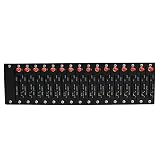
- 16 ports industrial-grade modem pool
- Based on EC21-E module for Quectel
- USB port Interface
- Control via AT commands
- Support FDD LTE: B1/B3/B5/B7/B8/B20 (800/850/900/1800/2100/2600), WCDMA: B1/B5/B8 (850/900/2100), GSM: 900/1800
| Operation | Useful limit dimensions | Purpose |
|---|---|---|
| Challenge creation | Phone number, account or enrollment context, IP address, device/session, and destination geography | Reduce SMS pumping, nuisance messages, and provider spend. |
| Code verification | Challenge, account or phone, IP address, and device/session | Limit guessing of short codes while allowing controlled recovery for legitimate users. |
| Flight-alert subscription changes | Account, destination number, IP/device, and subscription or flight context | Prevent unwanted subscriptions and abusive alert volume independently of login. |
| Outbound delivery | Subscription, event, destination, and provider/route capacity | Prevent duplicate sends and retry storms when a provider or carrier is failing. |
Use progressive delay or a step-up challenge as abuse increases. Avoid a policy that lets an attacker permanently lock a legitimate user merely by submitting wrong codes; distinguish temporary throttling from account recovery and operational support. Bound retries and apply backoff so transient provider failures do not multiply traffic.
Twilio’s Verify guidance gives one request per 30 seconds per phone number with exponential backoff as a provider-specific suggestion, and documents a 10-minute token validity period. Those figures describe Twilio’s product guidance and configuration, not universal requirements or NIST limits. Twilio also documents configurable rate-limit keys such as IP or session and fraud monitoring based on country and conversion patterns. Independently monitor send-to-verify conversion, unusual destination-country activity, and SMS spend.
Recommended Free Tools
Rank #3

- 16 Ports Industrial-Grade GSM Modem Pool
- Based on Wavecom Q2403A Module
- USB Port Interface
- Control via AT Commands
- Support Dual Frequencies: GSM/GPRS 900/1800MHz
How should flight updates become SMS alerts?
Choose an authorized source for the routes you serve
Flight status data is not a universally available public feed. Confirm authorization, route and geographic coverage, event definitions, freshness, commercial reuse rights, callback behavior, and cost with the selected source before designing around it.
| Option | What it is | Documented integration shape | What to establish for your project |
|---|---|---|---|
| FAA SWIM Flight Data Publication Service | An aviation-data service for authorized National Airspace System consumers. | Publication and request-response queries against an archive are documented by FAA. | Eligibility, coverage for the intended routes and events, service terms, latency, and data reuse rights. |
| FlightStats Alerts API | A commercial flight-status alert API. | FlightStats documents push-based alert rules with HTTP POST callbacks, including rules for specific flights and broader flight categories. | Contract and plan access, route/event coverage, callback retry behavior, freshness, cost, and reuse rights. |
| IATA AIDX | An XML messaging standard for operational flight-data exchange, not itself a turnkey flight feed. | Defines a format for exchange among airlines, airports, and other consumers. | A provider or partner that supplies data in the format, plus entitlement, coverage, support, and service terms. |
These are different kinds of choices, not interchangeable vendors. For any source, compare route coverage, status definitions, freshness, push versus polling, historical lookup, reliability, integration format, support, authorization, reuse rights, and total cost. For SMS providers, compare destination coverage, local sender-registration and compliance needs, deliverability callbacks, fraud controls, configurable limits, failover, token handling, retention, and per-message-segment cost. Current availability and prices require confirmation with providers.
Rank #4

- Smart Home Appliance Connector: Tuya bluetooth Gateway,Support 128 smart home devices supporting Tuya functionality, compatible with smart locks, light sources, switches, sockets, smart appliances and more. Easily extend the smart home system to every room, automate, and remote.
- Tuya App Remote Control: It connects with the tuya smart door lock to realize remote control and open the door lock when you are not at home. Please note that other apps cannot be connected.
- Stable and Reliable: The gateway connection works stably, with wide coverage, strong reception signal, low power consumption, and the Micro-USB can keep working when it is powered on.
- Perfect Size: It only occupies a small space, 2.36*2.36*0.59 inches (6*6*1.6 cm) and weighs 50 grams. White square design, it is a nice decoration in your home.
- Service Guarantee: No installation is required, the gateway powers up and is ready to use, with absolutely no wiring or technical skills required. There are detailed instructions and operation videos, cell phone connection is more convenient. If you have any questions, please contact us by email in time.
Accept and normalize updates durably
- Authenticate callbacks or API access, validate payloads, and persist the incoming event before acknowledging it. For polling, persist the fetched update before advancing the poll cursor.
- Retain the provider’s raw status and source timestamp for audit and debugging. Map provider-specific values into a small internal vocabulary, while keeping event time separate from the time your system ingested it.
- Identify a flight using enough context for the data source and service—typically operating or marketing carrier, flight number, date, and route as needed. A marketing flight number alone may not be globally unique.
- Deduplicate repeated, corrected, and out-of-order updates. Prefer a provider event ID when available. Otherwise derive a stable key from flight identity, event type, source timestamp or version, and status payload.
- Decide which meaningful state changes warrant a passenger message. Suppress duplicate events and semantically unchanged states rather than sending a text for every upstream update.
Keep the raw update even when the normalized state changes: it helps explain disagreements between a provider’s status and a message already sent. Define ordering and correction behavior explicitly, because event arrival order is not necessarily event-time order.
Independent reader supportYour contribution helps us test, update, and keep practical guides available for everyone.How do you prevent duplicate or misleading notifications?
Create an outbound job only after matching a normalized event to active subscriptions. Give each job a stable idempotency identity based on the subscription and event, and enforce uniqueness at the durable store or queue boundary. If ingestion is retried, the same event should not create a second logical alert; if delivery is retried, the worker should know whether the provider already accepted that job.
Free tools Windows power users keep installed
One-click scans. No signup required.
Best Value

- ◇Introduction: USB to GSM is a four-frequency GSM/GPRS module, its stable performance, and can meet a variety of customer needs. Integrated USB to serial port chip, directly plug in the computer can be debugging. The operating frequency of SIM800C is GSM/GPRS 850/900/1800/1900mhz, which can be used worldwide. It can realize the transmission of voice, SMS messages, and data information with low power consumption, and can be suitable for various compact product design requirements.
- ◇ On-board original SIM800C GSM/GPRS module; On-board CH340T USB to serial port chip, simple driver installation and high compatibility; self-elastic SIM card slot design, can use 2G/3G/4G Micro SIM and Nano card;
- ◇The USB to GSM module will automatically start up and connect to the network when it is powered on. It does not need to control the startup with buttons, which saves the troublesome startup process;
- ◇Support SMS sending and receiving, provide management software; provide reference host computer source code (c#, vb) supporting materials and instructions for use; support GPRS data transmission under 2G network, which can be used in mobile meter reading and other occasions;
- ◇Support Bluetooth data transmission, IEEE802.15 bluetooth standard, 2.4GHz working frequency band; support adaptive baud rate; with working indicator, no network, no SIM card or when the SIM card is inserted backward, the LED light flashes quickly at 1-second intervals, normal Blinks once every 3 seconds when connected to the network.
Track at least these states per notification:
- Queued: accepted internally for delivery.
- Submitted: the SMS provider accepted the send request. This is not proof of handset receipt.
- Delivered: a delivery receipt reports delivery, where the provider and route make receipts available.
- Failed: delivery or submission failed under the provider’s reported outcome.
- Expired: the alert is no longer useful, for example because a newer event superseded it or its delivery window passed.
Use bounded retries with backoff for transient errors; classify permanent failures rather than retrying them indefinitely. Persist provider message IDs and callback outcomes, and make callback processing idempotent too. A provider can accept a message while a carrier later filters it: Twilio documents carrier filtering of A2P automated messages, including OTPs, as a cause of undelivered status. Report “submitted” and “delivered” distinctly, and show flight-data freshness or unavailability honestly instead of implying the alert reflects live data when it may be stale.
Document internal event and notification contracts with the same care as external interfaces: whether each operation is synchronous or asynchronous, whether it is idempotent, its inputs and outputs, and its fault messages. FAA-STD-073A describes these documentation dimensions for services; applying them internally clarifies safe retries and failure handling.
Quick Recap
What should be decided before implementation?
- Routes and jurisdiction: determine flight-source coverage, messaging rules, sender registration, and user-consent requirements for each region served.
- Risk and recovery: decide which accounts and actions may use SMS OTP, what stronger factor is available, and how users recover access after a lost or changed number.
- Operational targets: set volume, latency and freshness expectations, uptime goals, retry bounds, retention, and alert-expiry rules.
- Provider entitlements: verify data access and reuse rights, callback guarantees, SMS coverage, data handling terms, and costs before selecting vendors.
- Observability: measure OTP send and verification outcomes, rate-limit denials, event age, duplicate suppression, queue delay, provider acceptance, delivery receipts, failures, and spend.
Product prices and availability are accurate as of the date/time indicated and are subject to change. Any price and availability information displayed on Amazon at the time of purchase will apply.

