
Free tools Windows power users keep installed
One-click scans. No signup required.
IoT makes vehicles smarter by connecting onboard sensors and control systems to software, networks, cloud services, other road users and roadside infrastructure. That connectivity can help warn drivers about hazards, improve traffic flow and give fleets better operational data. The benefits depend on reliable communications, compatible systems, adequate infrastructure and strong security and privacy protections; a connected vehicle is not automatically an autonomous vehicle, and not every connected car has V2X capability.
How IoT works in a smart vehicle
A smart vehicle combines sensors and electronic control systems with software and one or more network connections, such as cellular or GPS. The vehicle can use those connections to exchange data with cloud services, other vehicles and roadside equipment. This supports services such as vehicle monitoring and connected traffic applications.
Vehicle-to-everything, or V2X, is the part of this system that lets vehicles communicate with other road users and infrastructure. The U.S. Department of Transportation describes connected-vehicle technologies as equipment, applications or systems that use V2X communications for roadway safety, system efficiency or mobility. Depending on the system, messages may involve cars, pedestrians, cyclists, motorcycles, buses, trucks or roadside equipment. They can convey information about hazards a driver’s line-of-sight sensors may not yet detect.
Connected features are not the same as automated driving
Connectivity can provide information or warnings to a driver and can support automated-driving systems, but it does not by itself make a vehicle fully automated. Driver-assistance features and automated driving have different roles: V2X can add information from beyond the vehicle’s immediate sensors, while the vehicle’s automation level determines what driving tasks it can perform. USDOT expects V2X to help automated vehicles integrate with today’s non-automated fleet, provided interoperability and security are maintained.
Windows Errors? Fix Them Before They Spread
Repair common Windows errors and clear accumulated junk for a smoother, more stable PC - no reinstall needed.Free scan · no reinstallOutdated Drivers Are Slowing You Down
One free scan finds every outdated or missing driver and matches the right update for your exact hardware.Free scan · exact hardware match#1 Best Overall

- Made for BimmerCode and recommended by the BimmerCode Team (app sold separately)
- 100% Coverage of vehicles, protocols and advanced features supported by BimmerCode
- Easy in-app pairing to iOS & Android, advanced sleep mode and overvoltage protection allow OBDLink CX to be left plugged in
- Rock-solid connection avoids data corruption and dropped packets, won’t brick your ECU
- OBDLink app included — monitor live parameters, perform diagnostics, clear check-engine light
Where the automotive sector benefits
| Benefit | How IoT or V2X contributes | What the evidence shows |
|---|---|---|
| Crash avoidance | V2V and vehicle-to-infrastructure (V2I) messages can provide warnings about hazards outside a driver’s line of sight. | NHTSA testing found prototype V2V equipment could track potential forward-collision-warning threats. The tests also exposed difficulties with curves and lane changes, so the result is not proof that every system will avoid crashes in all conditions. |
| Traffic and mobility | Vehicles can share position and speed information with infrastructure and other road users, enabling connected traffic applications. | An ITS Deployment Evaluation portal report for 2024/2025 recorded a 40.4% decrease in stops and a 13.3% reduction in travel time for one connected-school-bus signal-priority deployment. |
| Safety performance in a specific use case | A V2X application can provide a warning that may help a driver respond to a forward-collision threat. | An ITS Deployment Evaluation 2024 snapshot reported a 9% decrease in normalized forward-collision-warning conflict rates in one V2X use case. This is a result for that evaluated use case, not a general crash-reduction rate. |
| Fleet operations | Telematics data can support routing, maintenance scheduling, driver coaching, utilization analysis and incident response. | USDOT’s connected-vehicle architecture describes the data-exchange foundation for these kinds of connected applications; the benefits a particular fleet achieves depend on its systems and operations. |
| Automated-driving integration | V2X can give automated vehicles information about surrounding road users and infrastructure beyond what the vehicle alone detects. | USDOT identifies integration with the existing non-automated fleet as a potential role for V2X, contingent on interoperability and security. |
Why the opportunity matters
NHTSA reported 39,254 people killed in U.S. motor-vehicle crashes in 2024. Separately, a USDOT source page describing 2018 conditions estimated crash-related emergency-response, fatality, injury and property-damage costs at more than $140 billion per year. These figures provide context for safety and mobility efforts; they do not show that connected vehicles have already eliminated a particular share of crashes or costs.
What 5G adds—and whether a smart car needs it
5G can support real-time communication between vehicles and infrastructure, according to the U.S. Department of Homeland Security. It is one possible communications layer for connected services, not a requirement for every smart-vehicle function. Basic vehicle telemetry, cloud-connected features or other networked services may rely on different connections or operate without V2X. The relevant question is whether a particular feature needs a given network’s coverage, latency and reliability—not whether the car is simply labelled “smart.”
Rank #2

- Multi-function OBD2 Car Power Adapter: Our obd2 car power adapter has two charging ports: usb and type-c. The USB port output power is 18W, the type c port output power is 30W. Dual port outputs up to 48W Max.
- Dual Ports: Equipped with dual fast-charging ports for USB and Type-C, it seamlessly supports Type-C and USB-A devices, providing stable and continuous power supply. It can power two devices at the same time, dual port output, fast charging. Designed for 16-pin OBD and OBD2 ports, dedicated for charging.
- Adjustable Voltage & Current: Offers multiple output options, including 5V/3A, 9V/3A, 9V/2A, 12V/2.5A, 15V/2A, and 20V/1.5A, providing flexible charging solutions for a wide range of devices. It features a smooth surface material and a compact design, taking up minimal space.
- Widely Application: Our OBD car charger is a standard OBD interface power adapter that supports 12V and 24V car power supplies. Compatible with all vehicles equipped with a 16-pin OBD2 interface, such cars, trucks, SUVs, etc. This charger can charge your devices, including mobile phones, tablets, dash cams, radar detectors, dash cam GPS, navigators, electronic dogs, etc.
- Notice: Our OBD car charger is equipped with a constant power mode that supports 24-hour ultra-long standby, allowing charging to continue even after the engine has been turned off. Special note: If the OBD charger is repeatedly plugged in and unplugged, the vehicle will automatically shut down the OBD interface for 1 hour for protection, after which the interface will return to normal. Please do not plug and unplug the OBD charger frequently.
More connectivity also creates greater exposure to network outages and cybersecurity risks. A vehicle or service that depends on timely messages can only be as useful as the communications and infrastructure available where it is being used.
What limits the benefits
Coverage and interoperability
A connected application may depend on compatible vehicles, roadside infrastructure and communications standards. A message is useful only when the systems involved can exchange and interpret it. GAO has identified interoperability standards, spectrum sharing, and state and local deployment resources as practical challenges. These constraints mean a benefit demonstrated in one deployment should not be assumed across every vehicle or road network.
Rank #3
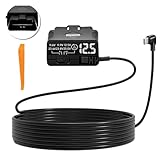
- Plug and play — no fuse tapping, no ACC wire hunting, no electrical knowledge required. Simply locate your OBD port, plug in, and you‘re done in under 60 seconds. Zero damage to factory wiring.
- Built-in ACC smart chip switches to continuous recording while driving and automatically enters parking surveillance mode when engine is off. 24/7 protection against hit-and-runs and parking lot dings — critical footage always saved.
- Offers 4 adjustable cutoff levels (11.6V / 11.9V / 12.5V / 20-Min Timer) for different battery conditions and usage scenarios. First-time users should start with 12.5V to ensure reliable startup even with older batteries or in cold weather.
- Built-in LED voltmeter display shows real-time battery voltage at a glance. Automatically cuts power when voltage drops below your preset level, ensuring enough reserve power for a smooth start every time — no more dead battery anxiety.
- Powers directly from OBD port — completely frees up your cigarette lighter. Charge your phone, run your inflator, or use your car vacuum simultaneously — no more fighting over the only 12V socket.
Driver response and accountability
A warning can inform a driver, but it does not guarantee that the driver will see, understand or act on it in time. GAO has identified driver response to warnings and liability uncertainty as deployment concerns. Safety claims should therefore distinguish between a system detecting or communicating a potential hazard and a demonstrated reduction in crashes.
Cybersecurity and privacy
Connected vehicles rely on electronics, sensors and computing systems, making cybersecurity important to the safety and reliability of advanced features. NHTSA recommends a risk-based cybersecurity process that is maintained and updated as threats change. Precise, real-time location data and vehicle communications can also be sensitive personal information, so privacy protections matter alongside technical security.
Rank #4

- 🚙OBD2 Car Power Adapter: It is equipped with USB and Type‑c dual fasting charging port, with a total power of 30W Max. The USB port output power is 18W, the type c port output power is 30W. Dual port outputs up to 48W Max.
- 🚗 Applicability: This OBD car charger is a standard OBD interface power supply, supporting 12V and 24V car power. It is suitable for all vehicles with 16 pin OBD2 port, such as cars, trucks, off-road vehicles. And this charger can charge your devices, such as mobile phones, tablets, DVR, radar detector, dash camera GPS, navigators, electronic dogs, etc.
- 🚕Dual Ports: Our obd car power adapter has two charging ports: usb and type-c. Stable charging, can power two devices at the same time, dual port output, fast charging. Designed for 16-pin OBD and OBD2 ports, dedicated for charging.
- 🚜Variable Voltage & Current: Provides 5V/3A, 9V/3A, 9V/2A, 12V/2.5A, 15V/2A, 20V/1.5A output options, provides versatile charging for a variety of devices. And it has a glossy surface material and a compact size that doesn't take up a lot of your space
- 🚌Superior Standby: The OBD car charger is equipped with constant power mode, 24 hours super standby, and can still be charged after the engine is turned off. Special Note: If you unplug the OBD charger several times, the car automatically protects the OBD interface from power failure for 1 hour and the interface will return to normal, please do not unplug the OBD charger repeatedly.
How to assess a connected-vehicle system
For a vehicle feature, fleet system or V2X deployment, compare more than its headline capability. These questions reflect requirements and barriers identified by USDOT, NHTSA, GAO and DHS:
- Safety performance: What hazard is the system intended to address, and what evidence supports its performance under relevant conditions?
- Latency and reliability: Does it deliver information quickly and consistently enough for the intended use, including where coverage is limited?
- Interoperability: Can it exchange usable messages with the vehicles, infrastructure and services it must work with?
- Security and privacy: How are messages authenticated, risks updated and sensitive location or communications data protected?
- Infrastructure coverage: What roads, regions or facilities have the supporting equipment?
- Cost and updates: What are the total deployment and operating costs, and can the system be maintained and updated over time?
- Governance: Have spectrum, deployment resources, driver response and liability responsibilities been addressed?
Can an existing car be made smarter?
An OBD-II vehicle telematics adapter can be an entry-level way to collect basic telemetry from a compatible existing car. It is a limited data-collection accessory: it does not replace native V2X, manufacturer safety systems, roadside infrastructure or professional cybersecurity controls. Before choosing one, verify vehicle compatibility, cellular coverage, data-plan terms and the provider’s privacy policy.
The Tool Desk
Outbyte Driver Updater FREEFix the driver behind crashes, sound loss and screen glitchesFind Drivers →Outbyte PC Repair FREEClear out junk files and repair common Windows errorsFree Scan →Best Value

- Error Diagnosis: This OBD2 adapter can be connected to a smartphone via Bluetooth, and together with the dedicated application, it can quickly read the vehicle fault codes. It can effectively assist car owners in promptly understanding the vehicle's condition and formulating maintenance plans
- Real Time Monitoring: This product supports real-time viewing of various vehicle data, such as coolant temperature, fuel system status, vehicle speed, airflow, and fuel pressure. Data updates are rapid, allowing drivers to monitor the vehicle's current operating status and enhance driving safety
- Superior Quality: The scanner's housing is made of high-strength ABS, offering excellent insulation and impact resistance. Its smooth, wear-resistant surface effectively prevents scratches and wear during daily use, ensuring long-term, stable operation
- Compact Size: This OBD2 Bluetooth car diagnostic scanner measures 3.1 × 1.6 inches or 3.5×1.8 inches and weighs 41 grams. It is compact and lightweight, making it easy to carry. It fits easily into a pocket or glove compartment, making it ideal for daily commutes, long-distance drives, or emergency checks
- Scope of Use: This OBD2 diagnostic scanner is specifically designed for 12V vehicles equipped with a standard OBD2 port and is widely compatible with sedans, SUVs, pickup trucks, and light trucks. To ensure compatibility, please verify that your vehicle's model year and port type match before purchasing
The main value of automotive IoT is not connectivity for its own sake. It is the possibility of giving drivers, fleets and traffic systems useful information sooner or helping them coordinate more effectively. Those gains depend on evidence-backed safety performance, compatible systems, available infrastructure and dependable safeguards.
Quick Recap
Product prices and availability are accurate as of the date/time indicated and are subject to change. Any price and availability information displayed on Amazon at the time of purchase will apply.

