
There is no universally cheaper or safer choice. Build or retain owned capacity when a workload is steady, highly utilized, and needs close control—and when you can fund and staff resilient operations. Use colocation, hosting, or public cloud when speed, flexibility, specialist capabilities, or lower upfront capital matter more. For many organizations, the practical answer is a workload-by-workload mix.
What does “build or outsource” mean?
The decision is not simply between owning a building and moving everything to the cloud. You can own and operate a data center, rent space and power in a colocation facility, use a hosting provider that manages more of the infrastructure, or consume public-cloud services. Those options shift different costs, responsibilities, and control to the provider.
- Owned data center: Your organization funds and controls the facility and its infrastructure. You retain responsibility for operations such as power, cooling, physical security, and capacity planning.
- Colocation: You place your equipment in a provider’s facility and pay for space and related services. You keep more control over your hardware than in public cloud, while relying on the provider for facility operations.
- Hosting: A provider supplies and may manage some or all of the infrastructure. The division of responsibilities depends on the service and contract.
- Public cloud: You provision computing resources as services rather than operating the underlying data-center facility. You still need to manage your workloads, access, data, and the parts of security and resilience assigned to you.
Colocation is not just a fallback for organizations that cannot build. Uptime Institute’s 2024 survey found that 61% of colocation providers reported hosting hyperscale tenants. Its report explains that hyperscale providers may use colocation to enter or expand in a market faster and more economically than building a new site, which can take years in many cases.
How do the options compare?
| Decision factor | Owned data center | Colocation or hosting | Public cloud |
|---|---|---|---|
| Cost at expected utilization | Can suit steady, high utilization that spreads fixed costs; construction, power, staffing, and refreshes remain your costs. | Facility costs are shared through provider services; equipment, service scope, and contract terms affect your total. | Can avoid facility investment, but recurring usage and network charges need to be modeled against sustained demand. |
| Time to capacity | Requires site, utility, design, permitting, procurement, and commissioning work. | Can provide access to capacity without building a new facility; availability depends on the market and provider. | Can provision resources quickly, subject to the service, region, and capacity available. |
| Control and portability | Offers the most direct control over facility and infrastructure choices; moving workloads still takes planning. | Retains control over some or much of the equipment, depending on the service; facility operations sit with the provider. | Provider manages underlying infrastructure; workload portability depends on architecture, services used, and migration effort. |
| Resilience and accountability | Your organization designs and operates facility and workload resilience. | Facility resilience is shared with the provider; workload design and contract boundaries still matter. | Provider infrastructure does not by itself define your recovery design or responsibilities. |
| Security, sovereignty, and compliance | Direct control can help meet specific isolation, location, or audit requirements, but does not remove the need to operate securely. | Can offer a controlled environment; location, access, audit rights, and provider obligations require review. | Capabilities vary by service and region; verify data location, jurisdiction, isolation, and contractual obligations. |
| Staffing and ongoing work | Requires facilities and operations expertise, including electrical, cooling, and round-the-clock incident response. | Provider takes on facility duties; your team still manages its contracted responsibilities and workloads. | Reduces facility operations work but does not eliminate workload, security, cost, or resilience management. |
| Migration and exit | Moving in or out requires equipment and workload planning. | Exit depends on contract terms, equipment ownership, and the logistics of moving workloads. | Data transfer, service dependencies, and application changes can make migration or exit costly. |
The table is a starting point, not a price ranking. The allocation of responsibility varies by provider, service, and contract; document it before comparing offers.
#1 Best Overall

- Save valuable floor space: 6U wall mount server cabinet Dimensions: 13.78" H x21.65" W x17.72" D.Maximum mounting depth is 14.2"
- Keep critical network equipment secure: glass door and side panels are lockable to prevent unauthorized access. Front door can be installed on either side of the front of the cabinet to satisfy your door swing orientation preference
- Easy equipment configuration: Fully adjustable mounting rails and numbered U positions, with square holes for easy equipment mounting with top and bottom punch-out panels for easy cable access
- Durability: Made of high quality cold rolled steel holds up to 110lb (50kg) (Easy Assembly Required)
- PCI & HIPPA and EIA/ECA-310-E compliant
Is it cheaper to build, use colocation, or choose public cloud?
Compare fully loaded cost for each workload at its expected utilization. A facility with low or erratic demand can leave expensive capacity underused; a consistently busy workload can make fixed infrastructure costs easier to spread. Colocation and cloud shift some upfront investment into recurring charges, but recurring charges are not automatically lower over a long period.
Uptime Institute’s 2025 survey shows why a universal cost verdict is misleading. For workload provisioning, 42% of respondents said their own data center was cheaper than colocation, while 28% said colocation was cheaper. Against public cloud, 46% said their own data center was cheaper, while 19% said public cloud was cheaper. Comparing colocation with public cloud, 47% said colocation was cheaper and 29% said public cloud was cheaper. These are respondents’ reported comparisons, not a guarantee of what a particular organization will pay.
Build a model that includes more than a facility lease or cloud bill:
Rank #2

- Universal 19” Rack Mount Compatibility – Perfect for pro audio, video, IT, and network gear. Compatible with mixers, routers, patch panels, servers, power amps, and more.
- Heavy-Duty Load Capacity – Built to support up to 550 lbs. Ideal for studio gear, DJ setups, server equipment, and AV components that demand serious stability.
- Robust Steel Frame & Design – Made with 1.5mm thick steel and weighs 36 lbs for maximum durability, reduced vibration, and long-term reliability in any setting.
- Mobile & Secure – Preinstalled with 3” industrial-grade caster wheels (lockable), making it easy to move and position your rack exactly where you need it.
- All-In-One Setup Kit Included – Comes with 34 rack screws (5mm & 6mm), a 1U blank spacer, and an assembly tool—ready for fast installation out of the box.
- Owned capacity: construction or expansion, financing, taxes, power, network, hardware, refresh cycles, facilities labor, maintenance, and the cost of unused capacity.
- Colocation or hosting: space and power charges, connectivity, equipment, managed services, contract commitments, migration, and eventual exit.
- Public cloud: compute and storage usage, data transfer and connectivity, managed services, support, migration, and any work required to reduce provider-specific dependencies.
- All options: include the cost of resilience, backup, geographic redundancy, compliance, and the people needed to operate the arrangement.
Run the comparison at more than one utilization level and over the same planning period. Test what happens if demand grows, stays flat, or falls; account for refresh and exit costs rather than treating initial deployment cost as the whole answer. Uptime Institute identifies long-term total-cost benefits as a reason to own, while short- to medium-term cost and converting capital expenditure to operating expenditure can favor outsourcing.
When does building or retaining owned capacity make sense?
Ownership is worth considering when the workload has predictable, sustained demand and the organization needs control that is difficult to obtain through a service contract. It is a stronger candidate if the organization can finance long-lived infrastructure and has the skills and governance to operate it reliably.
- Workloads are highly utilized and stable enough to justify fixed capacity.
- Latency, data sovereignty, isolation, or specialized hardware is central to the workload.
- Regulatory, customer-contract, or audit requirements call for a controlled environment.
- The organization can support facilities engineering, electrical and cooling expertise, 24/7 operations, incident response, and staff retention.
Ownership does not mean every layer must be built from scratch. An organization can retain control over equipment and workloads while placing them in colocation, or combine owned infrastructure with outsourced services.
Rank #3

- ADJUSTABLE DEPTH: 4- Post 22U 19" server rack enclosure with 4 vertical rails and adjustable mounting depth 5.7" to 33.0" (14,4cm to 83,8cm); IT rack is compatible with various servers / switches / data / video / AV and other IT networking equipment
- EASY SHIPPING AND ASSEMBLY: Enclosed 22U data rack cabinet ships compact flat-packed to avoid damage and facilitate installation; Include wheels & levelling feet to offer more stability; Home server rack cabinet is only 46.6in (118,3cm) in height
- DESIGN AND VENTILATION: Half height server rack cabinet has lockable and removable door and side panels with vented top allowing airflow; 4 Post 19" rack with 1764lb (800kg) weight capacity (stationary); Computer cabinet rack is EIA/ECA-310-E Compliant
- HARDWARE INCLUDED: Rolling home network rack includes rack mounting and equipment mounting hardware, such as 20 M6 cage nuts / screws, PVC cup washers; Front/rear doors and side panels Keys, 2x allen keys; Rack assembly hardware; Casters and leveling feet
- THE IT PRO'S CHOICE: Designed and built for IT Professionals, this 22U IT Server Cabinet is backed for life, including free lifetime 24/5 multi-lingual technical assistance
When should you outsource?
Outsourcing is attractive when a facility build would delay a needed service, demand is hard to predict, or the organization would rather direct capital and staff elsewhere. Colocation, hosting, and public cloud are not interchangeable: choose based on how much control you need over equipment and operations, not just on the label.
- Choose colocation when you want to retain your equipment or infrastructure choices but do not want to build and operate the facility. Check power availability, connectivity, expansion capacity, location, service levels, and contract flexibility.
- Choose hosting when you want a provider to supply or manage more of the infrastructure. Specify which tasks the provider performs and which remain yours.
- Choose public cloud when rapid provisioning, elastic capacity, or distributed access matters more than controlling the physical environment. Model recurring use and data-transfer costs, and understand service dependencies.
Uptime Institute’s 2024 report found that 51% of respondents had difficulty finding qualified data-center candidates. In the same year’s survey, 60% cited data security and 44% cited regulatory or compliance concerns as reasons not to host mission-critical workloads in public cloud. These findings point in both directions: a staffing shortage can make outsourcing appealing, while security or compliance needs can favor an owned or controlled private environment. Neither is a substitute for checking your own obligations and capabilities.
Quick wins for a faster PC:
Clear out junk files and repair common Windows errorsFree Scan →Fix the driver behind crashes, sound loss and screen glitchesFind Drivers →Repair Windows errors before they cause bigger problemsFix Now →When does a hybrid strategy make sense?
Hybrid is useful when workloads have materially different requirements. Instead of choosing one venue for the whole organization, define a placement policy and assign each workload to the environment that fits it.
Rank #4
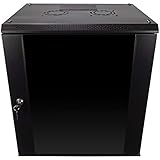
- DURABLE BUILD: Constructed from high-quality Cold Rolled Steel, the NavePoint Consumer Series 12U network cabinet boasts a sturdy, welded frame. Fitting EIA standard 19” networking equipment, this server cabinet confidently supports up to 110 lbs, providing a resilient base for your vital IT gear and equipment
- CONVENIENT DESIGN: This 12U cabinet features a reinforced, heat-treated, tempered glass front door with a security lock. Perfect for applications requiring both security and accessibility, its compact design of 17.72"L x 21.65"W x 24.42"H offers a practical solution for space-constrained settings.
- EASY & CUSTOMIZABLE EQUIPMENT SET UP - The 12U IT cabinet, with removable side panels and security locks, offers customization at its finest. Whether it's for an efficient device or cable management, this data cabinet ensures secure, adaptable configurations that suit your networking server requirements
- ENHANCED VENTILATION & SECURITY - Built-in fans and flow-through ventilation work to prevent overheating, ensuring optimal operation of your equipment. The reinforced, lockable tempered glass front door not only boosts security but also facilitates easy monitoring of installed equipment.
- SAFETY & COMPLIANCE - All NavePoint products are built to industry standards.
- Consider owned or colocated infrastructure for consistently utilized, latency-sensitive, specialized, or regulated workloads that need tighter control.
- Consider public cloud for bursty, variable, distributed, or short-lived workloads where rapid scaling is valuable.
- Consider more than one venue where an application has distinct components with different performance, location, or control requirements.
Uptime Institute’s 2024 survey found that 44% of respondents reported using on-premises private-cloud infrastructure. Its reporting describes organizations combining on-premises, colocation, and public cloud according to workload needs, rather than treating them as mutually exclusive. A hybrid model also has coordination costs: teams must manage networking, identity, observability, security policy, and recovery across environments.
What risks come with outsourcing?
Outsourcing changes who performs work and where dependencies sit; it does not remove risk. A provider can reduce your direct facility responsibilities while creating reliance on that provider’s operations, contracts, locations, and incident response.
- Provider outage exposure: Uptime Institute’s 2025 outage analysis says third-party IT and data-center providers accounted for about two-thirds of publicly reported outages it tracked over nine years. That describes the tracked public reports, not the probability that a particular provider will fail. The analysis also identifies power as the leading cause of impactful outages.
- Concentration and dependency: A critical service can depend on one provider, region, network path, or management plane. Map failure domains and decide whether an independent recovery path is necessary.
- Responsibility gaps: A service-level agreement is not the same as an end-to-end recovery guarantee. Spell out who detects incidents, restores data, communicates, and meets recovery time and recovery point objectives.
- Compliance and data location: Verify where data is stored and processed, which jurisdiction applies, what audit evidence is available, and whether the contract meets customer or regulatory requirements.
- Exit friction: Contracts, data transfer, proprietary services, and equipment logistics can complicate a move. Establish export, transition, deletion, and assistance terms before migrating.
Uptime Institute’s 2025 outage announcement cautions that outsourcing may reduce risk for some enterprises while major failures still occur. Treat provider resilience as one layer of your own continuity plan, not as the plan itself.
PC Slower Than It Used to Be?
A free scan shows the junk files, broken settings and background clutter dragging Windows down - then fixes them in one click.Free scan · Windows 10 & 11Outdated Drivers Are Slowing You Down
One free scan finds every outdated or missing driver and matches the right update for your exact hardware.Free scan · exact hardware matchHow to make the decision workload by workload
- Define the workload and its constraints. Record expected demand, growth range, latency needs, data location, isolation, specialized hardware, and contractual or regulatory obligations.
- Set service and recovery targets. Specify availability, recovery time, recovery point, geographic redundancy, and which failure scenarios matter. Assign an accountable party to every layer.
- Compare fully loaded costs. Model owned, colocated or hosted, and cloud options over the same period and at low, expected, and high utilization. Include power, network, labor, refresh, migration, financing, and exit.
- Check delivery time and capability. Compare the required go-live date with build lead time and provider capacity. Confirm that your team or provider can actually operate the chosen design.
- Review security, sovereignty, and contract terms. Validate jurisdiction, auditability, access, service boundaries, capacity commitments, price changes, renewal, data export, and termination rights.
- Choose a placement and revisit it when conditions change. Keep the decision tied to workload economics and requirements. Reassess when utilization, regulation, architecture, provider terms, or staffing changes materially.
Uptime Institute’s 2024 capacity survey publication reported that 64% of enterprise operators said they were growing data-center capacity. That finding is a reminder that the decision may concern where to add capacity—not whether to own any at all.
Quick Recap
Product prices and availability are accurate as of the date/time indicated and are subject to change. Any price and availability information displayed on Amazon at the time of purchase will apply.

