
Do these 3 things before closing this tab:
1Fix the driver behind crashes, sound loss and screen glitches2Clear out junk files and repair common Windows errors3Scan for outdated or missing drivers - takes under a minuteiTechGuides is reader-supported. When you buy through links on our site, we may earn an affiliate commission. As an Amazon Associate I earn from qualifying purchases. Learn more
A reliable shipping exception queue turns delivery problems into distinct, owned cases: define which events create a case, apply shipment-appropriate aging rules, suppress repeated webhook deliveries, and make ownership and resolution visible. Product documentation supports those workflow elements, but it does not establish a universal stale-shipment threshold or an atomic claim protocol. Those decisions need to be explicit in your own system.
What counts as a shipping exception?
A shipping exception is a shipment problem that needs attention, rather than simply any new tracking event. AfterShip describes exception handling as flagging shipments that encounter an in-transit problem, with examples including a failed delivery attempt, a customs hold, or a lost parcel. Its documentation describes three distinct intake routes: carrier-reported exceptions, custom rules such as shipment aging, and manual flags. AfterShip also provides a shared Exceptions workspace for handling flagged shipments. AfterShip’s exception-handling documentation
Keep these intake routes separate in your case data. A carrier-reported problem is evidence supplied by the carrier; an aging rule is your own policy applied to tracking history; and a manual flag records an operator’s judgment. In AfterShip, flagging a custom exception does not itself change the shipment’s tracking status. That distinction matters: shipment status describes what tracking reports, while case status describes whether your team still needs to act. AfterShip’s exception-management documentation
Give the case and the event separate identities
A case represents the ongoing work for a shipment problem. An incoming webhook event is one piece of evidence about that problem. A shipment can produce multiple legitimate events, and one event can be delivered more than once. Store event records and case records separately so a repeated delivery does not create another case or repeat an action.
#1 Best Overall
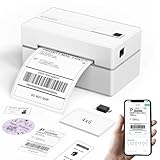
- Bluetooth Wireless Connection: KNAON Bluetooth shipping label printer enables wireless printing. For Mobile users, download the 'FlashLabel Pro' app from APP Store or Google Play for printing. Also, supports Windows and macOS, and can directly connect to the printer by downloading the 'FlashLabel Pro' App. Windows 7 or later computers can also print via Bluetooth by installing the latest advanced driver. Note: All devices CANNOT be connected directly to Bluetooth, and must be used through the 'FlashLabel Pro' app.
- USB Cable Connectivity: This printer ensures seamless USB connectivity with macOS, Windows (7 and above), ChromeOS, and Linux. KNAON printer features a built-in USB drive preloaded with drivers and tutorial videos for a fast and hassle-free setup. For ChromeOS, need to install 'FlashLabel' extension to your Google Chrome.
- Versatile DIY Labeling Options: KNAON Thermal Shipping Label Printer offers a vast selection of pre-designed templates, including 3,000+ templates, 5,000+ icons, and 100+ fonts available in the app. Designed for both professional and personal use, it supports various thermal paper sizes, ensuring effortless customization for all your labeling needs. Ideal for printing DIY shipping labels, barcode labels, thank-you labels, mailing labels, name tags, price tags, and various small thermal labels.
- Seamless Multi-Platform Compatibility: This Bluetooth shipping label printer works effortlessly with all major platforms, including Amazon, eBay, Shopify, USPS, UPS, Etsy, PayPal, Poshmark, DHL, and more, ensuring smooth and efficient label printing. (Note: Save the logistics label as a PDF file on the shipping platforms, then import it into the 'FlashLabel Pro' app for printing).
- Portable & Stylish Design: KNAON multi-function thermal label printer offers user-friendly operation in a compact design. Its perfect size (7.17 x 3.9 x 3.43 inches) makes it simple to store anywhere. With a fast printing speed of up to 180 mm/s and support for paper widths from 1.5 to 4.2 inches. The package also includes 10 test printing papers to get you started right away.
Preserve the source event ID when the sender supplies one. If it does not, define and document a composite identity using fields and business context that are stable for that carrier’s event model. There is no single composite key established for every carrier in the available documentation.
How long without a tracking update is too long?
There is no universal carrier standard in the cited product documentation. A stale threshold is a business rule: it should reflect the service level, shipment class, route expectations, and the cost of investigating too early or too late.
AfterShip gives examples of custom rules that flag a shipment with no movement for seven days or standard shipping that remains in transit for more than ten days. Its documentation says custom exception detection runs automatically every hour. These are examples of that product’s configurable behavior, not recommended thresholds for all shipments. AfterShip’s exception-management documentation
Make the trigger explainable
For each aging-based case, retain the last observed tracking update, the time or condition that triggered the exception, and the rule that applied. Configure thresholds by service level or shipment class where appropriate; a single timer can flag normal slow transit as readily as a genuine delay.
Rank #2

- Bluetooth Wireless Connection: KNAON Y41BT Bluetooth shipping label printer enables wireless printing. For iOS and Android users, need to download the 'FlashLabel Pro' App from Apple Store or Google Play. Windows 7 or later computers can also print via Bluetooth by installing the latest advanced driver. Mac users with M1/M2/M3/M4 processors can connect to the printer by downloading the 'FlashLabel Pro' App from Apple Store. Note: All devices CANNOT be connected directly to Bluetooth, and must be used through the 'FlashLabel Pro' app.
- USB Cable Connectivity: This printer ensures seamless USB connectivity with macOS, Windows (7 and above), ChromeOS, and Linux. KNAON printer features a built-in USB drive preloaded with drivers and tutorial videos for a fast and hassle-free setup. For ChromeOS, need to install 'FlashLabel' extension to your Google Chrome.
- Versatile DIY Labeling Options: KNAON Thermal Shipping Label Printer offers a vast selection of pre-designed templates, including 3,000+ templates, 5,000+ icons, and 100+ fonts available in the app. Designed for both professional and personal use, it supports various thermal paper sizes, ensuring effortless customization for all your labeling needs. Ideal for printing DIY shipping labels, barcode labels, thank-you labels, mailing labels, name tags, price tags, and various small thermal labels.
- Seamless Multi-Platform Compatibility: This Bluetooth shipping label printer works effortlessly with all major platforms, including Amazon, eBay, Shopify, USPS, UPS, Etsy, PayPal, Poshmark, DHL, and more, ensuring smooth and efficient label printing. (Note: Save the logistics label as a PDF file on the shipping platforms, then import it into the 'FlashLabel Pro' app for printing).
- Portable & Stylish Design: KNAON multi-function thermal label printer offers user-friendly operation in a compact design. Its perfect size (7.2 x 3.15 x 2.65 inches) makes it simple to store anywhere. With a fast printing speed of up to 180 mm/s and supports paper widths from 1.38 to 4.41 inches. The package also includes 20 test printing papers to get you started right away.
Hourly rule evaluation also means a rule may be detected after its threshold is crossed, rather than at the exact instant it is crossed. Show the trigger time and last-update time distinctly so an operator can tell how long the shipment has been stale and when the system identified it.
How do you stop duplicate shipment events creating duplicate cases?
Webhook senders may retry delivery, so receiving the same event again should not be treated as proof of a new shipment problem. Ship.com’s tracking-webhook documentation says retries resend the same event and directs integrators to use EventId for deduplication. It also describes a particular event scope: label-purchase events, not later in-transit scans. Do not assume that scope covers every tracking event from every provider. Ship.com tracking-webhook documentation
- Persist the sender’s event identity. Store the source event ID alongside the original payload or the fields needed to reconstruct its context.
- Enforce uniqueness durably. Make duplicate detection part of the persistent write path, so simultaneous retries cannot both create separate records or trigger the same downstream action.
- Separate event suppression from case matching. A new, legitimate event for the same shipment may belong in the existing case history; only a repeated delivery of the same event should be suppressed as a duplicate.
- Make downstream actions idempotent. Avoid sending the same alert, initiating the same refund workflow, or repeating another side effect just because an event delivery was retried.
Broker-level deduplication is useful but not sufficient as permanent case identity. Amazon SQS FIFO tracks a MessageDeduplicationId within a five-minute deduplication window. A repeat outside that window can fall beyond that particular guard, so keep durable event identity and case matching in your application as well. AWS documentation on SQS FIFO deduplication
Recommended Free Tools
Delivery semantics also affect recovery. SAP Commerce Cloud version 2211 documents at-least-once webhook delivery, meaning a destination can receive duplicates, and assigns duplicate-event handling to the destination. It also documents dead-letter handling for messages that cannot be delivered. The exact behavior depends on version and deployment configuration; a robust queue should track failed processing and provide a recovery path rather than silently dropping events. SAP Commerce Cloud 2211 webhook documentation
Rank #3

- Go Wireless by Bluetooth: Download the "NELKO"app to print via Bluetooth on your Nelko Bluetooth thermal label printer for iOS and Android. Printing shipping labels has never been easier. Windows 7 or later computers can also print via Bluetooth. For Mac users with M1 or M2 CPUs, install the app and connect to the printer via Bluetooth. Note: All devices cannot be directly connected to Bluetooth and need to be used through the app
- Print via USB: For Windows (7 and later), Mac OS,Chrome OS, you can connect the desktop label printer via USB cable. Note that Mac OS only works with USB connection, you can not print via Bluetooth
- Good Helper for Cost Saving: Advanced thermal direct technology is adopted to achieve the printing speed of 150 mm/s, up to 72 sheets 4x6 labels/min. High speed brings high efficiency and helps your business grow faster! 203 DPI makes printing clearer. No ink, no toner, only thermal labels needed. Both fanfold labels and roll labels could be used. Label size: labels width ranges from 1.54" to 4.1"(40-104 mm), such as 4x6, 3x2, 3x1, 2x1 thermal labels and so on
- Strong Platform Compatibility: This bluetooth shipping label printer can work with virtually all platforms, including Amazon, Ebay, Shopify, USPS, UPS, Esty, PayPal, Poshmark,etc.(Note: Please remember to save the logistics label as a PDF on the logistics platform, then upload it to the editor APP "NELKO" for printing
- Suitable for Commercial and Home Use: Printer driver, instruction videos and problem shooting videos are provided in U-Disk for better setting. Nelko PL70E label printer is much smaller than traditional printers and only requires a small piece of space to achieve printing. Very suitable for printing shipping labels, mailing labels, price labels, barcode labels, name tags and all kinds of small category labels
What should an operator see before taking ownership?
Show enough context to decide whether the case is actionable without making the operator reconstruct the shipment history elsewhere. A useful queue row exposes the shipment identity, current tracking status, exception reason, age, and current owner or unclaimed state. The source documentation supports several of these fields: ShipStation’s schema includes a tracking number, status code, exception status, and optional carrier exception description. AfterShip’s task details include carrier, exception type, and event reason code, and its interface can display a primary exception with an additional-exception count. ShipStation tracking schema AfterShip’s exception-handling documentation
- Shipment: tracking number and carrier.
- Problem: current status, primary exception, carrier description when available, and reason code when provided.
- Timing: last tracking update, time the exception rule triggered, and elapsed age.
- Work state: unclaimed or assigned owner, plus the case’s current status.
- History: relevant events and operator actions, so the next person can understand what has already happened.
Keep the original carrier wording and event context available even if the queue also displays a normalized reason. A short category helps sorting; the underlying evidence helps operators judge ambiguous or misclassified exceptions.
Independent reader supportYour contribution helps us test, update, and keep practical guides available for everyone.How should an operator claim a case?
The cited product documentation establishes shared exception queues and task views, but it does not establish the atomic locking or claim behavior of a queue. Treat claiming as an implementation requirement, not as a feature you can assume from the existence of a shared workspace.
Choose and enforce a concurrency rule
If a case must have only one active owner, the storage operation that claims it should be atomic: when two operators claim the same unowned case at nearly the same time, exactly one operation succeeds and the other sees that the case is already assigned. A visual refresh or a “Claim” button alone cannot guarantee that outcome when requests race.
Rank #4

- [HIGH TECH LABEL PRINTER] Equipped with a Japanese high tech thermal print head, 203 DPI high printing quality. No ink, No toner, Clean with no mess, economical. Works with both fanfold labels and roll labels. Label size: labels width ranges from 1.57" to 4.1"
- [PRINT WIRELESSLY]The label printer support printing wirelessly. For windows 8 or later and Mac, you can print via Bluetooth. For Android& iOS, you can’t print via Bluetooth on phone, need to download the App "Jadens printer" and print on it.
- [PRINT VIA USB] USB connection works with both Windows (7 and newer) and Mac OS (10.9 and newer) devices. Please long and press the feed button to identify and calibrate label size each time you change labels.
- [WIDE USAGE] JADENS thermal label printer is widely used to print labels from various marketplaces and shipping platforms, such as Endicia, Dazzle, ShipStation, Shipping Easy, Shippo, ShipWorks, Ordoro, eBay, Amazon, Easy, and Shopify. Use JADENS thermal label maker machine to print shipping labels, warehouse labels, market labels, helping increase your productivity. Ideal for your online small business for shipping packages.
- [EASY TO SET UP & RELIABLE AFTER-SALE SERVICE] Set up in one minute. Printer driver, instruction videos and problem shooting videos are provided in U-Disk for better understanding. Offer one year warranty; customer support can be reached out to email, phone, remote control.
Record the owner and claim timestamp, then decide and document what happens when a claim expires, when an operator releases it, and how a supervisor reassigns it. If your workflow permits multiple people to work a case, represent that explicitly rather than presenting a misleading single-owner claim state. These are design choices; the available documentation does not specify a universal claim protocol.
When should a shipping exception case close?
Define closure as a business condition, not simply the arrival of any later tracking event. Specify which signals resolve the case and whether a later event can reopen it. Keep the event and operator-action history so the decision remains explainable, and keep case status distinct from shipment status.
AfterShip documents one example: a custom exception can resolve automatically when the shipment is delivered or no longer matches the custom exception criteria. A task containing multiple shipments closes when all of those shipments are resolved. This is product behavior, not a universal closure rule; choose conditions that fit your own workflow. AfterShip’s exception-management documentation
What’s actually slowing this PC down?
Pick the symptom - the matching free tool is one click away.
Quick Recap
Implementation checklist
- Define carrier-reported, aging-rule, and manual intake criteria separately.
- Store shipment cases separately from incoming event records.
- Use a stable event ID where the sender supplies one, and document any carrier-specific fallback identity.
- Apply aging rules by relevant shipment class, and retain the trigger and last-update context.
- Deduplicate persistently; do not rely on a broker’s limited window as permanent uniqueness.
- Show operators shipment identity, status, reason, age, and ownership state before they claim work.
- Specify atomicity, expiry, release, and reassignment behavior for claims.
- Define resolution and reopening conditions, and retain an auditable case history.
- Track failed event processing and provide a deliberate recovery path.
Product prices and availability are accurate as of the date/time indicated and are subject to change. Any price and availability information displayed on Amazon at the time of purchase will apply.

