
iTechGuides is reader-supported. When you buy through links on our site, we may earn an affiliate commission. As an Amazon Associate I earn from qualifying purchases. Learn more
Sea walls, living shorelines, and managed retreat reduce coastal risk in fundamentally different ways: a wall protects a place with a built barrier, a living shoreline stabilizes a suitable shore with natural or hybrid features, and retreat or avoidance reduces exposure by moving development—or keeping it—out of harm’s way. None is universally best. The choice depends on local wave energy and flood exposure, ecological effects, future conditions, available land, and the full cost and time horizon of the project.
How the three strategies compare
NOAA and Washington Sea Grant describe a range of coastal risk-reduction approaches. The comparison below is qualitative: it helps frame decisions, but it cannot predict how a measure will perform at a particular property.
| Approach | How it reduces risk | Where it may fit | Main trade-off to assess |
| Sea wall or other hard defense | Uses a built structure to stabilize a shoreline or shield specific land and assets. | Developed shorelines where a designed structure is considered appropriate for local exposure and the assets at risk. | Local protection can come with effects on sediment movement, beaches, wetlands, or habitat migration; construction, maintenance, repair, and eventual replacement matter. |
| Living shoreline | Uses vegetation and other natural or hybrid features to stabilize a shore and dissipate waves. | Often sheltered estuarine coasts, bays, and tributaries; suitability depends on site conditions. | Design and performance are site-specific. It is not a standard product for every shoreline, especially exposed open-ocean beaches. |
| Managed retreat or avoidance | Reduces exposure by relocating development, infrastructure, or people, or by avoiding new development in hazard areas. | Places where assets can be moved or new exposure can be prevented, with suitable planning and receiving land. | It requires difficult land-use and community choices, and can involve acquisition, relocation, infrastructure changes, and compensation. |
When does a sea wall make sense?
A sea wall, bulkhead, revetment, or similar armoring structure may protect developed land or a particular asset and may reduce erosion at that location when appropriately designed. These structures differ in form and performance; the label “hard defense” does not establish how a specific design will perform under local conditions.
What’s actually slowing this PC down?
Pick the symptom - the matching free tool is one click away.
The protection is spatially focused. NOAA warns that armoring can alter sediment movement and restrict the natural processes that maintain beaches and wetlands. It can also prevent those shorelines from migrating inland as erosion or rising water levels change the coast. A proposal should therefore consider not only the protected parcel but also potential effects on neighboring shorelines and habitat.
#1 Best Overall

- 6 FT SLIDING DOOR BARRIERS: Use as protection for sliding doors, french doors, and similar at risk areas; Fresh water activated barriers offer easy protection against flooding and leaks in 5-10 min
- NO SAND REQUIRED: Evenly filled with water absorbing Sand Gel that stays in place; No sand, shovels, or heavy lifting required; Foldable and lightweight before deployment for compact storage
- 2 PACK: Measures 72 L x 5 W and expands up to 3 H inches; Great for absorbing and diverting water in front of sliding doors or around leaking appliances; Buy multiple for more coverage
- HEAVY-DUTY: Thick puncture-resistant fabric is built to last unlike traditional sandbags that rip and leak; Sand Gel filler solidifies once set to resist leaking for dependable performance
- EASY TO USE: Lay in the path of slow moving water to activate or pre-soak in a bucket to prep for fast moving water; Avoid contact with chlorine or salt water which can prevent activation or deactivate the gel; Packaging may vary
NOAA’s guidance puts the principle plainly: “The key to shoreline stabilization, if it is required, is to use a site-specific stabilization method that balances the needs of the public and the needs of the natural system.” A wall is not a substitute for assessing what it protects, what it changes, and how long the design is expected to remain useful.
Can a living shoreline protect property from flooding?
A living shoreline is a protected and stabilized shoreline made with natural materials such as plants, sand, or rock. Depending on the location, a design may combine native vegetation with low sills, oyster reefs, anchored wood, or other harder elements. It is a family of site-specific designs, not one standardized product.
NOAA identifies possible benefits that include erosion reduction, wave buffering, floodwater storage, habitat, water quality, and support for fisheries. These are potential functions, not guarantees for every project or storm. NOAA Ocean Service gives an illustrative figure that 15 feet of marsh can absorb 50% of incoming wave energy; it should not be treated as a performance promise for a particular marsh, property, or storm.
Rank #2

- No Sand Filling Required: Forget the hassle of traditional sandbags! This water-activated flood barrier only needs to be soaked in water—no messy sand required. It's lightweight, portable, and a smart, time-saving alternative to standard sandbags
- Quick Activation in 10 Minutes: In about 10 minutes, sandless sand bags expand up to 3.5 ~ 4 inches high after soaking. It's a fast and efficient way to prepare for incoming rain or floods—perfect for when every second counts during storm season
- Friendly to Earth & Durable: Made from durable canvas with reinforced stitching, this water barriers are filled with high-absorption polymer resin. When exposed to water, the resin turns into a pressure-resistant gel that's soft yet strong—won't burst under stress. It's friendly to earth, non-toxic, and safe to use. Note: A light powder may be present before use, and a slight gel residue may appear after soaking—both are normal
- 5-foot Multi-Pack Set: Each set includes 4 water-absorbing hurricane preparedness items flood barriers, each measuring 5 feet long and 8 inches wide when expanded. Ideal for covering larger areas or protecting multiple entry points quickly and easily.
- Versatile Flood Protection: These reusable hurricane supplies flood barriers are perfect for protecting doorways, windows, fences, gates, basement entries, garage doors, sewer drains, elevator lobbies, and more. Whether you're preparing for heavy rain, flash floods, or high winds, these barriers provide reliable protection when you need it most
Living shorelines are most commonly used on sheltered estuarine coasts, bays, and tributaries, and are not typically used on open-ocean beaches. NOAA lists several factors that influence site screening and design:
- Erosion rate and bank elevation.
- Wave energy and prevailing wind and wave conditions.
- Existing vegetation and soil.
- Neighboring shoreline conditions and drainage.
Some installations use native plantings, organic fiber mats or bio-logs, and oyster reefs or living breakwaters. Those materials are project components that professionals may specify; their presence alone does not make a design suitable for a site.
What does managed retreat mean for coastal communities?
Managed retreat is a land-use and relocation strategy, not a structure built along the water. It reduces risk by moving vulnerable development, infrastructure, or people away from hazards, or by avoiding new development in places where risk is expected to increase. Its mechanism is to reduce the presence of exposed assets rather than hold the shoreline in place.
Rank #3
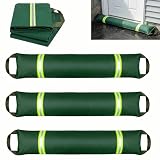
- Water Barriers for Flooding: Each 3FT x 9.84in Sand bags (3-pack) activates in water, non-woven fabric & SAP, swells to 3.5" height in 10 min. Rapidly protect doorways, Garages, Basements, and more from storm water & leaks
- Reliable Flood Barriers for Home: Garage water barrier Features easy-grip handles on both ends for simple placement, Reinforced edges for durability, and reflective strips for nighttime visibility. Provides reliable home protection
- Sandless Sand Bags for Flooding: No heavy sand, No messy filling. These water dam barrier store in minimal space. Just add water for instant deployment. A lightweight, Reusable alternative for emergency flood control
- Water Barrier with Safety Notice: Flood Barrier for Door do not use in saltwater, lime, or high-calcium water, as it will damage the internal material. The internal gel becomes extremely slippery after absorbing water—handle with caution
- Water activated flood barrier: Flood Bags Ideal for containing garden, patio, pool, hurricane-season rainwater flooding, construction sites, or directing water flow
Retreat can be planned over time and may create room for wetlands or beaches to migrate inland if land-use decisions allow it. Avoidance can also mean preventing new exposure before buildings and infrastructure are established. NOAA recommends considering where managed retreat may be the best long-term response as part of comprehensive coastal planning. Washington Sea Grant’s 2022 assessment describes retreat and avoidance as ways to reduce erosion and flood risk over time, while noting political hurdles and costs.
Free tools Windows power users keep installed
One-click scans. No signup required.
For a community, the difficult questions are practical as well as technical: which properties or infrastructure are exposed, who makes relocation decisions, where people or services can go, how land is acquired or compensated, and how roads or utilities change. The specific policies and options depend on the jurisdiction; a general comparison cannot determine local eligibility or process.
How should the time horizon and future conditions affect the choice?
A measure that lowers risk now may not provide the same protection as water levels and flood hazards change. NOAA’s coastal planning guidance asks communities to clarify whether their goal is to “prevent any coastal flooding,” “live with some,” or allow flooding while adapting land use, engineering, and behavior. These are planning choices about acceptable risk and adaptation, not a recommendation to leave people exposed to unmanaged harm.
Rank #4

- 3 FT DOORWAY BARRIERS: Use as protection for entryway doors and similar at risk areas; Fresh water activated barriers offer easy protection against flooding and leaks in 5-10 min
- NO SAND REQUIRED: Evenly filled with water absorbing Sand Gel that stays in place; No sand, shovels, or heavy lifting required; Foldable and lightweight before deployment for compact storage
- 2 PACK: Measures 36 L x 5 W and expands up to 3 H inches; Great for absorbing and diverting water in front of entryway doors or around leaking appliances; Buy multiple for more coverage
- HEAVY-DUTY: Thick puncture-resistant fabric is built to last unlike traditional sandbags that rip and leak; Sand Gel filler solidifies once set to resist leaking for dependable performance
- EASY TO USE: Lay in the path of slow moving water to activate or pre-soak in a bucket to prep for fast moving water; Avoid contact with chlorine or salt water which can prevent activation or deactivate the gel; Packaging may vary
Set an explicit planning horizon and compare the expected service of each option with the hazards over that period. For hard defenses, account for the possibility that effectiveness may be limited as sea level rises and flooding becomes more severe or frequent. For living shorelines, evaluate the site conditions and design needed to maintain the shoreline’s intended functions. For retreat or avoidance, consider how quickly exposure can be reduced and whether land-use decisions enable a durable change.
NOAA Ocean Service also states that 33% of U.S. shorelines will be hardened by 2100. That is NOAA’s projection, not a measurement of the current share; the page is undated and was last updated in 2026. It illustrates the scale of potential hardening described by NOAA, not the likely outcome for a particular coast.
How to compare costs without mistaking one project for a rule
There is no general cost figure that establishes a universal winner among walls, living shorelines, and retreat. Compare a project over its life rather than looking only at its initial construction price.
Best Value

- Effective Flood Barrier: This set includes 4 pcs of 48''x9.8''x6.7'' flood barrier bags, each capable of holding 0.47m³ of water. When filled, they form a sturdy heavy-duty barrier, effectively blocking, separating, and controlling floodwaters to protect homes, garages, basements.
- Easy to Use: Simply fill the water barriers for flooding by opening the valve, inserting a hose, filling with water, and then closing the valve for immediate use. The operation is simple and convenient.
- Durable Construction: Made from high-strength PVC tarpaulin, the flood barriers are robust and durable. Even when filled with water, they are resistant to tearing. Equipped with fixing clips, they can be secured in place with heavy objects to prevent sliding, providing a strong defense against flooding.
- Portable and Easy to Store: Weighing only 8.8 lbs, the flood barriers for home are lightweight and portable, folding neatly into storage cabinets without taking up space. Before storing, ensure they are thoroughly dried. When using, keep them away from sharp objects and store them in a cool, dry place.
- Versatile Flood Protection: Suitable for various flood-prone areas such as doorways, fences, gates, parking lots, garden gates, garage entrances, basements, and more, these flood water barrier are a powerful defense against heavy rainfall.
- Hard defense: include construction, maintenance, repair, and eventual replacement.
- Living shoreline: include initial construction and upkeep, and assess ecological co-benefits and potentially avoided repair or replacement costs.
- Retreat or avoidance: include acquisition, relocation, infrastructure changes, and compensation, alongside potential avoided future losses.
A 2021 Camp Wilkes analysis from the Mississippi-Alabama Sea Grant Consortium, hosted by NOAA, found that its living shoreline option was more economically efficient over 60 years than repeatedly replacing a bulkhead under the study’s assumptions. In that specific analysis, the living shoreline could remain more efficient even if its initial cost were 3.25 times the bulkhead’s initial cost. The report attributed much of the benefit to avoided bulkhead maintenance and repair. This was a small, site-specific case study, not a typical price, a general cost threshold, or proof that living shorelines cost less everywhere.
Washington Sea Grant’s 2022 report qualitatively assesses costs, effectiveness, and social and ecological implications for hard defenses, soft shore stabilization, accommodation, and retreat or avoidance in Washington. It is a regional framework for weighing trade-offs, not a national cost schedule.
A practical decision sequence
- Define what is at risk. Identify the exposed homes, infrastructure, land, and public uses, and specify whether the priority is reducing erosion, flooding, or both.
- Describe the site and its hazards. Assess wave energy, erosion, bank elevation, tides, slope, soils, vegetation, drainage, neighboring shorelines, and expected future water levels. NOAA’s living-shoreline screening factors are especially relevant when considering a natural or hybrid design.
- Establish the acceptable risk and time horizon. Decide what level of flooding or shoreline change can be tolerated, for how long, and how the plan will respond if hazard severity or frequency increases.
- Compare options across the affected area. Consider local asset protection, off-site effects, ecological functions, the possibility of shoreline migration, available land, and whether retreat or avoidance is feasible.
- Compare lifecycle costs and implementation barriers. Include maintenance and replacement where relevant; for relocation, account for acquisition, compensation, and infrastructure changes. Identify community, political, legal, and funding constraints.
- Complete site design and approvals. NOAA’s implementation outline for living shorelines includes site analysis and design, permit and legal compliance, preparation, and installation. Requirements vary by location, so confirm the applicable local and state rules before selecting or building a project.
This framework is not engineering advice for an individual parcel, a permit determination, or a forecast of future flood levels. Project design and local rules require site-specific assessment.
Recommended Free Tools
Quick Recap
Product prices and availability are accurate as of the date/time indicated and are subject to change. Any price and availability information displayed on Amazon at the time of purchase will apply.

