
Free tools Windows power users keep installed
One-click scans. No signup required.
iTechGuides is reader-supported. When you buy through links on our site, we may earn an affiliate commission. As an Amazon Associate I earn from qualifying purchases. Learn more
A projector screen is not strictly required. A smooth, matte, light-colored wall can be a workable surface for casual viewing. For a deliberate home theater, though, a dedicated screen is usually the more dependable choice, because it gives you a flat, uniform surface sized and matched to your projector. Whether the upgrade is worth it depends on four things: how much light reaches the wall, the projector’s throw type, where people sit, and how large the image needs to be. A wall is not automatically equivalent to a screen, and a screen is not automatically an improvement if it does not suit the projector or the room.
When an existing wall is enough
XGIMI’s screen-buying guidance states that “a wall can work for casual viewing if it is smooth, matte, and white.” Samsung UK answers the same question with “No, it’s not always necessary to have a screen,” and notes that its projectors can be used on a smooth, light-colored wall. Both statements are conditional. They describe what kind of wall can work, not what every painted wall will deliver.
Before you rely on a wall, check these conditions:
- Texture: Heavy textured plaster, brick, or stippled paint scatters light and makes the picture look grainy.
- Sheen: Glossy or eggshell finishes produce hot spots and reflections. Flat or matte paint is the safer choice.
- Color: Off-white, beige, or tinted walls change the colors you see on screen. Pure, neutral white is the usual reference.
- Blemishes and joins: Patches, seams between drywall sheets, outlets, and light switches show through the image.
- Shape: An alcove, a sloped ceiling line, or a wall broken by windows limits the image size and placement you can achieve.
If the wall fails one or more of these checks, a wall-mounted dedicated screen or a repainted, properly prepared wall are the practical alternatives.
Quick wins for a faster PC:
Clear out junk files and repair common Windows errorsFree Scan →Scan for outdated or missing drivers - takes under a minuteDriver Scan →Repair Windows errors before they cause bigger problemsFix Now →What a dedicated screen changes
A dedicated screen is a purpose-made projection surface. Its main advantage is uniformity. Fixed-frame models are stretched flat, which reduces ripple and unevenness across the image. Surface texture also matters more with ultra-short-throw (UST) projectors, which project at a steep angle, so small imperfections in a wall can become visible in a way they might not be with a standard long-throw setup. The screen itself does not improve the light in the room; it gives you a consistent surface for the light the projector already produces.
#1 Best Overall

- Wall Mounted Fixed Frame Projection Screen (Overall Size 63.625" Tall x 109.25" Wide) (Viewing Area 120" Diagonal x 58.875" Tall x 104.5" Wide) No option for Legs or Stands with this product. Recommended for projectors with Native 16:9 Resolution
- 1.1 Gain White screen surface with an exceptionally wide viewing angle at 160 degrees with no resolution loss at any viewing angle. Works great with Long, Short and Ultra Short Throw projectors. The standard white material is not acoustically transparent.
- 2 3/8" heavy duty beveled aluminum frame wrapped in light-absorbing black velvet material for a beautifully crisp viewing image; Enjoy beautiful movies, pictures, and games in FULL HD, 4K / 8K and Active 3D
- Quick and easy assembly with tensioning rod system ensures that you can bring cinema-quality entertainment to your home in just a few minutes. Secure top and bottom mounting brackets that allow horizontal adjustment
- Before purchasing, project an image on wall to determine the size works for the projector and watch the step by step instructional video listed.
Ambient light is the variable that matters most
Legrand AV, which publishes the Da-Lite screen brand, explains the core problem in its ALR FAQ: “Ambient light that falls on a standard projection screen will compete with light from the projector and wash out image contrast, color saturation and dynamic range.” A screen does not remove room light. For that reason, controlling the light is often the first step, and a specialized screen comes second.
Practical light control includes closing or blacking out windows, using dimmable or directional lighting, and choosing paint with a low sheen on walls near the screen. Assess the light during the hours you actually watch. A room that is dark at night but bright on weekend afternoons needs a different answer from a room that is always dark.
Gain
Gain describes how much light a screen reflects toward the viewer compared with a reference surface. Legrand AV defines gain relative to a magnesium-oxide or magnesium-carbonate reference board. A 1.5-gain screen, by its definition, reflects 50% more light than that board, and a 0.8-gain screen reflects 80% of it. ProjectorCentral’s 2026 buying guide gives a center-seat example: a 1.3-gain screen reflects about 1.3 times the incoming brightness toward a viewer sitting in the center. Gain does not raise brightness equally for every seat. Higher gain generally narrows the comfortable viewing angle, so viewers far off to the side may see a dimmer or shifted image.
Recommended Free Tools
Rank #2
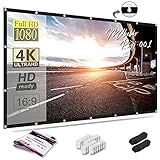
- CONVENIENT TO STORAGE AND CARRY : Compact one-piece,lightweight and folding design. You can fold the projector screen in small size and put it in your backpack or suitcase
- WIDE APPLICATION : Ideal choice for home theater movie,office,education, conference room presentation, public display, outdoor movie and more
- ANTI-CREASE AND HIGH ABSORBANCE MATERIAL : Made with natural Polyester fabric that The projection is sharper and brighter than most other projection screens, The Projector screen are thicken and smooth, no wrinkle when folded / crushed.
- EASY TO SET UP : The Projector Screen can be fastened easily with hooks, ropes, bracket, nails, double side tape on the wall/mount.
- 120 Inch Viewing Screen :Features 16:9 aspect ratio with a 120 inch diagonal, offering an expansive 104" x 58" viewing area
ALR screens
Ambient-light-rejecting (ALR) screens are designed for rooms where unwanted light cannot be eliminated. Legrand AV describes two broad families. Contrast-based designs block up to 80% of ambient light, according to the manufacturer’s description. True-optical designs can reject up to 99% of ambient light, but only from specific angles. Legrand AV’s criterion for calling a product a “true ALR screen” is at least 80% ambient-light rejection; this is the publisher’s stated threshold, not a universal industry standard.
ALR is situational. XGIMI advises that it is generally unnecessary in a fully dark, dedicated room, where a matte white or standard gray surface is usually sufficient. ALR is worth considering when light comes from a fixed direction you cannot remove, such as a window opposite the screen. The optical design should match the direction of that light and the projector’s throw, and ALR surfaces often have narrower preferred viewing angles.
UST-specific ALR
UST projectors need a screen whose material is designed for their steep projection geometry. A UST-specific ALR surface is built differently from a conventional long-throw ALR screen. Buying a long-throw ALR screen for a UST projector can produce poor results, so confirm the exact projector and screen match with the manufacturer before purchase.
Rank #3

- UNWAVERING STABILITY & REINFORCED BASE:Say goodbye to wobbly screens. This projector screen features an extended and reinforced base with a strong support frame, effectively solving the instability issues common in traditional stands. The premium steel accessories ensure long-term durability, resisting bending or breaking even with frequent use.
- WINDPROOF ACCESSORIES FOR OUTDOOR USE: Built for the outdoors. Beyond the reinforced base, this outdoor projector screen with stand includes a complete windproof kit: 4 ground stakes, 2 ropes, and 2 sandbags. Whether you're camping, hosting a backyard movie night, or tailgating, these accessories maximize stability so your screen won't sway or collapse in the wind.
- CINEMA-GRADE 4K HD VISUALS: Immerse yourself in stunning picture quality. Projector screen with premium washable milk silk fabric delivers vibrant 4K HD visuals with a high color reproduction rate. The integrated installation ensures the screen fits perfectly to the frame, eliminating wrinkles even at the edges for a seamless viewing experience.
- 160° ULTRA-WIDE VIEWING ANGLE: Enjoy the view from anywhere. With a 160° ultra-wide viewing angle, this projector screen outdoor offers a crisp, bright picture from both sides—front and back. Perfect for indoor living rooms or outdoor backyards, bringing the theater experience to your home.
- PORTABLE & EASY TO CARRY: Take the projector screen anywhere. This portable projector screen comes with a dedicated storage bag for easy transport, making it ideal for outdoor camping, road trips, and gatherings. It folds flat for compact storage and stays ready for your next screening.
Size and viewing distance
Epson Europe offers the following examples. The page does not state a publication year, so treat these as the manufacturer’s illustrative figures rather than universal sizing rules.
| Room type | Image diagonal | Viewing distance |
|---|---|---|
| Small living room | 50–100 inches | 1.5–3 m |
| Medium room | 100–150 inches | 3–5 m |
| Large home theater | 150–300 inches | 5–10 m |
Epson also presents a rule of thumb that the image should fill roughly 30% to 50% of the viewer’s field of view. For short-throw projectors, Epson describes a typical placement of around 1 to 2 m from the screen. Those are general descriptions; use the calculator or throw specification for your exact projector model, because throw distance and maximum image size vary considerably between models.
Brightness targets
Samsung UK’s 2026 guidance recommends 1,500 to 2,500 lumens in a controllable home-theater environment, and 3,000 lumens or more where large windows affect the viewing space. These are manufacturer guide recommendations, not a guaranteed image brightness. Larger screens spread the same light over more area, so the brightness you need rises with image size and with any ambient light you cannot remove.
Rank #4

- IMPORTANT: The VIVOHOME manual projector screen provides a 80-inch diagonal display area (70W×40H in, 16:9) for the best viewing experience at 7.2 ft; Its overall size is 75W×48H in, so please ensure your room allows enough space for easy installation
- SMOOTH MANUAL PULL & LOCKING: Manual retractable design with self-locking mechanism easily holds the screen at any height; Its smooth operation and secure positioning provide long-lasting reliability, making it suitable for both indoor and outdoor use
- EASY SETUP & PORTABLE: Tired of complex assembly with tiny parts? Mount our screen to the wall or ceiling, and you're done; Roll-up design for effortless storage and carrying; Ideal for home theater, meeting room, classroom, gaming room, and karaoke space (Screws/ L-Bracket not included)
- HIGH-DEFINITION VIEWING: This movie screen supports 3D, 1080P, 4K, 8K, and Full HD images; Matte white surface with 160° viewing angle delivers bright, uniform images while minimizing glare and ambient light for an immersive theater experience
- DURABLE MATERIAL: Metal casing protects the screen from deformation during transport; 3-layer water-proof PVC fabric resists creases and changes in temperature or humidity; Wipe-clean and flat surface ensures long-lasting professional-quality display
For a dark viewing room, ProjectorCentral’s 2026 buying guide cites an SMPTE target of 16 to 22 foot-lamberts for a dark theater. ProjectorCentral notes that home viewers may prefer brighter images. This is a reference target, not a requirement for your screen.
Independent reader supportYour contribution helps us test, update, and keep practical guides available for everyone.Choosing a surface and format
Surface and format are separate decisions. The table below summarizes the common surfaces and the conditions where each one fits.
Do these 3 things before closing this tab:
1Repair Windows errors before they cause bigger problems2Fix the driver behind crashes, sound loss and screen glitches3Clear out junk files and repair common Windows errors| Surface | Best fit | Main trade-off |
|---|---|---|
| Smooth matte white wall | Casual viewing in a light-controlled room | Texture, sheen, and color variation are not controlled; not stated as tested for a given wall |
| Matte white screen | Starting point for a light-controlled dedicated room, per XGIMI’s guide | Does not add contrast in rooms with unwanted light |
| Gray or contrast-enhancing screen | Rooms with some ambient light | Reduced white brightness, per Legrand AV and XGIMI |
| ALR screen | Light from a fixed direction that cannot be controlled | Narrower preferred viewing angles; the design must match light direction and throw |
| UST-specific ALR screen | Compatible UST projector with unavoidable ambient light | Specialized and only suitable for matched UST setups |
Fixed frame
A fixed-frame screen suits a dedicated room where a permanently visible screen is acceptable. It is held flat, which helps uniformity, but it occupies wall space all the time.
Best Value
- Wall Mounted Fixed Frame Projection Screen (Overall Size 78.25" Tall x 135.5" Wide) (Viewing Area 150" Diagonal x 73.5" Tall x 130.75" Wide) No option for Legs or Stands with this product. Recommended for projectors with Native 16:9 Resolution
- 1.1 Gain White screen surface with an exceptionally wide viewing angle at 160 degrees with no resolution loss at any viewing angle. Works great with Long, Short and Ultra Short Throw projectors.
- 2 3/8" heavy duty beveled aluminum frame wrapped in light-absorbing black velvet material for a beautifully crisp viewing image; Enjoy beautiful movies, pictures, and games in FULL HD, 4K / 8K and Active 3D
- Quick and easy assembly with tensioning rod system ensures that you can bring cinema-quality entertainment to your home in just a few minutes. Secure top and bottom mounting brackets that allow horizontal adjustment
- Before purchasing, project an image on wall to determine the size works for the projector and watch the step by step instructional video listed.
Retractable
Electric or manual retractable screens suit shared rooms where the screen should disappear when not in use. Check that the case can be installed without interfering with ceiling or wall fixtures.
Portable
Portable screens suit temporary setups, rentals, or viewing in different rooms. Their flatness depends on the frame and how they are set up, so check stability before relying on them for critical viewing.
Decision checklist
- Decide whether you want casual wall projection or a deliberate theater setup.
- Inspect the wall for texture, sheen, color, blemishes, and shape.
- Identify the projector type and throw ratio before choosing any ALR or UST-specific surface.
- Measure ambient light during the hours you actually watch, and control it before buying specialized material.
- Measure the room, seating distance, image size, and projector position; use the manufacturer’s calculator for your model.
- Choose a format: fixed, retractable, or portable.
- Compare gain and viewing-angle specifications together, especially if viewers sit across a wide area.
What the available evidence does not settle
The guidance above rests on manufacturer documentation and specialist buying guides, not on an independent controlled test that compares a wall with a screen in one specific room. No published study establishes how a particular paint or wall compares with a particular screen across all projectors, budgets, and layouts. Most of the figures cited here are the publishers’ own examples or recommendations, and several pages do not state a publication year. Before buying, confirm the specifications for your exact projector and screen model against the current manufacturer documentation.
Specific screen models are not recommended here, since the right choice depends on projector model, throw distance, target size, room light, seating layout, installation preference, and budget.
If you are shopping, the search term “home theater projector screen” covers fixed-frame, retractable, and portable options. A “UST ALR projector screen” is a narrower category that is only relevant if you own a compatible UST projector and have an ambient-light problem to solve.
Quick Recap
Product prices and availability are accurate as of the date/time indicated and are subject to change. Any price and availability information displayed on Amazon at the time of purchase will apply.

